
Key Fob Battery Voltage: What Is Normal and When to Replace

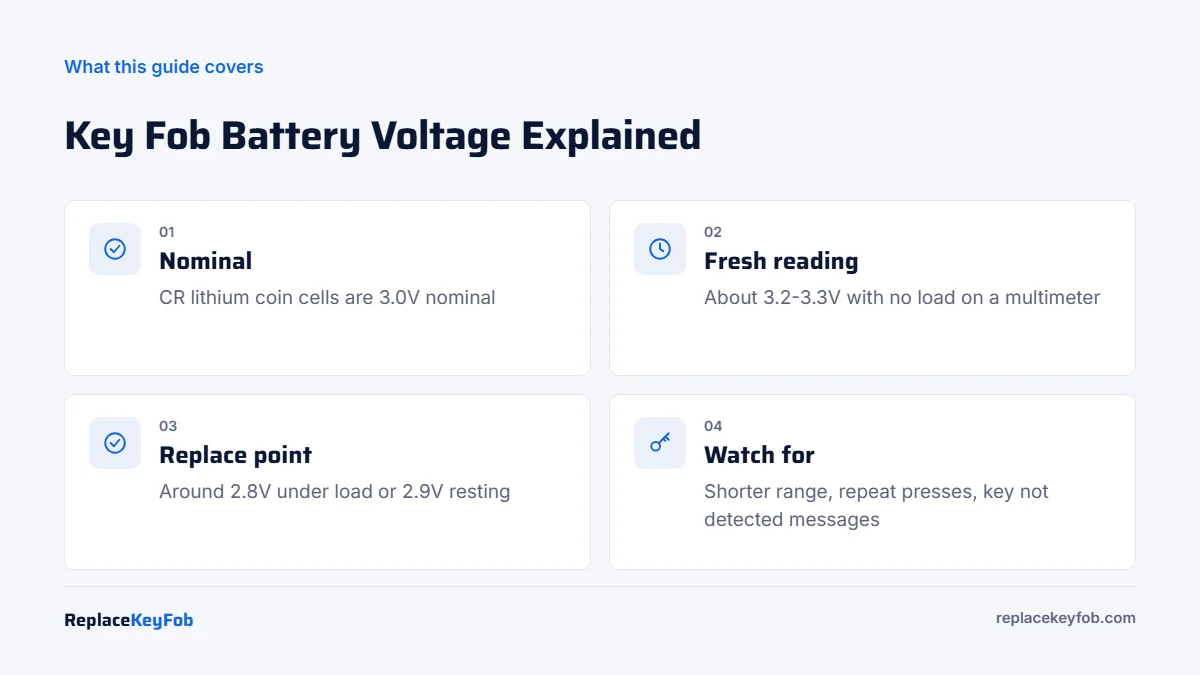
Normal key fob battery voltage is 3.0V nominal for the CR-type lithium coin cells most fobs use. A fresh cell typically reads about 3.2-3.3V with no load. Plan to replace it once it reads below roughly 2.8V under load, or about 2.9V resting, or whenever range drops noticeably.
Almost every modern key fob runs on a 3V lithium coin cell, whether it is a CR2032, CR2025, CR2016, CR2450, or one of the smaller 16 mm sizes. That shared chemistry means the same voltage rules apply to nearly every remote and smart key.
This guide explains what the numbers on your multimeter mean, why a battery can read fine and still fail, and when it is time to swap it.
What Voltage Is a Key Fob Battery?
Most key fobs use lithium manganese dioxide coin cells, identified by the “CR” prefix. This chemistry has a nominal voltage of 3.0V. The size code that follows (2032, 2450, 1620, and so on) only describes diameter and thickness. It does not change the voltage.
A small number of older remotes stack two 3V cells for about 6V, and a few very old designs used alkaline or silver-oxide button cells at 1.5V each. If your fob takes a CR-coded cell, you are dealing with 3V.
Key Fob Battery Voltage Chart
These are typical readings for a CR coin cell measured with a digital multimeter. Exact cutoffs vary by fob design and temperature, so treat them as guidelines.
| Reading (no load) | What it usually means | Action |
|---|---|---|
| 3.2-3.3V | Fresh or nearly new | Good to use |
| 3.0-3.1V | Healthy, normal working range | No action |
| 2.9-3.0V | Getting tired; may drop further under load | Buy a spare |
| Below about 2.9V | Weak; range and reliability likely reduced | Replace soon |
| Below about 2.5V | Nearly depleted | Replace now |
Under load (while a button is pressed), the reading on a healthy cell may sag a little. If it falls to roughly 2.8V or lower while transmitting, the fob is likely close to failing, especially in cold weather.
Why a “Good” Reading Can Still Mean a Weak Battery
Lithium coin cells hold a flat voltage for most of their life, then drop quickly near the end. A multimeter measures open-circuit voltage, which barely loads the cell. A tired battery can show 3.0V at rest and then sag hard when the fob’s radio draws a burst of current.
That is why the symptoms often come before the numbers look bad:
- You need to stand closer to the car for lock or unlock to work.
- You have to press buttons more than once.
- The dash shows a low key battery or “key not detected” message on push-button-start cars.
- The fob LED (if it has one) is dim or does not flash.
For more warning signs, see key fob battery low symptoms.
How to Check Key Fob Battery Voltage
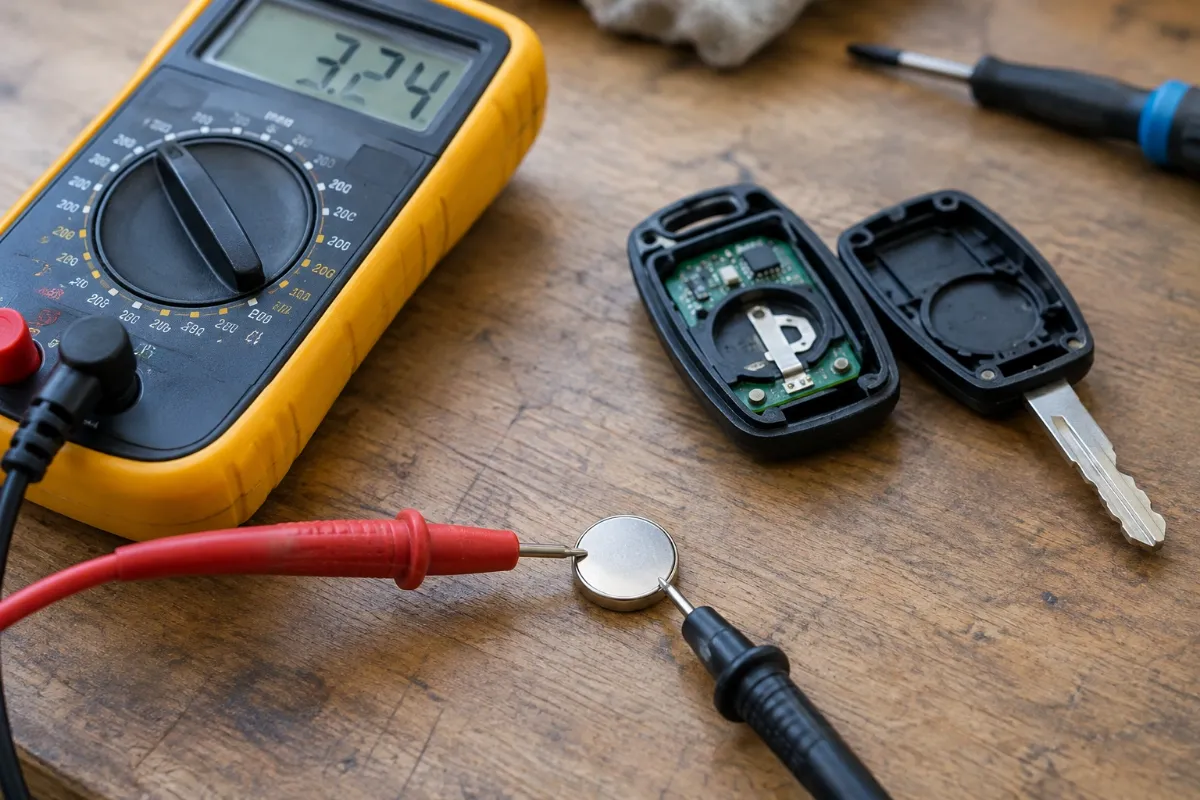
- Open the fob and remove the coin cell, noting which side faces up.
- Set a digital multimeter to DC volts, 20V range (or auto).
- Touch the red probe to the flat positive (+) face with the printing, and the black probe to the negative side.
- Read the number. Compare it with the chart above.
- Optional load check: Some battery testers apply a small load for coin cells, which gives a more realistic reading than open-circuit voltage.
Our full walkthrough on how to test a key fob battery covers testers and multimeter tips. If you are unsure which cell your fob takes, check the key fob battery size chart.
Voltage by Common Key Fob Battery Size
| Battery | Size (diameter x thickness) | Nominal voltage | Approx. capacity |
|---|---|---|---|
| CR1616 | 16 x 1.6 mm | 3V | About 50-55 mAh |
| CR1620 | 16 x 2.0 mm | 3V | About 70-80 mAh |
| CR1632 | 16 x 3.2 mm | 3V | About 120-140 mAh |
| CR2016 | 20 x 1.6 mm | 3V | About 80-90 mAh |
| CR2025 | 20 x 2.5 mm | 3V | About 150-170 mAh |
| CR2032 | 20 x 3.2 mm | 3V | About 210-240 mAh |
| CR2450 | 24 x 5.0 mm | 3V | About 550-620 mAh |
CR2450 Key Battery Voltage
The CR2450 is a larger 3V lithium coin cell, 24 mm wide and 5.0 mm thick, used in some BMW and Mini keys and the Jeep Wrangler JL fob, among others. Its voltage behavior is the same as a CR2032: about 3.2-3.3V fresh, 3.0V nominal, and replace when it falls to roughly 2.8-2.9V or when the car warns you. The extra capacity simply means it takes longer to get there. See our CR2450 key fob battery guide for fitment details.
What Affects Key Fob Battery Voltage
- Cold: Lithium cells deliver lower voltage in freezing weather. A marginal battery that works in summer may fail on a cold morning, then recover when warm.
- Heat: Leaving a fob on a hot dashboard speeds up self-discharge.
- Proximity drain: Smart keys that live near the car, or near phones and other RF sources, can wake up more often and drain faster.
- Age on the shelf: Coin cells lose a small amount of charge each year in storage. Check the date code when buying.
If your battery dies much faster than expected, read key fob battery drains quickly.
3V Lithium Coin Cell Battery
Buy the exact code printed on your old battery (CR2032, CR2025, CR2450, and so on) from a name brand with a recent date code.
As an Amazon Associate, ReplaceKeyFob earns from qualifying purchases.
Can a Low Fob Voltage Stop the Car From Starting?
On push-button-start cars, the fob battery powers the signal the car uses to confirm the key is inside. When voltage drops too low, the car may show “key not detected” and refuse to start. This is not a problem with the car’s 12V battery.
Almost every push-button car has a backup method that works with a dead fob battery. Usually you hold the fob against the start button, or place it in a marked spot in the console or steering column, so the car can read the transponder chip directly. The exact location is in your owner’s manual. Once you are home, replace the coin cell.
On older cars with a metal key and a separate remote, a dead fob battery only stops the remote buttons. The key still starts the car because the immobilizer chip in the key head does not need the battery.
What This Means for You
If your fob reads 3.0V or higher and works normally, leave it alone. If it reads below about 2.9V, or you notice range loss or warning messages, replace it. A coin cell is cheap, and swapping it early avoids being stuck with a dead fob.
- Need the swap steps? See how to replace a key fob battery.
- Replaced it and the fob still does nothing? See key fob not working after battery replacement.
- Fob lost its pairing? Start with how to program a key fob.
Frequently Asked Questions
A new CR coin cell usually reads about 3.2-3.3V with no load. Anything from about 3.0V up is normal. Below roughly 2.9V at rest, or 2.8V under load, it is time to replace it.
Most are 3V lithium coin cells with a CR prefix. A few very old remotes used 1.5V button cells, and some stack two 3V cells for 6V.
Same as other CR cells: 3.0V nominal and about 3.2-3.3V when fresh. It just holds more capacity because it is larger.
A meter reading at rest does not show how the cell behaves under load. A worn battery can sag when transmitting. Try a fresh cell, and also check the contacts and polarity.
No. Use the same 3V CR size the fob was designed for. Rechargeable 3.6V lithium coin cells (LIR types) can sit above the fob’s intended range and are not recommended.