
Key Fob Part Number: How to Match a Replacement

A key fob part number is the manufacturer’s catalog number for that exact key. It is often printed inside the fob, on a label on the circuit board, or on the original packaging, and a dealer can look it up from your VIN. Matching the part number is the most reliable way to buy a replacement that will program.
Two fobs can share the same FCC ID and look identical yet differ inside. The part number is what separates them. It tells you the exact version the factory built for your model, trim and year range.
Here is how part numbers work, where to find yours, and how to use it to match a replacement.
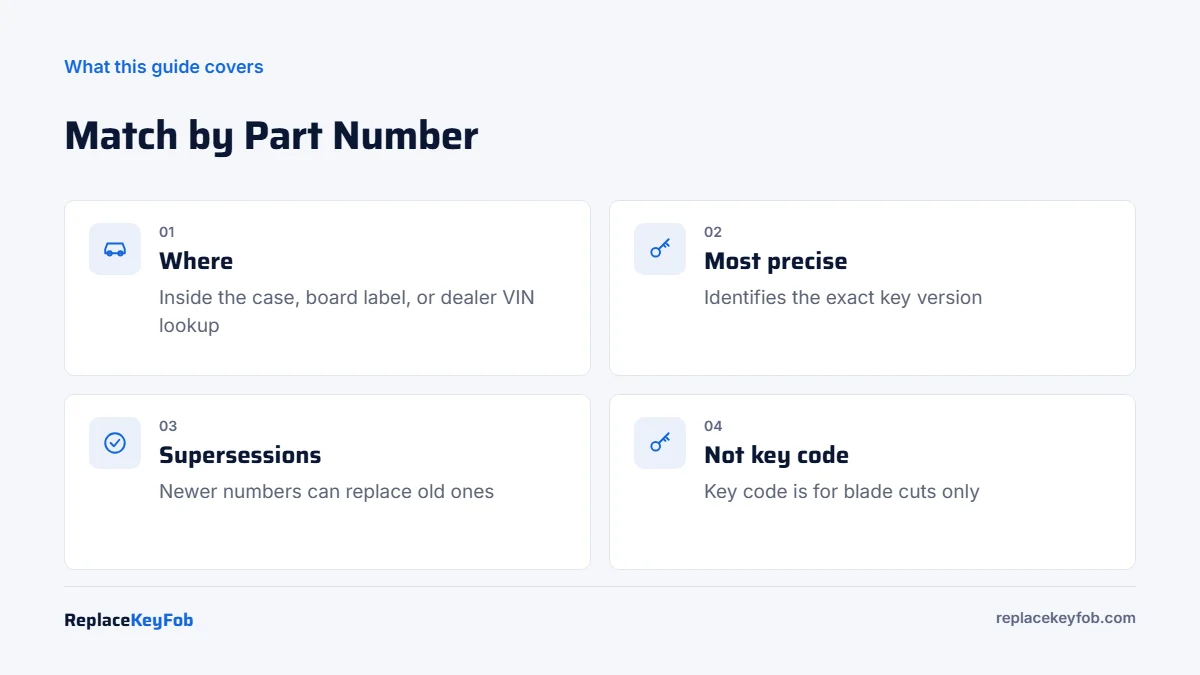
How Key Fob Part Numbers Work
Carmakers assign a part number to every component, including each key and remote version. When the electronics, button layout, frequency or chip change, the part number usually changes too. Some numbers are later “superseded,” meaning a newer part number replaces the old one and is designed to work in the same vehicles.
Several different numbers can appear on or around a fob:
- OEM part number: the carmaker’s catalog number. This is the one the dealer orders by.
- Supplier part number: the electronics maker’s own number for the board, sometimes printed on a label inside.
- FCC ID: the radio certification number. It identifies the transmitter design, not the full key. See how to find the FCC ID on a key fob.
- IC number: the Canadian certification equivalent of the FCC ID.
- Board or version codes: some smart keys carry small codes that distinguish software versions used across model years.
Where to Find Your Key Fob Part Number
| Location | What you may find | Tips |
|---|---|---|
| Back of the fob | Usually FCC ID and IC, sometimes a part number | Use angled light to read molded text |
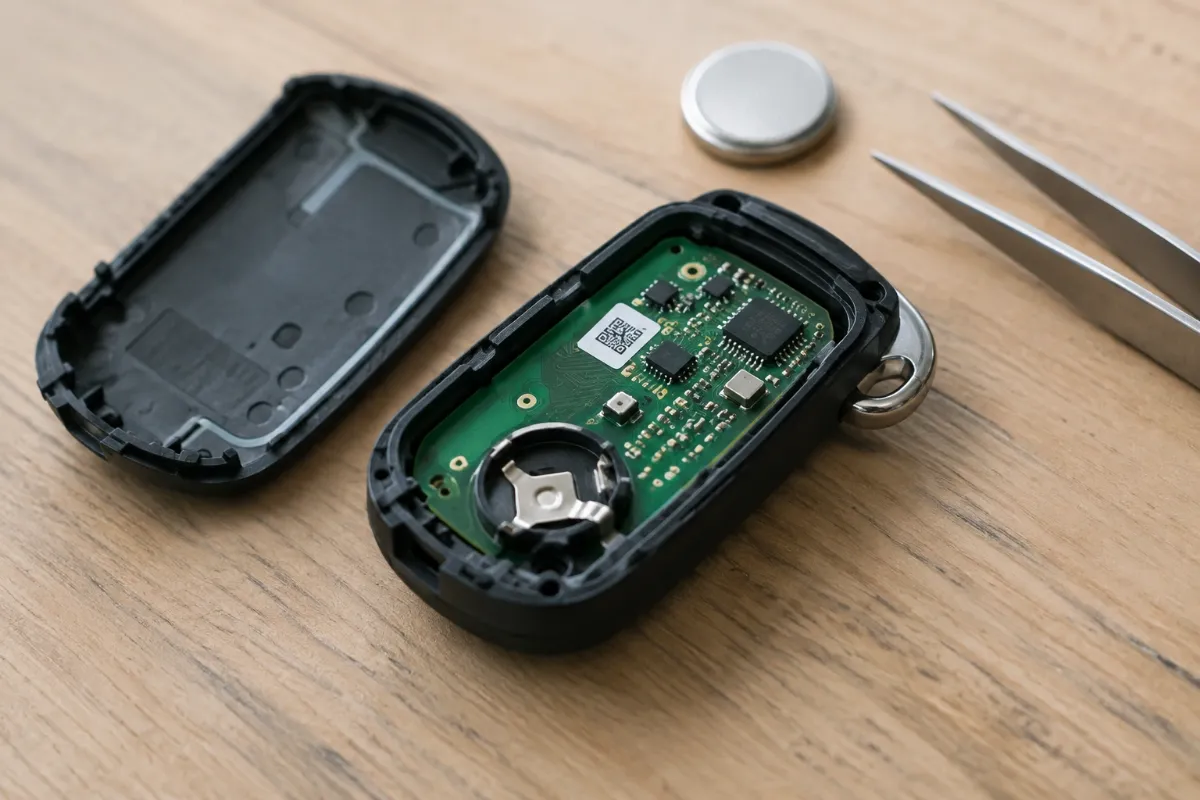
| Inside the case | Molded part number or supplier code | Open carefully with a plastic pry tool |
| Circuit board label | Supplier part number, version code | Do not peel the label off |
| Original box or dealer receipt | OEM part number | Check the glovebox and service records |
| Dealer parts counter | OEM part number by VIN, including supersessions | Most will give the number over the phone |
If your fob uses a coin cell, you will see the inside anyway when you change the battery. The key fob battery size chart lists common sizes so you can do both jobs at once.
How to Match a Replacement Using the Part Number
- Get your OEM part number. From the fob, paperwork, or a dealer VIN lookup.
- Search the part number directly. Use it in online OEM parts catalogs and marketplaces. Aftermarket listings often show “replaces part number” or “compatible with” lines.
- Check for supersessions. If your number is replaced by a newer one, the newer part is usually the correct buy. A dealer or OEM parts site can confirm.
- Confirm the FCC ID and buttons too. The part number is the strongest match, but confirm the other identifiers as a cross-check.
- Confirm programming. Ask a locksmith or dealer whether they can program that part for your VIN before you order.
Part Number vs FCC ID vs Key Type
| Identifier | Precision | Best use |
|---|---|---|
| OEM part number | Exact version | Final confirmation before buying |
| FCC ID | Transmitter family | First filter when shopping |
| Button layout | Features | Visual check |
| Key type (remote, flip, smart) | Broad category | Narrowing your search |
| Year, make, model | Broad, can span versions | Starting point only |
Why the Part Number Matters
- Same look, different chip. Manufacturers sometimes change the immobilizer chip or encryption mid-generation while keeping the same case.
- Trim differences. A fob for a trim with remote start or a power liftgate carries a different part number from the base trim.
- Regional versions. US and export versions can use different frequencies.
- Used and refurbished fobs. The part number confirms what the board actually is, which matters when deciding if a used key fob can be reprogrammed.
Replacement Key Fob (Search by Part Number)
Enter your OEM part number in the search. Choose a listing that names it in the title or compatibility section and also shows a matching FCC ID.
As an Amazon Associate, ReplaceKeyFob earns from qualifying purchases.
Reading Part Numbers by Brand
Every carmaker formats part numbers differently, which is why you should copy the number exactly as printed, including dashes and letter suffixes.
- Ford and Lincoln use alphanumeric part numbers with a prefix, a base number and a suffix separated by dashes. The suffix letters often change when a part is revised, so a different suffix can mean a different version.
- GM brands (Chevrolet, GMC, Buick, Cadillac) typically use all-numeric part numbers, often eight digits. Many GM keys have been superseded several times, so the dealer’s current number may differ from the one printed on your fob.
- Toyota and Lexus use a five-digit group code followed by a five-digit item number. Smart keys can also carry a separate board or version code that matters for programming.
- Honda and Acura use part numbers with a group and item code, and many keys also have a separate printed key code for cutting the blade.
- European brands often build keys to order by VIN, so the part number alone may not be enough to buy a usable key outside the dealer network.
If you are unsure how to read your number, call a dealer parts counter. They can confirm the current number and whether it has changed.
Don’t Confuse the Key Code With the Part Number
Many vehicles also have a key code, a short alphanumeric code that tells a locksmith how to cut the blade. It is often on a tag that came with the car or available to the dealer from the VIN. The key code describes the cuts, not the electronics. You need the part number to buy the right fob and the key code (or your existing key) to cut the blade.
What It Means for You and Next Steps
Once you have your part number, shopping becomes simple. Use it to compare dealer, locksmith and online prices in our guide on where to buy a key fob replacement, and check expected totals in the hub guide how much is a new key fob. If you plan to program it yourself, the key fob programming guide explains each method.
Keep a note of the part number with your car’s paperwork. The next time you need a spare, you will not have to open the fob or call the dealer.
Frequently Asked Questions
Call or visit a dealer parts counter with your VIN. They can look up the exact OEM part number for your key, including any newer number that replaced it.
No. The FCC ID identifies the radio transmitter design. The part number identifies the exact key version. Several part numbers can share one FCC ID.
It means the manufacturer replaced the old number with a newer one. The newer part is normally designed to work in the same vehicles.
Often on a label on the circuit board or molded inside the case. If you cannot find it, use the original box, service records or a dealer VIN lookup.
Every component has its own part number. A door lock actuator or receiver module number is different from the key’s number, so look each one up separately by VIN.