
How to Check What Type of Car Battery You Have

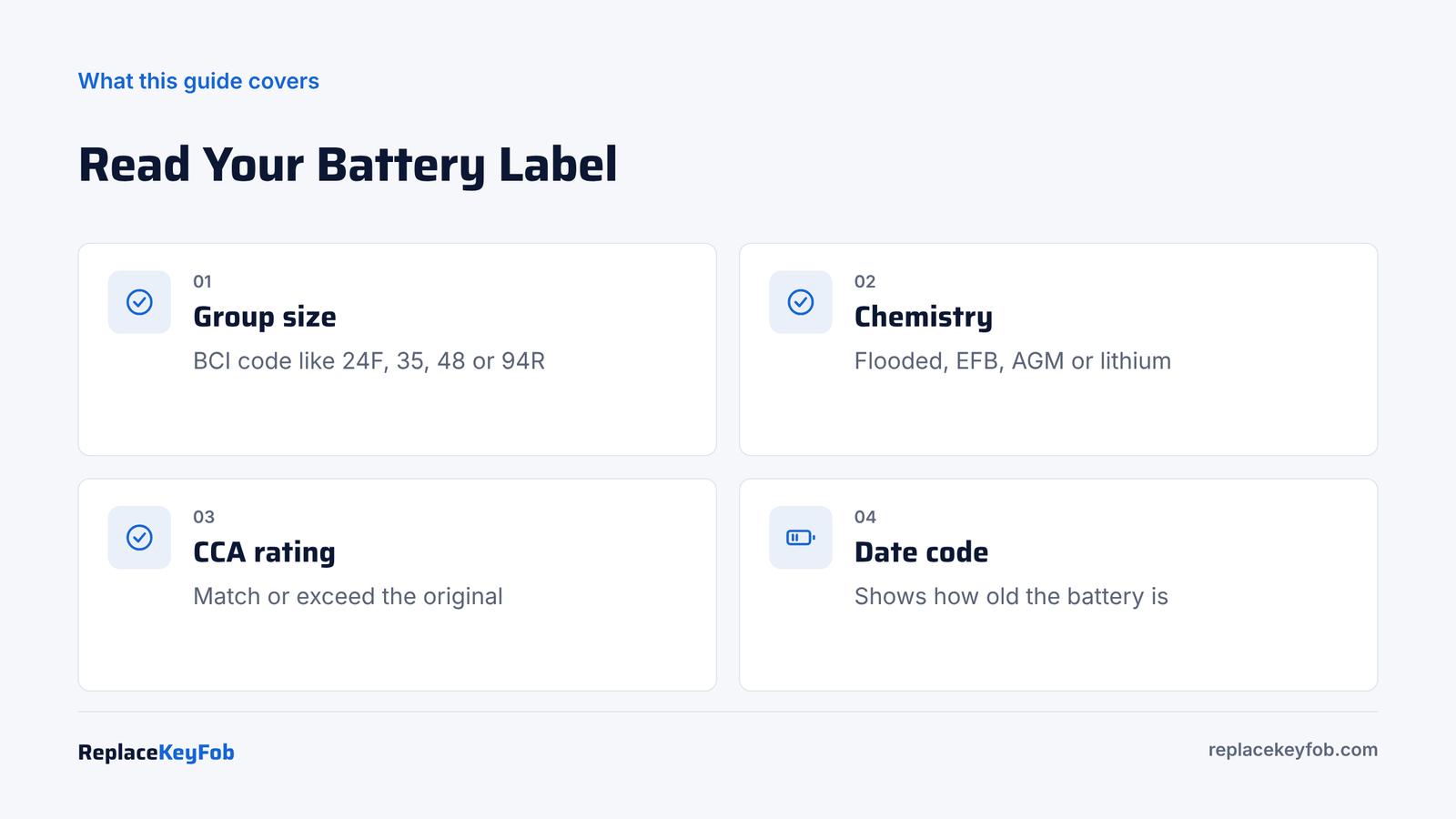
To check your car battery type, open the hood (or trunk) and read the battery label. Look for the BCI group size (such as 24F, 35, 48/H6 or 94R/H7), the cold cranking amps (CCA), and the chemistry: flooded, EFB, AGM or lithium. Confirm with the owner’s manual or a VIN lookup at a parts store before buying a replacement.
Car batteries look alike, but they are not interchangeable. The size has to fit the tray and hold-down, the posts must be on the correct side so the cables reach, the cranking power has to suit the engine, and the chemistry must match what the car’s charging system expects. Many newer cars with start-stop systems need AGM or EFB batteries, and putting a basic flooded battery in one usually leads to early failure.
The good news is that almost everything you need is printed on the battery or in the owner’s manual. This guide shows you where to look, how to decode each marking, and how to check the battery’s condition while you are there. If you already know your battery has failed, our guide to car battery replacement cost explains what each type typically costs.
Where to Find the Battery
Most batteries sit in the engine bay, near the front or to one side. Not all of them:
- Under the hood: most cars, trucks and SUVs
- In the trunk or cargo floor: many BMW, Mercedes, some Chrysler, Dodge and Cadillac models, and several hybrids
- Under the rear seat or front seat: some GM SUVs, some Lexus and Toyota hybrids, and other models
- Behind a wheel-well liner or under a cowl panel: some compact cars and crossovers
If the battery is hidden, the car usually has remote jump posts under the hood. The owner’s manual shows the location and access steps.
How to Read a Car Battery Label
Clean the top and sides with a damp rag so you can read the label. You are looking for these items:
| Label item | What it looks like | What it tells you |
|---|---|---|
| BCI group size | 24F, 35, 47, 48, 51R, 65, 94R | Physical size and post layout |
| DIN or EN size | H5, H6, H7, H8, LN3, LN4 | European size code, often on AGM batteries |
| CCA | 650 CCA | Cold cranking amps at 0°F |
| CA or MCA | 800 CA | Cranking amps at 32°F; higher than CCA |
| Reserve capacity | RC 120 min | How long it can run a 25 amp load |
| Ah (amp-hours) | 70 Ah | Total stored capacity, common on European labels |
| Chemistry | AGM, EFB, Flooded, Lithium | Battery technology |
| Date code | Sticker or stamp like 3/25 or K5 | Manufacture or ship date |
Group size codes
The group size is the most important number. It defines the case dimensions, post location and terminal type. Some examples:
- Group 24F, 35: common on many Japanese cars and small SUVs
- Group 48 (H6), 94R (H7), 49 (H8): common on many European, GM, Ford and other newer vehicles, often as AGM
- Group 65: common on many Ford trucks and larger vehicles
- Group 51R: small Honda and some other compact cars
An “R” means reversed terminals: the positive post is on the opposite side from the standard layout. Using the wrong layout means cables may not reach or may touch the wrong post.
Chemistry markings
| Type | How to recognize | Common in |
|---|---|---|
| Flooded (standard) | Removable caps or flat top, often “maintenance free” | Older cars, many trucks |
| EFB (enhanced flooded) | Marked EFB, sealed | Entry-level start-stop cars |
| AGM | Marked AGM, often heavier, sealed | Start-stop, luxury cars, high electrical loads |
| Lithium (LiFePO4) | Marked lithium, light weight, often electronics on top | Some EVs, performance cars, aftermarket |
| Gel | Marked gel | Rare in cars, some powersports |
If you are not sure whether yours is AGM or flooded, see our comparison of AGM vs flooded car batteries.
Digital Battery Tester With Type Selection
A tester that supports flooded, AGM, EFB and gel settings helps you confirm health once you know the type, and many show voltage and CCA in seconds.
As an Amazon Associate, ReplaceKeyFob earns from qualifying purchases.
How to Check Your Car Battery Type Step by Step
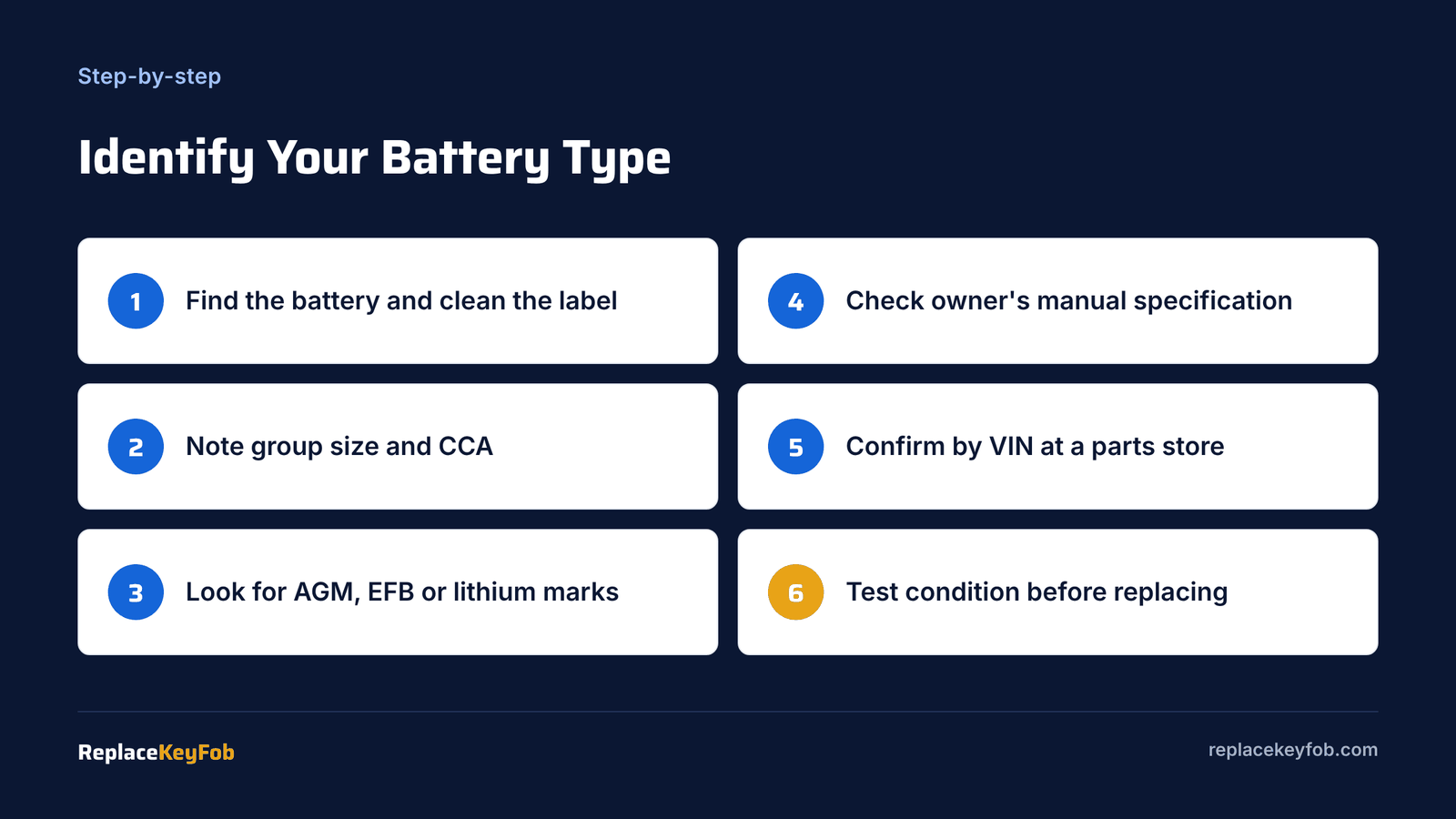
- Turn the car off and open the hood or the battery compartment.
- Clean the label with a damp cloth. Wear gloves if there is corrosion.
- Write down the group size, CCA and chemistry. Take a photo of the label too.
- Check the date code. Our guide on how to read a car battery date code explains the formats.
- Check the owner’s manual. Look under specifications or maintenance for battery type and size. If it says AGM, stay with AGM.
- Look for a start-stop system. If the car shuts its engine off at lights, it almost always needs AGM or EFB.
- Look up by VIN or year, make and model on a parts store website, or ask at the counter. This confirms fit if the battery has been replaced before with the wrong size.
- Check for a battery sensor on the negative cable. Its presence often means the car tracks battery type and age, and may need battery registration after replacement.
Why the factory spec beats the old label
The battery in the car may not be the original. A previous owner or shop could have fitted the wrong group size or a flooded battery in place of AGM. Always confirm with the manual or a VIN lookup instead of copying the label on the battery that is there now.
How to Check Car Battery Condition While You Are There
Once you know the type, a quick condition check tells you whether it needs attention.
- Look at the case. Bulging sides, cracks or leaks mean replace it now.
- Check the terminals. White or green crust is corrosion; clean it with the method in battery terminal corrosion.
- Check the charge eye if your battery has one. Green usually means charged, dark means low, and clear or yellow often means low electrolyte. Colors vary by brand, so check the label.
- Measure resting voltage. About 12.6 volts or more is full. 12.4 volts is about 75 percent. Under about 12.2 volts, charge and retest. See how to test a car battery with a multimeter.
- Check health with a scan tool. Many OBD2 scanners show battery voltage live; see how to check battery voltage with an OBD2 scanner.
- Run a tester. A digital battery tester gives health and CCA; see how to use a car battery tester.
Common Mix-Ups
| Mistake | What happens | How to avoid it |
|---|---|---|
| Flooded battery in a start-stop car | Short life, start-stop stops working | Match AGM or EFB |
| Wrong terminal layout (missing R) | Cables do not reach or are strained | Check group size letter |
| Lower CCA than original | Hard starts in winter | Match or exceed CCA |
| Battery too tall | Hood or cover touches posts, short risk | Match group size exactly |
| Skipping registration | Car may overcharge the new battery | Register when required |
If your car needs registration, our guide on how to register a car battery with a scan tool explains which vehicles need it and how to do it.
CCA, CA and Reserve Capacity: Which Number Matters?
Labels often show several ratings, and it is easy to compare the wrong ones. CCA is measured at 0°F and is the number to match for starting power. CA, sometimes called MCA, is measured at 32°F, so it is always higher and can make a battery look stronger than it is. Reserve capacity tells you how long the battery can run essential loads if the alternator fails. For cars with lots of electronics, a higher reserve capacity or Ah rating is useful. When in doubt, match the original CCA or go slightly higher, and never go lower.
Upgrading the Battery Type
You can usually go from flooded to AGM in a car that does not require AGM. It costs more but handles heat, vibration and short trips better. Going from AGM to flooded is not recommended in cars that came with AGM. Lithium 12-volt batteries should only replace lead-acid batteries if the maker or the battery supplier confirms compatibility with the charging system.
When to Ask a Pro
If the battery is hidden under a seat or in a wheel well, if the label is missing, or if your car needs registration, a parts store or shop can identify the battery for you, often at no charge. A new battery typically costs about $110 to $220 for flooded and about $200 to $380 for AGM before installation in 2026.
Frequently Asked Questions
Read the battery label for group size, CCA and chemistry such as AGM or EFB. Then confirm with the owner’s manual or a VIN lookup at a parts store.
It will usually say AGM on the label. AGM batteries are sealed, have no caps, and are standard on most start-stop cars. The owner’s manual will also list it.
R means reversed terminals. The positive post is on the opposite side compared to the standard group size, so the cables reach the correct posts.
Only if it fits the tray, the hold-down secures it, and the posts line up with the cables. Sticking with the specified group size is the safe choice.
Inspect the case and terminals, measure resting voltage, and run a battery tester or load test. Most parts stores also test for free.