
How to Test an Alternator With a Multimeter (5 Simple Checks)

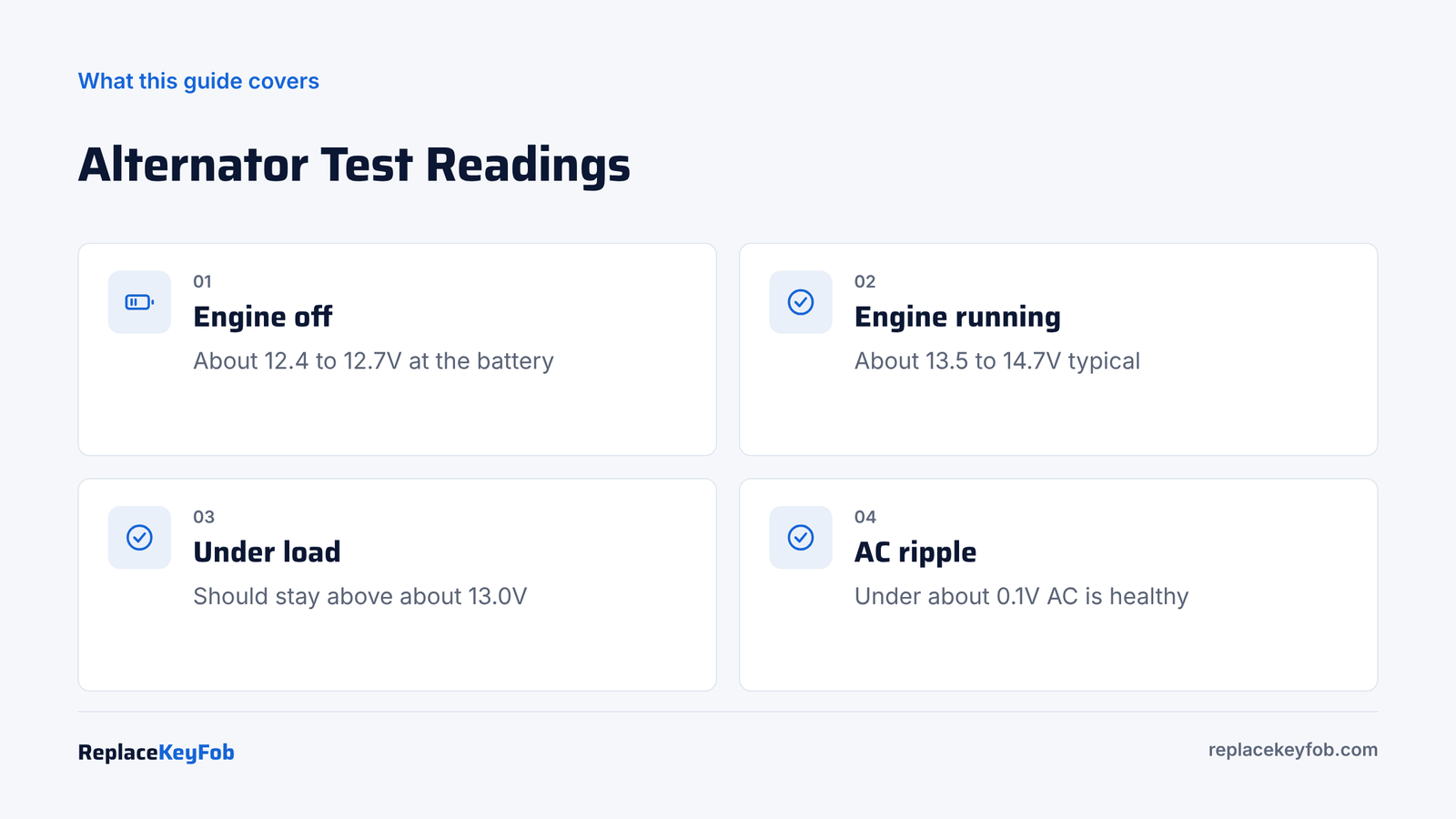
To test an alternator with a multimeter, set it to DC volts and read the battery with the engine off: about 12.4 to 12.7V is normal. Start the engine; a healthy alternator usually shows about 13.5 to 14.7V. Turn on headlights, blower and rear defrost; it should stay above about 13.0V. Below 13V running means the charging system needs attention.
A dead battery and a bad alternator can look the same from the driver’s seat: the car will not start, or it starts after a jump and dies again. The difference matters, because a new battery will not fix a bad alternator and will soon go flat too.
A basic digital multimeter answers the question in about ten minutes. This guide walks through five checks, from the simple running-voltage test to AC ripple and voltage drop tests that catch problems the basic test misses.
What You Need
- A digital multimeter with DC volts and AC volts settings. A meter that reads to two decimal places is ideal.
- Safety glasses.
- A helper is useful for the load test, but not required.
- A car battery that is reasonably charged. If the battery is flat, charge it first, or the alternator readings will be confusing.
Digital automotive multimeter
Look for a meter with DC and AC volts, auto-ranging, and good probe leads; a min/max function helps catch voltage dips while cranking.
As an Amazon Associate, ReplaceKeyFob earns from qualifying purchases.
If you would rather use a dedicated tester, our list of battery and alternator testers covers handheld units that read charging voltage and ripple automatically. You can also get a quick view from a scan tool; see how to test an alternator with an OBD2 scanner.
Safety Before You Start
- Keep hands, hair, sleeves and meter leads away from the fan, belts and pulleys.
- Park in a ventilated area with the parking brake on and the transmission in Park or Neutral.
- Never disconnect the battery cable with the engine running to “test” the alternator. That old trick can cause a voltage spike and damage modern electronics.
Test 1: Battery Voltage With the Engine Off
- Set the meter to DC volts (20V range on manual meters).
- Turn off the engine and all lights. Let the car sit for at least 15 to 30 minutes if it was just driven, or turn the headlights on for one minute and off to remove surface charge.
- Put the red probe on the battery’s positive terminal and the black on the negative terminal.
| Reading | Battery state |
|---|---|
| 12.6 to 12.7V | Fully charged |
| About 12.4V | About 75 percent |
| About 12.2V | About 50 percent |
| 12.0V or less | Discharged; charge before testing the alternator |
This is your baseline. Our guide on how to test a car battery with a multimeter covers battery-specific tests in more depth.
Test 2: Charging Voltage at Idle
- Start the engine and let it idle.
- Measure across the battery terminals again.
| Running reading | What it means |
|---|---|
| About 13.5 to 14.7V | Normal charging |
| About 13.0 to 13.5V | Low; possible weak alternator, slipping belt or smart charging |
| Under about 13.0V | Not charging properly |
| Over about 15.0V | Overcharging; voltage regulator fault likely |
A reading that matches the engine-off value, or keeps dropping while running, means the alternator is not charging at all.
Smart charging note: many newer cars (lots of 2010 and newer Ford, GM, BMW, Mercedes and others) vary the alternator output on purpose to save fuel. They may show about 12.5 to 13.0V at a steady idle when the battery is full, then jump to 14V or more under load or when the battery needs charge. If your car is in that group, do the load test before deciding the alternator is bad.
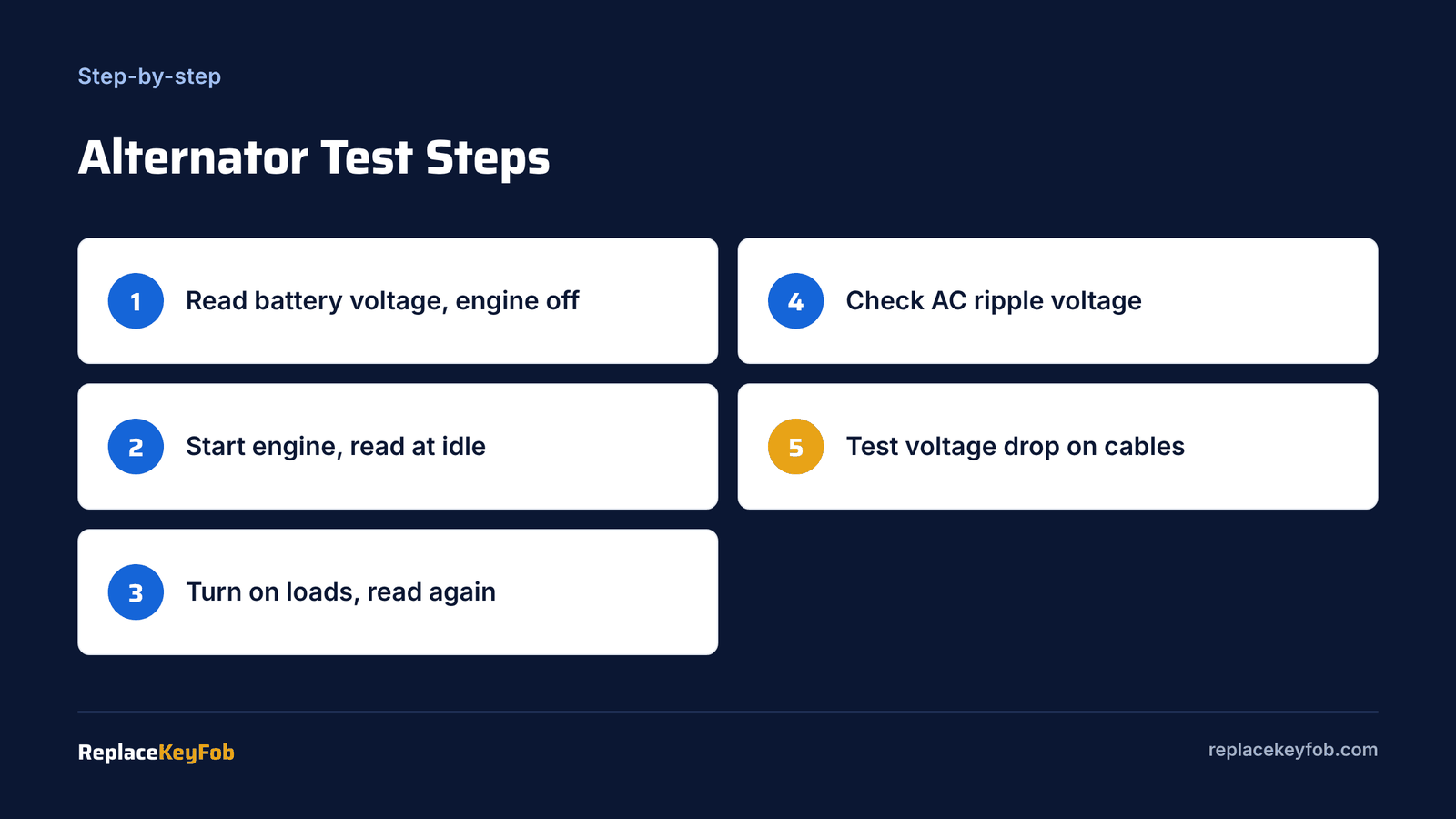
Test 3: Charging Voltage Under Load
- With the engine running, turn on the headlights on high beam, the HVAC blower on high, and the rear defrost.
- Raise the engine speed to about 1,500 to 2,000 rpm (a helper can hold it).
- Read the battery voltage again.
A healthy alternator should hold about 13.0V or more under this load. If it drops toward 12.5V or below, the alternator cannot keep up with demand. That points to worn brushes, a failing diode or regulator, or a slipping belt.
Test 4: AC Ripple (Diode Test)
An alternator makes AC current and converts it to DC through a set of diodes. When a diode fails, AC “ripple” leaks into the system. This can cause flickering lights, odd electrical faults and a battery that slowly drains.
- With the engine running at about 1,500 to 2,000 rpm and some loads on, set the meter to AC volts (low range).
- Put the probes on the battery terminals.
| AC reading | What it means |
|---|---|
| Under about 0.1V AC | Healthy diodes |
| About 0.1 to 0.5V AC | Borderline; recheck with more load |
| Over about 0.5V AC | Likely a failed diode or stator problem |
Some cheap meters do not read AC ripple accurately on top of DC voltage, so treat this as a strong hint rather than a final verdict.
Test 5: Voltage Drop on the Charging Wires
A healthy alternator can look bad if the cables between it and the battery have high resistance. This test checks the wiring.
Positive side
- Engine running at about 2,000 rpm with loads on.
- Set the meter to DC volts.
- Put the red probe on the alternator’s output (B+) terminal and the black probe on the battery positive terminal.
- A reading under about 0.5V is acceptable. Higher means corrosion or a poor connection in the charge wire or fuse.
Ground side
- Put the red probe on the alternator case and the black probe on the battery negative terminal.
- A reading under about 0.2 to 0.3V is good. Higher means a poor ground path between the engine and battery.
Corroded cables and loose grounds are common and cheap to fix. Our guide on how to test battery cables has more detail, and battery terminal corrosion covers cleaning.
Where to Measure if the Battery Is Hard to Reach
Many cars hide the battery in the trunk, under a seat or under a cover. You can still test:
- Use the under-hood jump posts. Red probe on the positive jump post, black probe on the marked ground point. Readings will be close to battery voltage.
- Use the 12V power socket with an adapter only as a rough guide; wiring loss makes it read a little low.
- Measure at the alternator (B+ terminal to engine ground) to confirm output when battery access is poor.
Optional: Check Output Current With a Clamp Meter
A DC clamp meter measures current without disconnecting anything. With the engine at about 2,000 rpm and all major loads on, clamp around the alternator output wire. A healthy alternator should produce a large share of its rated output (often 100 to 200 amps on modern cars, printed on the alternator label). A reading far below the rating under full load, with good voltage-drop results, points to a worn alternator. This check needs a DC-capable clamp meter; many basic clamp meters only read AC.
Reading the Results Together
| Battery off | Running | Under load | Likely diagnosis |
|---|---|---|---|
| 12.6V | 14.2V | 13.8V | Alternator and battery healthy |
| 12.2V | 14.4V | 13.9V | Alternator fine; battery low or worn |
| 12.6V | 12.6V | 12.0V | Alternator not charging |
| 12.6V | 13.2V | 12.4V | Weak alternator or slipping belt |
| 12.6V | 15.5V | 15.2V | Regulator overcharging |
| 12.6V | 14.0V | 13.6V, high AC ripple | Failing diode |
Other Signs of a Bad Alternator
- Battery or charging warning light on the dash.
- Headlights dim at idle and brighten with revs.
- Whining or grinding from the alternator.
- Burning rubber or electrical smell.
- Car dies while driving after a jump.
- Repeated dead batteries even after replacing the battery.
Mistakes to Avoid
- Testing with a flat battery. Charge it first.
- Ignoring the belt. A loose or glazed belt slips and mimics a weak alternator.
- Judging a smart-charging car on idle voltage alone.
- Disconnecting the battery with the engine running.
- Replacing the alternator before checking wiring and grounds.
When to Replace and Cost
If the alternator fails the running or load test with good wiring and a good belt, it needs replacement. In 2026, a remanufactured alternator typically costs about $150 to $350 for the part, and about $400 to $900 installed at a shop, more for luxury cars or engines where the alternator is hard to reach. Many parts stores also offer free charging-system tests.
Frequently Asked Questions
With the engine running, most healthy alternators read about 13.5 to 14.7V at the battery. Under heavy load, it should stay above about 13.0V.
Yes. A running voltage near or below the engine-off reading, or a big drop under load, shows the alternator is not charging. AC ripple and voltage drop tests add more detail.
Measure battery voltage with the engine off, then running, then under load. You do not need to remove anything, and you should never disconnect a battery cable with the engine running.
On many newer cars with smart charging, low idle voltage is normal when the battery is full. Turn on loads; a healthy smart system will raise output to about 14V.
Set the meter to AC volts and read across the battery with the engine at about 2,000 rpm. Under about 0.1V AC is healthy; over about 0.5V AC suggests a failed diode.