
How to Do a DPF Regeneration (Forced Regen)

This post contains affiliate links. As an Amazon Associate, ReplaceKeyFob earns from qualifying purchases, at no extra cost to you.
To do a DPF regeneration, first try a passive regen: drive at steady highway speed for 20 to 30 minutes so exhaust heat burns off soot. If the dash asks for a parked regen, follow the menu on your truck. If neither works, a scan tool with a forced or service regen function can run one while parked, with the engine warm and the truck outside.
The diesel particulate filter (DPF) traps soot from the exhaust. Over time it fills up, and the engine has to burn that soot off by heating the filter to very high temperatures. This burn-off is called regeneration. Most of the time it happens without you noticing. When it cannot finish, soot builds up, power drops and a warning light comes on.
This guide covers the three ways to regenerate a DPF, how to run a forced regen safely with a scan tool, and the signs that a filter is past the point where regeneration can help. If you have not picked a tool yet, see our list of the best OBD2 scanners with DPF regeneration.
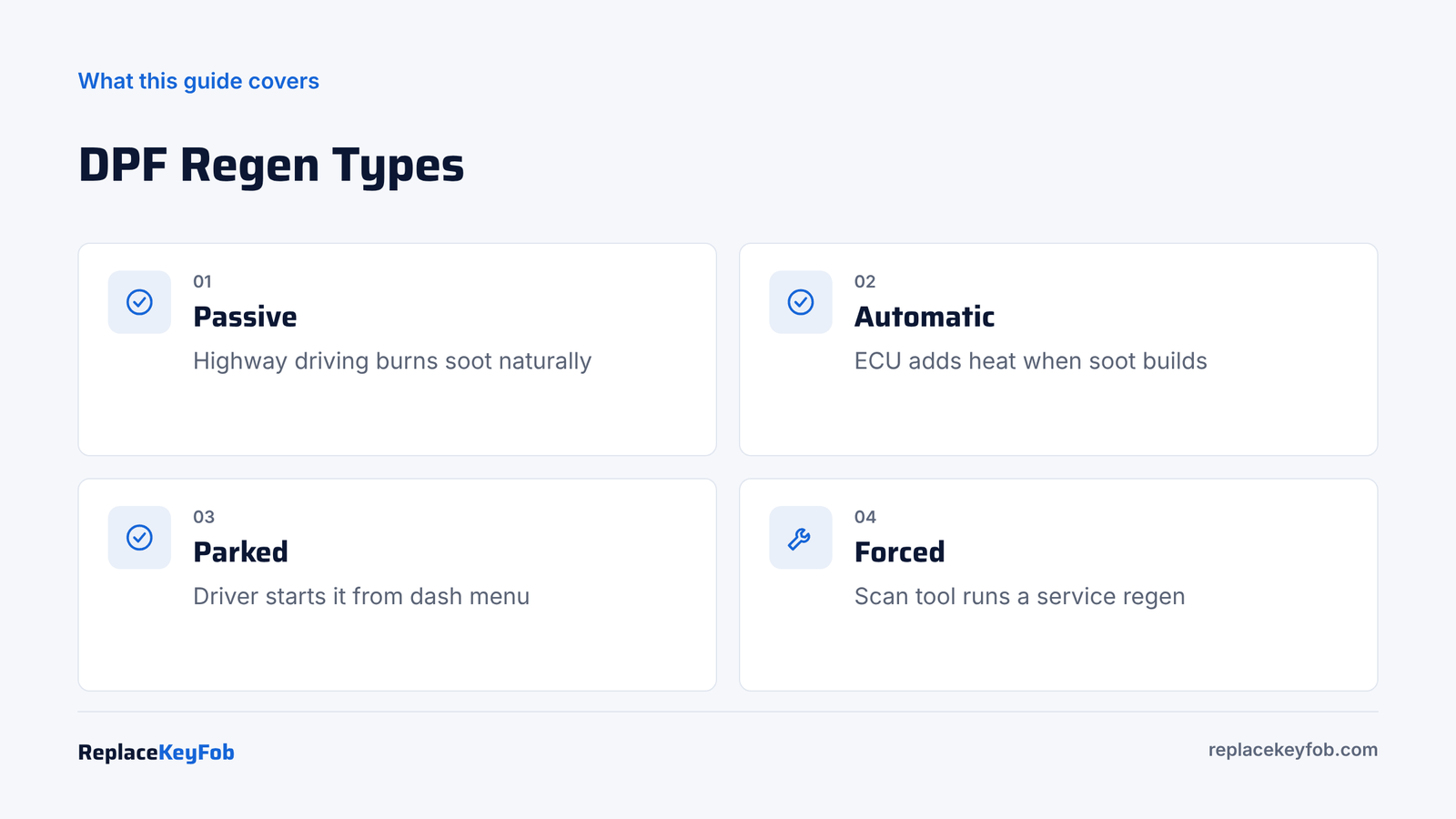
The Types of DPF Regeneration
| Type | How it starts | What you do | When it is used |
|---|---|---|---|
| Passive | Normal exhaust heat at load | Drive at highway speed | Trucks that tow or drive long distances |
| Active (automatic) | ECU injects extra fuel to raise heat | Keep driving until it ends | Most daily-driven diesels |
| Parked (driver-started) | Dash message or switch | Park, follow the menu | When active regen keeps getting interrupted |
| Forced (service) | Scan tool command | Run with tool, stay with truck | High soot load, after repairs, shop service |
DPF automatic regeneration is the one most drivers never see. The engine computer watches the pressure difference across the filter and adds heat, usually through extra post-injection fuel, until the soot is burned. You may notice a higher idle, the cooling fan running hard, a hot smell or a brief dip in fuel economy.
Signs Your DPF Needs a Regen
- A DPF or exhaust filter warning on the dash, often asking you to drive at highway speed
- Reduced power or limp mode
- Codes such as P2002 (DPF efficiency below threshold) or P2463 (DPF soot accumulation)
- More frequent regens than usual, or regens that keep stopping
- A rotten or hot smell after short trips
If you see a code, read the freeze frame before clearing anything. Our guide on freeze frame data explains what it shows.
What You Need for a Forced Regen
- A scan tool that lists service or forced DPF regeneration for your exact engine
- A safe outdoor spot on concrete or gravel with nothing flammable nearby
- At least a quarter tank of fuel and DEF topped up on trucks that use it
- A healthy battery, or a battery maintainer for long procedures
- A fire extinguisher within reach, a basic precaution for any high-heat job
Diesel scan tool with DPF regeneration
Confirm the listing names DPF or service regeneration for your exact truck and engine (for example Power Stroke, Cummins or Duramax), not just generic diesel code reading.
As an Amazon Associate, ReplaceKeyFob earns from qualifying purchases.
Method 1: Passive Regen by Driving
This is the easiest and safest method, and it costs only fuel.
- Drive on a highway or open road at a steady speed, usually about 40 to 65 mph.
- Keep engine RPM above roughly 2,000 if you can, using a lower gear if needed.
- Hold that for 20 to 30 minutes without long stops.
- If an active regen starts during the drive, do not shut the engine off until it finishes.
The reason this works is heat. Soot burns at high exhaust temperatures that short trips and idling never reach. A truck used only for five-minute runs around town is the one that clogs.
Method 2: Parked Regen From the Dash
Many newer diesel trucks let the driver start a regen while parked when the computer asks for it.
- Many 2017 and newer Ford Super Duty trucks offer a manual exhaust filter cleaning option in the cluster settings menu when soot is high enough.
- Many Ram Cummins trucks show a message when a parked regen is needed, with steps in the cluster.
- Many GM Duramax trucks show an exhaust filter message and may offer a service regen request through the driver information center on some years.
The exact menu names and requirements vary by model year. Check the owner’s manual for your truck. Usually you need the transmission in Park, the parking brake set, the engine warm, the fuel tank above a quarter full and no active fault codes.
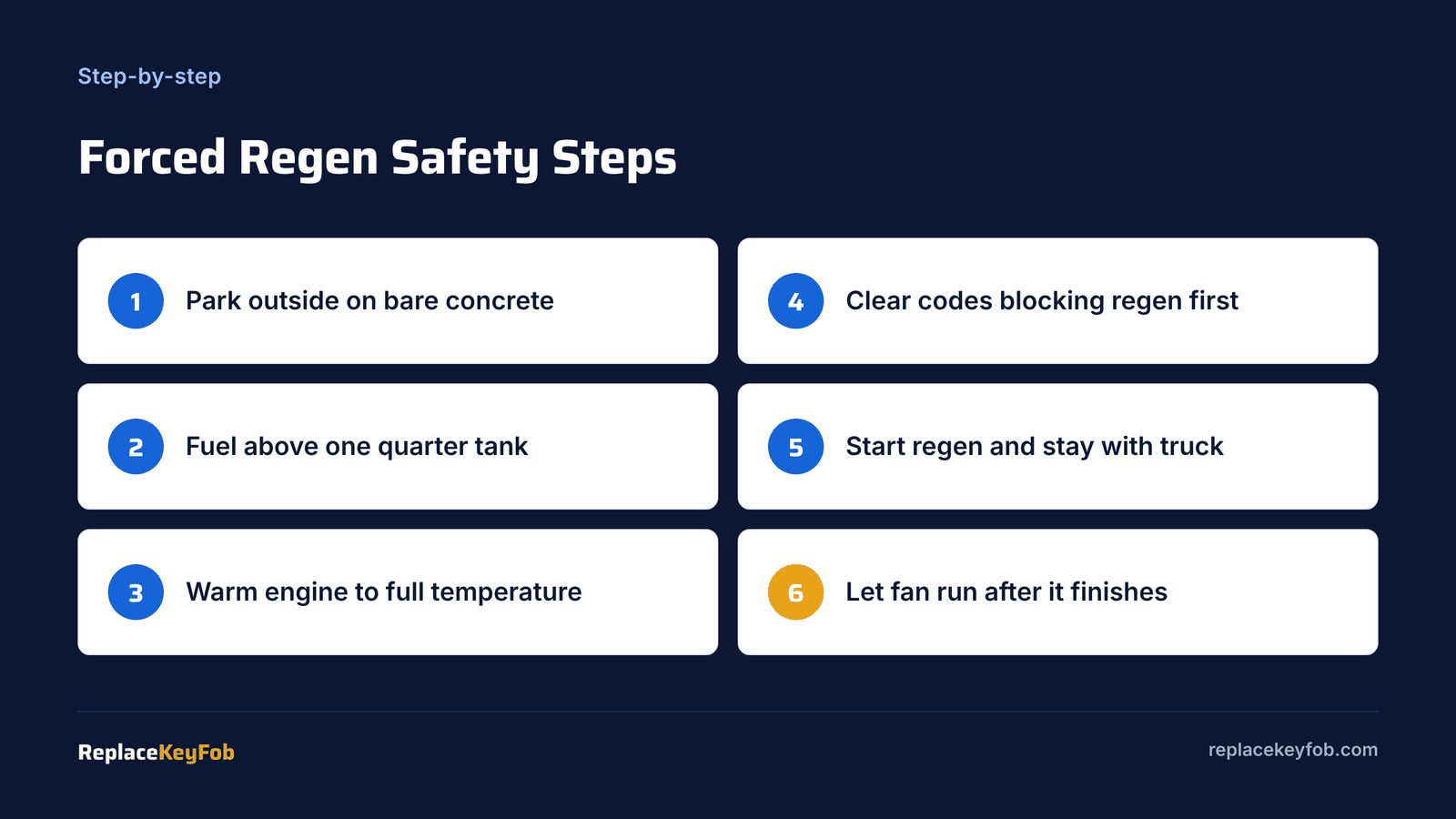
Method 3: How to Do a DPF Forced Regeneration With a Scan Tool
A forced or service regen uses a scan tool to command the ECU to heat the filter while parked. It is the right choice when the soot load is high, active regens keep failing, or after you have fixed a sensor that was blocking regens.
Before you start
- Use a scan tool that lists DPF regeneration for your exact engine. Generic code readers cannot do this. See diesel truck code scanners if you need one.
- Fix any codes that block regen first. A failed EGT sensor, differential pressure sensor, NOx sensor, EGR fault or low DEF can stop regen from starting.
- Check engine oil level. Repeated failed regens can thin oil with diesel fuel.
- Make sure the battery is healthy; a forced regen can take 20 to 60 minutes with the engine running.
Step by step
- Park outdoors on concrete or gravel, away from grass, leaves, buildings and anything that can burn. The exhaust tip can get extremely hot during a regen, often well above 1,000°F at the filter.
- Fill fuel above a quarter tank. Many trucks refuse regen below that.
- Warm the engine fully. Most tools require coolant at normal operating temperature before they will start.
- Connect the scan tool and read codes. Repair and clear anything that would block regen.
- Check soot load in the DPF menu or live data if available. Some tools show a soot mass or percent. Very high readings may mean regen is unsafe and the filter must be removed for cleaning.
- Select DPF Regeneration or Service Regen and follow the prompts. The tool may ask you to confirm Park, parking brake set and no pedal input.
- Stay with the truck. Idle will rise, the fan may roar and exhaust temperature will climb. Do not leave it unattended.
- Let it finish. The tool will report success or a reason it stopped. Do not shut the engine off early.
- Let the engine idle a few minutes after regen so temperatures come down, then recheck soot load and codes.
If Regen Will Not Start or Finish
| Problem | Likely cause | Next step |
|---|---|---|
| Tool says conditions not met | Low fuel, engine cold, codes present | Fix the listed condition |
| Regen stops halfway | Sensor fault, overheating, battery voltage drop | Read new codes and live data |
| Soot level too high | Filter overloaded | Professional cleaning or replacement |
| Regens happen every day | Short trips, injector, EGR or turbo problem | Diagnose root cause of excess soot |
| Pressure sensor reads wrong | Cracked hose or failed sensor | Inspect hoses, test sensor |
| Codes return right away | Ash-loaded DPF that regen cannot clear | Cleaning or replacement |
Sensors that commonly block regen
- Differential pressure sensor: measures the pressure drop across the DPF. A cracked hose or plugged port makes the computer think the filter is full or empty.
- Exhaust gas temperature (EGT) sensors: several are used before and after the filter. A failed one can stop regen as a safety step.
- NOx sensors and DEF faults: on trucks with SCR systems, these often trigger derate modes that prevent normal regen.
- EGR valve or cooler faults: too much soot from a stuck EGR valve fills the filter faster than it can clean itself.
Check these in live data before blaming the filter. A five-minute hose inspection can save hours of failed regens.
Remember that regen burns soot, not ash. Ash from oil additives builds up slowly over high mileage and only comes out with a professional cleaning.
Safety and Mistakes to Avoid
- Never run a forced regen indoors or in a closed garage.
- Keep everyone away from the exhaust outlet. It can ignite dry grass or burn skin.
- Do not interrupt a regen repeatedly. It adds fuel to the oil and leaves the filter half-cleaned.
- Do not delete or remove the DPF. It is illegal for road vehicles under US emissions law and can void warranties and fail inspections.
- Do not run regen with a known injector or turbo problem. Excess fuel or oil in the exhaust can overheat the filter.
When to Call a Pro and What It Costs
If soot load is beyond the safe limit, regens keep failing or you see oil in the exhaust, take the truck to a diesel shop. Typical 2026 US costs:
- Shop-performed forced regen: about $100 to $300
- Off-truck DPF cleaning: about $300 to $800
- New DPF: often $1,500 to $5,000 or more depending on the truck
Fixing the root cause, such as a leaking injector or a failed sensor, often saves a filter.
Frequently Asked Questions
A passive or active regen usually takes 20 to 40 minutes of driving. A forced regen with a scan tool typically takes 20 to 60 minutes, depending on soot load.
No. You need a scanner that lists DPF regeneration as a service function for your exact engine. Basic code readers cannot command it.
A steady 40 to 65 mph for about 20 to 30 minutes usually works, with the engine above roughly 2,000 RPM if possible.
Stopping once is not a disaster, but doing it often leaves the filter partly cleaned and can dilute engine oil with fuel. Let regens finish whenever you can.
Automatic regen is started by the engine computer while you drive. Forced regen is started with a scan tool while parked, usually when automatic regens cannot finish.