
How to Reset the TPMS Light on a Toyota

This post contains affiliate links. As an Amazon Associate, ReplaceKeyFob earns from qualifying purchases, at no extra cost to you.
To reset the TPMS light on a Toyota, first inflate all tires to the pressure on the driver door jamb with the tires cold. Then turn the ignition ON without starting the engine and hold the TPMS reset button (under the dash or in the glovebox on many models) until the light blinks slowly three times. Newer Toyotas use a Settings menu instead.
Toyota’s tire pressure monitoring system (TPMS) uses a sensor inside each wheel that reports pressure to the car. When one tire drops well below the set pressure, the yellow horseshoe-shaped light with an exclamation mark comes on. Adding air often clears it on its own after some driving. But Toyota also lets you tell the system what “correct” pressure is, which is why the reset step matters after you change pressures, rotate tires or swap wheels.
The method depends on your model year. Many Toyotas built from roughly 2008 through the late 2010s have a physical reset button. Many newer models move the reset into the multi-information display. A few recent models learn automatically. This guide covers all three, plus what to do when the light will not go off. For a broader view of how scanners fit in, see can an OBD2 scanner reset the TPMS light.
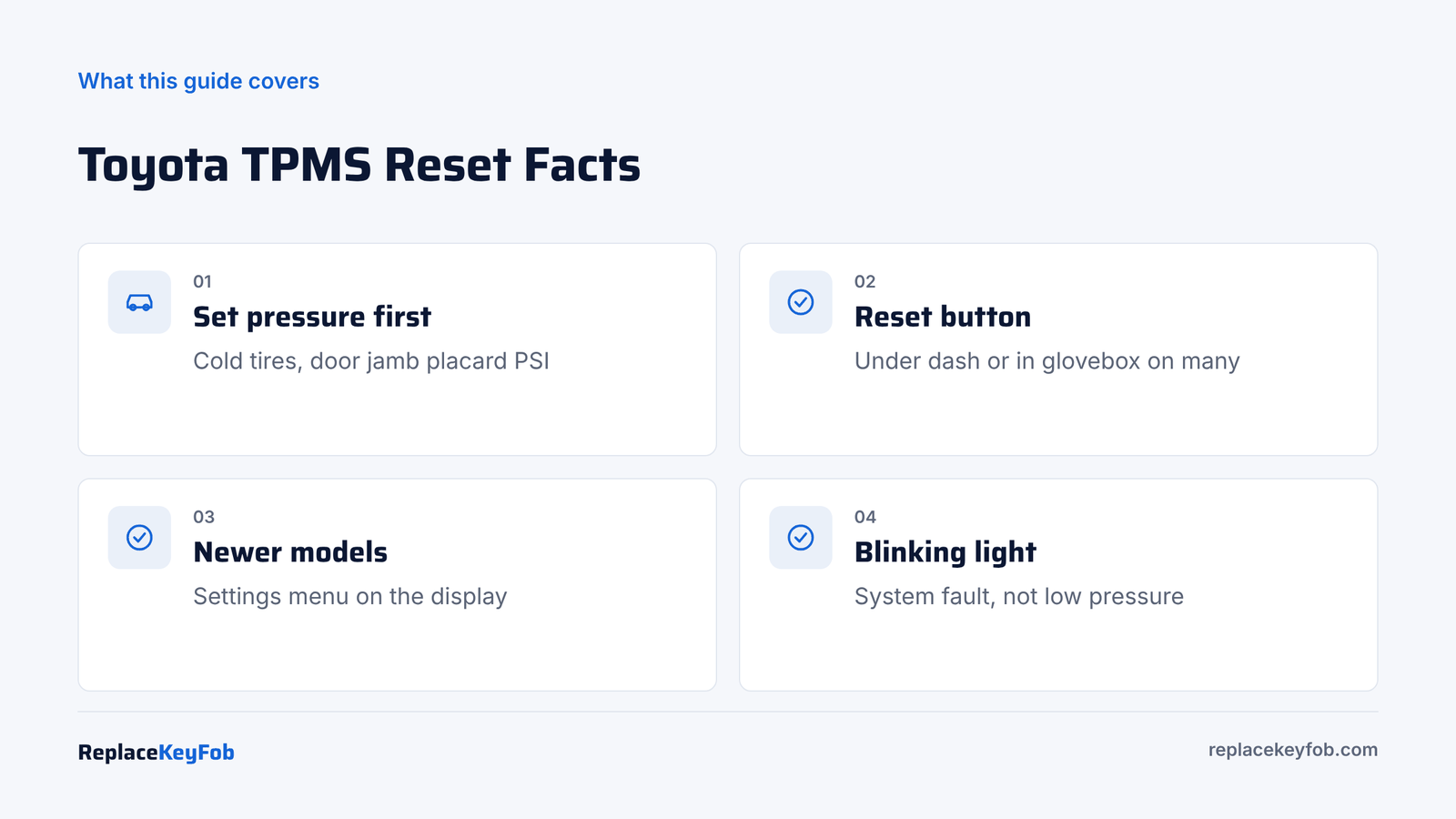
Before You Reset: Set the Right Pressure
The reset tells the system that the current pressures are the target. If you reset with a low tire, the system learns the wrong number and may not warn you later. So the first step is always pressure.
- Check the tires cold. Drive less than a mile or let the car sit for three hours. Warm tires read 2 to 4 PSI high.
- Find the placard on the driver door jamb. It lists front and rear pressure, which can be different.
- Inflate every tire to that number, including the spare if your Toyota has a sensor in it (many full-size spares on trucks and SUVs do).
- Use a good gauge. Gas station gauges are often off by a few PSI.
Do not use the maximum pressure printed on the tire sidewall. That is the tire’s limit, not the right pressure for your car.
Digital tire pressure gauge
Pick a gauge with a lit screen and 0.5 PSI resolution so you can set every tire, including the spare, to the exact door placard pressure before resetting.
As an Amazon Associate, ReplaceKeyFob earns from qualifying purchases.
Where Is the Toyota TPMS Reset Button?
On models that have one, the button is usually small and labeled TPMS or SET. Common spots:
| Location | Often found on |
|---|---|
| Lower dash, left of the steering column | Many Tacoma, Tundra, 4Runner and Sequoia years |
| Inside the glovebox, on the upper or side wall | Many Camry, Corolla, RAV4, Avalon and Highlander years |
| Under the dash near the knee bolster | Some Sienna and Venza years |
| Behind a small panel near the hood release | Some trucks and older SUVs |
These are typical spots, not a rule. If you cannot find it, your owner’s manual will show the exact location in the TPMS section. Some trims of the same model have a button and others do not.
How to Reset the TPMS Light With the Button
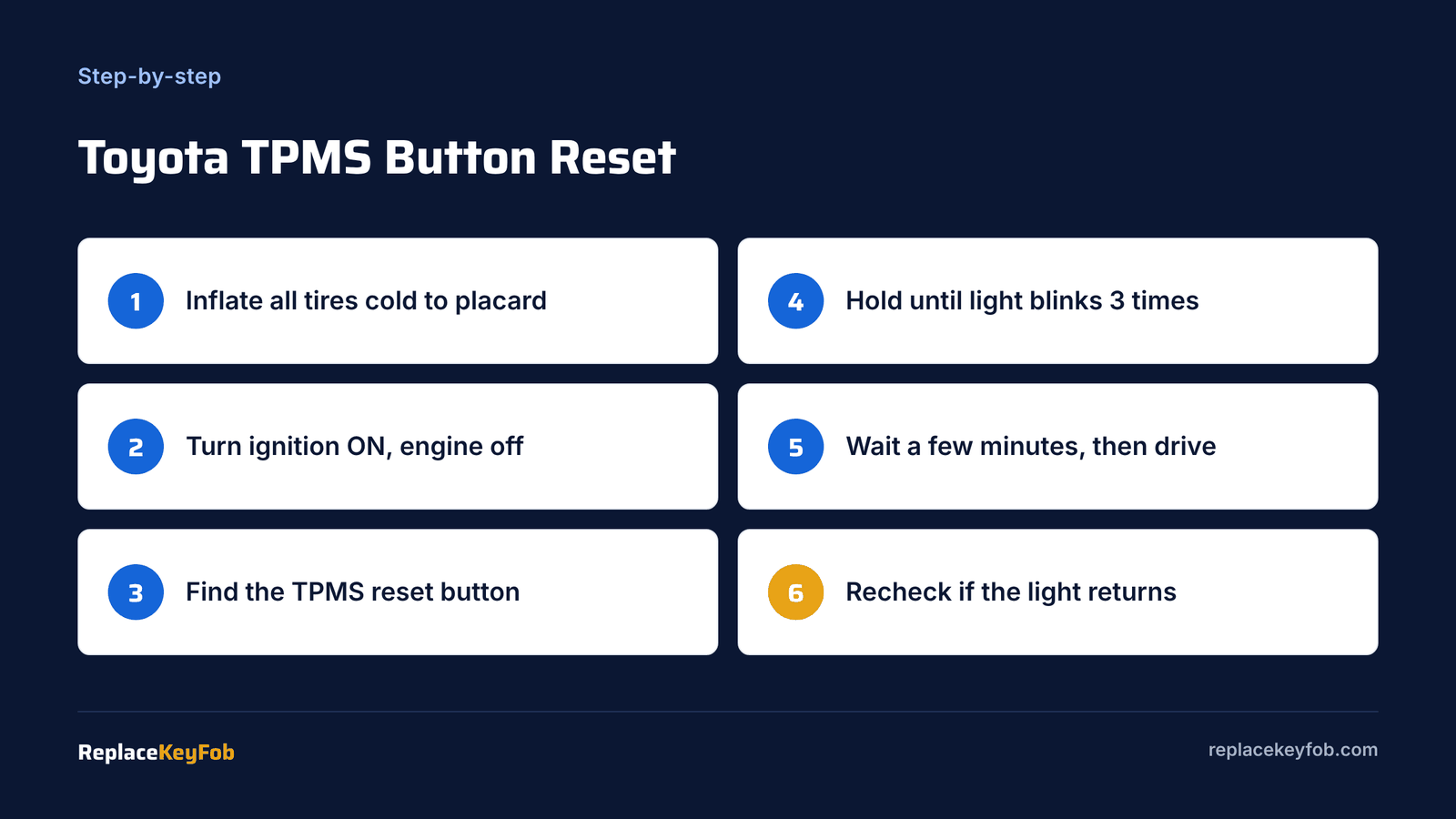
- Set all tire pressures to the placard value as described above.
- Turn the ignition to ON without starting the engine. On push-button models, press the start button twice without your foot on the brake.
- Press and hold the TPMS reset button.
- Keep holding until the TPMS light blinks slowly three times, then release. This usually takes about three seconds.
- Wait a few minutes with the ignition on, then start the engine. Many models finish the initialization within about 20 minutes of driving or idling.
- Check the light. It should stay off. If it comes back on, recheck pressures.
The reason you hold the button until the blink is that the blink is the system’s confirmation. Releasing early does nothing, which is the most common reason owners think the reset failed.
Model notes from common searches:
- 2011 Toyota Avalon: the button is in the glovebox area on many cars of this generation. The hold-until-three-blinks method is the same.
- 2014 Toyota RAV4: many cars have the button under the dash to the left of the steering wheel or in the glovebox. Hold until three slow blinks with ignition ON.
- 2010 Toyota Corolla: many have the button under the dash or in the glovebox, and the same procedure applies. Some base trims may lack a button and clear after driving.
Newer Toyotas: Reset From the Display Menu
On many newer Toyotas with a color multi-information display, there is no button. The reset lives in the settings menu.
- Set tire pressures first.
- Turn the ignition ON with the car in Park.
- Use the arrow buttons on the steering wheel to scroll to the Settings screen (the gear icon).
- Open Vehicle Settings or a similar menu, then select TPWS (Tire Pressure Warning System).
- Choose Set Pressure or the initialization option, then press and hold OK until the display confirms.
- Drive at normal speeds for about 10 to 20 minutes so the system finishes learning.
Menu names vary by model and year. On some 2020 and newer models, the system initializes automatically once pressures are correct, and there is no reset step at all. Your owner’s manual will say which method your car uses.
When You Need a TPMS Tool Instead
The button and the menu only reset pressure targets. They do not register new sensor IDs. You need a TPMS relearn tool or a shop when:
- You installed new TPMS sensors
- You put on a second set of wheels (for example winter wheels with their own sensors)
- A sensor’s battery died and was replaced
Many Toyotas store two sets of sensor IDs, which helps owners who swap summer and winter wheels. Switching between sets still needs a tool on most models. See the difference between a TPMS tool and an OBD2 scanner for what each can do.
What a Flashing TPMS Light Means
If the TPMS light flashes for about a minute and then stays on, the system has a fault, not a pressure problem. A reset will not fix it. Common causes:
- A dead sensor battery (sensors usually last about 7 to 10 years)
- A wheel without a sensor, such as an aftermarket or spare wheel
- A damaged sensor after a tire change
- Interference or a receiver fault
A TPMS tool can read which sensor is not reporting. For the general version of these steps, see our guide on how to reset the TPMS light.
Toyota TPMS After a Tire Rotation or New Tires
A simple rotation on a Toyota with direct sensors does not change which sensors the car knows, but it does change where each sensor sits. Most Toyotas only show a general low pressure warning rather than a position, so a rotation usually just needs correct pressures and a reset. Models that display individual tire pressures on the screen may show the wrong corner until a relearn is done with a tool.
With new tires on the same wheels, the sensors stay in place. Ask the shop to check sensor condition and replace the valve core and seal, since corroded valve stems are a common source of slow leaks. Then reset with the button or menu at the new placard pressures.
Troubleshooting a Toyota TPMS Light That Will Not Reset
| What you see | Likely cause | What to do |
|---|---|---|
| Light stays solid after reset | One tire still low, or spare low | Recheck all five tires cold |
| Light flashes then stays on | Sensor or system fault | Scan sensors with a TPMS tool |
| Cannot find reset button | Model uses a menu or auto-learn | Check owner’s manual TPMS section |
| Light returns each cold morning | Pressure set a bit low; air contracts in cold | Add 1 to 2 PSI to placard in winter |
| Light after tire rotation | Sensor positions changed | Reset pressures; some models need relearn |
| Light after new wheels | Sensor IDs not registered | Register IDs with a TPMS tool |
Mistakes to Avoid
- Resetting with warm tires. The system learns pressures that are too high.
- Forgetting the spare. Many Toyota trucks and SUVs monitor it.
- Using sidewall maximum pressure. Always use the door placard.
- Assuming a scanner will fix a flashing light. That is a hardware fault.
When to Visit a Shop and What It Costs
If the light flashes, you replaced sensors or you swap seasonal wheels, a tire shop or dealer can register sensors quickly. In 2026 typical US prices are:
- TPMS relearn or ID registration: about $25 to $75
- New sensor, installed: about $60 to $150 per wheel
- Dealer diagnosis of a TPMS fault: about $100 to $180
Many tire shops include relearn free when you buy tires from them.
Frequently Asked Questions
On models that have one, it is usually under the dash to the left of the steering column or inside the glovebox. Your owner’s manual shows the exact spot for your model and year.
No. Many newer Toyotas use a menu in the multi-information display, and some recent models learn automatically after you set the right pressures.
After a button or menu reset, the light should go off right away or after a short drive. Initialization can take up to about 20 minutes of driving.
Tire pressure drops about 1 PSI for every 10°F drop in temperature. A tire set right in warm weather can fall below the warning point on a cold morning.
On menu-based models, yes, through Settings. On button models, adding the right air and driving may clear it, but the button sets new targets properly.