
How to Reset the TPMS Light on a Jeep

This post contains affiliate links. As an Amazon Associate, ReplaceKeyFob earns from qualifying purchases, at no extra cost to you.
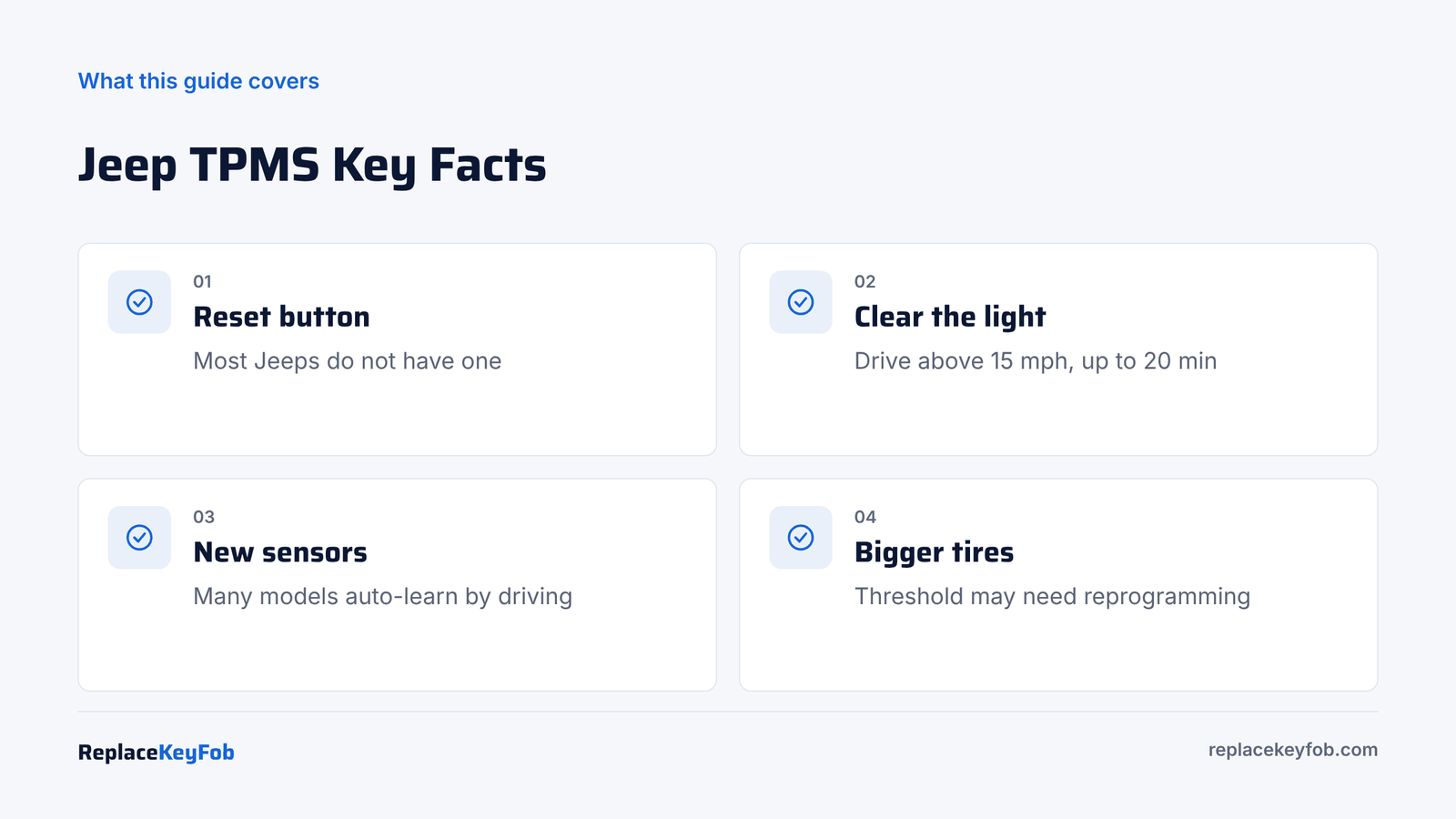
Most Jeeps have no TPMS reset button. To reset the light, inflate every tire to the pressure on the driver door placard while cold, then drive above about 15 mph. The system updates as the sensors report, and the light usually turns off within 20 minutes of driving. New sensors on many Jeeps learn automatically the same way.
Jeep shares its tire pressure monitoring system with other Chrysler, Dodge and Ram vehicles. Each wheel has a sensor that reports real pressure to the body computer. Many newer Jeeps, including recent Grand Cherokee, Wrangler, Gladiator, Cherokee and Compass models, show each tire’s pressure in the cluster. That screen is the best tool you have, because it tells you which tire is low before you even get out a gauge.
Searches for a “Jeep TPMS reset button” are common, but on most models it does not exist. This guide explains how the system actually clears, how to deal with new sensors and lifted Jeeps, and what a flashing light means. For the overall process on other brands, see how to reset the TPMS light.
Jeep TPMS Reset Button Location: Does It Exist?
On most Jeep models, there is no TPMS reset button. You will not find one under the dash, in the glovebox or near the steering column.
- Jeep Liberty: most years have no reset button. The light clears after correct inflation and driving.
- Wrangler JK and JL: no reset button. Pressures show in the cluster on many years.
- Grand Cherokee: no reset button. Cluster shows pressures on most years since 2011.
- Compass, Patriot, Renegade, Cherokee: no reset button on most years.
If a forum post mentions a button, it is usually a different brand or an aftermarket system. Trying to reset by disconnecting the battery will not help either.
What You Need
- A good tire gauge (or the cluster tire pressure page)
- An air source; a portable compressor is handy for off-roaders who air down
- The door placard pressures
- A TPMS tool only if a sensor is new, dead or not learning
Portable air compressor for off-road tires
Jeep owners who air down for trails need a 12V compressor that can refill larger tires quickly. Check the duty cycle and maximum PSI against your tire size.
As an Amazon Associate, ReplaceKeyFob earns from qualifying purchases.
How to Reset the TPMS Light on a Jeep
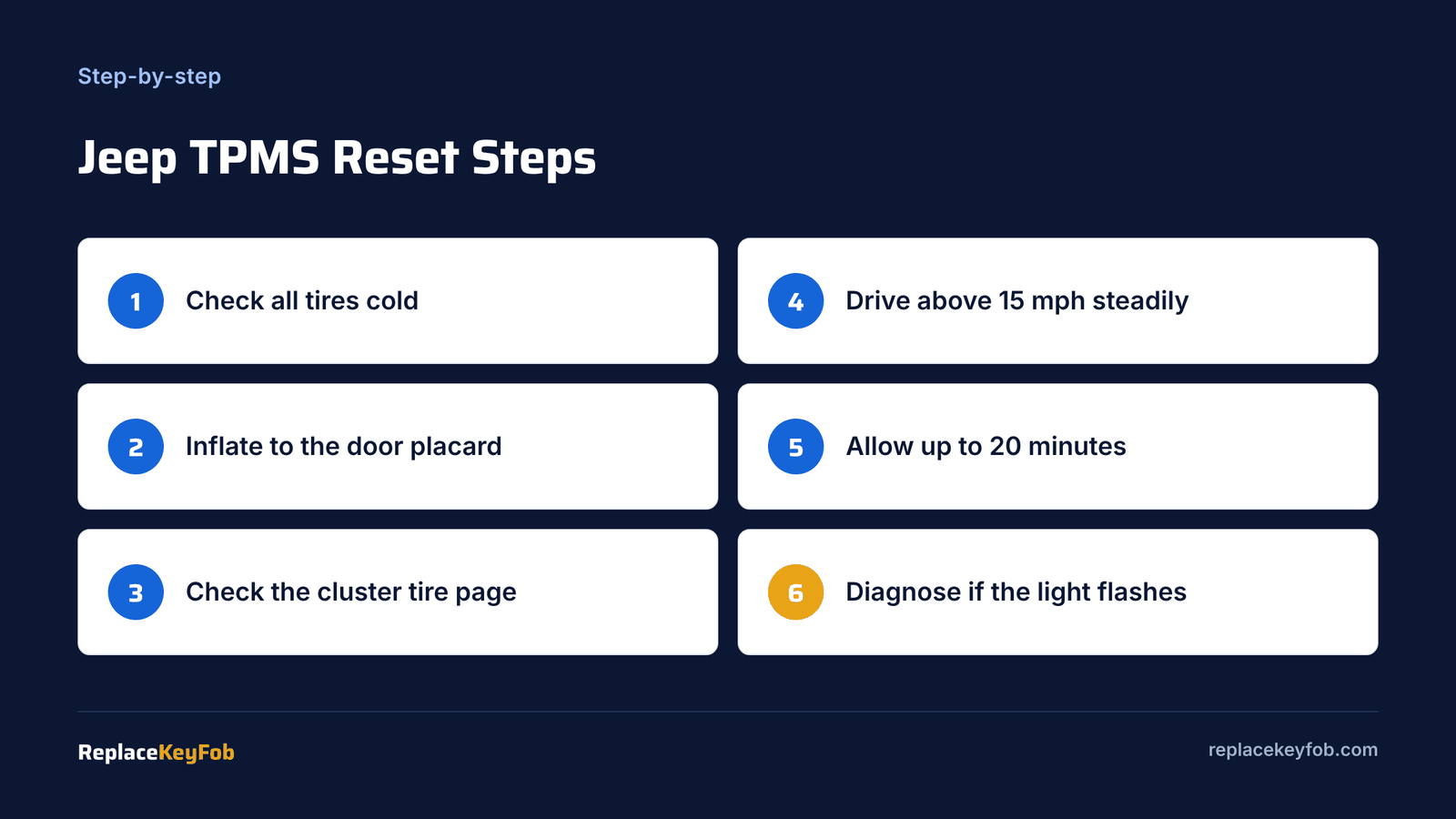
- Check pressure cold. Before driving, or after the Jeep has been parked for three hours.
- Inflate each tire to the placard pressure on the driver door jamb. Jeeps often run different pressures than the sidewall suggests.
- Open the tire pressure page in the cluster if your model has one. It may show the old readings until you drive.
- Drive above about 15 mph. The sensors transmit more often at speed.
- Give it up to 20 minutes. Many owners see the light clear in a few minutes, but the system may take longer to confirm all four.
- Recheck the cluster. All tires should show their new pressure and the light should be off.
The reason there is no button is that the system compares live sensor readings to a fixed target stored in the computer. Once the readings are above the warning threshold, the light goes out by itself.
New Sensors on a Jeep: Auto-Learn
Many Jeep and Chrysler-family vehicles learn new sensor IDs automatically.
- Install the new sensor and inflate the tire to placard pressure.
- Let the Jeep sit for about 20 minutes so the system notices the old sensor is gone. Many manuals and technicians recommend this.
- Drive above about 15 mph for up to 20 minutes.
- The light should turn off once the new sensor is learned.
If it does not learn, the sensor may need to be activated with a TPMS tool, or it may be the wrong frequency or type. Some models and some aftermarket sensors need a tool-based relearn. A Jeep TPMS reset tool listing your model year will handle this, or a tire shop can do it in minutes.
Lifted Jeeps and Bigger Tires
Many Wrangler and Gladiator owners fit larger tires and run lower pressures than the factory placard. The problem is that the computer still wants the original pressure. Run 30 PSI on a Jeep that expects 37, and the light will stay on.
Options:
- Reprogram the TPMS threshold. Dealers and several aftermarket programming tools can change the target pressure stored in the Jeep. Support varies by model and year.
- Run the factory pressure on road and only air down for trails, then refill before highway driving.
- Do not remove or disable the sensors. The light will stay on and you lose a useful safety warning.
If you change the target, follow the tire maker’s load tables for your new size. Larger tires on heavier Jeeps still need enough pressure to carry the weight.
Airing down for the trail
When you air down, the TPMS light will come on, and that is normal. Refill before driving on pavement. Once all tires are back at the target, the light will clear after a short drive.
Model Notes
- Wrangler JK (2007 to 2018): many years show pressures in the cluster; some need a tool for sensor learning.
- Wrangler JL (2018 and newer) and Gladiator: cluster tire page on most trims. A full-size spare may or may not be monitored; check the manual.
- Grand Cherokee (2011 and newer): cluster shows each tire on most years; auto-learn common.
- Cherokee and Compass: cluster pressure display on many years; standard inflate and drive.
- Liberty: standard inflate and drive; sensors on older Libertys are often past their battery life.
Checking Tire Pressure on the Jeep Cluster
On models with a tire pressure page, the cluster is the quickest way to see what the system sees:
- Turn the ignition ON.
- Use the arrow buttons on the left side of the steering wheel to scroll the cluster menu.
- Stop on Tire Pressure (on some years it sits under Vehicle Info).
- Read each corner. The display may show the last known values until you drive for a minute or two.
If one tire reads several PSI lower than the rest every morning, it has a slow leak. On Jeeps that go off road, check for a bent wheel lip, a damaged valve stem or a rock-cut sidewall. Trail use is hard on the TPMS sensors too: a hit to the valve stem can crack the sensor body.
What a Flashing Jeep TPMS Light Means
If the light flashes for about 75 seconds and then stays on, the system has a fault. On a Jeep, the usual causes are:
- A dead sensor battery, typical after 7 to 10 years
- A wheel without a sensor, such as an aftermarket wheel or a spare in use
- A damaged sensor from a tire change or trail damage
- A sensor not learned
The cluster may also show dashes for the affected tire. A TPMS tool or a scan tool that reads body module codes will narrow it down. Our list of the best OBD2 scanners for Jeep includes tools that read TPMS codes.
Troubleshooting a Jeep TPMS Light
| What you see | Likely cause | Fix |
|---|---|---|
| Light stays on after inflation | Not driven long enough, or one tire low | Drive 20 minutes above 15 mph, recheck |
| Light flashes then stays on | Sensor fault or missing sensor | TPMS tool diagnosis |
| Dashes for one tire | Sensor not reporting | Check for damage or dead battery |
| Light with bigger tires | Running below programmed target | Reprogram threshold or raise pressure |
| Light after airing down | Normal | Refill before road driving |
| New sensor not learning | Wrong type or needs activation | Tool relearn |
Mistakes to Avoid
- Hunting for a reset button. Most Jeeps do not have one.
- Running low pressure on the highway to avoid the light. Low pressure overheats tires at speed.
- Disconnecting the battery to reset. It does not clear TPMS on these systems.
- Throwing out sensors when changing wheels. Move them to the new wheels or buy new ones.
When to Call a Pro and What It Costs
A tire shop can test and learn sensors quickly. Typical 2026 US costs are about $25 to $75 for a relearn, about $60 to $150 per installed sensor, and about $75 to $150 for a dealer to reprogram the TPMS threshold after a tire size change. For more on what scan tools can do here, see can an OBD2 scanner reset the TPMS light, and for the hardware difference, see TPMS tool vs OBD2 scanner.
Frequently Asked Questions
Most Jeep models do not have one. The light clears after you set all tires to the placard pressure and drive above about 15 mph for up to 20 minutes.
Most Liberty years have no reset button. Inflate to the placard and drive; if the light flashes before staying on, a sensor has likely failed.
Often a few minutes, but allow up to about 20 minutes of driving above 15 mph once all tires are at the correct pressure.
Many Jeeps learn new sensors automatically after sitting for a while and then driving. Some models or sensors need a TPMS tool.
On many models, yes, with a dealer tool or an aftermarket programmer. Use the tire maker’s load tables to pick a safe pressure.