
P0106 Causes: What Triggers This MAP Sensor Code

P0106 causes often start with a vacuum leak, faulty MAP sensor, dirty throttle body, wiring damage, or a bad sensor ground. The code means the engine computer sees manifold pressure data that does not match engine load, throttle position, or rpm.
- Check vacuum hoses first.
- Inspect the MAP sensor connector.
- Compare live scan data.
- Do not replace parts blind.
Your scan tool shows P0106, and now you need one clear answer. The code points to the manifold absolute pressure system, but the MAP sensor is not always the guilty part.
The engine computer sets P0106 when pressure data looks wrong for current engine load. This takes about 8 minutes to read, and it will help you check the most likely causes in the right order.
Key point: P0106 is a correlation problem, not just a sensor problem. The computer compares MAP sensor data against throttle position, rpm, airflow, and barometric pressure.
P0106 Meaning Comes From Mismatched Pressure Data
P0106 means the powertrain control module sees manifold absolute pressure data outside the expected range. The signal does not match engine load, throttle opening, rpm, or barometric pressure.
The MAP sensor measures intake manifold pressure. The PCM uses that signal to calculate fuel delivery, ignition timing, and emissions control strategy.
You may think a P0106 code proves the MAP sensor failed. That belief causes wasted money because vacuum leaks and wiring faults can send the same wrong pressure signal.
For emissions context, the EPA explains that OBD checks support inspection and maintenance programs because the system tracks emissions-related faults. See the EPA guidance on OBD inspection checks.
The real question is not “which part is bad?” The real question is “why does the pressure signal not match engine conditions?”
That difference changes the full diagnosis. The next section ranks the causes from most practical to least common.
Main P0106 Causes You Should Check First
The most common P0106 causes are intake vacuum leaks, damaged MAP sensor wiring, a dirty or failed MAP sensor, throttle body deposits, EGR flow faults, and incorrect airflow data. Each cause changes the pressure signal in a different way.
Start with low-cost checks before buying a sensor. A cracked vacuum hose can create the same code as a failed MAP sensor because both make the PCM see pressure data that does not fit engine load.
This table shows what each cause changes and what you should inspect first.
| Cause | Why it triggers P0106 | First check |
|---|---|---|
| Vacuum leak | Extra air changes intake pressure. | Hoses, intake boot, manifold gasket |
| Bad MAP sensor | The sensor sends wrong voltage. | Live MAP kPa and sensor voltage |
| Wiring damage | Signal, ground, or 5-volt reference drops out. | Connector pins and harness movement |
| Dirty throttle body | Airflow at idle becomes unstable. | Throttle plate carbon buildup |
| Stuck EGR valve | Wrong exhaust flow changes manifold pressure. | EGR position and idle quality |
| MAF data fault | Airflow data conflicts with MAP data. | MAF grams per second and intake boot |
| PCM fault | The computer reads or processes data incorrectly. | Only after all other checks pass |
The strongest first move is a visual inspection and live data check. That saves time because P0106 often comes from air or wiring, not the sensor itself.
Tip: Check freeze-frame data before clearing the code. Engine speed, throttle position, load, and MAP reading show when the fault happened.
P0106 Symptoms Help Narrow The Cause
P0106 symptoms depend on whether the fault comes from air leakage, sensor signal loss, or bad fuel calculation. The check engine light can appear alone, but drivability clues help narrow the cause.
A vacuum leak often causes high idle, lean fuel trims, hesitation, or stalling. A bad MAP sensor can cause rough idle, hard starting, poor fuel economy, black smoke, or weak acceleration.
Here is where most people make the mistake: they judge the code by the warning light only. The light tells you the system failed a test, not which component failed.
- Rough idle points toward air leaks or throttle deposits.
- Black smoke points toward rich fuel calculation.
- Stalling points toward unstable idle airflow.
- Poor acceleration points toward wrong load data.
- No symptoms points toward intermittent wiring or sensor drift.
Some manufacturers also release service bulletins for known P0106 patterns. One NHTSA-hosted service bulletin links P0106 with reduced engine power and MAP sensor connector concerns on specific diesel trucks: NHTSA service bulletin covering P0106 diagnostic conditions.
The symptom pattern gives direction. The scan data gives proof.
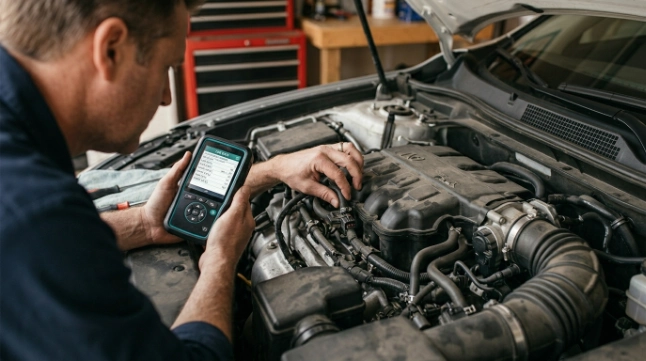
IMAGE SUGGESTION: Close-up photo of a technician viewing MAP sensor live data on an OBD-II scanner beside an open engine bay.
ALT TEXT: P0106 causes MAP sensor live data scan tool diagnosis
P0106 Diagnosis Starts With Data, Not Guessing
P0106 diagnosis should start with code confirmation, freeze-frame review, visual inspection, and live data comparison. This order prevents part swapping and catches air leaks before sensor replacement.
First, scan for related codes. P0107, P0108, P0171, P0172, P0300, MAF codes, and throttle position codes can change the diagnosis.
Next, inspect the MAP sensor connector. Look for oil contamination, water, loose pins, corrosion, broken insulation, and stretched wiring near the intake manifold.
- Record all codes and freeze-frame data.
- Inspect hoses, intake duct, clamps, and PCV lines.
- Check MAP sensor connector and wiring.
- Compare MAP kPa with barometric pressure key-on engine-off.
- Start the engine and check idle MAP response.
- Raise rpm and watch for smooth signal change.
- Smoke-test the intake if data looks unstable.
What most people do not think to ask is whether the MAP reading makes sense before the engine starts. Key-on engine-off MAP pressure should closely match local barometric pressure because the manifold has no vacuum yet.
If the key-on engine-off value looks wrong, focus on the sensor, wiring, 5-volt reference, ground, or PCM input. If the value looks normal before start but fails at idle, focus on leaks, throttle airflow, EGR, or engine mechanical issues.
Warning: Do not clear the code before saving freeze-frame data. Clearing codes deletes the best clue about when the P0106 fault appeared.
What Most People Get Wrong About P0106 Causes
The biggest mistake is replacing the MAP sensor first. The MAP sensor can fail, but P0106 often appears because the pressure signal conflicts with another engine condition.
Wrong belief one: “P0106 always means bad MAP sensor.” Correct view: P0106 means the MAP signal does not fit expected engine behavior.
Wrong belief two: “No rough idle means no vacuum leak.” Correct view: small leaks can show up under certain load or temperature conditions, then disappear during a quick driveway check.
Wrong belief three: “Clearing the code fixes the issue.” Correct view: clearing the code resets the warning, but the PCM will run the test again during the right drive conditions.
California BAR explains that readiness monitors must rerun after repairs, battery disconnects, or cleared codes. The California BAR OBD test reference gives inspection context for readiness status.
The practical takeaway: P0106 repair succeeds when the MAP reading, airflow data, throttle data, and engine condition agree again.
Safe Driving And Repair Priority For P0106

You can drive short distances with P0106 only when the engine runs smoothly, power feels normal, and no warning lights flash. You should not keep driving if the engine stalls, hesitates hard, smokes, misfires, or loses power.
The repair priority depends on symptoms. A sensor-only fault can feel mild, while an intake leak or fuel calculation issue can damage the catalytic converter through rich running or misfires.
Use this decision block before your next drive.
- If the engine stalls, stop driving and diagnose now.
- If the engine smokes black, avoid long trips.
- If the idle surges, inspect intake air leaks first.
- If P0106 returns after sensor replacement, test wiring.
- If emissions testing is due, complete the drive cycle after repair.
A shop visit makes sense when live data does not match simple checks. A technician can smoke-test the intake, load-test wiring, compare pressure data, and test the MAP sensor response under vacuum.
For DIY repair, take one small step first: inspect every vacuum hose and the MAP connector under bright light. That two-minute check catches causes that scanners cannot see.
IMAGE SUGGESTION: Simple labeled diagram showing MAP sensor, intake manifold, vacuum hose, throttle body, and PCM signal path.
ALT TEXT: P0106 causes MAP sensor intake manifold wiring diagram
P0106 causes should be diagnosed as a pressure-data mismatch, not as an automatic MAP sensor failure.
As vehicles rely more on sensor correlation, future diagnostics will depend more on comparing live data across connected systems.
Before buying a part, open the hood and check the MAP connector, vacuum hoses, and intake boot for two minutes.
Frequently Asked Questions
Can a dirty MAP sensor cause P0106?
Yes, a dirty MAP sensor can cause P0106 when oil, dust, or moisture affects the pressure reading. Cleaning can help when contamination is light, but a damaged sensor or weak internal circuit still needs replacement after voltage testing.
Can a vacuum leak trigger P0106?
Yes, a vacuum leak can trigger P0106 because extra air changes intake manifold pressure. The PCM compares that pressure against throttle position, rpm, and airflow data, then sets the code when those readings do not agree.
Will P0106 clear itself after repair?
P0106 can clear after the PCM completes enough successful self-tests, but the check engine light often stays on until the code is cleared. After clearing, the vehicle still needs a proper drive cycle to reset readiness monitors.
Is P0106 the same as P0107 or P0108?
No, P0106 is a range or performance problem, while P0107 usually means low MAP circuit voltage and P0108 usually means high MAP circuit voltage. P0106 focuses more on whether the signal makes sense during engine operation.
Should I replace the MAP sensor first?
No, you should test before replacing the MAP sensor. Inspect the connector, hoses, intake duct, throttle body, and live data first because air leaks and wiring faults can trigger the same P0106 code.
