
P0155 Code Meaning — Oxygen Sensor Heater Circuit Bank 2 Sensor 1 Explained

Quick Answer: The P0155 code means the oxygen sensor heater circuit for Bank 2 Sensor 1 is malfunctioning. This sensor helps the engine reach optimal air-fuel mixture faster. When it fails, fuel efficiency drops, emissions increase, and cold-start performance becomes poor.
The P0155 trouble code appears when the Engine Control Module (ECM) detects a fault in the heater circuit of the upstream oxygen sensor on Bank 2. This sensor is critical for emissions control and engine efficiency. It often signals electrical issues, sensor failure, or wiring damage.
What Does P0155 Mean in Simple Terms?
P0155 means the oxygen sensor heater in Bank 2 Sensor 1 is not working properly. This heater warms the sensor quickly after engine startup. Without it, the engine runs inefficiently during cold starts.
Bank 2 refers to the side of the engine opposite cylinder 1. Sensor 1 is the upstream sensor before the catalytic converter. This location makes it critical for fuel mixture regulation.
When this heater fails, the ECM cannot trust early oxygen readings. It then defaults to safer fuel maps, increasing fuel consumption.
Where Is Bank 2 Sensor 1 Located?
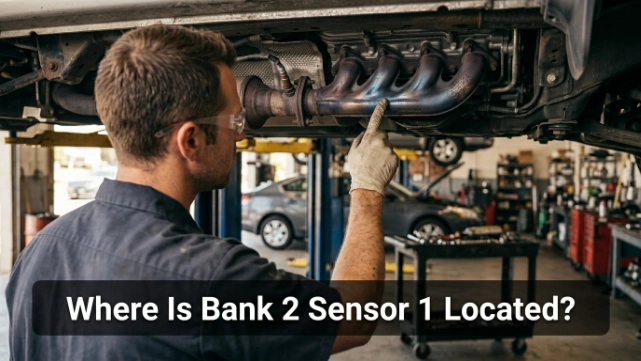
Bank 2 Sensor 1 is mounted on the exhaust manifold before the catalytic converter. It is positioned on the engine bank that does not contain cylinder 1.
In V6 and V8 engines, there are multiple oxygen sensors. Bank 1 and Bank 2 each have upstream and downstream sensors. Sensor 1 always refers to the upstream sensor.
This sensor plays a direct role in real-time fuel control. Its heater allows fast activation after ignition.
- Bank 1 = cylinder 1 side
- Bank 2 = opposite cylinder 1 side
- Sensor 1 = upstream sensor
- Sensor 2 = downstream sensor
Symptoms of P0155 Code
The most common symptoms of P0155 are related to fuel efficiency and engine behavior. The engine may still run, but performance becomes less efficient.
Cold starts are usually the first noticeable issue. The vehicle may feel sluggish until it warms up fully.
Drivers often ignore early symptoms, which can lead to catalytic converter stress.
- Check Engine Light ON
- Increased fuel consumption
- Rough cold starts
- Reduced engine efficiency
- Failed emissions test
Common Causes of P0155
P0155 is usually caused by electrical failure rather than mechanical engine damage. The oxygen sensor heater circuit is sensitive to wiring and voltage issues.
In many real-world cases, damaged wiring or blown fuses are responsible. Sensor aging is also a major factor.
What most people don’t think to ask is whether voltage supply to the heater circuit is stable. That is often the hidden root cause.
- Faulty oxygen sensor heater
- Blown fuse or relay issue
- Damaged wiring harness
- Poor electrical connection
- ECM control fault (rare)
How Serious Is P0155?
P0155 is not an immediate engine breakdown risk, but it should not be ignored. It affects emissions control and fuel economy significantly.
If driven long-term, it can increase catalytic converter wear due to improper fuel mixture control.
The real risk is gradual system damage and higher fuel costs over time.
How to Diagnose P0155 Step by Step
Diagnosis starts with checking electrical supply to the oxygen sensor heater circuit. A multimeter is essential for accurate testing.
Next, inspect wiring near the exhaust manifold. Heat damage is common in this area.
Finally, test the oxygen sensor resistance to confirm heater failure.
- Scan vehicle for additional codes
- Inspect wiring and connectors
- Check fuse and relay system
- Test oxygen sensor heater resistance
- Confirm ECM voltage output
How to Fix P0155 Code
Fixing P0155 depends on the root cause. In most cases, replacing the oxygen sensor resolves the issue.
If wiring damage is found, repair or replace the harness before installing a new sensor.
Electrical issues must always be fixed first to avoid repeated sensor failure.
- Replace oxygen sensor (most common fix)
- Repair damaged wiring
- Replace blown fuse or relay
- Clean and secure connectors
- Reset ECM after repair
Can You Drive With P0155?
Yes, you can drive with P0155, but it is not recommended for long-term use. The engine will run in a less efficient fuel mode.
Fuel economy drops and emissions increase while driving with this code active.
Short-term driving is safe, but repair should not be delayed.
Common Misconceptions About P0155
Many drivers think P0155 means engine failure. This is incorrect. It is an electrical sensor heater issue.
Another misconception is that oxygen sensors always need replacement. In reality, wiring issues are often the cause.
People also assume fuel injectors are at fault, but they are unrelated in most cases.
P0155 Repair Cost Overview

Repair costs vary depending on the cause. Sensor replacement is the most common and cost-effective fix.
Wiring repairs may cost more in labor due to location near the exhaust system.
ECM replacement is rare but significantly more expensive.
| Repair Type | Estimated Cost |
|---|---|
| Oxygen Sensor Replacement | $120 – $300 |
| Wiring Repair | $80 – $250 |
| Fuse/Relay Replacement | $20 – $80 |
| ECM Repair | $300 – $1000+ |
Final Thoughts on P0155
P0155 is a common oxygen sensor heater circuit fault that mainly affects emissions and fuel efficiency. It rarely indicates engine damage.
Most cases are solved with simple electrical repairs or sensor replacement. Early diagnosis prevents long-term catalytic converter issues.
The fastest way forward is scanning, testing wiring, and replacing the faulty sensor if needed.
Key Takeaway
P0155 indicates a failure in the oxygen sensor heater circuit on Bank 2 Sensor 1, affecting fuel efficiency and emissions.
Fixing it early prevents catalytic converter damage and improves engine performance.
Scan your vehicle and inspect wiring or replace the sensor to resolve it quickly.
Frequently Asked Questions
What causes a P0155 code?
P0155 is usually caused by a faulty oxygen sensor heater, wiring damage, or blown fuse. Electrical issues are more common than sensor failure in many vehicles.
Is P0155 serious?
P0155 is not immediately dangerous but affects fuel efficiency and emissions. Long-term neglect may damage the catalytic converter.
Can a bad battery cause P0155?
Yes, low voltage from a weak battery can disrupt the heater circuit. However, it is not the most common cause of this code.
How do you fix P0155 quickly?
The fastest fix is usually replacing the Bank 2 Sensor 1 oxygen sensor. Always check wiring and fuses before replacement.
Will P0155 clear itself?
No, P0155 will not clear until the electrical fault is fixed. The code may temporarily disappear but will return if the issue persists.
