
P0172 Repair Cost: What You May Pay and How to Avoid Unnecessary Repairs

Your check engine light is on, your OBD2 scanner shows P0172, and now you want to know how much the repair will cost. The problem is that the code does not identify one failed part.
The P0172 repair cost can be relatively low if the engine only needs an air filter or mass airflow sensor cleaning. It can exceed $1,000 if the cause is a leaking fuel injector, fuel pump problem, or another complex fuel-system failure.
This guide explains what P0172 means, realistic repair costs, common causes, diagnostic steps, and when professional help is worth paying for.
Quick Answer
The typical P0172 repair cost ranges from about $100 to more than $1,500, depending on the cause. Diagnosis often costs $120–$250. A dirty sensor may be inexpensive to clean, while replacing a mass airflow sensor, fuel injector, pressure regulator, oxygen sensor, or fuel pump can cost several hundred dollars or more.
What Does the P0172 Code Mean?
P0172 means “System Too Rich, Bank 1.”
Your engine needs a controlled mixture of air and fuel. A “rich” condition means the engine computer believes there is too much fuel or not enough air in that mixture.
“Bank 1” refers to the side of the engine containing cylinder number one. On an inline four-cylinder engine, there is usually only one bank.
The vehicle’s onboard diagnostic system detects the condition and stores P0172. The EPA’s OBD consumer guidance explains that OBD systems monitor major engine and emissions components and use the check engine light to provide an early warning of a malfunction. (NEPIS)
P0172 is a diagnostic clue, not a final diagnosis. It does not automatically mean the oxygen sensor, mass airflow sensor, or fuel injector has failed.
Average P0172 Repair Cost
Most car owners should budget for two separate expenses:
- Diagnostic testing
- The repair that corrects the rich condition
Current national estimates place professional check engine light diagnosis and testing at approximately $122 to $233, before taxes, location adjustments, or additional repairs. (RepairPal.com)
Your total cost will then depend on what the technician finds.
| Possible service or repair | Typical U.S. cost range |
|---|---|
| Professional diagnosis | $120–$250 |
| Replace dirty air filter | $30–$100 |
| Clean mass airflow sensor | $50–$200 |
| Repair loose intake connection or wiring | $100–$400 |
| Replace EVAP purge valve | $150–$450 |
| Replace mass airflow sensor | $275–$400 |
| Replace fuel pressure regulator | $330–$450 |
| Replace oxygen sensor | $200–$600 |
| Replace one or more fuel injectors | $500–$1,500+ |
| Replace fuel pump or fuel delivery module | $1,000–$1,600+ |
| Repair internal engine or computer problem | $1,000–$3,000+ |
These ranges are general planning figures. Labor rates, part quality, engine design, vehicle age, and local taxes can change the final price significantly.
As of July 2026, national estimator averages included approximately $273–$382 for mass airflow sensor replacement, $331–$422 for a fuel pressure regulator, $454–$550 for an oxygen sensor, and $764–$947 for fuel injector replacement. Fuel pump replacement averaged approximately $1,319–$1,504. Some individual vehicles cost much less or much more. (RepairPal.com)
Do not approve a costly repair simply because it appears on this list. The failed component must be confirmed through testing.
What Causes P0172?
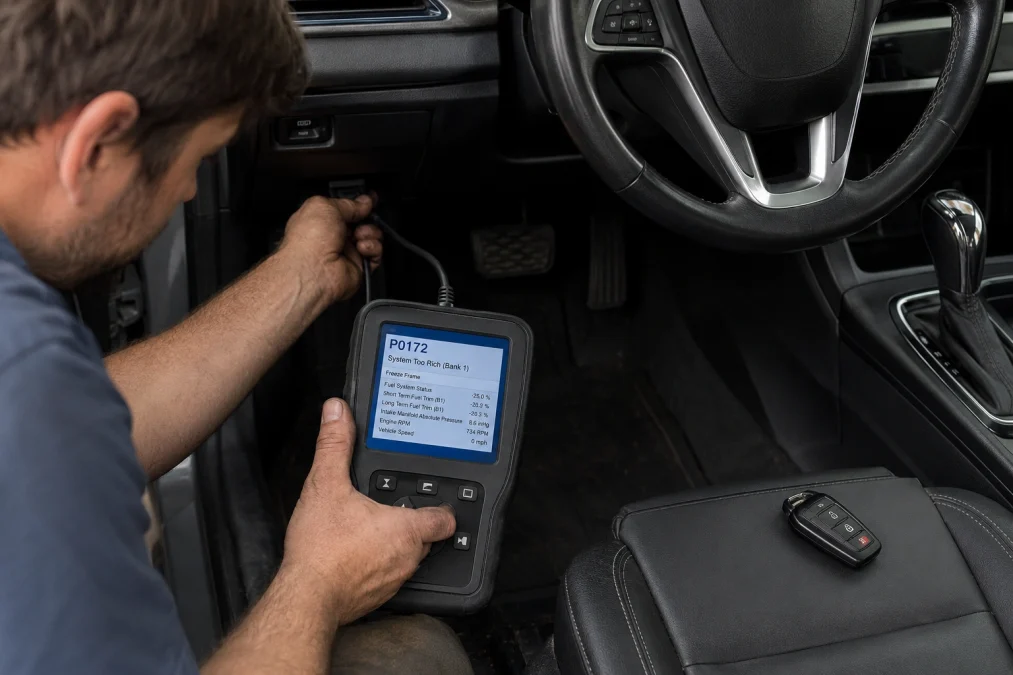
A rich condition can be caused by too much fuel entering the engine, too little air reaching it, or incorrect information being sent to the engine computer.
Dirty or Faulty Mass Airflow Sensor
The mass airflow sensor, commonly called the MAF sensor, measures how much air enters the engine.
Oil, dust, or debris can contaminate the sensing element. The sensor may then report an incorrect airflow reading, causing the computer to add more fuel than the engine needs.
A technician should inspect live MAF data and compare it with expected readings before recommending replacement.
Leaking Fuel Injector
A fuel injector should open and close in controlled pulses. A leaking or stuck injector can continue adding fuel when it should not.
Possible signs include:
- Rough starting
- Fuel smell
- Black exhaust smoke
- Poor fuel economy
- One unusually wet or dark spark plug
- Engine oil that smells like gasoline
Injector testing may require a fuel-pressure leak-down test, balance test, or removal of the injectors.
Excessive Fuel Pressure
High fuel pressure can force too much fuel through otherwise functional injectors.
Possible causes include:
- Failed fuel pressure regulator
- Faulty fuel pressure sensor
- Restricted fuel return line
- Incorrect replacement fuel pump
- Electrical or computer-control problem
Fuel pressure should be measured with the correct equipment and compared with the manufacturer’s specification.
Restricted Air Intake
A severely dirty air filter, collapsed intake hose, blocked air duct, or incorrectly installed filter may reduce airflow.
These problems are often less expensive to correct, which is why a visual intake inspection should occur before costly parts are replaced.
Faulty Engine Coolant Temperature Sensor
The engine uses extra fuel when it is cold. If the coolant temperature sensor falsely reports that the engine is still cold, the computer may continue using an overly rich mixture.
A technician can compare the reported coolant temperature with the actual engine temperature after the vehicle has been sitting overnight.
Stuck EVAP Purge Valve
The evaporative emissions system stores fuel vapor and later routes it into the engine.
A purge valve stuck open may allow excessive vapor into the intake, especially during startup or idle. This can cause hard starting after refueling, rough idle, rich fuel trims, or related EVAP codes.
Oxygen Sensor or Wiring Problem
An upstream oxygen or air-fuel ratio sensor helps the computer adjust the mixture.
A sensor that falsely reports a lean condition may cause the computer to add unnecessary fuel. However, an oxygen sensor code or unusual reading does not prove the sensor itself is defective. Wiring damage, exhaust leaks, fuel problems, and other sensors can affect its readings.
Less Common Causes
P0172 may also result from:
- Faulty manifold pressure sensor
- Contaminated engine oil
- Incorrect spark plugs
- Misfire or weak ignition
- Damaged sensor wiring
- Incorrect engine computer programming
- Internal engine mechanical problems
Common P0172 Symptoms
Some vehicles continue to run normally when P0172 first appears. Others develop noticeable drivability problems.
Common warning signs include:
- Steady check engine light
- Rough or unstable idle
- Hard starting
- Reduced fuel economy
- Sluggish acceleration
- Strong gasoline smell
- Black smoke from the exhaust
- Soot around the tailpipe
- Engine hesitation
- Spark plug fouling
- Oil level rising because of fuel contamination
- Failed emissions inspection
A strong gasoline smell, visible fuel leak, flashing check engine light, or severe misfire requires immediate attention.
Can You Continue Driving With P0172?
A short, careful drive to a repair facility may be reasonable when the check engine light is steady and the vehicle runs normally. However, continuing to drive for weeks is not a good idea.
An excessively rich mixture can:
- Waste fuel
- Contaminate engine oil
- Foul spark plugs
- Increase emissions
- Damage the catalytic converter
- Cause poor starting or stalling
The EPA advises drivers to seek diagnosis promptly when the check engine light stays on. A blinking light may indicate a severe problem such as an active misfire, so driving should be minimized and high speeds or heavy loads avoided. (NEPIS)
Stop driving and arrange a tow if the engine shakes badly, loses power, overheats, produces heavy smoke, or smells strongly of raw fuel.
How a Technician Should Diagnose P0172
A proper diagnosis involves more than clearing the code or replacing the first sensor mentioned by a scanner.
1. Record All Codes and Freeze-Frame Data
Freeze-frame data captures operating conditions from when the code was stored. It may include:
- Engine speed
- Coolant temperature
- Vehicle speed
- Airflow reading
- Fuel pressure
- Short-term fuel trim
- Long-term fuel trim
This information helps determine whether the rich condition happened during startup, idle, acceleration, or highway driving.
2. Inspect the Air Intake
The technician should inspect the air filter, intake ducts, electrical connectors, throttle body, and MAF sensor.
Loose clamps, damaged hoses, heavy contamination, or an incorrect filter may be found without replacing expensive parts.
3. Review Live Scan Data
Fuel-trim numbers show how much the computer is correcting the commanded mixture.
Strongly negative fuel trims indicate the computer is removing fuel because it detects a rich condition. Comparing trims at idle and higher engine speed helps narrow the cause.
4. Test Fuel Pressure
Fuel pressure should be tested against the vehicle manufacturer’s specification.
Pressure that remains too high may indicate a regulator, return-line, pump-control, or sensor problem.
5. Check for Leaking Injectors
The shop may perform a pressure leak-down test, injector balance test, spark plug inspection, or cylinder-specific test.
Replacing all injectors without confirming leakage can turn a manageable repair into an expensive mistake.
6. Test Sensors and Wiring
The technician should verify sensor signals, power, ground, connector condition, and wiring continuity.
A damaged wire or corroded terminal may cost far less to repair than replacing the sensor or engine computer.
7. Verify the Repair
After the repair, the shop should clear the code, perform a road test, review fuel trims, and confirm that the OBD readiness monitors begin completing normally.
Expert Tip: Ask the shop what test proved the recommended part had failed. A clear answer involving live data, fuel pressure, wiring tests, or injector testing is more trustworthy than “the scanner said so.”
DIY Diagnosis Versus Professional Repair
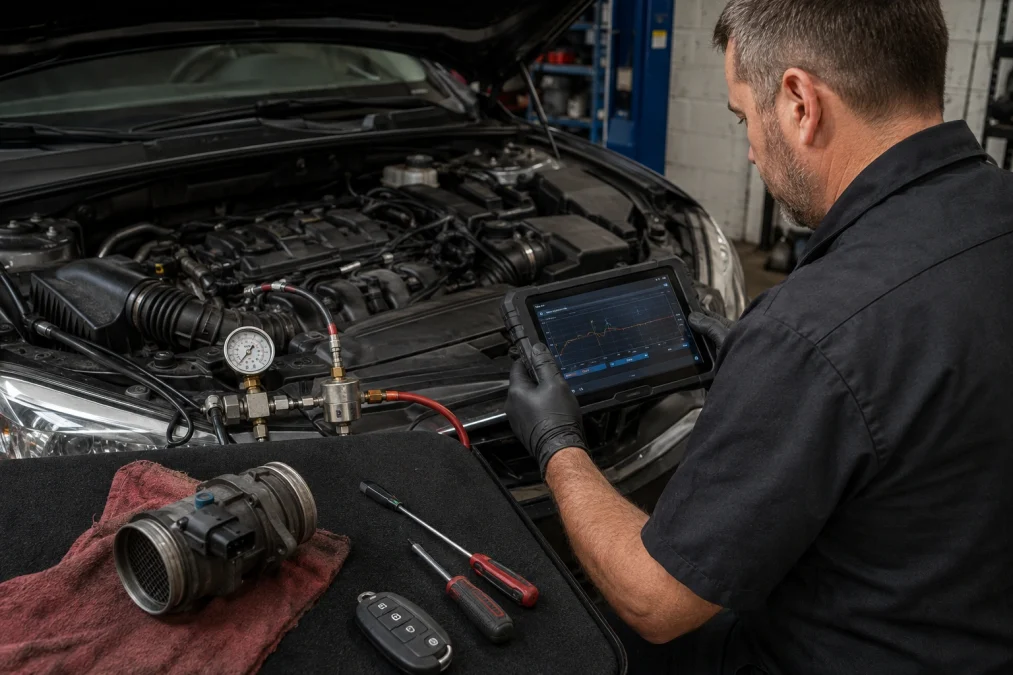
An inexpensive OBD2 scanner can help you read P0172 and save useful information. It may also display live fuel trims if the scanner supports enhanced data.
Safe owner-level checks include:
- Inspecting the air filter
- Looking for disconnected intake hoses
- Checking visible wiring and connectors
- Recording all stored and pending codes
- Reviewing freeze-frame data
- Checking whether the engine oil smells like fuel
- Looking up manufacturer service information
- Confirming whether a recall applies
You can use the NHTSA VIN recall lookup to check for open safety recalls. Manufacturers are generally responsible for providing the recall remedy without charging the owner. (NHTSA)
DIY work becomes risky when it involves pressurized fuel, hot engine components, electrical testing, or opening the fuel system.
Never disconnect a fuel line on a hot engine. Escaping gasoline can cause a fire, serious burns, or harmful vapor exposure.
When to Call a Professional Locksmith or Dealership
P0172 is an engine fuel-mixture code, not a key fob, transponder, or immobilizer code. In most cases, you need an engine performance technician or mechanical repair shop, not an automotive locksmith.
Choose an independent repair shop when:
- The vehicle is out of warranty
- The shop has modern scan tools
- The technician has experience with your make
- You want lower labor costs
- The shop can perform fuel-pressure and injector testing
Consider a dealership when:
- The vehicle is still under factory or emissions warranty
- Manufacturer-specific programming may be required
- A technical service bulletin may apply
- The problem is intermittent and difficult to reproduce
- An engine computer software update is suspected
- The model uses complex direct-injection equipment
Call an automotive locksmith only when there is a separate access or security issue, such as:
- Lost or damaged key
- Immobilizer warning light
- Key not recognized
- Vehicle lockout
- Ignition lock problem
- No-start caused by key programming
A locksmith may be able to scan basic vehicle information, but most locksmith services do not include advanced fuel-mixture diagnosis.
Before authorizing repairs, follow the FTC’s auto repair guidance: ask about diagnostic charges, request a written estimate, understand the parts being installed, and require approval before the shop exceeds the agreed amount. (Consumer Advice)
How to Keep the P0172 Repair Cost Under Control
Ask Whether the Diagnostic Fee Is Applied to the Repair
Some shops credit the diagnostic charge toward the final repair. Others charge it separately.
Ask about this policy before leaving the vehicle.
Request an Itemized Estimate
The estimate should separate:
- Diagnostic labor
- Repair labor
- Parts
- Shop supplies
- Taxes
- Programming charges
- Additional recommended work
This makes it easier to compare quotes fairly.
Ask About Part Quality and Warranty
The cheapest sensor is not always the best value. Poor-quality airflow and oxygen sensors may provide inaccurate readings or fail early.
Ask whether the part is:
- Original equipment
- Original-equipment supplier quality
- New aftermarket
- Remanufactured
- Used or salvage
Also ask whether the warranty covers both the part and the labor required to replace it again.
Get a Second Opinion for Expensive Repairs
A second opinion is reasonable when a shop recommends injectors, a fuel pump, an engine computer, or internal engine work without showing test results.
Paying for another diagnosis may save hundreds of dollars in unnecessary parts.
Common Mistakes Car Owners Should Avoid
- Replacing the oxygen sensor immediately. P0172 describes a rich condition; it does not prove the oxygen sensor caused it.
- Buying parts from the code description alone. A scanner identifies the affected system, not necessarily the failed component.
- Clearing the code before recording data. This can erase freeze-frame information that helps diagnose the problem.
- Using the wrong cleaner on the MAF sensor. Harsh solvents can damage the delicate sensing element. Use only a product specifically labeled for mass airflow sensors.
- Touching the MAF sensing wire. Even gentle contact may damage or contaminate it.
- Ignoring fuel-contaminated oil. Gasoline can thin the oil and reduce engine protection. Ask whether an oil change is needed after the rich condition is corrected.
- Driving with a flashing check engine light. This can turn a smaller repair into catalytic-converter or engine damage.
- Authorizing injectors without testing. Injector replacement can be expensive and should be supported by leak-down, balance, or cylinder-specific evidence.
- Choosing a specialist based only on price. Proper diagnostic equipment and experience can reduce the total cost by preventing wrong-part replacement.
FAQs
How much does it cost to fix code P0172?
Most repairs cost between $100 and $1,500 or more. A simple air-filter or sensor-cleaning service is inexpensive, while injectors, fuel pumps, wiring problems, or computer faults can be costly.
Can a dirty air filter cause P0172?
Yes. A severely restricted air filter may reduce airflow enough to contribute to a rich mixture. However, the filter should be inspected rather than assumed to be the only cause.
Is P0172 usually caused by an oxygen sensor?
Not necessarily. A faulty oxygen sensor can cause incorrect fuel control, but dirty airflow sensors, leaking injectors, excessive fuel pressure, purge-valve problems, and incorrect temperature readings are also possible.
Can I fix P0172 by cleaning the mass airflow sensor?
Cleaning may help when contamination is causing inaccurate airflow readings. It will not fix damaged wiring, a failed sensor, leaking injector, high fuel pressure, or another unrelated problem.
Will P0172 clear itself?
The light may turn off after several successful trips if the rich condition disappears. The code may remain in history, and an intermittent problem can return. Diagnosis is still wise if symptoms continue.
How serious is the P0172 code?
P0172 is often considered moderately serious. The car may remain drivable, but a continuing rich mixture can waste fuel, contaminate oil, foul spark plugs, and damage the catalytic converter.
Does a dealership charge more than an independent shop?
Dealership labor rates are often higher, but dealers may have better access to manufacturer-specific software, technical information, warranty coverage, and specialized tools. Compare the total estimate and diagnostic plan, not just the hourly rate.
Conclusion
The P0172 repair cost depends entirely on why the engine is running rich. A basic diagnosis and cleaning service may cost a few hundred dollars or less. A leaking injector, fuel-pressure problem, fuel pump, wiring fault, or control-module issue may push the total beyond $1,000.
Start by recording the code and freeze-frame data. Check simple intake problems, but do not replace sensors or fuel-system parts based only on an OBD2 code description.
For the smartest next step, obtain a written diagnostic estimate from a qualified engine-performance shop or dealership. Ask what testing confirms the failed component, review the parts and warranty, and approve the repair only when the diagnosis clearly supports it.
