
P0174 Causes: How to Diagnose a Lean Bank 2 Code With an OBD2 Scanner

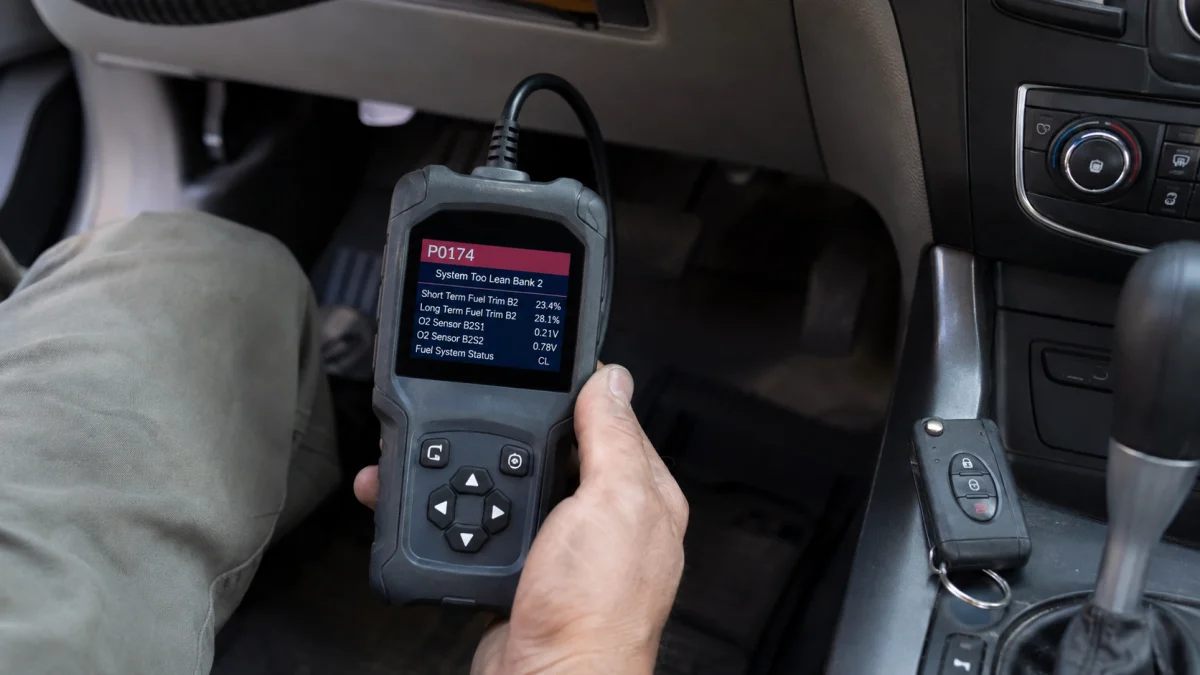
Your check engine light is on, and your OBD2 scanner displays P0174: System Too Lean Bank 2. The message may sound serious, but it does not identify one failed part.
The most common P0174 causes include vacuum leaks, dirty airflow sensors, weak fuel pressure, clogged injectors, exhaust leaks, and inaccurate oxygen-sensor readings. Finding the real problem requires more than clearing the code or replacing the first sensor mentioned online.
This guide explains what P0174 means, how an OBD2 scanner helps, what symptoms to watch for, and when professional diagnosis is the smarter choice.
Quick Answer
P0174 means the engine computer detects too much air or too little fuel on Bank 2. Common P0174 causes include vacuum leaks, a dirty mass airflow sensor, low fuel pressure, clogged injectors, exhaust leaks, and sensor problems. An OBD2 scanner can read codes and fuel-trim data, but additional testing is usually needed.
What Does the P0174 Code Mean?
P0174 is a generic OBD2 diagnostic trouble code. Its description is:
System Too Lean — Bank 2
“Too lean” means the engine is receiving either:
- Too much air
- Too little fuel
- An incorrect sensor signal that makes the computer believe the mixture is lean
The engine control module, often called the ECM or PCM, constantly adjusts the air-fuel mixture. It uses information from the mass airflow sensor, oxygen sensors, fuel system, throttle system, and other components.
When the computer must add an excessive amount of fuel to Bank 2 for too long, it may store P0174 and turn on the check engine light.
The California Air Resources Board’s OBD2 fact sheet explains that OBD2 systems monitor components that can affect emissions and alert the driver when a malfunction is detected. However, a trouble code identifies the affected system—not necessarily the exact defective part. (California Air Resources Board)
What Is Bank 2?
Bank 2 is the side of the engine that does not contain cylinder number one.
Bank numbers normally apply to V-shaped, flat, or opposed engines with two cylinder banks. An inline four-cylinder engine usually has only one bank, so P0174 is less common on that design.
The location of Bank 2 depends on the vehicle. It might be the driver’s side on one model and the passenger’s side on another.
Before replacing Bank 2 sensors or injectors, check reliable service information for your exact:
- Model year
- Make
- Model
- Engine size
- VIN or engine code
Do not identify Bank 2 by guessing from the driver’s seat. Using the wrong bank can waste money and create new problems.
Most Common P0174 Causes
Several problems can create a lean condition. Some affect the whole engine, while others affect only Bank 2.
1. Vacuum or Intake Air Leaks
A vacuum leak allows air to enter the engine without being measured correctly. The computer then adds fuel to compensate.
Common leak points include:
- Cracked vacuum hoses
- Loose intake clamps
- Split air-intake boots
- Leaking intake manifold gaskets
- Damaged PCV hoses or valves
- Brake-booster vacuum hoses
- Disconnected emissions hoses
A leak close to Bank 2 may set P0174 by itself. A larger leak before the intake manifold splits into separate banks may trigger both P0174 and P0171.
Vacuum leaks are often more noticeable at idle because unmetered air represents a larger percentage of total airflow at low engine speed.
2. Dirty or Faulty Mass Airflow Sensor
The mass airflow sensor, or MAF sensor, measures how much air enters the engine. If it underreports airflow, the computer may deliver too little fuel.
Possible signs include:
- P0174 appearing with P0171
- Hesitation during acceleration
- Rough idle
- Low calculated engine load
- Unusually low airflow readings on the scan tool
A contaminated sensor may sometimes be cleaned with a product made specifically for MAF sensors. Do not touch the sensing element or use brake cleaner, carburetor cleaner, or compressed air.
Cleaning is not guaranteed to repair a damaged sensor. Test the sensor readings before buying a replacement.
3. Low Fuel Pressure or Low Fuel Volume
The engine may run lean when the fuel system cannot deliver enough fuel.
Possible causes include:
- Weak fuel pump
- Restricted fuel filter
- Failing fuel-pump control module
- Faulty pressure regulator
- Damaged fuel line
- Electrical voltage loss at the pump
Low fuel pressure often affects both banks. The vehicle may start normally but lose power when climbing a hill, accelerating, or carrying a heavy load.
Fuel pressure must be compared with the manufacturer’s specification. A reading that seems “close enough” may still be too low under load.
4. Clogged or Weak Fuel Injectors on Bank 2
A restricted injector cannot deliver the required amount of fuel. One clogged injector may also cause a cylinder-specific misfire code, such as P0304 or P0306.
Several weak injectors on the same bank may produce P0174.
Professional testing may involve:
- Injector balance testing
- Electrical resistance checks
- Current-ramp testing
- Listening for injector operation
- Comparing cylinder misfire data
Pour-in fuel-system cleaner may help with minor deposits, but it will not repair an electrically failed or heavily restricted injector.
5. Intake Manifold Gasket Leak
An intake manifold gasket can leak near one side of the engine. That makes it an important possibility when only Bank 2 is lean.
Typical clues include:
- Rough idle when cold
- Lean fuel trims at idle
- Improved trims at higher RPM
- Hissing near the intake manifold
- P0174 without P0171
A professional smoke test is one of the safest and most effective ways to locate this type of leak.
6. Exhaust Leak Before the Bank 2 Oxygen Sensor
An exhaust leak can pull outside air into the exhaust stream. The upstream oxygen sensor may interpret that extra oxygen as a lean mixture.
Possible leak locations include:
- Exhaust manifold
- Manifold gasket
- Cracked exhaust pipe
- Loose flange
- Damaged flex section
You may hear ticking during a cold start. The sound can become quieter as hot metal expands.
Repair exhaust leaks promptly. Exhaust gases contain carbon monoxide and should never enter the passenger compartment.
7. Faulty Upstream Oxygen or Air-Fuel Ratio Sensor
The upstream sensor helps the computer adjust fuel delivery. A biased sensor may report a lean condition even when the actual mixture is acceptable.
However, oxygen sensors are frequently replaced without proper testing.
Before replacing one, check for:
- Vacuum leaks
- Fuel-pressure problems
- Exhaust leaks
- Contaminated wiring connectors
- Damaged sensor wires
- Relevant heater-circuit codes
- Slow or biased live-data response
A sensor reporting a lean condition may be doing its job correctly. Do not assume the sensor caused the condition it detected.
8. PCV System Problems
The positive crankcase ventilation system routes crankcase vapors back into the intake.
A split PCV hose, stuck valve, damaged diaphragm, or failed oil-separator assembly can create a major vacuum leak. Some vehicle designs hide these parts beneath engine covers or intake components.
Common symptoms include:
- Whistling or hissing
- Rough idle
- Excessive crankcase vacuum
- Oil leaks
- P0171 and P0174 together
9. Sensor, Wiring, or Computer Problems
Less common P0174 causes include:
- Damaged oxygen-sensor wiring
- Corroded connectors
- Poor engine grounds
- Incorrect coolant-temperature readings
- Faulty manifold-pressure readings
- Outdated control-module software
- Internal PCM problems
Computer failure is uncommon. Wiring, connectors, air leaks, and fuel-delivery problems should normally be checked first.
P0174 Diagnostic Clues
| Scanner observation | What it may suggest | Best next check |
|---|---|---|
| P0174 only | Bank 2-specific leak, injector issue, exhaust leak, or sensor problem | Inspect and smoke-test Bank 2 |
| P0171 and P0174 together | MAF error, major vacuum leak, low fuel pressure, or PCV problem | Check both-bank fuel trims |
| Trims high at idle but improve at 2,500 RPM | Vacuum or intake manifold leak | Smoke-test the intake |
| Trims remain high at idle and higher RPM | MAF error or fuel-delivery problem | Test MAF data and fuel pressure |
| Misfire code on one Bank 2 cylinder | Injector, ignition, compression, or local intake leak | Diagnose the affected cylinder |
| Lean reading with exhaust ticking | Leak before upstream oxygen sensor | Inspect the manifold and gasket |
| Code returns immediately after clearing | Active fault or major leak | Stop clearing and begin testing |
Symptoms You May Notice
P0174 does not always cause an obvious driving problem. Common symptoms include:
- Check engine light
- Rough or unstable idle
- Hesitation
- Weak acceleration
- Engine surging
- Hard starting
- Stalling at stoplights
- Reduced fuel economy
- Misfires
- Spark knock or pinging
- Increased emissions
A flashing check engine light usually indicates an active misfire that may damage the catalytic converter. Reduce speed, avoid hard acceleration, and arrange immediate diagnosis.
How to Diagnose P0174 With an OBD2 Scanner
A basic scanner can read and clear P0174. A better scanner can display freeze-frame information, live sensor data, fuel trims, oxygen-sensor activity, and misfire counts.
Step 1: Read Every Stored Code
Do not focus only on P0174. Record pending, confirmed, and permanent codes.
Related codes may identify the correct diagnostic direction:
- P0171: System Too Lean Bank 1
- P0101: Mass Airflow Sensor Range or Performance
- P0300: Random or Multiple-Cylinder Misfire
- P0301–P0308: Cylinder-specific misfire
- Oxygen-sensor circuit codes
- Fuel-pressure or fuel-pump codes
Step 2: Save the Freeze-Frame Data
Freeze-frame data records operating conditions when the code was set.
Record:
- Engine RPM
- Vehicle speed
- Coolant temperature
- Engine load
- Short-term fuel trim
- Long-term fuel trim
- Intake-air temperature
- MAF reading, when available
A code recorded at idle may point toward a vacuum leak. A code recorded during heavy acceleration may suggest inadequate fuel delivery.
Step 3: Compare Bank 1 and Bank 2 Fuel Trims
Short-term fuel trim shows immediate corrections. Long-term fuel trim shows learned corrections over time.
Positive numbers mean the computer is adding fuel. Negative numbers mean it is removing fuel.
The exact acceptable range varies by vehicle, operating temperature, altitude, and test conditions. What matters most is the pattern.
For example:
- Bank 1 near normal and Bank 2 strongly positive: investigate a Bank 2-specific problem.
- Both banks strongly positive: investigate a shared air-measurement or fuel-delivery issue.
- High trims at idle that improve as RPM rises: suspect a vacuum leak.
- High trims at all speeds: test fuel pressure and MAF accuracy.
Step 4: Inspect the Intake System
With the engine off and cool, inspect:
- Air-filter housing
- Intake tube
- Hose clamps
- Vacuum lines
- PCV plumbing
- Brake-booster hose
- Electrical connectors
- Oil cap and dipstick seal
Bend rubber hoses gently to expose hidden cracks.
Do not spray flammable chemicals around a running engine to search for leaks. Hot surfaces, electrical sparks, and ignition components create a fire risk.
Step 5: Use a Smoke Test
A smoke machine introduces low-pressure diagnostic vapor into the intake system. Escaping smoke reveals leaks that may be difficult to hear or see.
This is safer and more precise than spraying combustible cleaners around the engine.
Step 6: Test Fuel Pressure
Fuel-pressure testing may require a mechanical gauge or a compatible scan tool. Some direct-injection vehicles use extremely high fuel pressure and require specialized procedures.
Do not loosen high-pressure fuel lines unless you have the correct training and equipment. Fuel under pressure can penetrate skin, ignite, or cause serious injury.
Step 7: Check for Exhaust Leaks and Sensor Problems
Inspect the Bank 2 exhaust manifold and upstream sensor area. Then review the sensor’s live response.
The sensor should react when the mixture changes. A fixed or slow signal may result from a failed sensor, damaged wiring, an exhaust leak, or a real fuel-mixture problem.
Step 8: Repair the Cause and Confirm the Fix
After repairs:
- Clear the codes.
- Start the engine.
- Watch fuel trims at idle.
- Raise engine speed and compare readings.
- Complete an appropriate road test.
- Scan again for pending codes.
Do not consider the repair successful simply because the check engine light stays off for a few minutes.
Expert Tip: Save the original codes, freeze-frame data, and fuel-trim readings before disconnecting the battery or clearing anything. Erasing that information can remove the best clues about when and why P0174 appeared.
Can an OBD2 Scanner Program a Key Fob?
A standard OBD2 scanner normally reads engine and emissions data. It usually cannot program a replacement key fob, smart key, or transponder chip.
Key programming may require:
- A specialized automotive security programmer
- Vehicle-specific software
- Security PIN or authorization access
- Proof of ownership
- A compatible key or remote
- Mechanical key cutting
Some advanced bidirectional scan tools offer immobilizer functions, but coverage varies widely. A tool may support engine diagnosis on a vehicle without supporting key programming.
P0174 is also not normally caused by the key fob. A weak fob battery may cause reduced remote range, intermittent lock-button operation, or a “key not detected” warning, but it does not change the engine’s air-fuel mixture.
When security or key programming is needed, ALOA’s consumer guidance for hiring a professional locksmith can help car owners evaluate training, identification, estimates, and credentials before authorizing service. (Aloa)
Estimated P0174 Diagnostic and Repair Costs
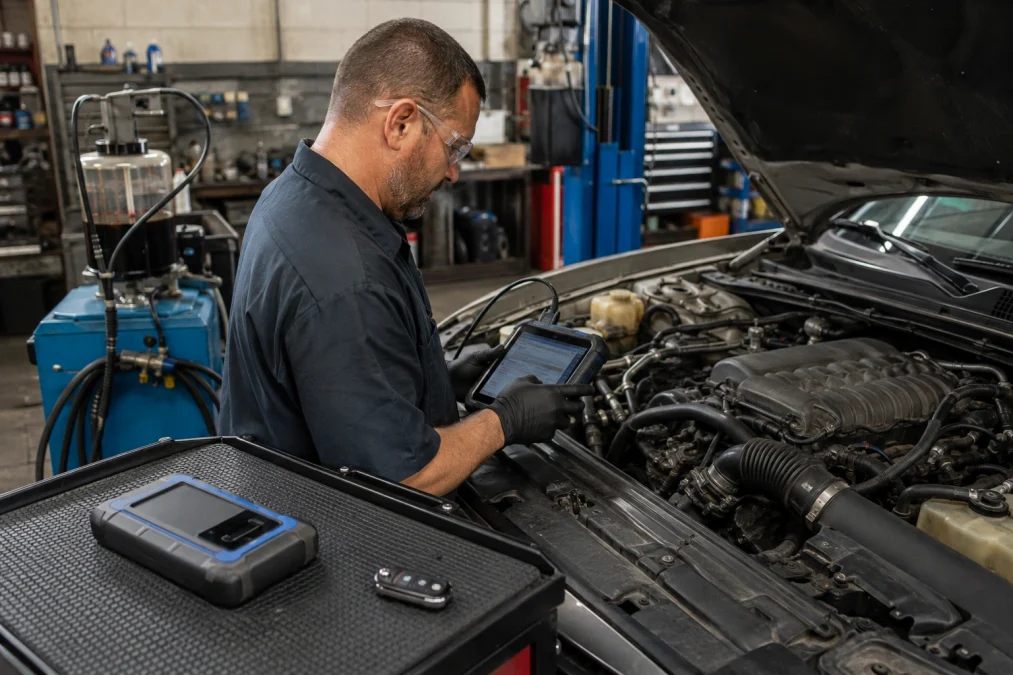
Prices vary by vehicle, labor rate, location, engine design, and the actual cause.
| Service or repair | Typical U.S. price range |
|---|---|
| Professional diagnostic inspection | $100–$220 |
| Vacuum hose repair | $50–$200 |
| Intake boot replacement | $100–$350 |
| MAF sensor cleaning | $20–$120 |
| MAF sensor replacement | $150–$500 |
| Intake manifold gasket replacement | $350–$1,200 |
| Fuel-pressure testing | $100–$250 |
| Fuel pump replacement | $500–$1,500 |
| Fuel injector cleaning or service | $150–$500 |
| Fuel injector replacement | $250–$700 per injector |
| Upstream oxygen sensor replacement | $200–$550 |
| Exhaust manifold or gasket repair | $300–$1,500 |
These ranges are general estimates, not quotes. Some vehicles require significant disassembly to reach a low-cost gasket, hose, injector, or sensor.
Ask the shop to explain:
- Which tests were performed
- What evidence confirmed the failure
- Whether related components were inspected
- Whether parts are OEM, aftermarket, new, or remanufactured
- What warranty covers the repair
- Whether additional charges require approval
The FTC’s auto repair guidance recommends asking for a written estimate, understanding the shop’s policies, and obtaining a completed repair order describing the work and parts used. (Consumer Advice)
Is It Safe to Drive With P0174?
A mild lean code may not stop the vehicle immediately, but it should not be ignored.
A prolonged lean condition can contribute to:
- Misfires
- Overheating combustion chambers
- Poor performance
- Increased nitrogen oxide emissions
- Catalytic-converter damage
- Engine damage in severe cases
Avoid driving and arrange assistance when the vehicle has:
- A flashing check engine light
- Severe shaking
- Repeated stalling
- Major power loss
- Fuel odors
- Smoke
- Abnormal mechanical noise
- An overheating warning
You can also check the vehicle’s VIN through the official NHTSA recall lookup tool. A manufacturer recall or service campaign may sometimes affect engine-management components, and open safety-recall repairs are handled through an authorized dealership. (NHTSA)
When to Call a Professional Locksmith or Dealership
Call a Repair Technician or Mechanic When:
- P0174 returns after a basic visual inspection
- You need smoke testing
- Fuel pressure must be measured
- The engine has direct injection
- Live-data readings are unclear
- Misfire codes are present
- An exhaust leak is suspected
- The vehicle stalls or loses significant power
- Internal engine testing may be required
An independent repair shop can often diagnose P0174 as effectively as a dealership when it has trained technicians, accurate service information, and suitable equipment.
Call the Dealership When:
- The vehicle is under factory warranty
- An open recall applies
- A manufacturer software update is required
- The fault involves specialized proprietary systems
- The independent shop cannot access necessary programming
- The manufacturer has published a relevant technical procedure
Call an Automotive Locksmith When:
- The key fob is lost, damaged, or not detected
- A transponder key needs programming
- The mechanical key must be cut
- The ignition lock is damaged
- You are locked out
- You need a spare key or remote
An automotive locksmith generally does not repair vacuum leaks, fuel systems, oxygen sensors, or engine-management problems. Likewise, a general repair shop may not have authorization or equipment for immobilizer programming.
Choose the professional whose tools and training match the problem.
Common Mistakes Car Owners Should Avoid
- Replacing the Bank 2 oxygen sensor immediately. The sensor may be accurately reporting a lean condition caused elsewhere.
- Clearing the code before recording data. This can erase freeze-frame information and learned fuel trims.
- Buying parts based only on the code description. P0174 identifies a condition, not a confirmed failed component.
- Using flammable spray to find vacuum leaks. This can cause a fire.
- Ignoring P0171 when it appears with P0174. Two lean banks usually point toward a shared problem.
- Installing a low-quality sensor without testing. Poor sensor accuracy can create new drivability problems.
- Disconnecting the battery as a repair. This may temporarily turn off the warning light without fixing anything.
- Assuming the key fob caused the engine code. Remote and immobilizer faults are separate from fuel-mixture control.
- Using an unknown mobile locksmith without verifying identity and pricing. Confirm credentials, vehicle identification, and the total price before service begins.
- Continuing to drive with a flashing check engine light. An active misfire can quickly damage the catalytic converter.
FAQs
Can a dirty air filter cause P0174?
A severely restricted air filter usually reduces airflow rather than creating a traditional lean condition. However, an incorrectly installed filter, damaged air box, or leak in the intake tube may affect MAF readings and contribute to P0174.
Can a bad oxygen sensor cause P0174?
Yes, but it is not the most common cause. An upstream sensor can become slow or biased. Vacuum leaks, low fuel pressure, exhaust leaks, and airflow-measurement errors should also be tested before replacing it.
Why do P0171 and P0174 appear together?
Both codes mean the engine computer is adding excessive fuel. When both banks are lean, look for a shared cause such as a major vacuum leak, contaminated MAF sensor, PCV failure, or low fuel pressure.
Can I clean the MAF sensor to fix P0174?
Cleaning may help if contamination is causing incorrect readings. Use only dedicated MAF sensor cleaner, allow the sensor to dry fully, and never touch its sensing element. Cleaning will not repair damaged electronics.
Will clearing P0174 fix the check engine light?
Clearing the code only resets the warning. If the lean condition remains, P0174 will return after the computer reruns its tests. Diagnose and repair the cause before relying on a reset.
Can a weak car battery cause P0174?
Low system voltage can occasionally create misleading sensor or communication problems, but it is not a typical P0174 cause. Test a weak starting battery and charging system, especially if several unrelated codes appeared together.
Does P0174 mean I need a new key fob?
No. P0174 is an engine air-fuel mixture code. A key-fob problem may cause poor remote range, failed lock buttons, immobilizer warnings, or a no-start condition, but it does not normally create a Bank 2 lean code.
Conclusion
The most common P0174 causes are vacuum leaks, intake manifold gasket leaks, inaccurate MAF readings, inadequate fuel delivery, restricted injectors, exhaust leaks, and sensor or wiring faults.
An OBD2 scanner is the right starting point because it can reveal stored codes, freeze-frame information, fuel trims, and sensor behavior. It cannot prove which part failed without careful inspection and testing.
Record the diagnostic data before clearing the code. Compare both banks, inspect the intake system, and avoid replacing an oxygen sensor based only on the code description.
For smoke testing, fuel-pressure diagnosis, direct-injection work, or persistent drivability problems, request a written diagnostic estimate from a qualified repair professional. For lost keys, transponder programming, or key-fob replacement, use a verified automotive locksmith or authorized dealership with the correct security equipment.
