
What Does P0430 Mean? Causes, Symptoms, Diagnosis, and Fix

Quick Answer
P0430 means the engine computer has detected catalyst efficiency below the expected threshold on Bank 2. The code points to the catalytic-converter monitoring system, but it does not prove the converter itself has failed, so check the complete fault picture with an OBD2 diagnostic code reader before replacing parts.
What P0430 usually points toward
- Catalyst deterioration: The Bank 2 converter may no longer store oxygen and clean exhaust as effectively as expected.
- Exhaust leaks: Outside air entering near the converter or oxygen sensors can distort sensor readings.
- Sensor problems: A slow, biased, or damaged oxygen or air-fuel sensor can mislead the computer.
- Engine problems: Misfires, rich running, oil burning, or coolant contamination can damage a healthy converter.
- Calibration issues: Some vehicles may need manufacturer-specific diagnosis or an applicable software update.
Best first move
- Save every stored and pending code plus freeze-frame data before clearing anything, then diagnose engine-running problems before condemning the catalytic converter.
You plugged in an OBD2 scanner and found P0430. The car may still run normally, which makes this code easy to underestimate.
I treat P0430 as a diagnostic starting point, not permission to order an expensive converter. This guide explains what Bank 2 means, what causes the code, and how to confirm the fault without guessing.
In This Guide
What Does P0430 Mean?
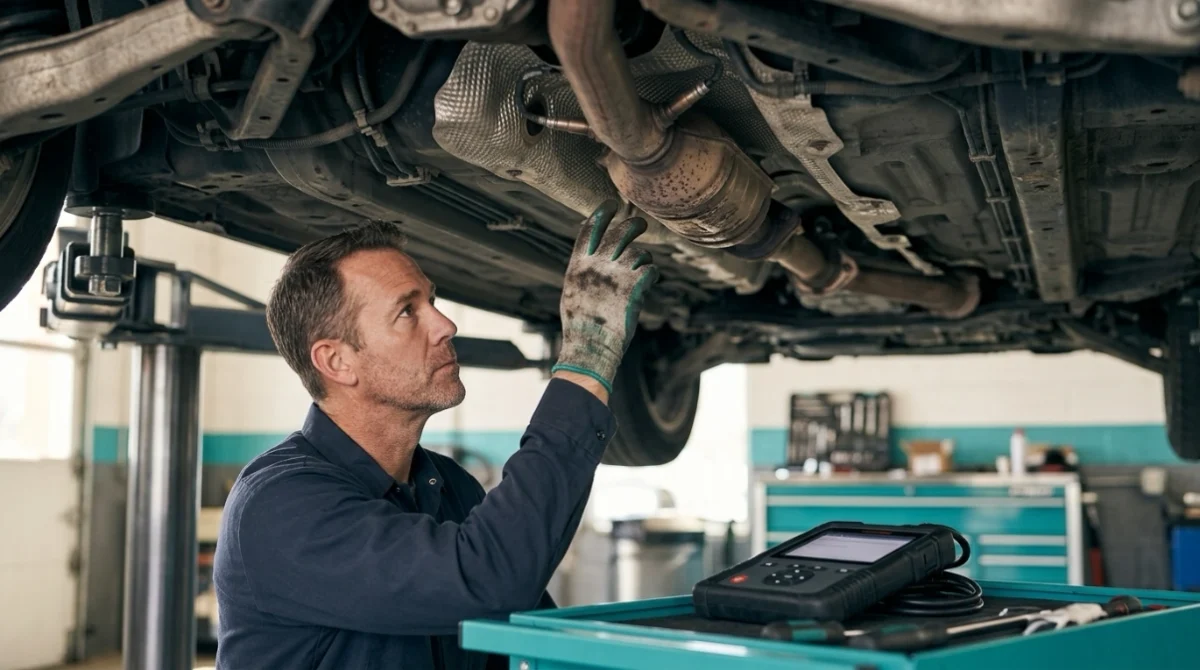
P0430 means Catalyst System Efficiency Below Threshold, Bank 2. It is a generic powertrain diagnostic trouble code related to the vehicle’s emissions-control system.
A catalytic converter changes harmful exhaust gases into less harmful compounds. The engine computer monitors that process using exhaust sensors before and after the converter.
What does Bank 2 mean on P0430?
Bank 2 is the side of the engine that does not contain cylinder 1. This terminology normally matters on engines with two cylinder banks, such as many V6 and V8 engines.
Don’t identify Bank 2 by assuming it is the driver or passenger side. Engine orientation varies, so confirm cylinder numbering with reliable service information for your vehicle.
- Bank 1: The cylinder bank containing cylinder 1.
- Bank 2: The opposite cylinder bank.
- Upstream sensor: Measures exhaust before the catalytic converter.
- Downstream sensor: Helps the computer evaluate converter performance after exhaust passes through it.
How does the computer detect low catalyst efficiency?
The upstream sensor normally responds quickly to changes in exhaust oxygen. A healthy converter smooths those changes before the exhaust reaches the downstream sensor.
If downstream activity begins looking too similar to upstream activity, the powertrain control module may determine that oxygen-storage capacity has fallen below its programmed threshold. After the required monitor conditions occur, it can store P0430.
| Code | Affected Bank | Meaning | Main Difference |
|---|---|---|---|
| P0420 | Bank 1 | Catalyst efficiency below threshold | Applies to the cylinder-1 bank |
| P0430 | Bank 2 | Catalyst efficiency below threshold | Applies to the opposite bank |
P0430 is an emissions code, not a key fob, transponder chip, smart-key, or immobilizer fault. A remote-entry problem would send the diagnosis in a different direction.
Section Takeaway: P0430 identifies poor catalyst-monitor performance on Bank 2, but the code alone cannot tell you which component failed.
What Are the Symptoms of P0430?
Many vehicles with P0430 show no obvious driving problem beyond the check engine light. The converter may lose emissions efficiency before engine performance changes noticeably.
Possible symptoms include:
- Check engine light: This is often the only symptom.
- Failed emissions inspection: A stored catalyst-efficiency code or incomplete readiness monitor may prevent a passing result.
- Reduced fuel economy: This can occur when an underlying fuel-control problem is also present.
- Loss of power: A severely restricted converter can limit exhaust flow, especially under acceleration.
- Unusual exhaust odor: A damaged or overheated catalyst may produce an abnormal smell.
- Other trouble codes: Misfire, fuel-trim, or oxygen-sensor codes may appear alongside P0430.
Can you drive with P0430?
A short drive is often possible when the check engine light stays steady and the vehicle runs normally. That does not mean the fault should be ignored.
If the light flashes, the engine shakes, power drops sharply, or you smell strong fuel, stop driving when safe. AAA’s check engine light guidance also treats a flashing warning as a reason for immediate attention.
- Usually less urgent: Steady light, normal temperature, normal power, and no unusual noises or smells.
- Needs prompt diagnosis: Code repeatedly returns or the vehicle must pass an emissions inspection soon.
- Stop and get help: Flashing light, severe misfire, overheating, smoke, strong fuel smell, or major power loss.
A severe misfire or rich condition can overheat the converter by sending unburned fuel into the exhaust. Continuing to drive can turn one repair into several.
Section Takeaway: A steady P0430 light may allow limited driving, but abnormal engine behavior or a flashing light changes the situation quickly.
What Causes a P0430 Code?
The most common P0430 causes involve the converter, exhaust system, sensor feedback, or an engine problem that damaged the catalyst. Diagnose the cause before deciding which part needs replacement.
1. An aging or damaged Bank 2 catalytic converter
Catalytic converters can lose efficiency as their internal coating ages or becomes contaminated. Physical damage can also reduce their ability to store oxygen and process exhaust gases.
Converter failure becomes more likely when sensor data and exhaust testing support the code and no upstream engine fault remains.
2. An exhaust leak near the catalyst or oxygen sensors
A small exhaust leak can pull outside oxygen into the exhaust stream. That extra oxygen can alter sensor signals enough to confuse catalyst monitoring.
- Cracked exhaust manifolds
- Failed flange or manifold gaskets
- Loose connections
- Damaged flex pipes
- Cracks near an oxygen-sensor bung
3. A faulty oxygen or air-fuel sensor
A degraded sensor can react too slowly or report a biased value. Wiring damage, connector corrosion, or heater-circuit trouble can create similar problems.
Don’t replace the downstream sensor simply because P0430 mentions catalyst efficiency. Test its behavior first.
4. Misfires or incorrect air-fuel mixture
Rich combustion can send excess fuel into the converter. Lean operation and repeated misfires can also create abnormal exhaust conditions.
- Worn spark plugs or weak ignition coils
- Fuel injector problems
- Vacuum or intake leaks
- Incorrect fuel pressure
- Airflow or mixture-sensor faults
- Engine mechanical problems
I have seen the expensive part become the victim rather than the original cause. Replacing a converter without correcting an active misfire can damage the replacement too.
5. Oil or coolant contamination
An engine that burns significant oil or coolant can contaminate the catalyst material. In that case, replacing only the converter leaves the underlying engine problem untouched.
Pro tip: Before approving a catalytic converter, identify and correct any active misfire, rich-running condition, oil consumption, or coolant-loss problem.
Section Takeaway: P0430 often involves an inefficient converter, but exhaust leaks, sensors, mixture faults, and engine problems must be ruled out first.
How Do You Diagnose P0430 Correctly?
A good P0430 diagnosis works from evidence toward the converter. Parts replacement should come last.
Step 1: Scan every code and save the data
Start by reading stored, pending, and permanent codes with your OBD2 scanner. Save freeze-frame information before clearing anything.
Pay close attention to misfire, fuel-trim, oxygen-sensor, heater-circuit, or airflow codes. Those faults may explain why P0430 appeared.
Step 2: Check whether Bank 2 is identified correctly
Confirm which engine bank contains cylinder 1 using vehicle-specific service information. The other side is Bank 2.
This matters because replacing a converter or sensor on the wrong bank is an expensive mistake.
Step 3: Inspect for exhaust leaks
Inspect the Bank 2 exhaust path from the engine toward the downstream sensor. Look for soot marks, cracked joints, damaged flex sections, or obvious leakage.
- Listen carefully during a cold start.
- Inspect sensor mounting points.
- Check flange and manifold areas.
- Repair confirmed leaks before judging catalyst efficiency.
Step 4: Review fuel trims and misfire data
Short-term and long-term fuel trims can reveal mixture problems. Misfire counters can show whether poor combustion may be overheating the catalyst.
A catalyst code should not distract you from an engine that is clearly running incorrectly.
Step 5: Compare upstream and downstream sensor activity
A scan tool with graphing makes this easier. Compare Bank 2 sensor behavior after the engine reaches operating temperature and the vehicle enters closed-loop operation.
Don’t rely on one voltage snapshot. Sensor types and expected patterns differ between vehicles.
Step 6: Check manufacturer information before replacing parts
Technical service information may describe known calibration changes, sensor issues, exhaust leaks, or catalyst concerns for a specific model. You can also review broad NHTSA vehicle safety resources when checking vehicle-specific issues.
Technician’s note: Converter testing and sensor interpretation vary by engine design, so vehicle-specific service specifications should override generic internet values.
Section Takeaway: Diagnose P0430 by checking other codes, leaks, fuel control, misfires, and sensor behavior before blaming the Bank 2 converter.
How Do You Fix P0430, and What Can It Cost?

The correct P0430 fix depends on what testing finds. Clearing the code does not repair the underlying fault.
Possible repairs include:
- Repair an exhaust leak.
- Repair damaged oxygen-sensor wiring or connectors.
- Replace a confirmed faulty oxygen or air-fuel sensor.
- Repair ignition, fuel, airflow, or mechanical faults causing poor combustion.
- Correct excessive oil or coolant consumption.
- Replace the Bank 2 catalytic converter after confirming it has lost efficiency.
- Apply an applicable manufacturer calibration update when specified.
Typical P0430 repair cost ranges
Costs vary widely by vehicle, labor rate, converter design, and region. Use these only as rough U.S. budgeting ranges, not repair quotes.
| Repair Area | Rough Planning Range | When It Makes Sense |
|---|---|---|
| Diagnostic testing | About $100–$250+ | Before replacing emissions parts |
| Exhaust leak repair | About $150–$800+ | When inspection confirms a leak |
| Oxygen/A/F sensor repair | About $200–$600+ | When testing confirms sensor or circuit failure |
| Catalytic converter | About $1,000–$3,500+ on many vehicles | After catalyst failure is confirmed |
Some vehicles use expensive integrated manifolds or multiple catalysts, so costs can exceed these ranges. OEM versus aftermarket requirements can also change the final figure.
Cost note: Get a written estimate tied to your VIN, engine, emissions specification, and actual test results before authorizing converter replacement.
Should you clear P0430 after the repair?
A technician may clear stored codes after completing repairs, but clearing also resets emissions readiness information on many vehicles. The catalyst monitor must run again before the system can confirm the repair.
A permanent emissions code may remain visible until the vehicle completes the required self-test and confirms the fault is gone. Don’t repeatedly clear codes to hide an unresolved problem.
Section Takeaway: Fix the tested cause of P0430, then allow the vehicle’s onboard monitor to verify the repair instead of treating code clearing as the repair.
P0430 Frequently Asked Questions
Does P0430 always mean the catalytic converter is bad?
No. P0430 commonly points toward poor Bank 2 catalyst performance, but exhaust leaks, oxygen-sensor problems, misfires, mixture faults, and engine contamination can produce misleading catalyst-monitor results.
Can a bad oxygen sensor cause P0430?
Yes, a slow or biased sensor can contribute to P0430 if its signal makes the converter appear less effective. Test sensor response and wiring rather than replacing the sensor based on the code alone.
Which side is Bank 2 on a P0430 code?
Bank 2 is the cylinder bank that does not contain cylinder 1. Its physical position varies by engine and vehicle, so check reliable service information before identifying parts.
Is P0430 the same as P0420?
The codes describe the same type of catalyst-efficiency problem on different banks. P0420 applies to Bank 1, while P0430 applies to Bank 2.
Will clearing P0430 fix the problem?
No. Clearing the code erases diagnostic information and may switch off the warning temporarily, but an active fault can trigger P0430 again once the catalyst monitor reruns.
Can bad spark plugs cause P0430?
Worn plugs can contribute indirectly if they cause repeated misfires. Unburned fuel entering the exhaust can overheat or damage the catalytic converter and eventually lead to a catalyst-efficiency code.
How soon will P0430 come back after clearing it?
There is no universal number of miles. P0430 normally returns only after the vehicle meets manufacturer-specific conditions that allow the catalyst monitor to run and detect the fault again.
What Should You Do Next?
If you just found P0430, don’t start by buying a catalytic converter. Start by saving your scan data and checking whether other engine or exhaust faults are present.
- First: Record every stored and pending code.
- Second: Save freeze-frame data.
- Third: Check for misfires, mixture problems, and exhaust leaks.
- Fourth: Compare Bank 2 sensor data with known-good behavior.
- Fifth: Confirm converter failure before approving replacement.
If the car has an unusual safety-related symptom or you suspect a broader vehicle defect, use official resources and check your VIN with the manufacturer. Never ignore severe shaking, overheating, smoke, or a flashing check engine light.
As of 2026, even affordable OBD2 scanners can give you the code and basic data. The important part is interpreting that information before replacing expensive components.
Section Takeaway: P0430 means Bank 2 catalyst efficiency is below the computer’s expected threshold, but proper diagnosis determines whether the converter, sensor, exhaust system, or engine is responsible.
