
What Does P0440 Mean? Causes, Symptoms, Diagnosis, and Fixes

Quick Answer
P0440 means your vehicle detected a general problem with the evaporative emission control system, usually called the EVAP system. The code does not identify one failed part, so use an OBD2 scanner and proper testing before replacing anything. You can also use the AAA diagnostic code translator as a general reference when reviewing OBD codes.
Common Things to Check
- Fuel cap: Check whether it is loose, damaged, incorrectly installed, or missing its sealing surface.
- EVAP hoses: Look for cracked, disconnected, pinched, or deteriorated vapor lines.
- Purge valve: A valve that sticks open or closed can interfere with normal EVAP operation.
- Vent valve: A faulty vent valve or blocked vent path can prevent the system from completing its self-test.
- Charcoal canister: Physical damage or fuel saturation can cause EVAP problems.
- Electrical faults: Damaged wiring or connectors can affect EVAP valves and sensors.
Before Buying Parts
- Read all stored and pending codes, inspect the fuel cap and hoses, then test the EVAP system instead of guessing from P0440 alone.
If your scanner just displayed P0440, don’t assume you need an expensive component. I’ve seen EVAP faults come from something as simple as a sealing problem and from issues that needed smoke testing to find.
This guide explains what P0440 means, what usually causes it, how serious it is, and how to diagnose it without loading the parts cannon.
In This Guide
What Does P0440 Mean?
P0440 is a generic OBD-II powertrain code indicating a malfunction in the evaporative emission control system. It means the vehicle’s computer detected that the EVAP system did not operate as expected.
The important word is general. P0440 usually doesn’t tell you which EVAP component caused the fault.
Definition: The EVAP system captures gasoline vapors from the fuel system and stores or routes them so they can be burned by the engine instead of escaping directly into the atmosphere.
What does the EVAP system do?
Gasoline produces vapor even while your vehicle is parked. The EVAP system manages those vapors using sealed lines, valves, a charcoal canister, and related controls.
The engine computer can run diagnostic checks to determine whether parts of that system are functioning correctly.
- Fuel tank: Holds the fuel and associated vapor.
- Charcoal canister: Temporarily stores fuel vapor.
- Purge valve: Controls when stored vapor enters the engine.
- Vent valve: Helps control airflow through the EVAP system.
- Vapor lines: Connect major EVAP components.
- Pressure-related monitoring: Helps the computer evaluate EVAP operation on vehicles equipped with the necessary sensors.
Federal OBD requirements include monitoring of the evaporative emission system because escaping fuel vapor contributes to vehicle emissions.
That is why an EVAP problem can turn on the check engine light even when the engine still feels normal.
Does P0440 mean you have a gas leak?
Not necessarily. P0440 can appear because the computer detected an EVAP malfunction without identifying a specific leak size or component.
Other EVAP codes can provide more detail, so reading every stored and pending code matters.
| Code | General Meaning | Diagnostic Value |
|---|---|---|
| P0440 | General EVAP system malfunction | Broad starting point |
| P0441 | EVAP purge flow problem | Points more toward purge-flow operation |
| P0442 | EVAP small-leak condition | Suggests a smaller sealing leak |
| P0455 | EVAP large-leak condition | Suggests a larger leak or major sealing issue |
Technician’s note: Always diagnose the complete code set. A second EVAP code can narrow your testing much faster than P0440 by itself.
Is P0440 Serious, and Can You Keep Driving?
P0440 usually doesn’t mean the engine is about to fail. Many vehicles continue to drive normally because EVAP faults often affect emissions control rather than basic engine operation.
You still shouldn’t ignore the check engine light. An unresolved EVAP fault can hide another problem and may affect emissions inspection readiness.
What symptoms can P0440 cause?
Many drivers notice no change except the warning light. That lack of symptoms is common with EVAP-related faults.
- Illuminated check engine light
- Possible fuel-vapor odor
- Another EVAP-related trouble code
- Difficulty completing an emissions inspection
- Occasional refueling-related complaints on some vehicles
A strong gasoline smell deserves more attention. Raw fuel, wet areas around fuel-system components, or obvious leakage should not be treated as a routine code-clearing problem.
If the check engine light is flashing, that’s also different. AAA advises that a flashing warning can indicate a problem requiring immediate attention.
Safety note: If you see liquid fuel or smell a strong persistent fuel odor, avoid guessing at the repair and have the vehicle inspected in a safe, well-ventilated setting.
What Causes a P0440 Code?
P0440 can be caused by anything that prevents the EVAP system from sealing, venting, purging, or reporting its condition correctly. A loose fuel cap is one possibility, but it isn’t the only one.
I start with simple checks because they cost nothing and often expose obvious faults.
1. Loose or damaged fuel cap
The cap forms part of the sealed fuel-vapor system on many vehicles. A damaged seal, wrong cap, or cap that isn’t seated correctly can interfere with EVAP testing.
Inspect the sealing surface instead of just tightening the cap harder.
2. Cracked or disconnected EVAP hose
EVAP lines live in areas exposed to heat, dirt, vibration, and age. Rubber connections can split while plastic lines can crack or disconnect.
Some faults are obvious during a visual inspection. Small leaks often aren’t.
3. Purge valve problem
The purge valve controls vapor flow from the charcoal canister toward the engine. A valve that sticks, leaks, or doesn’t respond correctly can disturb EVAP operation.
Don’t replace it solely because P0440 is stored. Test its operation first.
4. Vent valve or vent-path problem
The EVAP vent system must open and close under specific conditions. Dirt, corrosion, wiring faults, or a failed valve can prevent that.
Vehicles driven on dusty or salted roads deserve careful inspection around exposed EVAP components.
5. Charcoal canister damage
The charcoal canister stores fuel vapor until the engine can purge it. Physical damage or fuel contamination can interfere with its job.
Repeatedly forcing extra fuel into the tank after the pump automatically shuts off is a habit worth avoiding.
6. Wiring, connector, or control fault
EVAP valves depend on electrical commands. Broken wiring, loose pins, corrosion, or poor connections can create faults that look like failed components.
- Inspect connector locks.
- Look for rubbed-through wiring.
- Check for corrosion or moisture.
- Confirm power and control circuits using vehicle-specific service information.
Section Takeaway: P0440 identifies an EVAP system problem, not a guaranteed bad gas cap, purge valve, or canister. Testing separates an inexpensive sealing fault from an electrical or component problem.
How Do You Diagnose P0440 With an OBD2 Scanner?
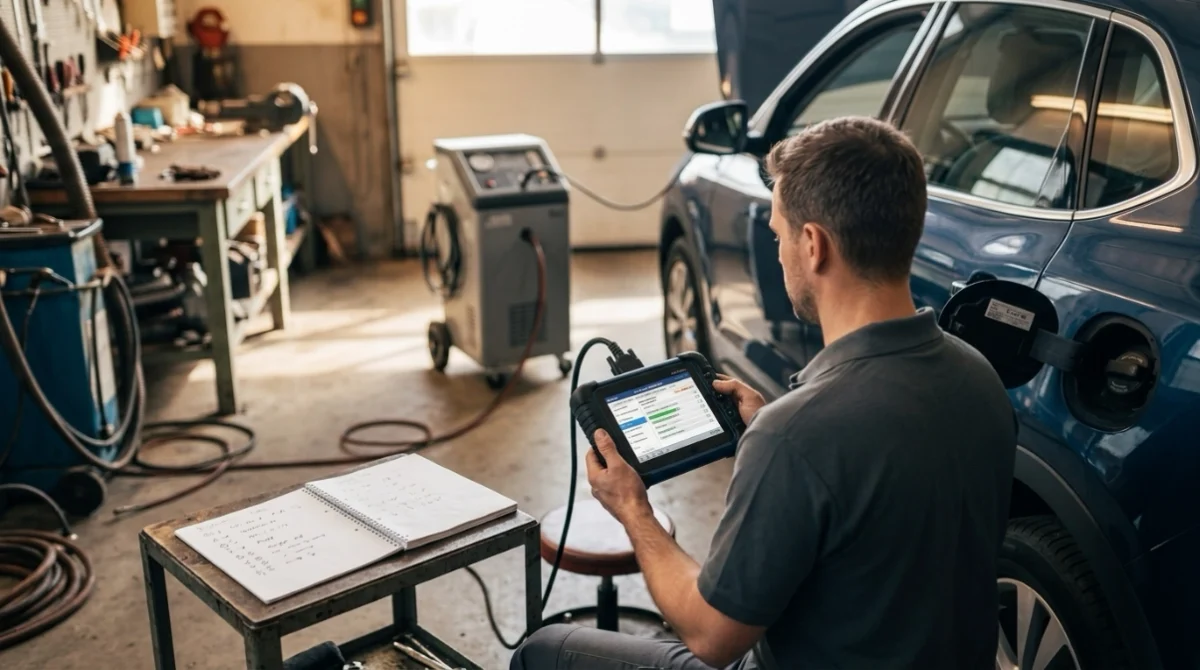
Start by scanning the vehicle before clearing anything. Stored, pending, and related EVAP codes can give you information that disappears after codes are erased.
A basic scanner can confirm P0440. A more capable scan tool may provide freeze-frame information, live data, monitor status, and bidirectional controls depending on the vehicle.
Step 1: Record every code
- Connect the OBD2 scanner with the ignition in the position required by the tool and vehicle.
- Read stored trouble codes.
- Check pending codes.
- Record freeze-frame information when available.
- Note any additional EVAP or electrical codes.
Don’t assume P0440 is the only useful clue. Another code may identify a purge-flow, leak, sensor, or circuit problem.
Step 2: Inspect the fuel cap and filler area
Remove the fuel cap and inspect its sealing surface. Look for cracks, damage, debris, or anything preventing a proper seal.
Make sure the replacement cap, if one has been fitted, is correct for the vehicle.
Step 3: Visually inspect EVAP components
- Check accessible vapor hoses for splits.
- Look for disconnected lines.
- Inspect electrical connectors.
- Look for damage around the charcoal canister.
- Inspect areas recently repaired or disturbed.
Visual inspection catches the easy failures. It won’t reliably find every small vapor leak.
Step 4: Review scan-tool data
If your scanner supports enhanced data, compare the relevant EVAP information with manufacturer specifications. Generic P0440 alone doesn’t provide a universal pass-or-fail value for every vehicle.
Technician’s note: Don’t copy a test value or command procedure from a different make, model, or year. EVAP strategies vary considerably between manufacturers.
Step 5: Smoke-test the system when needed
A professional EVAP smoke machine introduces low-pressure test vapor so leaks can become visible. This is often much faster than replacing components one at a time.
Use equipment designed for automotive EVAP testing and follow its safety instructions. Fuel-vapor systems require care.
| Diagnostic Method | What It Can Reveal | Main Limitation |
|---|---|---|
| Basic OBD2 scan | Stored and pending DTCs | Doesn’t locate the physical leak |
| Visual inspection | Loose cap, broken hose, damaged connector | Small leaks may be invisible |
| Enhanced scan data | Monitor status and vehicle-supported EVAP data | Capabilities vary by scanner and vehicle |
| Smoke testing | Physical vapor-system leaks | Requires suitable equipment and safe technique |
| Electrical testing | Valve, wiring, power, and control faults | Needs vehicle-specific diagrams and specifications |
Section Takeaway: Your scanner tells you where to begin, not which part to buy. Combine code data with visual inspection, leak testing, and electrical checks.
How Do You Fix P0440?
The correct P0440 repair is the repair that fixes the verified EVAP fault. There is no single universal part that solves this code on every vehicle.
Start with the diagnosis. Then repair only what testing confirms.
Common P0440 repairs
- Correct the fuel-cap problem: Reseat or replace a damaged or incorrect cap when inspection confirms a sealing issue.
- Repair EVAP hoses: Replace cracked, split, pinched, or disconnected vapor lines using suitable parts.
- Replace a failed purge valve: Do this after confirming the valve isn’t operating or sealing correctly.
- Repair the vent system: Correct a blocked vent path, failed valve, connector issue, or related wiring fault.
- Repair canister damage: Replace a physically failed or contaminated canister when diagnosis supports it.
- Repair electrical faults: Fix damaged wiring, terminals, grounds, or control circuits according to service information.
Should you clear P0440 after the repair?
You can clear the code with a suitable scanner after completing a confirmed repair. However, clearing the light does not prove the problem is fixed.
The EVAP monitor may need the vehicle to meet specific operating conditions before it runs again.
Those conditions vary by manufacturer. Temperature, fuel level, driving pattern, and other factors may affect monitor completion.
Technician’s note: Avoid promising that an EVAP monitor will reset after a specific number of miles. Follow the manufacturer’s diagnostic information for your exact vehicle.
How much does P0440 cost to repair?
There is no honest single price for P0440 because the code covers several possible failures. A simple sealing problem costs far less than diagnosis involving a canister, valves, wiring, or difficult-to-access vapor lines.
Labor rates and component prices also vary by make, model, year, and region.
For that reason, pay for diagnosis before approving multiple parts when the cause isn’t obvious. Good testing often costs less than guessing.
Section Takeaway: Fix the confirmed fault, clear the code, and verify that the EVAP monitor can run without P0440 returning. Don’t use code clearing as a substitute for repair.
How Can You Reduce the Chance of P0440 Returning?
You can’t prevent every EVAP component from aging, but a few habits reduce avoidable problems. Most take only seconds.
- Install the fuel cap correctly: Make sure it seats as designed after refueling.
- Stop when the pump clicks off: Avoid repeatedly forcing additional fuel into the tank.
- Address warning lights: Scan new codes instead of allowing several unrelated faults to accumulate.
- Inspect damaged areas: Check EVAP lines after underbody repairs, collision damage, or work near the fuel system.
- Use the correct replacement parts: Verify parts using your VIN and manufacturer information where compatibility matters.
- Protect connectors: Repair loose locks, damaged seals, and corrosion when found.
As of 2026, OBD2 scanners are useful for far more than turning off the check engine light. Even an entry-level tool can help you preserve codes before deciding what to inspect next.
For broader vehicle-safety information, you can also consult the National Highway Traffic Safety Administration. For background on vehicle emissions and OBD requirements, the U.S. Environmental Protection Agency vehicle-emissions section provides regulatory information.
P0440 FAQ
Can a loose gas cap cause P0440?
Yes, a fuel-cap sealing problem can contribute to an EVAP fault on vehicles where the cap is part of the sealed system. However, P0440 does not prove the cap is bad, so inspect it before replacing it.
Will P0440 clear itself after tightening the gas cap?
The light may eventually turn off if the cap was the only problem and the vehicle later completes its EVAP self-tests successfully. The timing varies, so don’t rely on a fixed number of trips or miles.
Can I drive with a P0440 code?
Many vehicles remain drivable with P0440 because it often involves emissions control rather than immediate engine operation. Investigate it promptly, especially if you smell strong fuel vapor, see fuel leakage, or notice other warning signs.
Does P0440 mean the purge valve is bad?
No. A faulty purge valve can contribute to an EVAP malfunction, but P0440 alone doesn’t condemn that valve. Hoses, the vent system, fuel-cap sealing, wiring, the canister, and other faults can produce similar results.
Can a bad charcoal canister cause P0440?
Yes, canister damage can create EVAP problems. Still, replacing the canister without testing is expensive guesswork because several easier-to-fix faults can set the same general code.
Can an OBD2 scanner tell me exactly where the P0440 leak is?
A basic scanner usually cannot physically locate an EVAP leak. It identifies diagnostic trouble codes, while leak location often requires inspection, enhanced scan data, component tests, or an automotive EVAP smoke test.
Why does P0440 come back after I erase it?
If P0440 returns after the EVAP monitor runs, the underlying condition probably remains or has become intermittent. Record all codes, inspect the system, and test it instead of repeatedly clearing the warning light.
Final takeaway: P0440 means the EVAP system failed a diagnostic check, but it doesn’t tell you which part failed. Scan all codes, check the simple sealing issues first, then use proper leak and electrical testing before spending money on replacement parts.
If P0440 is sitting in your scanner right now, save the code and any freeze-frame data before clearing it. Those clues can make the next diagnostic step much easier.
