
10 Best OBD2 Scanners with VIN Auto Detect in 2026

A check engine light rarely tells the whole story. It points to a system, not a fix, and figuring out what’s actually wrong means reading fault codes, checking live sensor data, and sometimes commanding a component to test whether it responds correctly. That’s the gap between a fifteen-dollar code reader and a real diagnostic tool.
VIN auto detect matters more than it sounds. Instead of scrolling through menus to manually select year, make, model, and engine, the scanner pulls that data straight from the vehicle and loads the correct software profile automatically. It cuts down on user error and gets you to actual fault codes faster, which counts for a lot when you’re lying under a dashboard with a cold connector in one hand.
The scanners that do this well also tend to separate themselves through bidirectional control, service reset functions, and how honestly they handle newer vehicle security protocols like FCA SGW and CAN FD. We looked at ten scanners spanning basic OBD2 readers up through shop-grade bidirectional tools, weighing VIN detection reliability, system coverage, update policy, and where each one hits a wall.
Best overall for serious DIYers: LAUNCH CRP123I V3.0 Elite
Best for bidirectional repair confirmation: Innova 5610 Bidirectional Scan Tool
Best for AI-assisted fault code lookup: MUCAR 632 Elite
Best for professional-level active tests: XTOOL D7 Bidirectional Scan Tool
Best budget multi-system scanner with resets: TOPDON AD500
Best for straightforward 4-system code reading: FOXWELL NT604 Elite
Best no-frills code reader for occasional use: ANCEL AD310
Best proven basic scanner for check engine diagnosis: FOXWELL NT301
Best for ABS codes plus battery testing: Autel AL549
Best entry-level scanner on a tight budget: MOTOPOWER MP69033
LAUNCH CRP123I V3.0 Elite
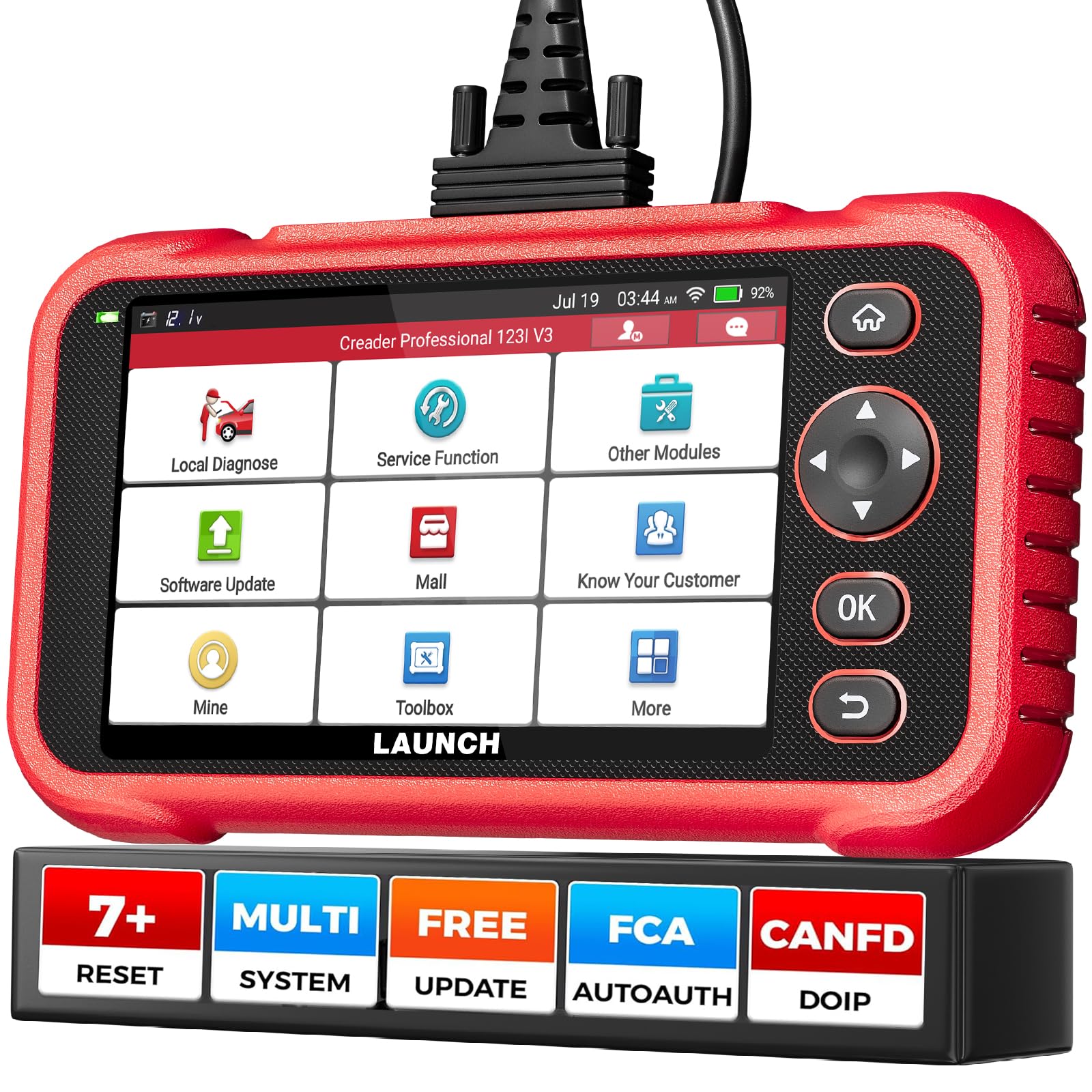
Buy this if you want a tablet-style scanner that covers four vehicle systems and seven service resets without ongoing subscription costs.
Pros
- Seven reset functions including oil, SAS, EPB, and DPF regeneration
- Lifetime free updates with FCA SGW and CAN FD protocol support
- Large 5-inch touchscreen with Android 8.1 for smooth navigation
Cons
- AutoAuth registration for FCA vehicles requires a separate paid account
- Some newer transmission codes need cross-referencing with outside sources
- Bulkier than pocket-sized code readers
The CRP123I V3.0 covers engine, ABS, SRS, and transmission systems with Auto VIN detection that pulls vehicle data without manual entry in most cases. The seven reset functions push this past basic code reading into actual service work: oil resets after changes, SAS calibration after alignments, EPB resets for pad jobs. Battery voltage graphing is a nice add for diagnosing electrical gremlins.
The FCA SGW support is real but comes with an asterisk. Chrysler, Jeep, and Ram owners still need to register a separate AutoAuth account through FCA, which carries its own annual fee. That’s not a LAUNCH problem specifically, it’s an industry-wide requirement, but buyers should know it going in.
Innova 5610 Bidirectional Scan Tool

Buy this if you want to verify repairs by actively commanding components instead of just reading what they report.
Pros
- True bidirectional controls for fuel pump, EPB, and other actuators
- Pairs with RepairSolutions2 app for guided repair suggestions
- US-based technical support by phone and email
Cons
- Bidirectional features limited to select makes and models
- Smaller 3.5-inch screen compared to tablet-style competitors
- No built-in service reset menu separate from bidirectional commands
Bidirectional control is the feature that separates a scan tool from a code reader. The 5610 can trigger a fuel pump on and off or retract an electronic parking brake, letting you confirm a component actually responds instead of guessing from a code alone. That’s diagnostic depth most budget scanners don’t offer.
Coverage varies by vehicle. Reviewers note strong results on Toyota, Ford, and Volvo platforms with gaps on brands like Porsche. Check Innova’s coverage tool against your specific vehicle before buying, since “bidirectional” doesn’t mean every command works on every car.
MUCAR 632 Elite
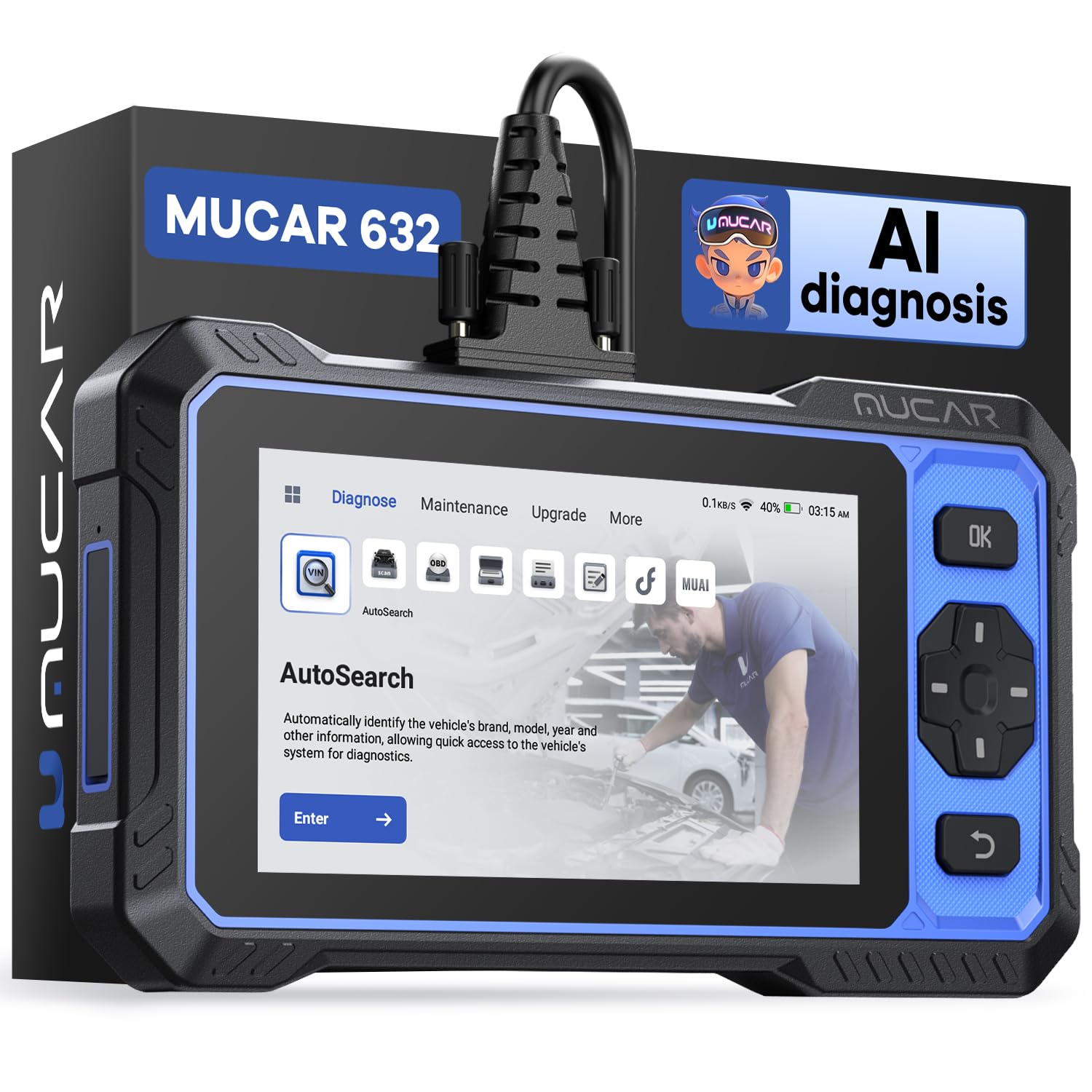
Buy this if you want fifteen reset services plus plain-language explanations of what a fault code actually means.
Pros
- Fifteen reset services, more than most competitors in this price range
- AI fault code lookup gives probable causes and repair suggestions
- Large 6.2-inch touchscreen with Auto VIN scanning
Cons
- Requires internet connection for AI analysis features to function
- Some units arrive with screen protector already applied over a scratch
- Newer brand with a shorter track record than established scan tool makers
The AI label gets thrown around loosely in this category, but here it does something concrete: tap a fault code and get an explanation of likely causes instead of just a numeric definition. That’s useful for owners who don’t have a repair manual memorized. It’s a lookup assistant, not a replacement for judgment.
Fifteen reset functions is a genuinely high count, covering battery matching, injector coding, and key matching alongside the usual oil and TPMS resets. Build quality feedback is mixed, with a couple of reports of cosmetic screen issues out of the box, so an inspection on arrival is worth the two minutes.
XTOOL D7 Bidirectional Scan Tool
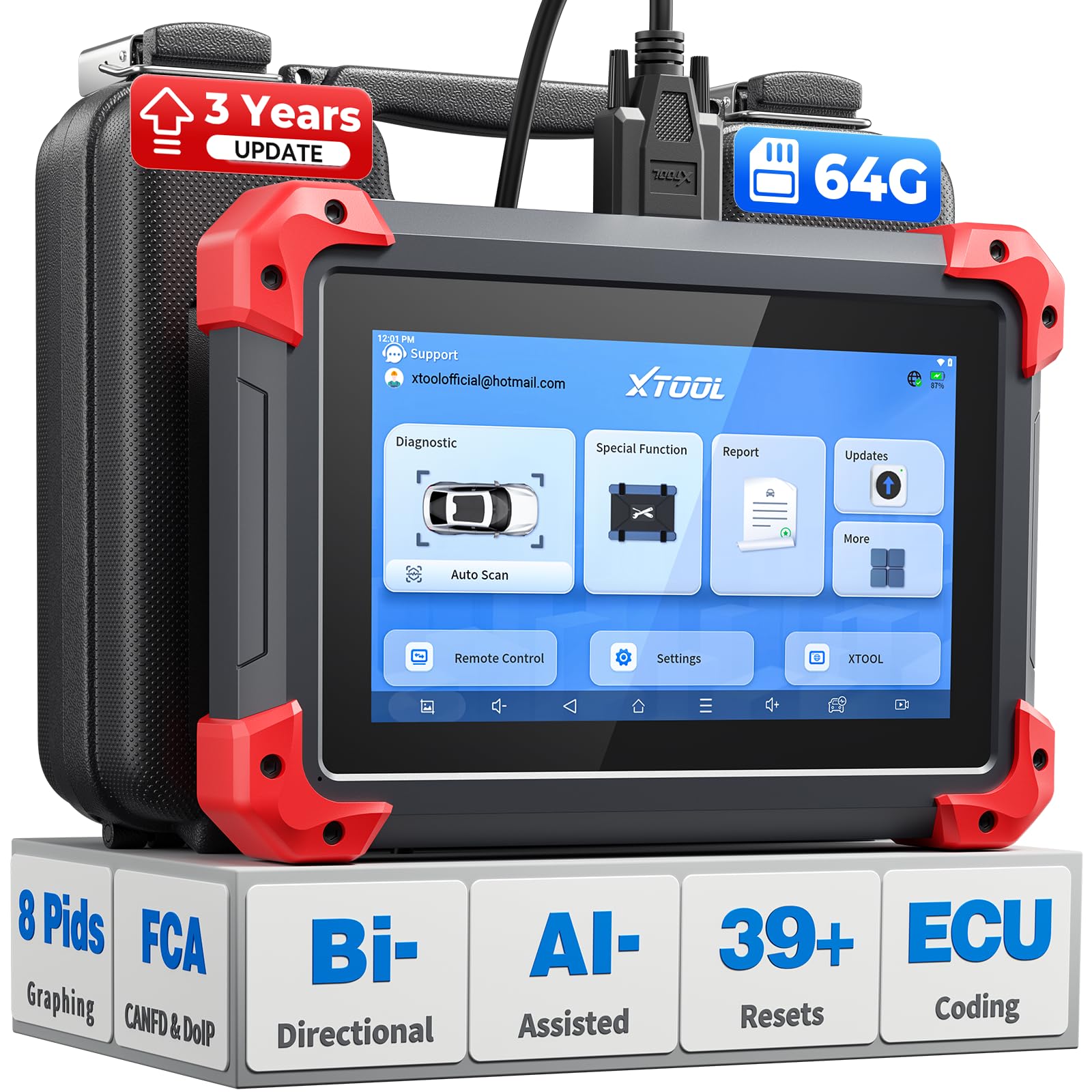
Buy this if you want the closest thing to shop-level diagnostics without the shop-level price tag.
Pros
- Over 4,000 active tests and bidirectional PIDs across 39+ special functions
- Graphs up to 8 live data parameters simultaneously
- Supports FCA AutoAuth, CAN FD, and DoIP for newer vehicles
Cons
- Free updates run three years, then renewal costs $99 annually
- Doesn’t support some Indian and a handful of other regional makes
- Larger 7-inch unit with a steeper learning curve for first-time users
The D7 is built for people who want to go past reading codes into actually testing components: cycling an A/C clutch, running an ABS pump test, checking a solenoid’s response in real time. That level of active testing is normally reserved for tools costing several times more. Reviewers doing key fob programming and multi-system diagnostics on daily drivers report solid results here.
Three years of included updates is generous, but plan for a $99/year renewal afterward if you want continued coverage for new model years. For a working mechanic or serious hobbyist, that’s a reasonable cost against the diagnostic depth on offer.
TOPDON AD500
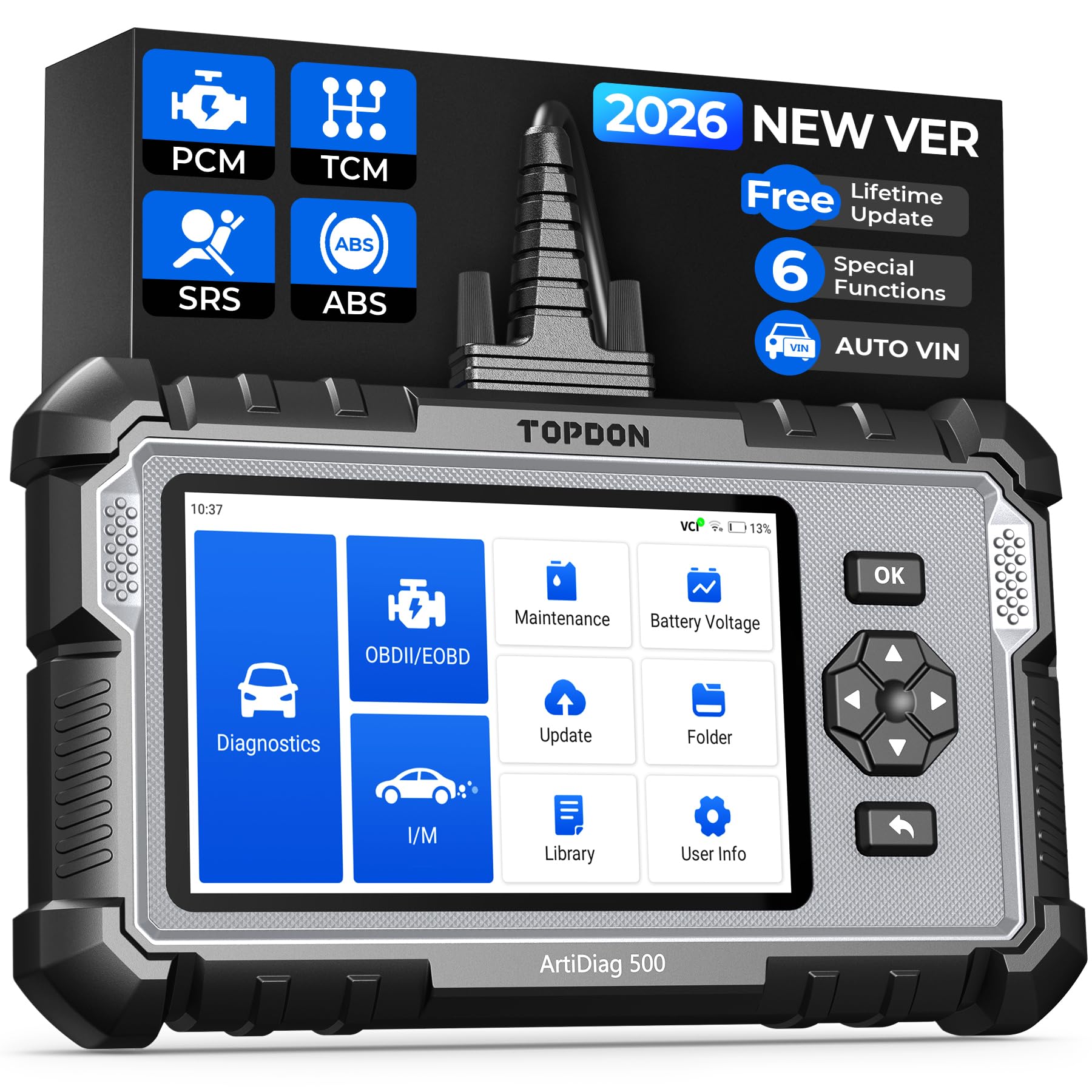
Buy this if you want four-system diagnostics and six reset functions without paying for bidirectional controls you may not use.
Pros
- Six reset functions covering oil, SAS, TPMS, BMS, and EPB
- Smart AutoVIN combined with CAN FD support for 2020+ GM and Chrysler
- Solid combination of touchscreen and physical buttons
Cons
- Initial setup requires account creation and Wi-Fi, which some find slow
- No bidirectional active testing
- Battery life shorter than tablet-style competitors at 3350mAh
The AD500 hits a comfortable middle ground: real system-level diagnostics for engine, transmission, ABS, and SRS, plus enough reset functions to handle routine maintenance after brake jobs, battery swaps, or tire rotations. FCA AutoAuth support means Jeep and Ram owners aren’t locked out entirely, though the same third-party subscription caveat applies here as with other scanners.
Setup friction shows up in owner feedback, with the account creation and update process taking longer than expected on first use. Once configured, day-to-day operation runs smoothly according to most reports.
FOXWELL NT604 Elite

Buy this if you want clean four-system code reading without paying for reset functions you won’t use.
Pros
- Diagnoses engine, ABS, SRS, and transmission out of the box, no downloads needed
- Comes with a sturdy protective case instead of a flimsy pouch
- AUTOVIN pulls vehicle info automatically on most supported models
Cons
- No reset functions at all, including oil or battery resets
- Cannot clear SRS crash/collision data
- Smaller 4.3-inch screen with lower resolution than premium competitors
This is a code reader in the fullest sense: it reads and clears fault codes across four major systems and shows live data, but it will not reset an oil light, bleed ABS brakes, or relearn a throttle body. For an owner who just wants to know what’s wrong before a repair, that’s plenty. For anyone doing their own maintenance afterward, it’s a hard limitation.
The AUTOVIN feature works reliably according to owner reports, cutting setup time versus manual vehicle selection. Build quality earns consistent praise, particularly the included hard case, which is a small detail that matters when a scanner lives in a toolbox.
ANCEL AD310

Buy this if your only goal is reading and clearing check engine codes without paying for features you’ll never touch.
Pros
- Simple, well-reviewed code reader with a large user base
- Supports all major OBD2 protocols including CAN
- Compact, rugged design that survives glovebox storage
Cons
- Emissions-related codes only, no ABS, SRS, or transmission access
- No VIN auto detect functionality
- No live data graphing or reset functions
This is the tool to buy when a warning light is the only mystery you need solved. It reads engine fault codes reliably and clears them once the underlying issue is fixed, without menus, updates, or setup friction. There’s no VIN auto detect here at all, worth noting given this roundup’s focus, so vehicle identification is manual.
For anyone cross-shopping against the more advanced scanners above, the AD310 makes sense as a glovebox backup rather than a primary diagnostic tool. It won’t touch ABS or airbag codes, and there’s no live data stream for chasing intermittent issues.
FOXWELL NT301

Buy this if you want live data graphing and smog-readiness checks in a plug-and-play code reader.
Pros
- Live data graphing for oxygen sensors, fuel trims, and coolant temperature
- One-click I/M readiness check with clear pass/fail indicators
- No charging or setup required, plug in and go
Cons
- Engine system only, no ABS, SRS, or transmission access
- No VIN auto detect
- No reset functions for oil, battery, or brakes
The NT301 punches above its category by including live data graphing, a feature usually reserved for pricier multi-system scanners. Watching fuel trims or O2 sensor values in real time helps catch problems a static fault code won’t reveal, like an intermittent lean condition. The I/M readiness check is a genuine convenience before a smog test.
It stays firmly in check-engine-light territory otherwise. No ABS or SRS access, no VIN auto detect, no resets. For engine-only diagnostics with data logging, it’s one of the more capable basic readers available.
Autel AL549
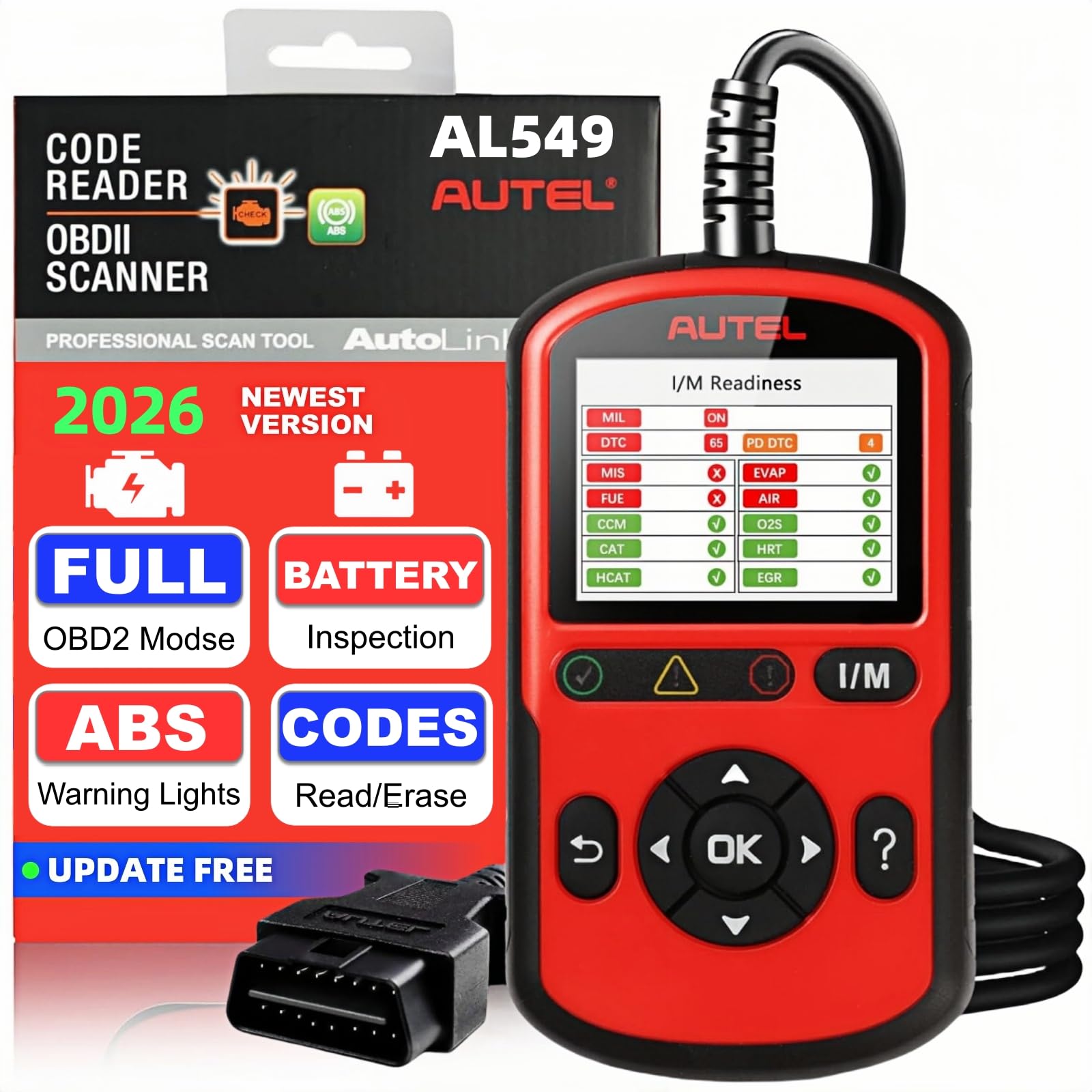
Buy this if you want ABS code access and a battery/alternator test alongside standard OBD2 functions.
Pros
- Reads and clears ABS codes on top of full OBD2 diagnostics
- Built-in battery and alternator test with guided on-screen steps
- Auto VIN technology for quick vehicle identification
Cons
- ABS diagnosis only supports pre-2020 vehicles
- Limited to 21+ car brands for ABS-specific coverage
- Sparse printed instructions according to owner feedback
The AL549 adds two things a basic code reader lacks: ABS fault code access and a battery test that walks through alternator output and battery health step by step. That combination covers a lot of the reason people upgrade from a $30 reader in the first place. Auto VIN speeds up vehicle setup, matching what pricier scanners offer.
The ABS coverage cutoff at 2020 is a real limitation for anyone with a newer vehicle, so check your model year before counting on that feature. Owners consistently mention thin documentation, meaning some trial and error is likely on first use.
MOTOPOWER MP69033

Buy this if you want the simplest possible way to find out why the check engine light is on.
Pros
- Reads codes, clears codes, and shows live data at an entry-level price
- Supports 9 protocols across a wide range of 1996-and-newer vehicles
- No battery or charging needed, powered through the OBD port
Cons
- No ABS, SRS, or transmission diagnostics
- No VIN auto detect
- Small 2.8-inch screen with basic monochrome display
The MP69033 does one job and does it consistently: pull engine codes, show a definition, clear them once the repair is done. Live data streaming for RPM, coolant temperature, and vehicle speed is a genuine bonus at this price point, letting an owner watch for odd sensor behavior during a test drive.
Vehicle identification is manual since there’s no VIN auto detect, and the system stays limited to OBD2 engine codes. As a first scanner for a driver who just wants clarity before a repair shop visit, it covers the basics without complication.
Buying Guide
What VIN Auto Detect Actually Does
VIN auto detect reads the vehicle’s identification number through the OBD port and uses it to load the correct diagnostic software profile automatically. That means correct sensor names, correct fault code definitions, and correct system menus without manually selecting year, make, model, and engine from a list.
It’s not flawless. Older vehicles, some import models, and cars with non-standard VIN broadcasting can fail to auto-detect, requiring manual entry as a fallback. A scanner with dependable VIN detection saves real time across dozens of diagnostic sessions, but treat it as a convenience feature rather than a guarantee.
Bidirectional Control vs. Basic Code Reading
| Capability | Basic Code Reader | Bidirectional Scan Tool |
|---|---|---|
| Read/clear fault codes | Yes | Yes |
| Live data streaming | Sometimes | Yes |
| Command components (fuel pump, EPB, ABS pump) | No | Yes |
| Confirm repair with active test | No | Yes |
| Typical price tier | Entry-level | Mid-to-premium |
Bidirectional control lets the scanner send a command to a component and watch how it responds, rather than only reading what the component reports. That’s the difference between guessing a fuel pump is weak and actually cycling it to confirm pressure drops off. Not every bidirectional feature works on every vehicle, so check make/model compatibility before assuming full functionality.
Reset and Service Functions Worth Having
- Oil reset: clears the maintenance reminder after an oil change.
- EPB (electronic parking brake) reset: required before and after brake pad replacement on vehicles with electric parking brakes.
- SAS (steering angle sensor) reset: needed after wheel alignments or steering component replacement.
- BMS (battery management) reset: registers a new battery so the vehicle’s charging system calibrates correctly.
- TPMS reset: relearns tire pressure sensor IDs after rotation or replacement.
Not every scanner offers all five. Match the reset list against the maintenance you actually perform, since paying for fifteen reset functions is wasted money if only three apply to your vehicles.
FCA SGW, CAN FD, and DoIP: What These Protocols Mean
FCA SGW (Secure Gateway) is a security module on 2018-and-newer Chrysler, Jeep, Dodge, and Ram vehicles that blocks unauthorized scanner access. Getting past it typically requires a separate AutoAuth subscription through FCA directly, on top of the scanner’s own price. CAN FD and DoIP are newer communication protocols used on recent vehicle architectures; a scanner without support for them will struggle to fully diagnose certain 2020-and-later models.
Confirm these protocols are actually supported for your specific vehicle year before buying, not just listed as a general feature.
Update Policy and Long-Term Cost
Lifetime free updates sound appealing but vary in what they cover. Some scanners include vehicle database updates only, while software feature updates or third-party gateway access carry separate ongoing fees. Read the specific terms before assuming “lifetime free” means zero cost forever.
Editor’s Choice
For most DIY owners and serious home mechanics, the LAUNCH CRP123I V3.0 Elite earns the top recommendation. It balances four-system diagnostics, seven genuinely useful reset functions, and lifetime update coverage without the steep learning curve of a full bidirectional tool.
Anyone doing regular repair verification work, testing actuators, confirming a new fuel pump actually primes, checking a solenoid’s live response, should look at the XTOOL D7 instead. Its active test library and 8-channel data graphing put it closer to shop equipment than to a consumer code reader, and the three years of included updates make the eventual $99/year renewal easier to swallow.
Drivers who only need to understand a check engine light before a repair shop visit are better served by the FOXWELL NT301 or MOTOPOWER MP69033. Both handle the core job reliably without asking you to learn a menu system built for a mechanic’s daily workflow.
Conclusion
The right scanner depends on how deep your repairs go, not how many features are listed on the box. A code reader that clears a check engine light saves a diagnostic fee at the shop. A bidirectional tool that commands a fuel pump or bleeds ABS brakes saves an entire repair visit.
Match the reset functions and protocol support to your actual vehicles before buying, especially if you own a 2018-or-newer FCA vehicle facing SGW restrictions. Verify VIN auto detect and system coverage against your specific make and model using the manufacturer’s compatibility checker when one is available, since “universal” coverage claims rarely mean universal in practice.
FAQS
Does VIN auto detect work on every vehicle? No. It works reliably on most 2008-and-newer vehicles with standard OBD2 VIN broadcasting, but older vehicles and some imports may require manual entry as a backup.
Do I need a bidirectional scan tool for basic maintenance? Not for oil changes or reading a check engine light. Bidirectional control matters more for confirming repairs, testing a fuel pump, cycling an ABS pump, or running an active test on a component you’ve replaced.
Why do FCA vehicles need a separate AutoAuth subscription? Chrysler, Jeep, Dodge, and Ram vehicles built 2018 and later include a Secure Gateway Module that blocks third-party scanner access without manufacturer authorization. That authorization comes through a paid AutoAuth account managed by FCA, separate from the scanner purchase.
What’s the real difference between CAN FD, DoIP, and standard OBD2? CAN FD and DoIP are newer, faster communication protocols used on recent vehicle electrical architectures. A scanner without support for them can still read basic OBD2 codes on newer cars but may miss deeper module-level diagnostics.
Is “lifetime free update” ever misleading? It can be if it only covers the vehicle database and not feature updates or third-party gateway access. Read what’s included before assuming zero future cost.
Can a basic code reader damage my car? No. Reading and clearing standard OBD2 codes carries no risk to the vehicle. Bidirectional commands carry more responsibility since they actively control components, so following on-screen guidance matters there.
