
10 Best OBD2 Scanners with Bidirectional Control in 2026

A basic code reader tells you which sensor tripped a check engine light. A bidirectional scanner lets you talk back: firing an injector, cycling a cooling fan, waking up a parking brake motor, or commanding a steering angle sensor to recalibrate. That two-way conversation is what separates a shop-grade diagnostic tool from a glorified fault-code lookup, and it’s the difference between guessing at a repair and confirming it before you spend money on parts.
Active tests, service resets, and ECU coding are where these tools earn their keep. Some scanners run thousands of documented active tests across dozens of brands; others cap out at a handful of common resets tied to a phone app and a subscription. Coverage also splits along hardware lines: standalone Android tablets with their own processors and screens versus Bluetooth dongles that borrow your phone’s screen and battery. Both approaches work, but they suit different budgets and different levels of seriousness about the hobby or the trade.
The right bidirectional scanner for you depends less on brand name and more on how many active tests your specific vehicle supports, whether CAN FD and DoIP protocols are included for newer cars, and whether software updates are free for life or bill you annually. A scanner that lists “4,000 active tests” sounds impressive until you find out your 2015 sedan only qualifies for a dozen of them. We’ve used and compared ten of the most capable bidirectional scanners on the market to help you match capability to your actual repair needs, not just the spec sheet.
Best for shop-grade speed on a budget: Autel MaxiCheck MX808S
Best for large-screen full-system diagnostics: Autel MaxiCheck MX900
Best for tracing module communication faults: XTOOL D8S
Best for wireless freedom around the vehicle: ANCEL DS500BT
Best for European ECU coding and VAG vehicles: LAUNCH X431 CRP919XBT
Best for beginners who want guided repair reports: Innova 5610
Best value for aspiring mobile mechanics: XTOOL D7
Best budget Bluetooth bidirectional tool: XTOOL A30M V2.0
Best pocket-sized AI-assisted scanner: TOPDON TopScan Lite
Best for techs who want zero subscription costs: GEARWRENCH GWSMARTBT
Autel MaxiCheck MX808S
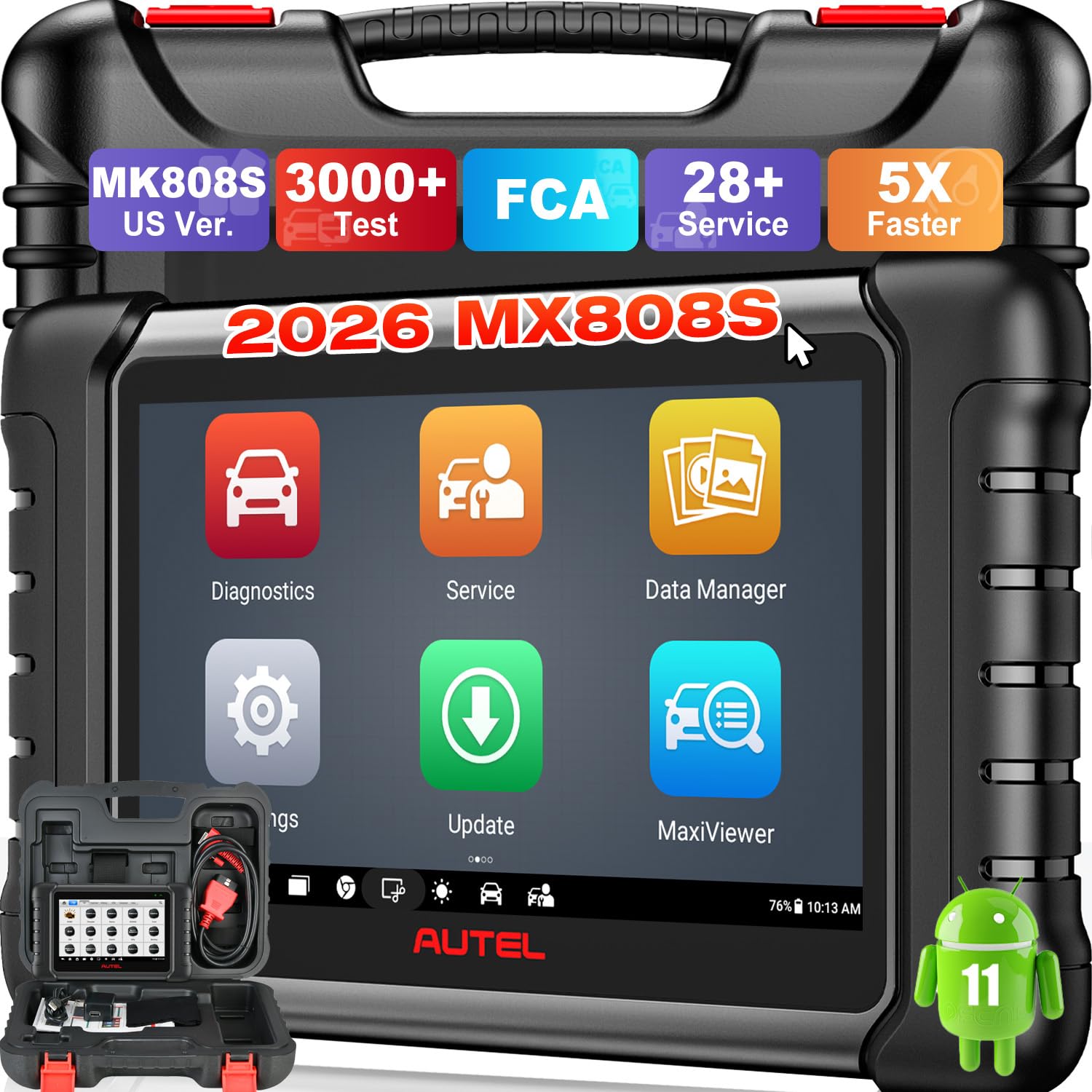
Buy this if you want Autel’s fast tablet hardware and deep active-test library without paying MX900 money.
Pros
- Quad-core processor with 64GB storage boots and switches systems quickly
- Over 3,000 active tests plus 28 service functions including oil reset and SAS calibration
- FCA AutoAuth support for 2018+ Chrysler, Jeep, Dodge, and Fiat
Cons
- 7-inch screen is smaller than higher-tier Autel tablets
- Some minor settings (unit conversion, radio codes) are locked on certain makes
- Vehicle coverage for pre-2000 cars needs confirmation before buying
The MX808S runs on the same Rockchip processor as Autel’s pricier MK900 line, so screen transitions between Engine, ABS, SRS, and Transmission feel instant rather than laggy. That speed matters most during Auto Scan, when the tool is pulling codes from every module at once.
Active tests are where this scanner justifies its position above basic code readers. Owners report using it to run EVAP solenoid activation and fuel pump tests that cheaper tools skip entirely. One shop-owner review specifically called out compatibility confirmation with a Porsche Macan and a Duramax diesel truck before purchase, which is the right habit: message Autel with your VIN first.
Autel MaxiCheck MX900
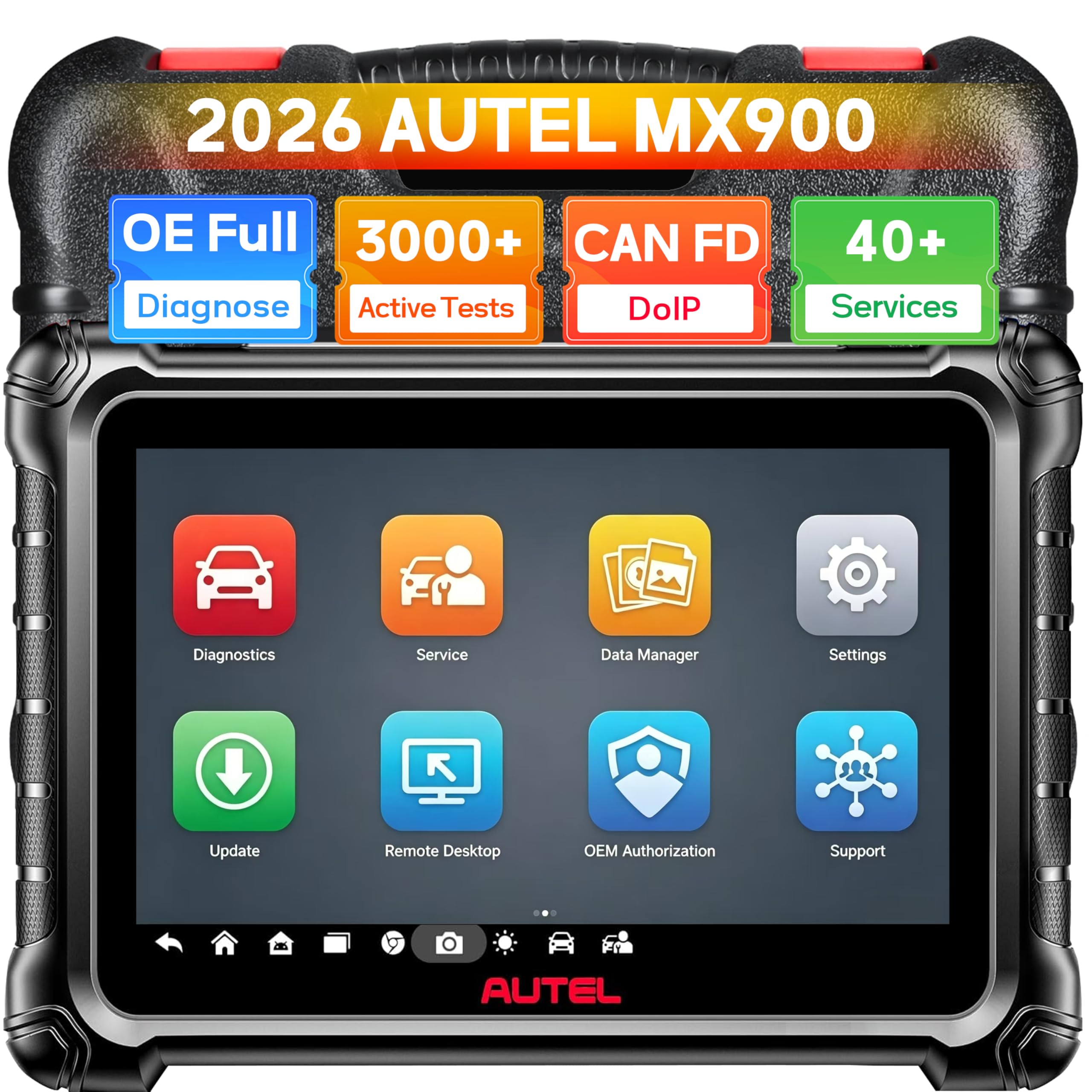
Buy this if you’re running a repair shop and need a bigger screen, DoIP/CAN FD support, and 40-plus service functions in one wired tablet.
Pros
- 8-inch display with cloud report management and Wi-Fi printing
- DoIP and CAN FD protocols cover newer European and GM modules
- 40+ service functions, up from the MX808S’s 28
Cons
- Wired-only connection means no Bluetooth freedom around the car
- Free updates run one year before optional subscription applies
- Heavier and bulkier than 7-inch competitors
Shop owners moving up from the MK808 line consistently mention the MX900’s larger screen and quicker refresh rate on live data streams. A Honda master tech reviewer noted the data list matches Honda’s own factory HDS tool closely, which is a meaningful endorsement for accuracy.
DoIP and CAN FD support future-proof this scanner against newer BMW, Jaguar, Land Rover, and GM modules that older tools can’t reach. The tradeoff is the wired connection: you’re tethered to the vehicle’s OBD2 port rather than roaming with a Bluetooth dongle. For a stationary shop bay, that’s rarely a problem.
XTOOL D8S
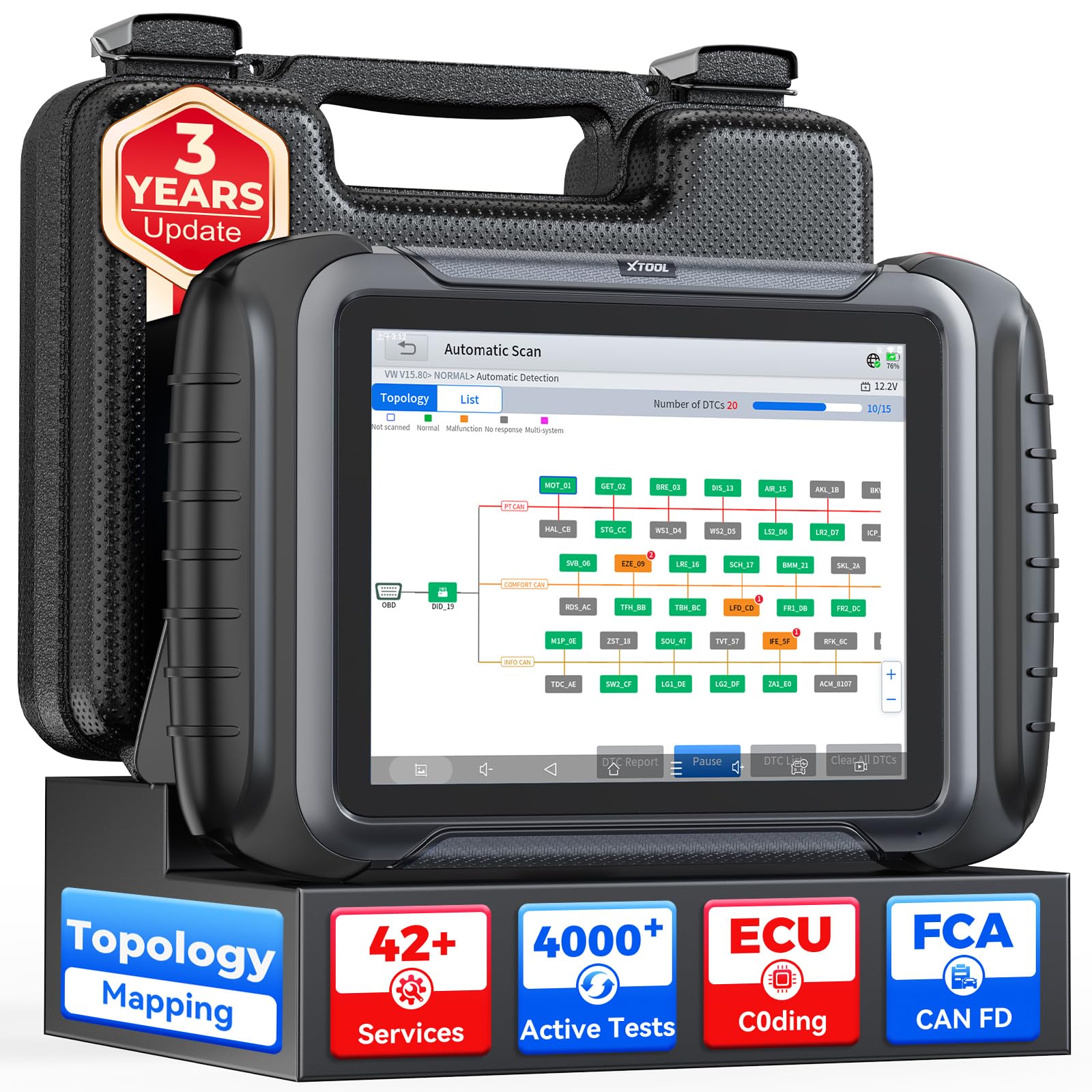
Buy this if you chase intermittent module communication faults and want a topology map showing which control units are online.
Pros
- Topology mapping visualizes which modules are talking on the network
- AI-assisted fault code analysis suggests likely repairs
- ECU coding and PMI (Parameter Module Instruction) support for Ford and Mazda
Cons
- AI suggestions are reference only, not a replacement for judgment
- Some owners report inconsistent vehicle-specific support
- RAM specification has drawn scrutiny in owner teardown reviews
Topology mapping is the standout feature here, and it’s genuinely rare below the four-figure price bracket. When multiple warning lights fire at once, seeing a visual map of offline modules saves the guesswork of chasing wiring by trial and error.
The D8S also handles PMI for Ford and Lincoln, which restores calibration data after an ECU swap, a function usually reserved for dealer-level tools. One reviewer used it to solve a Toyota Prius “triangle of death” hybrid fault, and another used the key programming function to pay for the tool through a single Mazda job.
ANCEL DS500BT
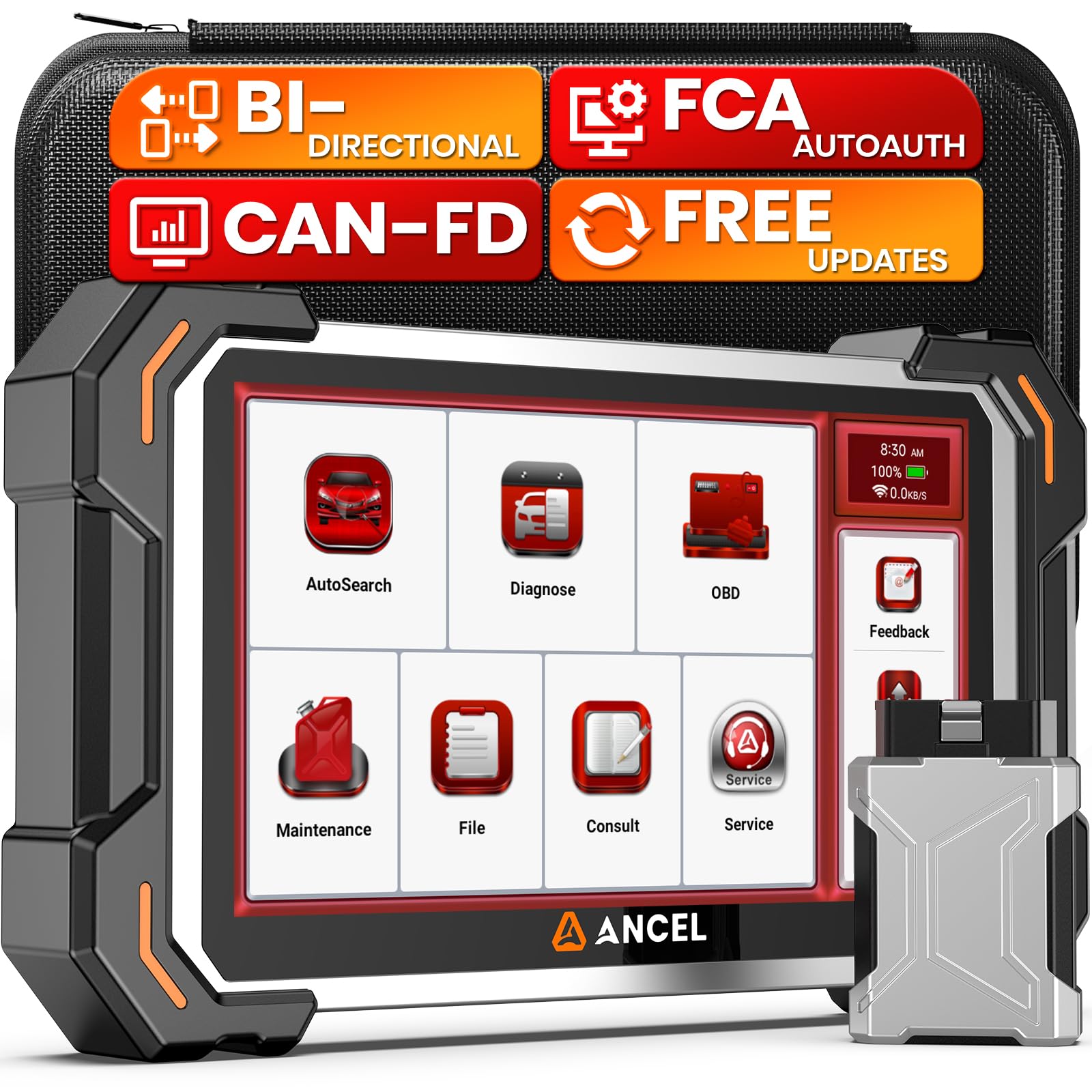
Buy this if you want a wireless tablet experience with lifetime free updates and no annual renewal decision to make.
Pros
- Bluetooth 5.0 VCI lets you move around the vehicle during live tests
- Lifetime free software updates avoid recurring subscription costs
- CAN FD support extends coverage to newer vehicle models
Cons
- Menu navigation isn’t immediately intuitive for first-time users
- Some 2025+ models (like certain Ford E450 configurations) aren’t yet supported
- 7-inch tablet is on the larger side for a wireless kit
A reviewer specifically mentioned clearing a persistent Volvo “City Safety” fault that a well-known repair shop couldn’t resolve, which speaks to the depth of the ABS and safety-system access here. That’s a meaningful data point for anyone whose local shop has already struck out on a code.
Lifetime free updates set the DS500BT apart from scanners that quietly shift to paid renewals after year one. Combined with wireless VCI operation, it’s a strong pick for a family mechanic running diagnostics across a dozen vehicles without racking up ongoing software costs.
LAUNCH X431 CRP919XBT
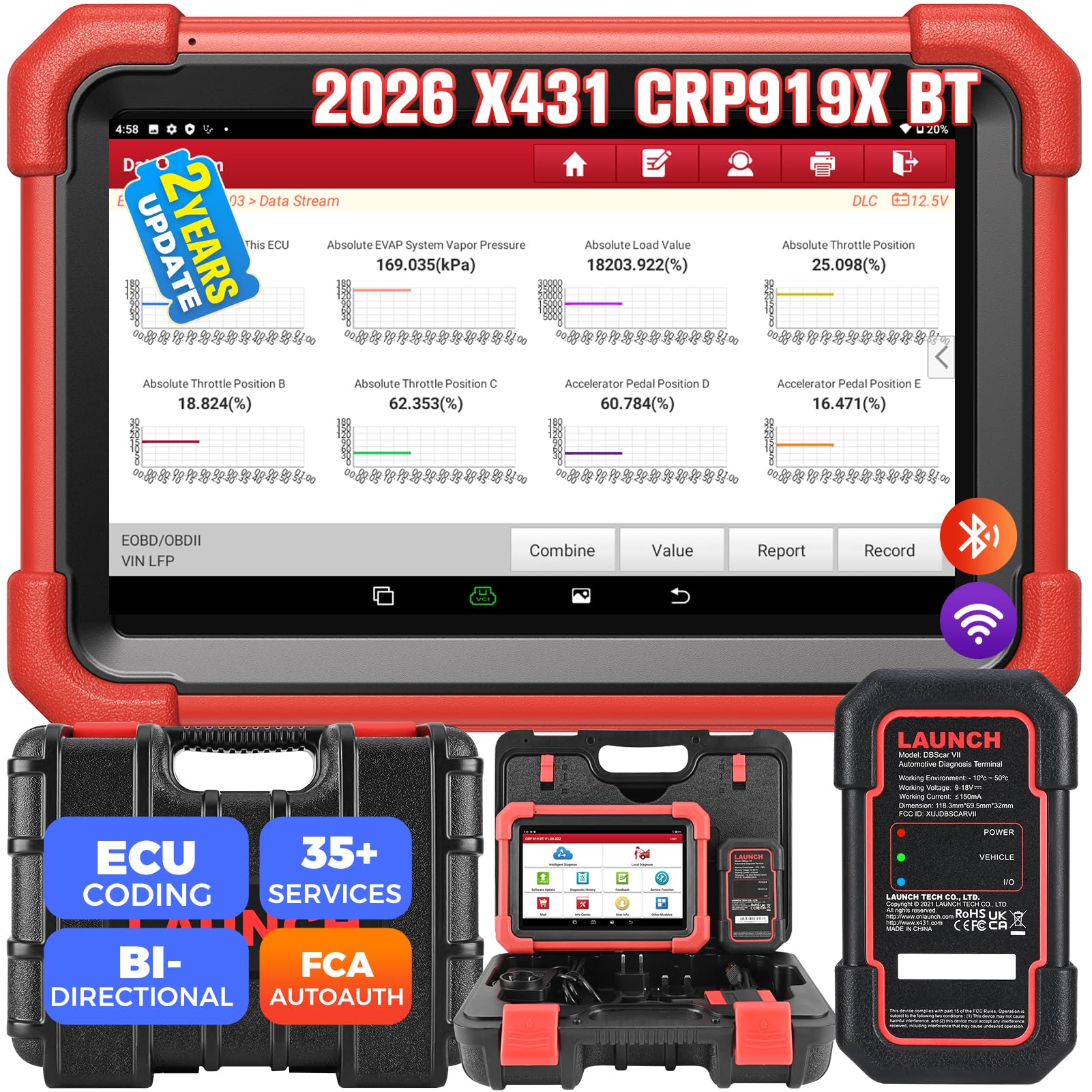
Buy this if you work on VW, Audi, or Skoda vehicles and need guided access to security codes without hunting through menus.
Pros
- V.A.G guided function locates security access codes automatically
- ECU coding for VW/Audi/Skoda, Ford, Lincoln, and Mazda
- FCA AutoAuth and CAN FD/DoIP built into the wireless VCI
Cons
- Wireless VCI is an extra component to keep track of and charge
- Some owners report limited depth on specific European modules like Mercedes air suspension
- 2 years of free updates is shorter than lifetime-update competitors
Reviewers repeatedly single out the Bluetooth connection speed and the tablet’s responsiveness for full-system scans, calling it a genuine bridge between basic code readers and expensive dealer tools. The V.A.G guided feature deserves particular credit: it removes the tedious hunt for channel numbers on Volkswagen Group vehicles that trips up other bidirectional scanners.
One reviewer’s experience with a Mercedes air suspension fault fell short of expectations, a reminder that Mercedes-specific systems can be hit-or-miss even on capable multi-brand tools. Confirm your make and specific system before buying if you work heavily on German imports.
Innova 5610

Buy this if you want a simple handheld unit backed by a phone app and real US-based phone support when you get stuck.
Pros
- RepairSolutions2 app translates codes into plain-language repair suggestions
- US-based ASE-certified phone and email support, English and Spanish
- Compact handheld design with no tablet to carry
Cons
- Bidirectional functions are compatible with select makes and models only, not universal
- Small 3.5-inch screen limits on-device data viewing compared to tablet rivals
- Reset functions cover fewer systems than full tablet-based competitors
The 5610 pairs a modest handheld scanner with an app that has built a genuine following, four million users according to Innova’s own figures. That combination matters for a first-time buyer who wants plain-language guidance rather than raw PIDs and code numbers to interpret alone.
Bidirectional coverage here is real but narrower than the tablet-based competitors on this list. One reviewer’s Ram 3500 didn’t support bidirectional control, exactly as Innova’s own compatibility disclaimer warns. Check the coverage checker on Innova’s site against your VIN before assuming full functionality.
XTOOL D7
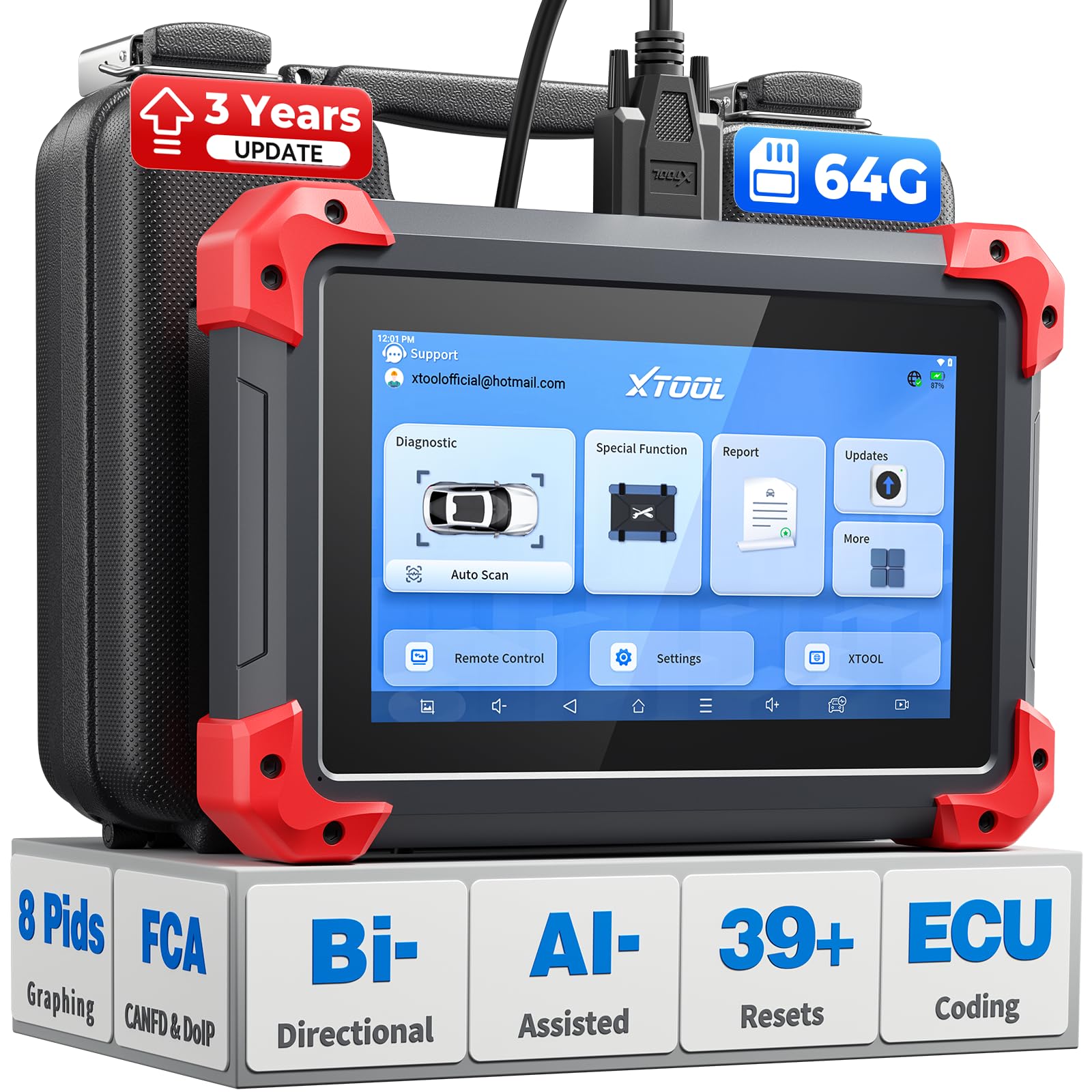
Buy this if you’re starting a mobile diagnostic side business and need true bidirectional PIDs without D8S-level pricing.
Pros
- 8 PIDs of simultaneous live data graphing for trend spotting
- 39+ special functions including SRS reset and crank sensor relearn
- Battery voltage reading warns against running tests on a weak battery
Cons
- 3 years of free updates, then $99/year renewal
- Not all vehicle makes are supported (some Indian-market cars excluded)
- Toyota/Lexus support has drawn mixed feedback in owner reviews
One reviewer used the D7 to trace a misfire down to specific cylinders and short/long fuel trims on a Chevy Silverado, exactly the kind of live-data-plus-active-test workflow that separates a diagnostic tool from a code reader. Key fob programming has also reportedly paid for the tool on a single Acura job.
At this price point, the combination of true bidirectional PID monitoring (not just active test triggers) and 4,000+ documented tests is difficult to match. The catch is the $99 annual renewal after year three, worth budgeting for if you plan to keep using it long-term.
XTOOL A30M V2.0

Buy this if you want bidirectional control through your own phone or tablet without paying for a dedicated screen.
Pros
- Lifetime free updates with no subscription required
- Bluetooth 4.0 range up to 33 feet for hands-free active tests
- 26 reset functions including throttle relearn and crank sensor relearn
Cons
- Relies on your phone’s screen and battery, no standalone tablet
- CAN FD limited to 2020+ GM models specifically
- FCA AutoAuth requires a separate paid registration on Chrysler’s site
A shop owner review calls this a legitimate stand-in for far pricier professional tools, citing the live-data graphing and bidirectional range as standouts for the cost. Testing a brake pedal position sensor learned value after a repair was cited as a specific save.
The dongle format means no tablet to carry, but also no backup if your phone dies mid-diagnosis. For a home garage with one or two regular vehicles, that tradeoff rarely matters. For a shop running back-to-back jobs, a dedicated tablet avoids the interruption.
TOPDON TopScan Lite

Buy this if you want a pocket-sized dongle with AI repair guidance, but plan around the subscription that kicks in after year one.
Pros
- Compact dongle, smaller than a car key fob
- TopFix AI assistant offers step-by-step repair suggestions
- FCA, Renault, and Nissan gateway unlock support built in
Cons
- Advanced functions (bidirectional control, live data, code clearing) require a paid subscription after the first year
- Mixed owner feedback on post-subscription functionality
- Core free tier is limited to basic scanning and code reading
TopScan Lite’s core diagnostics stay free permanently, but the features that matter most for this roundup, bidirectional control and live data, shift to paid access after twelve months. Owners are split: some call the subscription fair given continuous vehicle coverage updates, others feel a device without an active subscription performs worse than a basic $30 reader.
Budget for the renewal cost as part of the purchase price. If you need bidirectional testing occasionally rather than constantly, weigh a monthly plan against a lifetime-update competitor instead.
GEARWRENCH GWSMARTBT

Buy this if a familiar tool brand and permanently free updates matter more to you than the widest possible active-test count.
Pros
- Free software updates for life, no subscription tiers
- Covers 85+ vehicle manufacturers with 23 reset/relearn functions
- Backed by a recognized tool brand with a 2-year warranty
Cons
- Connection reliability complaints appear in a portion of owner reviews
- VIN auto-identification struggles on some newer vehicles
- Fewer active tests than XTOOL or Autel tablets in this lineup
A reviewer who returned more than ten competing scanners called this one the best for personal use, citing its full-report format and DPF cycle access. That’s meaningful praise from someone who’s clearly shopped the category exhaustively.
Reliability complaints do surface, particularly around Bluetooth pairing consistency. For a brand best known for hand tools entering the diagnostic space, the core bidirectional and reset functions hold up, but it’s worth setting expectations against dedicated diagnostic-tool manufacturers with longer track records in software support.
Buying Guide
Start With Active Tests, Not Marketing Numbers
Advertised active-test counts range from a few hundred to over 4,000, but the number that matters is how many apply to your specific make, model, and year. A scanner’s total test library includes every supported vehicle combined. Your particular car might qualify for a dozen tests or a few hundred, regardless of the headline figure.
Ask before buying: does the tool support active tests for the systems you actually need, such as fuel pump activation, injector buzz tests, or ABS solenoid cycling? Sending your VIN to the manufacturer’s support email before purchase is standard practice in this category and worth doing every time.
Understand the Protocols Behind the Acronyms
| Term | What It Does | Why It Matters |
|---|---|---|
| CAN FD | Faster data bus protocol used in newer GM (2020+), some Ford, and other modern vehicles | Without it, some 2020+ models won’t communicate at all |
| DoIP | Diagnostics over internet protocol, used on BMW F/G chassis, Jaguar, Land Rover, Volvo | Required for full-system access on select newer European vehicles |
| FCA AutoAuth | Security gateway authorization for 2018+ Chrysler, Jeep, Dodge, Fiat | Requires separate account registration and fee through Stellantis, not the scanner maker |
| Ford PMI | Parameter/module instruction restoring calibration data after ECU replacement | Needed after certain Ford and Lincoln module swaps |
Tablet vs. Bluetooth Dongle
A standalone Android tablet runs its own processor, storage, and display, independent of your phone. That means faster boot times, dedicated battery life for all-day shop use, and a bigger screen for reading live data graphs. It also costs more and adds bulk.
A Bluetooth dongle paired to a phone app costs less and stores easily in a glovebox. The tradeoff: your phone’s battery drains faster during long diagnostic sessions, and losing phone signal or battery mid-test interrupts the job.
Weigh Update Policies Like a Recurring Bill
- Lifetime free updates: No renewal decision, best long-term value for occasional users
- Multi-year free updates (2-3 years), then paid renewal: Common middle ground, factor the annual fee into total cost
- Subscription-gated advanced features: Core scanning stays free, but bidirectional control and live data require ongoing payment
Match Coverage to Your Actual Vehicles
Vehicle coverage claims (10,000+ models, 150+ brands) describe the software database, not guaranteed function support on every listed vehicle. A tool can list your make and still lack a specific reset for your exact trim or model year. Cross-reference the manufacturer’s compatibility checker or email support with your VIN before finalizing a purchase, especially for less common resets like Ford PMI or VAG-guided access.
Editor’s Choice
For a home garage handling multiple vehicles or a side business doing mobile diagnostics, the Autel MaxiCheck MX808S earns the top recommendation. It matches the processing speed of Autel’s higher-end MX900 and MK900 tablets, delivers over 3,000 documented active tests, and includes FCA AutoAuth support, all at a price that undercuts full-size shop tablets significantly.
For shops running full-system diagnostics daily, especially on newer CAN FD and DoIP vehicles, the Autel MaxiCheck MX900 is worth the step up. The larger screen and 40+ service functions justify the wired-only design in a stationary bay setting.
Anyone chasing intermittent electrical gremlins across multiple modules should look at the XTOOL D8S for its topology mapping feature alone. Seeing which control units have dropped off the network beats hours of continuity testing with a multimeter.
Conclusion
Bidirectional control turns a scanner from a code-reading convenience into a genuine diagnostic instrument. The right choice depends on how often you’ll use active tests, which protocols your vehicles require, and whether you want a dedicated tablet or a phone-based dongle.
Match the tool to your garage, not the spec sheet. A DIYer maintaining two family cars doesn’t need 4,000 active tests any more than a mobile mechanic needs to be tied to a wired tablet. Confirm your vehicle’s compatibility with the manufacturer before buying, since that single step prevents more return-and-refund headaches than any feature comparison ever will.
FAQS
What does bidirectional control actually let me do that a code reader can’t?
A code reader only pulls fault codes and shows sensor data. Bidirectional control sends commands back to the vehicle, activating a fuel pump, cycling a cooling fan, or running a steering angle sensor calibration, so you can confirm a component works before replacing it.
Do I need CAN FD or DoIP support for my vehicle?
Only if you’re working on select 2020+ GM or Ford models (CAN FD) or newer BMW F/G chassis, Jaguar, Land Rover, and Volvo vehicles (DoIP). Vehicles older than that communicate over standard CAN protocols that every scanner on this list supports.
Why do some scanners require a subscription while others don’t?
Software subscriptions fund ongoing vehicle coverage and function updates. Some brands build lifetime updates into the purchase price; others offer a free introductory period, then shift advanced features like bidirectional control behind a paid renewal.
Is FCA AutoAuth included in the price of the scanner?
No. FCA AutoAuth requires a separate account and fee registered directly through the manufacturer’s security gateway portal, regardless of which scanner brand you buy. The scanner only needs to support the protocol to communicate once you’re authorized.
Can I trust the advertised number of active tests?
Treat it as a database total across every supported vehicle, not a guarantee for your specific car. Confirm which active tests apply to your make, model, and year before purchase, since actual per-vehicle support varies widely.
