
10 Best OBD2 Breakout Box Tools for 2026

A breakout box sits between the OBD2 port and your scan tool, giving you direct access to all 16 pins so you can verify power, ground, and communication before you trust an expensive scanner to the connection. For anyone doing CAN-bus diagnostics or bench-testing an ECU outside the vehicle, this kind of interface turns guesswork into measurable data. Instead of back-probing a connector with a multimeter and risking spread pins, you get stable banana-jack or 4mm access points built for repeated testing.
Not every breakout box does the same job. Some are simple LED pinout indicators that flash when a signal is present. Others add voltage displays, termination resistance switches, auxiliary power inputs for ECU memory retention, and full bench-testing capability for modules removed from the vehicle. The right choice depends on whether you’re chasing an intermittent CAN fault in-vehicle or running a module on the bench with no vehicle harness at all.
Cable quality, connector fit, and whether the box passes data through cleanly to a connected scanner also separate the reliable tools from the frustrating ones. A loose DB25 connection or a breakout box that interrupts communication mid-scan costs more time than it saves.
Best for ECU bench testing: Godiag GT100+ OBDII Breakout Box
Best for basic LED pinout checks: CMTOOL OBD2 Breakout Box
Best for cramped footwell access: Kawish OBD2 Breakout Box
Best for voltage alarm monitoring: OTC 3415 CAN Test Box
Best for multi-module bench setups: GODIAG GT100
Best budget CAN voltage tester: WOYO CTB007
Best for CAN termination control: AUTOOL OBD2 Breakout Box
Best for shop-grade durability: Power Probe PPECB
Best for simple pass-through monitoring: OONO OBD-II Breakout Box
Best for jumper-wire flexibility: KAISAL OBD2 Breakout Box
Godiag GT100+ OBDII Breakout Box

Buy this if you need to power and diagnose an ECU on the bench, not just monitor a vehicle’s OBD2 port.
Pros
- Bench power adapter plus current display for verifying ECU condition
- Covers non-standard OBD pins (1, 3, 8, 9, 11, 12, 13) beyond the standard 16
- Banana plug and DB25 connector options for module wiring
Cons
- Overkill for simple in-vehicle pinout checks
- Learning curve for techs unfamiliar with bench setups
The GT100+ earns its place with technicians doing immobilizer work, ECU repair, and module bench testing where a live vehicle harness isn’t available. The current display is the standout feature: it tells you immediately whether a cable is wired correctly or the module itself has failed, which saves diagnostic time compared to blind continuity checks. Auxiliary power support during battery replacement is a useful bonus for shops handling memory-sensitive ECUs.
CMTOOL OBD2 Breakout Box

Buy this for straightforward, color-coded LED confirmation of power, ground, and communication signals at the OBD2 connector.
Pros
- Yellow, green, and red LEDs map directly to specific pin groups
- 90cm extension cable keeps the box out of the footwell
- Standard 4mm banana sockets for multimeter or oscilloscope hookup
Cons
- No numeric voltage display, only LED indication
- No CAN-L LED per some user reports, limiting differential signal visibility
This box handles the fundamentals cleanly: confirm ground at pins 4/5, power at pin 16, and communication activity across the standard signal pins. It won’t replace a scope for detailed CAN-H/CAN-L waveform analysis, but as a fast go/no-go check before connecting a scan tool, it does the job reliably. The banana jacks make it easy to drop into a bench setup alongside other test equipment.
Kawish OBD2 Breakout Box

Buy this when you need extra reach to move testing away from a cramped dashboard footwell.
Pros
- 128cm extension cable, among the longest in this category
- Built-in voltage display plus LEDs for power, ground, and communication
- Supports 12V and 24V systems including J1939 diesel protocols
Cons
- Some users report voltage display accuracy drifting from actual battery readings
- Basic protocol coverage compared to true bench-testing units
The long cable is the reason to consider this box: working under a dash with the breakout unit tucked against your knee is a real annoyance, and 50 inches of slack solves it. J1939 support extends usefulness to light diesel work. Voltage accuracy complaints in a handful of reviews are worth checking against a known-good multimeter reading before relying on it for close calls.
OTC 3415 CAN Test Box

Buy this for a shop-grade voltage monitor with an audible high/low alarm built into daily diagnostic work.
Pros
- Continuous numeric voltage display, not just LED indication
- Audible alarm at 11.6V low and 15.2V high thresholds
- Passes through to a connected scan tool without interruption
Cons
- No switch to mute the alarm, which some techs find intrusive
- No option to isolate pin 16 for injecting external 12V independently
OTC’s reputation for durable tools carries through here. The pass-through design means you can leave a scanner connected while monitoring CAN activity and voltage simultaneously, which is exactly how a working diagnostic bay operates. The alarm is genuinely useful for catching charging system faults mid-test, though a mute option would improve it for repetitive bench use.
GODIAG GT100

Buy this for bench setups that need to power and communicate with multiple ECU modules at once.
Pros
- Connects multiple control modules simultaneously
- Female and male connectors with 1.2m extension cable
- OBD1-to-OBD2 conversion support for older module testing
Cons
- Fewer bench-specific extras than the GT100+
- Best suited to techs already comfortable with module wiring diagrams
The GT100 predates the GT100+ but still holds value for shops running multi-module immobilizer or instrument cluster work where several ECUs need power and ignition signal at once. It lacks the current display and expanded non-standard pin access of the Plus model, so treat it as the entry point into GODIAG’s bench-testing lineup rather than the top-tier option.
WOYO CTB007
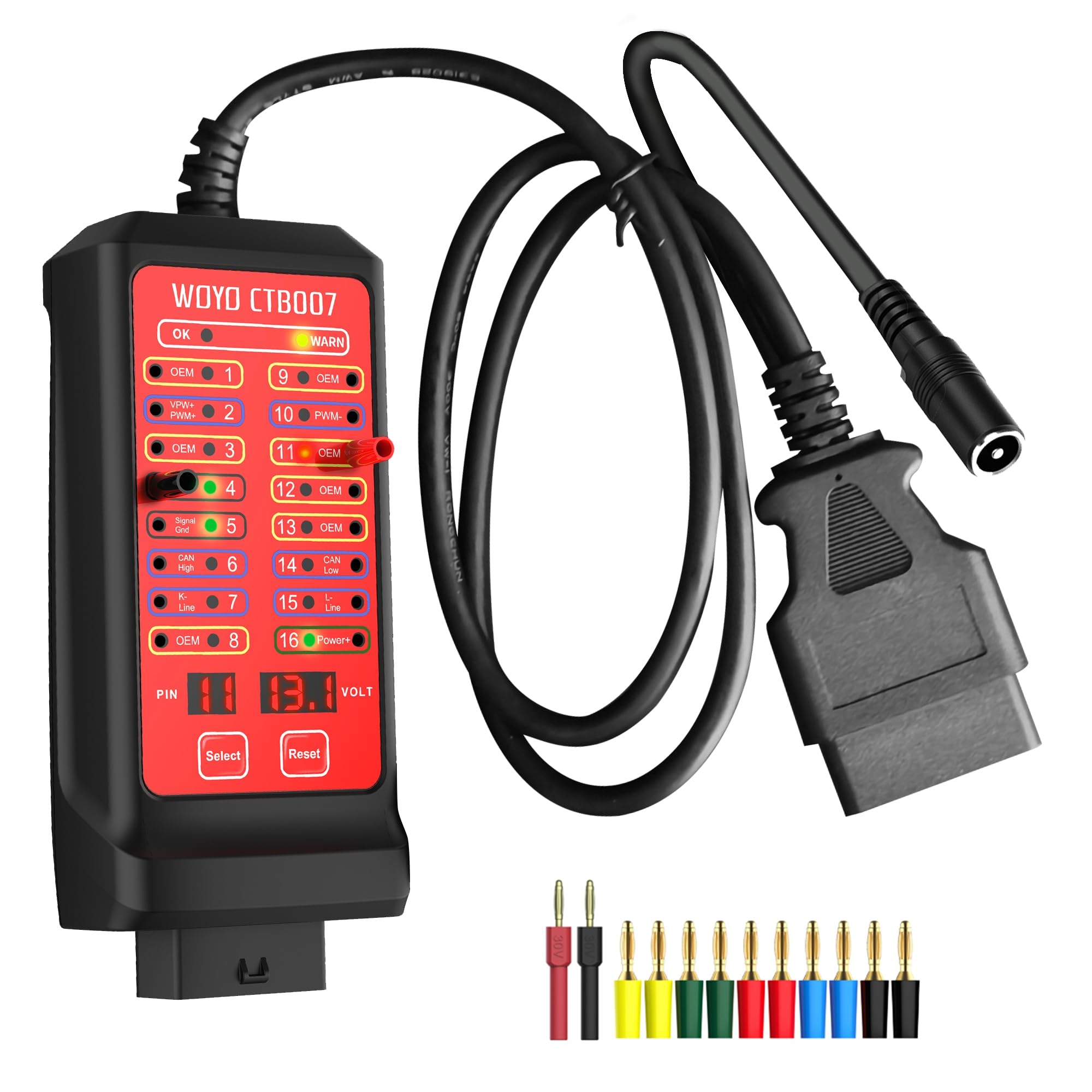
Buy this for per-pin voltage readings on a budget, with the tradeoff of smaller 2mm test probes instead of standard banana plugs.
Pros
- Digital VPP voltage readout selectable per pin
- Reverse polarity and overload protection up to 2A
- Auxiliary 12V-24V power input protects ECU memory during battery swaps
Cons
- Uses 2mm probe jacks instead of industry-standard 4mm banana plugs
- Smaller connector size may not suit techs with a full set of 4mm test leads
The per-pin voltage selection is a genuine differentiator at this price, letting you check individual OBD2 pins without moving probes around blindly. The 2mm jack choice is the catch. CMTOOL and CMTOOL-style boxes standardize on 4mm banana plugs, so WOYO owners either adapt existing leads or invest in new ones. Included adapters help but add a step.
AUTOOL OBD2 Breakout Box
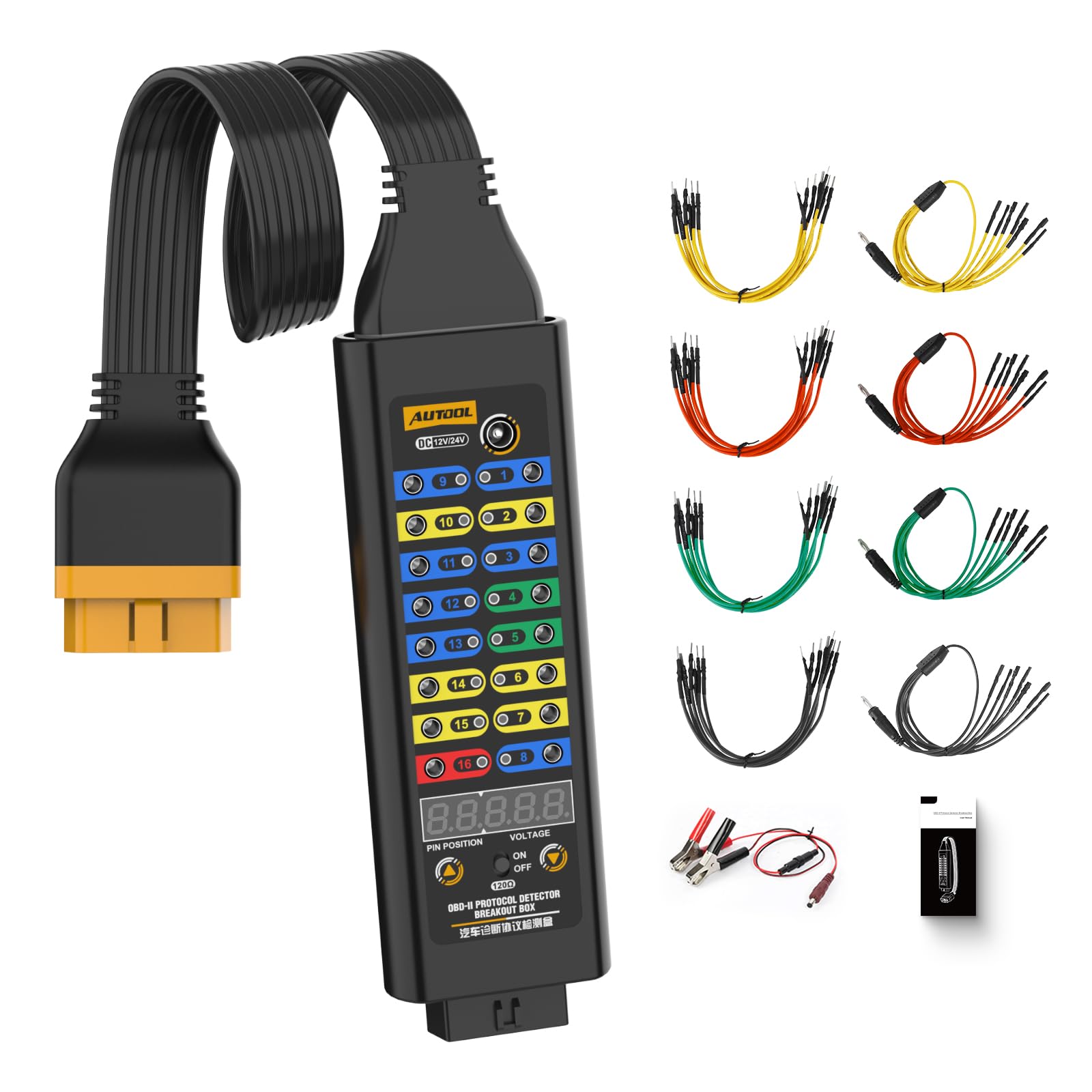
Buy this for CAN-bus data acquisition on a module that’s been pulled from the vehicle, thanks to its manual 120Ω termination resistance switch.
Pros
- Switchable 120Ω termination resistance for isolated ECU testing
- OLED display cycles through real-time voltage per pin
- Wide 6V-30V DC input supports gasoline, hybrid, and select EV systems
Cons
- Smaller review base than more established competitors
- Termination resistance function requires understanding CAN-bus topology to use correctly
The termination resistor switch sets this box apart for anyone doing CAN-bus work on a removed module, since a standalone ECU without the vehicle’s twisted-pair network needs that 120Ω closed to communicate properly. The OLED per-pin voltage display adds precision LEDs alone can’t match. This is a tool for technicians who already understand CAN network architecture, not a first breakout box for beginners.
Power Probe PPECB

Buy this for a slim, shop-tested breakout box that pairs well with existing Power Probe diagnostic equipment.
Pros
- Slim footprint fits alongside a connected scan tool without crowding the DLC
- Pass-through design lets you monitor CAN activity while scanning
- Strong reputation among working technicians for build quality
Cons
- Premium price relative to LED-only competitors
- A few reports of loose DLC connector fit on certain vehicle makes
Technicians already running Power Probe’s scan tools and clamp meters gain the most from this box, since it’s built to sit inline without disrupting an existing workflow. The voltage readout directly on the unit is convenient for quick checks, though one reviewer noted a discrepancy against a calibrated multimeter, worth a cross-check on any voltage-critical diagnosis. Connector fit issues on a few specific makes are worth checking against your typical vehicle mix.
OONO OBD-II Breakout Box

Buy this for a no-frills, pass-through pinout box that sits between the vehicle and scanner without adding electronics of its own.
Pros
- Male and female headers allow simultaneous vehicle and scan tool connection
- Color-coded 4mm banana sockets for quick pin identification
- Compact 16-inch cable keeps the footprint manageable
Cons
- No LEDs, voltage display, or active indicators of any kind
- Requires a multimeter or scope for any actual signal reading
This is the most stripped-down box in the group, and that’s the point: it’s pure mechanical access to all 16 pins with no batteries or electronics to fail. Pair it with a multimeter for CAN-H/CAN-L checks and you get reliable, unfiltered readings. Anyone expecting built-in LED feedback should look elsewhere; this box assumes you’re bringing your own measurement tool.
KAISAL OBD2 Breakout Box
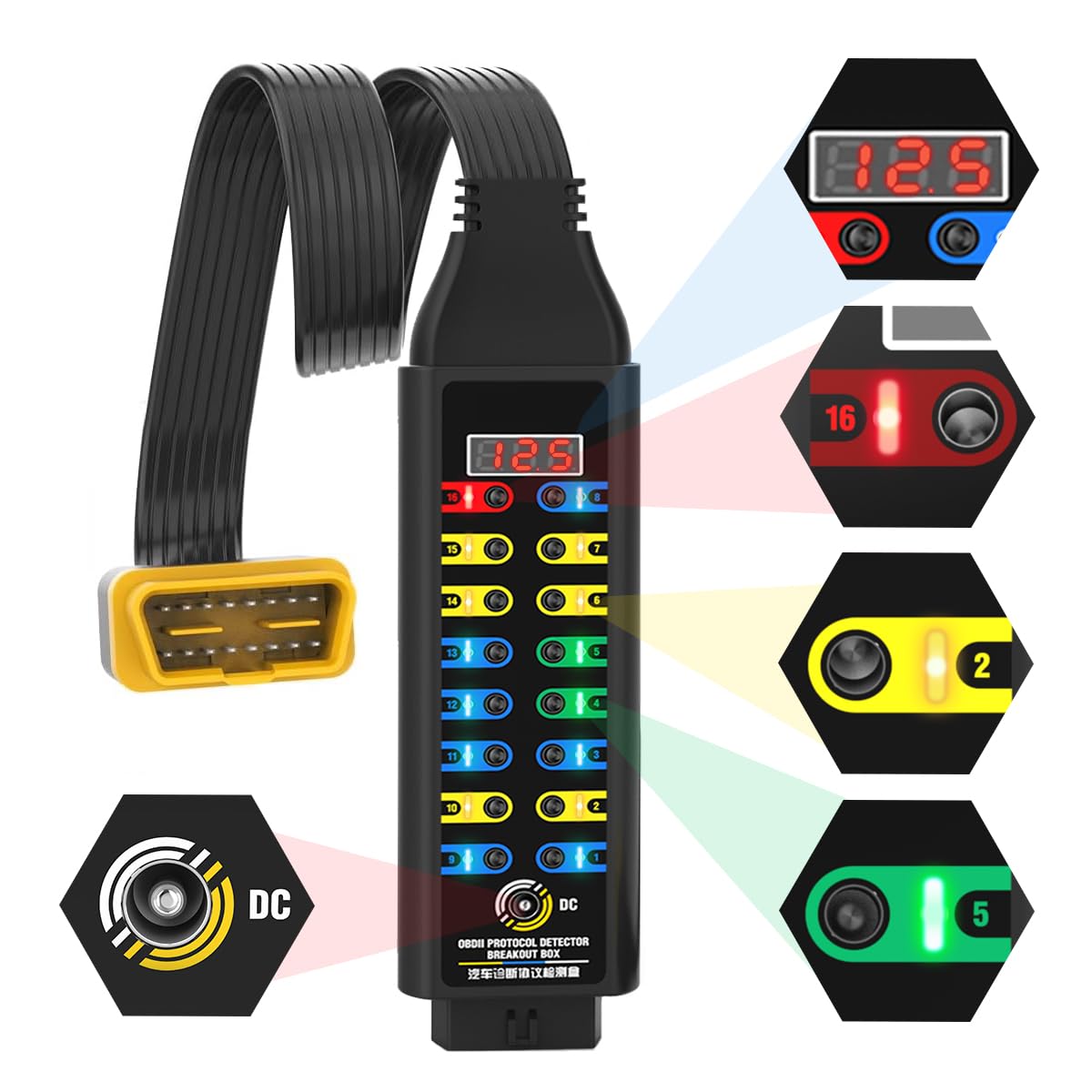
Buy this for the included jumper wire set, useful for connector drag/tension testing beyond standard breakout functions.
Pros
- Four sets of color-coded jumper wires included for flexible wiring
- LCD voltage display plus 3-color LED indicators
- Auxiliary power clip for battery replacement without ECU data loss
Cons
- Smaller review base compared to established competitors
- One reported case of a manufacturing defect, resolved by seller replacement
The jumper wire kit is what separates this from typical LED-and-display boxes. Techs use them for pin tension testing or to bridge connectors during diagnosis, extending the tool past passive monitoring into active circuit manipulation. The auxiliary power clip is a practical touch for battery jobs on cars with finicky infotainment or ECU reprogramming requirements after a disconnect.
Buying Guide
Pin Access and Wiring Standard
A true breakout box exposes all 16 OBD2 pins through individual 4mm banana jacks, not just a subset. Confirm the jack layout matches the standard OBD2 pinout so you can identify CAN-H (pin 6), CAN-L (pin 14), power (pin 16), and ground (pins 4/5) without consulting a wiring diagram every time.
Some boxes extend beyond the standard 16 to cover manufacturer-specific pins (1, 3, 8, 9, 11, 12, 13) used in K-line and non-standard protocols. This matters if you regularly work on vehicles with proprietary diagnostic circuits.
Voltage Range and Vehicle Compatibility
| Feature | Why It Matters |
|---|---|
| 12V support | Standard for passenger cars and light trucks |
| 12V/24V support | Required for diesel and commercial vehicle work |
| Wide DC input (6V-30V) | Accommodates hybrid and EV auxiliary systems |
| Auxiliary power input | Preserves ECU memory during battery replacement |
Confirm the voltage range before buying if your shop handles medium-duty diesel or commercial fleets. A 12V-only box will not give reliable readings on a 24V truck electrical system.
Display and Indicator Type
LED-only boxes give fast go/no-go confirmation but no numeric data. A voltage display, whether LCD, OLED, or LED numeric, lets you catch marginal conditions an LED won’t flag, like a battery reading 11.9V instead of a healthy 12.6V. For CAN-bus work, per-pin voltage selection offers more diagnostic depth than an aggregate reading.
CAN Termination and Jumper Functions
Bench-testing a removed ECU requires a 120Ω termination resistor to simulate the vehicle’s CAN network, since the module won’t communicate correctly on an open bus. Boxes with a manual termination switch support this work directly. Jumper wire kits add flexibility for connector tension tests and circuit bridging beyond passive monitoring.
Cable Length and Connector Fit
Cable length determines how far you can move the box from a cramped footwell. Options range from short 16-inch pass-through cables to extended 50-inch runs for shop bench setups. Check connector fit reports for your typical vehicle makes; a loose DLC connection undermines every reading downstream.
Pass-Through Compatibility
Confirm the box passes signal through cleanly to a connected scan tool. A box that only intercepts and doesn’t pass through forces a choice between monitoring and scanning, when most diagnostic work benefits from doing both simultaneously.
Editor’s Choice
For ECU bench testing, the Godiag GT100+ stands out for its current display and expanded pin coverage, giving technicians a real diagnostic edge over LED-only competitors. Its bench power adapter and DB25 connector support make it the strongest choice for shops doing immobilizer, ECU repair, or module-level diagnostic work.
For straightforward vehicle-side troubleshooting without bench-testing needs, the OTC 3415 CAN Test Box delivers reliable pass-through monitoring with a numeric voltage display and audible alarm, backed by a manufacturer known for durable shop tools. Technicians doing CAN-bus work on modules removed from the vehicle should look to the AUTOOL OBD2 Breakout Box for its switchable termination resistance, a feature most competitors in this category lack entirely.
Conclusion
Matching a breakout box to your actual workflow matters more than chasing the highest feature count. In-vehicle troubleshooting calls for a reliable LED or voltage-display box with a long cable and clean pass-through to a scan tool. Bench testing a removed ECU calls for auxiliary power, current monitoring, and in some cases termination resistance control.
Technicians running fleets with 24V diesel equipment need to confirm voltage range before anything else, since a 12V-only box gives false readings on those systems. For shops that do both bench work and roadside diagnostics, owning two purpose-built boxes, one simple LED pinout tool and one bench-capable power box, often works better than expecting a single unit to cover every scenario.
FAQS
What does an OBD2 breakout box actually do that a scan tool can’t? A scan tool reports whether communication succeeded or failed. A breakout box shows you why, giving direct access to power, ground, and each communication line so you can trace the fault to a specific pin or circuit rather than guessing from a generic error code.
Do I need a breakout box with a voltage display, or are LEDs enough? LEDs confirm presence or absence of signal quickly. A voltage display catches marginal conditions, like a weak ground or a battery reading slightly under spec, that an LED simply won’t show since it only indicates on or off.
What is termination resistance and when do I need it? A CAN-bus network requires 120Ω termination resistors at each end to function correctly. When bench-testing an ECU removed from its vehicle harness, that termination is missing, so a breakout box with a manual 120Ω switch lets the module communicate as if still installed.
Can I leave my scan tool connected while using a breakout box? Pass-through models allow this, letting you monitor pin activity and voltage while a scanner runs its normal communication. Confirm pass-through support before buying if simultaneous scanning and monitoring is part of your regular workflow.
Are 4mm and 2mm test jacks interchangeable? Not without an adapter. Most multimeter and oscilloscope probes use 4mm banana plugs as the standard. Boxes using smaller 2mm jacks typically include adapters, but confirm this before assuming your existing test leads will fit directly.
