
P0606 Causes: What Triggers an ECM/PCM Processor Fault?

Quick Answer
P0606 means the ECM or PCM detected a processor-related fault. Common P0606 causes include an internal control-module failure, unstable battery voltage, damaged power or ground circuits, relay or connector problems, and software or calibration faults; a manufacturer P0606 diagnostic procedure shows why battery, wiring, relay, and ECM checks should come before automatically replacing the computer.
Common P0606 Causes
- ECM/PCM failure: The module’s internal processor, memory, or supporting electronics may fail a self-check.
- Low system voltage: A weak battery or unstable electrical supply can interfere with control-module operation.
- Power circuit fault: An open, short, damaged relay, or poor connection can interrupt power reaching the module.
- Ground problem: Excessive resistance or a damaged ground connection can make a healthy module behave incorrectly.
- Software issue: Some vehicle-specific cases require an updated PCM calibration rather than hardware replacement.
- Electrical interference: Certain model-specific components can create interference capable of triggering P0606.
Best First Check
- Save every stored and pending code plus freeze-frame data before clearing anything, then check battery condition and module power and ground circuits.
I spend much of my diagnostic work around key fobs, immobilizers, smart keys, and vehicle electronics, but P0606 belongs to the powertrain side of the car. Your OBD2 scanner is reporting that the engine or powertrain computer detected a processor-related problem.
The important part is not to assume that the computer itself is dead. Power supply faults, wiring problems, software issues, and several vehicle-specific conditions can produce the same code.
In This Guide
What Does P0606 Mean?
P0606 is an OBD2 powertrain diagnostic trouble code associated with an ECM or PCM processor fault. The ECM is the engine control module, while PCM usually means powertrain control module.
A control module is essentially a specialized vehicle computer. It monitors sensor signals, performs calculations, and commands systems such as fuel delivery, ignition, electronic throttle control, and sometimes transmission functions.
- P identifies a powertrain-related code.
- 0 indicates a standardized generic-code family.
- 606 identifies the processor-related fault within that family.
The important phrase is processor fault. The module has detected something wrong with its ability to perform or verify an internal operation.
That doesn’t prove the physical processor has permanently failed. A processor cannot work correctly when its electrical supply or supporting circuits are unstable.
Diagnostic note: treat P0606 as a starting point, not permission to order a PCM immediately.
What Are the Most Common P0606 Causes?
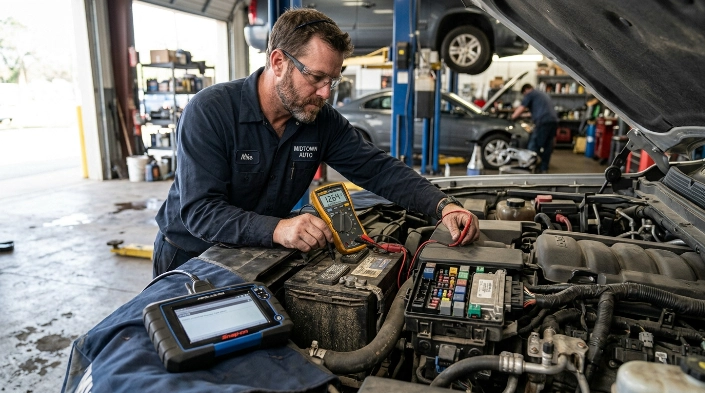
The main P0606 causes fall into five categories: the control module, its voltage supply, its wiring, its software, and vehicle-specific electrical faults. I would investigate them in that order only after considering the other codes and symptoms stored with P0606.
1. Internal ECM or PCM failure
An internal ECM or PCM problem is one possible cause. The module may fail an internal processor, memory, communication, or integrity check.
A persistent P0606 that returns quickly under stable voltage deserves more attention than a one-time code recorded during an obvious battery problem. Context matters.
2. Weak battery or unstable voltage
The control module needs a stable electrical supply. Low voltage, interrupted power, or unstable charging voltage can interfere with electronic modules.
A vehicle that recently had a dead battery, charging-system problem, or electrical work should make you investigate voltage first. Don’t condemn an expensive computer until the electrical foundation is verified.
- Check battery condition.
- Check charging-system behavior.
- Inspect battery terminals for looseness or corrosion.
- Look for related low-voltage or communication codes.
3. Damaged module power, ignition, or ground circuits
P0606 can appear when the module isn’t receiving the electrical conditions it expects. An open circuit, short circuit, damaged connector, relay problem, or high-resistance connection can be involved.
Mitsubishi’s factory P0606 information, for example, directs technicians through battery, ignition-supply, harness, connector, and relay checks before ECM replacement. That is a useful diagnostic principle even though exact procedures vary by vehicle.
Pro tip: use the factory wiring diagram for your exact year, engine, and trim before testing control-module terminals.
4. PCM software or calibration problem
Hardware isn’t always the problem. Manufacturers sometimes release updated software to correct conditions that can set processor-related trouble codes.
Before replacing a module, check manufacturer communications and applicable campaigns for your exact VIN. The NHTSA recall and manufacturer-communication search is a useful place to begin for U.S. vehicles.
5. Model-specific electrical interference or component problems
A generic code can have an unusual vehicle-specific cause. One manufacturer bulletin for certain older Honda Civic models linked P0606 to electrical interference from particular aftermarket spark plugs with built-in capacitors.
That doesn’t mean spark plugs are a general P0606 cause. It shows why factory service information matters before applying a universal repair.
| Possible Cause | Clue That Supports It | Next Check |
|---|---|---|
| Internal ECM/PCM fault | Code repeatedly returns with stable power and verified circuits | Follow factory module test procedure |
| Low or unstable voltage | Recent dead battery, jump start, or voltage-related codes | Test battery and charging system |
| Power/ground fault | Intermittent symptoms or several module-related codes | Test module feeds, grounds, fuses, and connectors |
| Software issue | Manufacturer bulletin or calibration update applies | Confirm current calibration with proper service equipment |
| Vehicle-specific interference | Known bulletin matches year, model, engine, and condition | Follow that bulletin rather than generic advice |
Section Takeaway: P0606 can point to the PCM, but power supply, wiring, software, and model-specific faults must be ruled out first.
How Should You Diagnose P0606 With an OBD2 Scanner?
Start by saving information instead of immediately clearing the code. Your scanner can provide context that helps separate a module failure from an electrical event.
- Read every code. Record stored, pending, and permanent codes before changing anything.
- Save freeze-frame data. Note voltage, engine speed, temperature, and other available values when P0606 set.
- Look for companion codes. Low-voltage, communication, relay, ignition-supply, or module codes may change the diagnostic direction.
- Check the battery. Verify battery condition and charging performance using appropriate test equipment.
- Inspect power and grounds. Use the manufacturer’s wiring information for the specific vehicle.
- Check connectors and relays. Look for loose terminals, corrosion, harness damage, or a known relay problem.
- Check service information. Look for calibration updates, technical bulletins, and known vehicle-specific causes.
- Retest. Clear the fault only after recording your data and performing the relevant checks.
A basic OBD2 scanner may read and clear P0606. A higher-level scan tool may be needed for manufacturer-specific data, module communication tests, or programming functions.
Don’t attempt an ECM reflash with a generic scanner unless the equipment, software, and manufacturer procedure specifically support it. Interrupted programming can create a larger problem.
Locksmith’s note: security-related modules, immobilizers, and replacement ECMs may require additional pairing or initialization procedures after module work.
Does P0606 Always Mean the PCM Needs Replacement?
No. P0606 can eventually lead to ECM or PCM replacement, but replacement should follow proper testing rather than precede it.
A useful rule is simple: prove the computer has correct power, ground, wiring conditions, and applicable software before blaming the computer. Factory diagnostic procedures often follow this same logic.
- Repair the electrical supply first if testing finds a battery, relay, fuse, connector, power, or ground problem.
- Update software first when an applicable manufacturer bulletin calls for revised programming.
- Replace the module when the manufacturer’s diagnostic path identifies an internal module fault after external causes are eliminated.
A replacement control module also isn’t always plug-and-play. Depending on the vehicle, it may require programming, calibration, immobilizer registration, or other setup.
That is one reason buying a random used PCM by appearance alone can become expensive. Hardware numbers, software, vehicle configuration, and security functions can all matter.
Pro tip: verify replacement-module compatibility through the vehicle VIN and manufacturer information before ordering parts.
Can You Drive With a P0606 Code?
Whether you should drive depends on how the vehicle is behaving. Because the ECM or PCM controls important engine functions, processor-related problems deserve prompt diagnosis.
Stop driving if the engine stalls, loses major power, enters severe fail-safe operation, or cannot run reliably. Arrange professional assistance instead of risking an unpredictable shutdown.
- Do not continue if the engine repeatedly stalls.
- Do not continue if throttle response becomes unpredictable.
- Do not continue after a no-start condition becomes intermittent.
- Do not assume clearing P0606 fixed the underlying cause.
If you need roadside help in the U.S. or Canada, services such as AAA roadside assistance may be safer than repeatedly restarting an unreliable vehicle.
You can also check your VIN for relevant recalls or manufacturer communications through NHTSA. A recall lookup will not diagnose P0606, but it can identify applicable safety campaigns.
Which Repair Matches Each P0606 Cause?

The correct repair depends entirely on what testing finds. Replacing the PCM does nothing for a poor power connection, while replacing a battery won’t solve a confirmed internal processor failure.
| Confirmed Problem | Typical Repair Direction | Important Caution |
|---|---|---|
| Weak or failed battery | Correct battery condition and retest | Check why the battery failed before assuming the problem is finished |
| Charging-system fault | Repair charging problem | Verify stable voltage afterward |
| Damaged wiring or connector | Repair circuit according to factory wiring information | Do not guess terminal functions |
| Relay or power-supply problem | Repair or replace confirmed faulty component | Confirm the relay is actually faulty before replacing it |
| Applicable software issue | Perform manufacturer-approved programming | Maintain proper battery support during programming |
| Confirmed internal ECM/PCM fault | Repair, replace, and program as specified by manufacturer | Replacement may involve immobilizer or configuration work |
Repair costs vary too widely by vehicle, region, diagnostic time, programming requirements, and module availability for one universal number to be useful. Get the fault identified before comparing repair quotes.
Cost note: ask whether a quote includes diagnosis, programming, security-system setup, and the replacement module itself.
P0606 Causes FAQ
Can a weak battery cause P0606?
A battery or electrical-supply problem can contribute to module faults, so battery condition belongs early in the diagnostic process. Some manufacturer P0606 procedures specifically instruct technicians to check the battery before replacing the ECM.
Can a bad alternator cause P0606?
An unstable charging system can affect the electrical supply available to vehicle modules. Test charging performance and module power circuits before assuming the PCM itself has failed.
Can bad wiring cause a P0606 code?
Yes, depending on the vehicle. Manufacturer diagnostic information may list damaged connectors, open or shorted ignition circuits, relays, or control-module supply circuits as possible causes.
Can clearing P0606 fix the problem?
Clearing the code only removes stored diagnostic information. If the fault is still present, P0606 can return after the module runs its monitoring checks again.
Can P0606 be caused by PCM software?
Yes, on some vehicles. Manufacturer technical bulletins have documented P0606 conditions corrected through updated control-module software, so check applicable service information before replacing hardware.
Can an OBD2 scanner diagnose P0606?
An OBD2 scanner can confirm the code and may provide freeze-frame and related-code information. Electrical testing, factory service information, and sometimes manufacturer-level diagnostic equipment are still needed to identify the actual cause.
What should I check first when I get P0606?
Record all codes and freeze-frame data first. Then check battery condition, system voltage, ECM or PCM power and ground circuits, connectors, related relays, and applicable manufacturer service information.
The main takeaway: don’t treat P0606 as an automatic PCM replacement code. Diagnose the battery, power supply, grounds, wiring, software, and vehicle-specific service information before spending money on a control module.
If P0606 returns after those checks, have the vehicle tested using the factory diagnostic procedure for its exact year, make, model, engine, and VIN.
