
P0700 Repair Cost: What You May Pay and What to Check First

Quick Answer
P0700 repair cost can range from a relatively inexpensive electrical or fluid-related repair to several thousand dollars for major transmission work. P0700 itself does not identify the failed component, so the smartest first expense is a proper transmission-module diagnosis before approving parts or a rebuild; you can also compare repair options through the AAA Auto Repair resource.
Typical P0700-related costs
- Fluid service: Often around $150–$400 when the diagnosis points to fluid condition or a serviceable filter.
- Sensor repair: A transmission speed or related sensor repair may fall around $150–$450.
- Solenoid repair: Roughly $250–$1,000 is a useful ballpark, depending on access and whether several solenoids are serviced together.
- Wiring repair: Connector or harness work may range from roughly $150–$600.
- Major repair: Valve-body, control-module, rebuild, or replacement work can push the bill into the low thousands or higher.
What to do before spending money
- Have the transmission control module scanned for the companion code that explains why P0700 was stored.
P0700 looks intimidating because it points toward the transmission, one of the most expensive systems in a vehicle. The important detail is that this code alone does not tell you to replace a transmission.
I work around vehicle electronics and scan-tool diagnostics every day, and this distinction matters. A code is evidence to investigate, not a parts order.
In This Guide
What Does P0700 Mean?
P0700 means the vehicle’s transmission control system has detected a problem and requested a warning through the engine-management system. It is generally a pointer to more detailed transmission information rather than a diagnosis by itself.
A transmission control module, usually shortened to TCM, manages functions such as gear selection, shift timing, and electronically controlled transmission components. The exact architecture varies between vehicles.
Definition: P0700 is a generic powertrain diagnostic trouble code that tells the technician to investigate the transmission control system for additional fault information.
This difference explains why a cheap OBD2 code reader can create confusion. It may display P0700 while failing to access the transmission module where the more useful code is stored.
- P0700: Tells you the transmission control system reported a problem.
- Companion code: Helps identify the circuit, sensor, solenoid, gear ratio, or other condition involved.
- Live data: Helps a technician compare commanded and actual transmission behavior.
- Freeze-frame data: May preserve operating conditions from when a monitored fault occurred.
That is why replacing a part based only on P0700 is risky. Two vehicles showing the same P0700 code can need completely different repairs.
I see the same diagnostic mistake with many electronic systems. People understandably focus on the code name instead of asking what evidence sits behind it.
Diagnostic note: confirm that your scanner can access the transmission control module before assuming P0700 is the only code present.
How Much Does P0700 Cost to Fix?
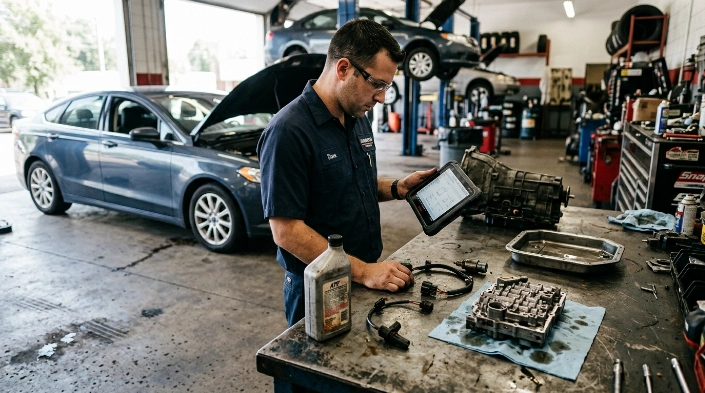
There is no single P0700 repair price. As of 2026, a useful U.S. budgeting range runs from a few hundred dollars for common service, sensor, or electrical faults to several thousand dollars for internal transmission work.
The table below is a planning guide, not a quote. Labor rates, transmission design, parts availability, vehicle age, and region can move the total considerably.
| Possible Repair | Broad 2026 Cost Range | Why the Price Varies |
|---|---|---|
| Transmission fluid/filter service | About $150–$400 | Fluid type, capacity, filter access, and service procedure |
| Speed or transmission sensor | About $150–$450 | Sensor location, parts cost, and diagnostic time |
| Shift solenoid work | About $250–$1,000 | Individual solenoid versus internal pack and pan removal |
| Wiring or connector repair | About $150–$600 | Fault location and time required to trace the circuit |
| Valve body repair or replacement | About $600–$2,500 | Transmission design and whether programming or adaptation is required |
| TCM replacement/programming | About $500–$1,800 | Module price, software access, coding, and vehicle-specific procedures |
| Transmission rebuild or replacement | About $2,500–$7,000+ | Vehicle class, unit availability, internal damage, and labor hours |
Why is the P0700 cost range so wide?
The same warning code can sit above a simple wiring fault or severe internal wear. P0700 does not distinguish between those outcomes.
A technician therefore needs the transmission-side codes before giving you a meaningful repair estimate. Without them, a large estimate is still a hypothesis.
- Vehicle design: Some components are externally accessible, while others require transmission-pan removal.
- Parts strategy: One vehicle may allow a single solenoid replacement while another uses an integrated assembly.
- Programming: Electronic modules may require vehicle-specific setup after installation.
- Labor rate: Independent shops, specialists, and dealerships often charge different hourly rates.
- Damage level: An electrical fault costs far less than worn clutches, gears, or a damaged torque converter.
Before approving expensive work, ask for a written estimate showing parts and labor separately. AAA’s repair resources also emphasize written estimates as part of informed repair decisions.
Cost note: these figures are broad budgeting ranges only. Always obtain a vehicle-specific written estimate based on the confirmed companion code and inspection findings.
Section Takeaway: P0700 does not have one fixed repair cost. Diagnose the underlying transmission fault before budgeting for a major repair.
What Causes a P0700 Code?
P0700 can appear whenever the transmission control system detects a fault serious enough to report through the powertrain diagnostics. The actual cause is usually identified by additional transmission codes and test results.
Several broad fault categories can lead to that situation. None should be assumed without checking the vehicle.
- Transmission fluid issue: Low, incorrect, overheated, or degraded fluid can contribute to shift or pressure-related faults.
- Shift-solenoid problem: An electrical or mechanical solenoid fault can interfere with hydraulic control.
- Speed-sensor fault: Incorrect input or output speed information can disrupt shift calculations.
- Wiring damage: Corrosion, loose terminals, damaged insulation, or poor connections can interrupt module signals.
- Valve-body problem: Hydraulic or electronic control faults inside the valve body can affect gear engagement.
- TCM problem: A control-module or software-related problem may trigger transmission faults on some vehicles.
- Internal transmission wear: Clutch, gear, bearing, or torque-converter problems can cause more serious companion codes.
Can low transmission fluid cause P0700?
Low fluid can contribute to transmission faults that ultimately cause the system to request a warning. It does not mean every P0700 vehicle simply needs fluid.
Some newer transmissions also lack a traditional dipstick. Their fluid level must be checked at a specified temperature and through a manufacturer-defined procedure.
Do not automatically add fluid because P0700 appeared. Overfilling or using the wrong specification can create additional problems.
Does P0700 mean the transmission is bad?
No. P0700 tells you the transmission control system reported a fault, not that the entire gearbox has failed.
A sensor, solenoid, wiring connection, fluid issue, or electronic control problem may produce the same top-level code. Internal damage is only one possibility.
This is an important money-saving distinction. A rebuild should follow evidence of internal failure, not simply the presence of P0700.
Technician-referral note: use the vehicle manufacturer’s fluid-checking procedure and transmission specifications rather than a generic online procedure.
How Should P0700 Be Diagnosed?
The first diagnostic step is to scan the transmission module, not simply clear P0700. You need the specific companion codes and related data before choosing a repair.
A basic engine-code reader may not provide that access. A full-system or manufacturer-capable scan tool is often more useful for transmission diagnostics.
- Record all codes. Save engine and transmission codes before clearing anything.
- Read freeze-frame information. Note operating conditions associated with the fault when available.
- Check symptoms. Record slipping, harsh shifts, delayed engagement, limp mode, or unusual noises.
- Inspect fluid correctly. Follow the manufacturer’s level and condition procedure.
- Inspect connectors and wiring. Look for corrosion, fluid intrusion, damaged insulation, or loose terminals.
- Use live data. A capable technician can compare commanded gear, speed signals, temperatures, and other supported parameters.
- Follow the companion code. Test the specific circuit or component indicated instead of replacing parts by guesswork.
Why does my scanner only show P0700?
Your scanner may be communicating with the engine controller but not the transmission controller. This is common with simpler code readers that focus on basic powertrain or emissions data.
An advanced OBD2 scanner can support more modules, but coverage still varies by vehicle. Check the tool’s compatibility list before buying one specifically for transmission work.
Should I clear P0700 and see if it comes back?
I prefer recording all available information before clearing codes. Erasing codes too early can remove useful diagnostic evidence and make an intermittent problem harder to trace.
After a repair, clearing codes and performing the manufacturer’s verification procedure can make sense. That is different from clearing the warning before diagnosis.
Diagnostic note: electrical measurements, solenoid activation tests, and transmission pressure tests should follow factory service information for the exact vehicle.
Section Takeaway: the companion transmission code is more valuable than P0700 itself. Scan first, preserve the data, and test before replacing anything.
Can You Drive With a P0700 Code?
Whether you should drive depends on how the transmission is behaving. A vehicle that shifts normally presents a different situation from one that is slipping, overheating, grinding, or stuck in a single gear.
P0700 should still be diagnosed promptly. Transmission faults can change quickly, and continued operation may increase repair costs when a mechanical problem exists.
Stop driving if you notice these symptoms
- Severe slipping: Engine speed rises without a matching increase in road speed.
- No gear engagement: Drive or Reverse does not engage reliably.
- Grinding or abnormal noise: Mechanical noise suggests more than a simple warning-light problem.
- Burning smell: An overheated or burnt odor deserves immediate attention.
- Repeated limp mode: The vehicle may be limiting operation because a serious transmission fault was detected.
- Unsafe acceleration: Poor or unpredictable power delivery makes normal traffic operation risky.
If drivability is poor, towing can be cheaper than turning a manageable fault into more damage. Use the correct towing method for your vehicle.
You can also check your VIN through the NHTSA recall lookup. NHTSA’s database can show unrepaired recalls and manufacturer communications associated with a vehicle.
For broader vehicle-safety information, the Insurance Institute for Highway Safety publishes independent research and consumer resources. These resources do not diagnose P0700, but they are useful when evaluating overall vehicle safety concerns.
Safety note: if the transmission will not engage correctly or the car cannot keep up safely with traffic, arrange professional inspection rather than continuing to drive.
How Can You Avoid Overpaying for P0700 Repairs?
Ask the shop to show you the transmission-specific fault information behind P0700. A large transmission quote should be supported by more evidence than one generic trouble code.
This does not mean a major repair is never justified. It means the diagnostic path should explain why that repair is needed.
Questions to ask before approving repairs
- What other codes are stored? Ask for the exact transmission-module codes.
- What tests confirmed the failed part? A code alone does not always prove component failure.
- Is the problem electrical or mechanical? That distinction can change the repair cost dramatically.
- Are parts and labor separated? A written estimate makes comparison easier.
- Does programming cost extra? Some electronic replacements require setup after installation.
- Is the repair guaranteed? Ask what the shop covers and for how long.
Independent transmission shop vs dealership
Either can be appropriate. The better choice depends on the vehicle, available diagnostic equipment, repair type, and technician experience.
| Option | Potential Advantage | What to Confirm |
|---|---|---|
| Transmission specialist | Frequent experience with gearbox diagnostics and internal repairs | Vehicle-specific scan and programming capability |
| General independent shop | May handle sensors, wiring, fluid service, and basic diagnostics efficiently | Whether advanced transmission testing is performed in-house |
| Dealership | Direct access to brand-specific procedures and factory-level equipment | Diagnostic fee, labor rate, parts policy, and programming charges |
Can you diagnose P0700 yourself?
You can perform useful preliminary work if you have a suitable scanner. Reading and recording codes can help you understand what the shop later recommends.
Do not assume that buying a scan tool turns every transmission repair into a DIY job. Some tests require safe vehicle lifting, electrical measurements, bidirectional control, programming access, or transmission-specific tools.
My preferred approach is simple: use the scanner to gather evidence, then decide whether the evidence points toward a reasonable DIY inspection or professional work. That keeps the tool useful without encouraging parts swapping.
Shop note: if a quote jumps directly from P0700 to full transmission replacement, ask what companion code, live-data result, pressure test, or mechanical inspection supports that conclusion.
Section Takeaway: the best protection against an unnecessary repair is a diagnosis you can understand. Ask for the underlying code, the confirming test, and an itemized estimate.
P0700 Repair Cost FAQ
How much is it to fix code P0700?

P0700 repair cost varies because the code does not identify one failed component. A minor fluid, sensor, or wiring repair may cost a few hundred dollars, while valve-body, control-module, or internal transmission work can run into the thousands.
Is P0700 expensive to fix?
It can be, but it is not automatically expensive. The bill depends on the transmission-specific fault stored alongside P0700, so diagnose that fault before assuming you need a rebuild or replacement transmission.
Can a transmission fluid change fix P0700?
A fluid service may help when the confirmed fault relates to fluid level, condition, contamination, or a service-related hydraulic problem. It will not repair a failed sensor, broken wire, defective solenoid, or damaged internal component.
Can a bad sensor cause P0700?
Yes, a transmission-related sensor fault can cause the control system to store a more specific code and request the warning that results in P0700. Scan the transmission module to identify the actual sensor or circuit involved.
Can a cheap OBD2 scanner diagnose P0700?
A basic reader may display P0700 but fail to access the transmission control module. For a useful diagnosis, choose a tool confirmed to support transmission-module codes and live data for your vehicle’s make, model, and year.
Does P0700 mean I need a new transmission?
No. P0700 alone never proves that the complete transmission needs replacement because electrical, hydraulic, sensor, solenoid, control-module, and internal faults can all sit behind the same top-level warning.
Should I buy parts before getting P0700 diagnosed?
Usually not. Record the transmission-specific codes and confirm the failed circuit or component first, because guessing can turn a small diagnostic fee into several unnecessary parts purchases.
P0700 deserves attention, but it should not trigger panic or an immediate transmission purchase. Start with a capable scan, identify the companion fault, and compare the diagnosis with the symptoms you are experiencing.
Once you know the root cause, the repair cost becomes much easier to judge. That is the point where you can confidently compare quotes, parts choices, and repair facilities.
