
P0715 Symptoms: Signs Your Input/Turbine Speed Sensor Circuit Has a Problem

Quick Answer
The most common P0715 symptoms are harsh or delayed shifts, erratic gear changes, transmission limp mode, poor acceleration, and an illuminated check-engine light. Some vehicles may also show slipping-like behavior, reduced fuel economy, speedometer problems, or stalling when stopping. These symptoms overlap with other transmission problems, so the code should be diagnosed before replacing parts.
Common P0715 Warning Signs
- Harsh shifting: Gear changes may feel unusually firm, abrupt, or jerky.
- Delayed shifts: The transmission may hesitate before engaging another gear.
- Limp mode: The vehicle may stay in one gear to protect the transmission.
- Check-engine light: The PCM or TCM may store P0715 and illuminate the warning light.
- Acceleration changes: Engine speed and vehicle speed may feel poorly matched.
- Possible stalling: Some vehicles may stall or stumble when coming to a stop.
What to Do
- Scan all stored codes and review live input-speed data before buying a new sensor.
P0715 can make an automatic transmission behave much worse than the failed component might suggest. I often see this distinction while using diagnostic equipment around vehicle electrical and immobilizer systems.
A scan code gives you a starting point, not a guaranteed failed part. This guide explains the symptoms, causes, diagnosis, driving risk, and likely repair paths.
In This Guide
What Are the Most Common P0715 Symptoms?
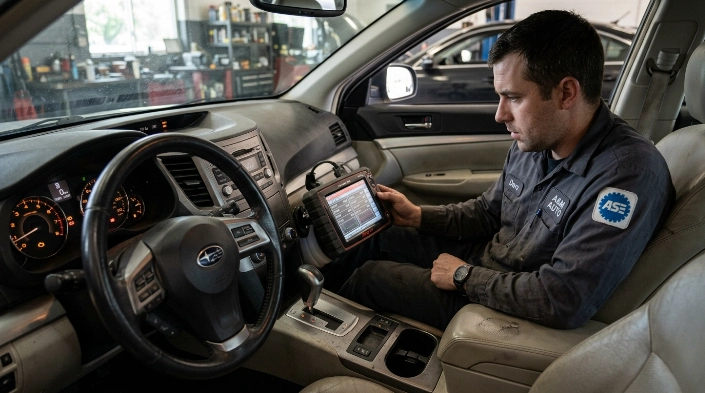
P0715 symptoms usually involve shifting because the transmission controller has lost a trustworthy input-shaft speed signal. The exact behavior depends on the vehicle and transmission design.
Harsh or Erratic Gear Changes
Hard shifting is one of the clearest signs. The transmission may suddenly engage gears with a noticeable jolt.
The controller uses transmission speed information when deciding how and when to shift. An unreliable signal can therefore affect shift timing and quality.
Delayed Shifting or Failure to Shift
Some transmissions hesitate between gears. Others may refuse to make a normal upshift or downshift.
- Delayed engagement: Drive or reverse may take longer to engage.
- Late upshifts: Engine RPM can climb before the next gear engages.
- Limited gears: The transmission may remain in a protective default gear.
Transmission Limp Mode
A vehicle may enter limp or fail-safe mode after the fault becomes serious enough. This limits transmission operation to reduce the chance of further damage.
Limp mode can feel dramatic. Acceleration may become slow, and normal gear changes may disappear.
Check-Engine or Transmission Warning Light
P0715 commonly activates the check-engine light. Some vehicles also display a separate transmission or gearbox warning.
Don’t assume the sensor itself has failed just because P0715 appears. A trouble code identifies the circuit or condition that needs diagnosis.
Poor Acceleration or Slipping-Like Behavior
The engine may rev higher than expected without a matching increase in road speed. That can resemble transmission slipping.
True mechanical slipping can produce similar symptoms. Live scan data helps separate an electrical signal problem from internal transmission trouble.
Other Possible Symptoms
- Reduced fuel economy
- Jerking during acceleration
- Unusual shift points
- Intermittent speedometer or odometer behavior on some applications
- Stalling or stumbling when coming to a stop in some cases
- No obvious driving symptoms despite a stored code
Section Takeaway: P0715 most often shows up as abnormal shifting, limp mode, or a warning light. Symptoms alone cannot confirm that the input speed sensor is bad.
What Does the P0715 Code Mean?
P0715 means the vehicle detected a problem with the transmission input or turbine speed sensor “A” circuit. It is a generic OBD-II powertrain diagnostic trouble code.
Definition: The input or turbine speed sensor measures how fast the transmission’s input side is rotating. The control module compares that information with engine RPM, output speed, vehicle speed, and commanded transmission operation.
The sensor may use an electromagnetic or another electronic design depending on the transmission. The vehicle converts its signal into rotational-speed information.
When that signal disappears, becomes electrically abnormal, or fails a rationality check, the controller may store a related fault code.
P0715 vs P0716 vs P0717
| Code | General Description | What It Suggests |
|---|---|---|
| P0715 | Input/Turbine Speed Sensor “A” Circuit | General electrical or signal fault involving the input-speed circuit. |
| P0716 | Circuit Range/Performance | A signal exists but appears outside the expected operating range. |
| P0717 | Circuit No Signal | The controller is not receiving the expected input-speed signal. |
Vehicle-specific definitions still matter. Manufacturers can apply different diagnostic logic to specific transmissions.
For that reason, check service information for your exact year, make, model, engine, and transmission.
What Causes a P0715 Code?
A failed input speed sensor is one possibility, but it isn’t the only one. Wiring and connector faults deserve equal attention early in diagnosis.
- Failed input/turbine speed sensor: The sensor may stop producing a reliable signal.
- Damaged wiring: Heat, vibration, abrasion, fluid contamination, or previous repairs can damage the circuit.
- Loose connector: Poor pin contact can create an intermittent signal.
- Connector corrosion: Moisture can increase resistance or interrupt the circuit.
- Metallic debris: Some magnetic sensors can collect debris that affects their readings.
- Damaged reluctor: A damaged tone or reluctor component can disturb the speed signal.
- Internal transmission trouble: Mechanical problems can sometimes create speed relationships the controller considers abnormal.
- Control-module issue: PCM or TCM faults are possible but should not be assumed first.
Low or badly deteriorated transmission fluid may appear alongside shifting complaints. However, P0715 is primarily a speed-sensor circuit-related code.
Changing fluid should not replace electrical diagnosis. Modern transmissions also require the correct fluid specification and service procedure.
AAA notes that many newer automatic transmissions use sealed systems and vehicle-specific fluids. Their automatic transmission fluid guidance explains why service requirements can vary substantially.
Locksmith’s note: don’t order a sensor from the trouble code alone. Confirm the transmission configuration and vehicle information before buying electrical parts.
How Do You Diagnose P0715 Correctly?
Good P0715 diagnosis starts with scan data rather than parts replacement. I want to know what the controller saw when it stored the fault.
That approach is familiar from immobilizer work too. Electronic systems are much easier to diagnose when you verify inputs before replacing modules.
1. Scan Every Stored Trouble Code
Record P0715 plus any companion transmission or engine codes. Save freeze-frame information when your scanner provides it.
Codes involving output speed, communication, voltage, or transmission control can change the diagnostic direction.
2. Review Live Transmission Data
Use an OBD-II scanner capable of reading transmission live data. Watch input speed, output speed, engine RPM, vehicle speed, and commanded gear when available.
The input-speed value should behave logically as transmission speed changes. Dropouts or obviously erratic readings deserve investigation.
3. Inspect the Connector and Harness
- Look for broken insulation.
- Check for melted or oil-soaked wiring.
- Inspect connector pins for corrosion.
- Look for loose or backed-out terminals.
- Check harness areas near hot or moving components.
Don’t overlook intermittent wiring. Vibration can open a damaged connection only while the vehicle is moving.
4. Check the Sensor Using Manufacturer Specifications
Sensor testing varies by design. Follow the manufacturer’s wiring diagram, test method, and specification for your exact transmission.
A digital multimeter may be useful for some sensors. An oscilloscope can reveal waveform problems that basic resistance testing misses.
Pro tip: never copy a resistance value, pin assignment, or test procedure from another model. Transmission electronics vary too much for a universal specification.
5. Check Manufacturer Communications
A known software, harness, sensor, or transmission issue may already have a published bulletin. NHTSA provides searchable manufacturer communications and investigation resources.
This matters because manufacturers sometimes publish model-specific diagnostic instructions. Those instructions should take priority over a generic code guide.
Section Takeaway: verify the signal, wiring, connector, and vehicle-specific service information before replacing the input speed sensor.
Can You Drive With a P0715 Code?
I wouldn’t treat P0715 as a code to ignore. Whether the car can move isn’t the same as whether continued driving is sensible.
A vehicle with mild symptoms may still reach a repair facility. Harsh shifting, slipping, overheating, or limp mode increases the urgency.
Stop Driving If You Notice These Signs
- The transmission repeatedly loses drive.
- The car will not shift normally.
- Acceleration becomes unpredictable.
- You smell burning transmission fluid.
- A transmission-temperature warning appears.
- The vehicle becomes unsafe to merge or maintain speed.
If the transmission behaves unpredictably, arrange professional diagnosis or towing. Avoid forcing the vehicle through repeated hard shifts.
You can also use the NHTSA recall lookup to check your VIN for applicable safety recalls.
A recall lookup does not diagnose P0715. It simply helps confirm whether a manufacturer has an open safety recall for your particular vehicle.
Safety note: if vehicle speed or gear engagement becomes unpredictable, prioritize safe transport over continuing the trip.
How Is P0715 Fixed and What Might It Cost?

The correct fix depends on the failed component. Replacing the sensor without testing can waste money if the problem is wiring or internal transmission damage.
Common P0715 Repairs
- Repair a damaged connector or wiring harness.
- Clean and secure electrical connections.
- Replace a failed input/turbine speed sensor.
- Correct transmission fluid level using the manufacturer procedure.
- Repair a damaged reluctor or related internal component.
- Address a confirmed TCM, PCM, or software problem.
- Repair internal transmission damage when testing proves it exists.
As of 2026, speed-sensor repair pricing varies widely by vehicle. Access to the sensor can make a major difference in labor cost.
Some speed sensors are externally accessible. Others sit inside the transmission or require substantial disassembly.
Published 2026 estimates for vehicle speed-sensor replacement can fall into the low hundreds of dollars, while some applications cost considerably more. Wiring, internal transmission work, taxes, labor rates, and location can change the final bill.
That is why I would treat any online price as a budgeting range, not a quote. Get a written estimate after diagnosis.
Pro tip: authorize diagnosis before a complete transmission replacement. P0715 can originate in a sensor circuit, so electrical test results matter.
Will Clearing the Code Fix P0715?
No. Clearing P0715 only erases the stored fault information and warning light until the system detects the problem again.
Clearing codes can still be useful after repair. A technician can then confirm whether the fault returns during an appropriate drive cycle.
Can an OBD2 Scanner Help?
Yes, especially when the scanner supports transmission data. A basic code reader may show P0715 but offer little information about why it appeared.
For useful diagnosis, look for access to freeze-frame data and transmission live-data parameters. Bidirectional functions can also help on supported vehicles.
P0715 Symptoms FAQ
What is the main symptom of P0715?
Abnormal transmission shifting is one of the most common P0715 symptoms. You may notice harsh shifts, delayed shifts, limp mode, or a transmission that refuses to change gears normally.
Does P0715 always mean the input speed sensor is bad?
No. P0715 can also result from damaged wiring, poor connector contact, corrosion, sensor contamination, reluctor problems, or less common control-module and transmission faults.
Can P0715 cause transmission slipping?
It can create symptoms that feel like slipping because the controller lacks reliable input-speed information. Genuine mechanical transmission slipping can also produce similar behavior, so live-data diagnosis is important.
Can low transmission fluid cause P0715?
Fluid problems can contribute to transmission symptoms, but P0715 specifically relates to the input or turbine speed sensor circuit. Check fluid where appropriate, but don’t assume fluid service alone will repair an electrical fault.
Can I reset P0715 with an OBD2 scanner?
Most compatible scanners can clear the code after repairs. If the underlying fault remains, the control module will usually detect the problem again and restore the code.
Is P0715 expensive to repair?
Not necessarily. A connector, harness, or accessible sensor repair can cost far less than internal transmission work, but pricing varies significantly by vehicle, region, labor rate, and sensor location.
Should I replace the sensor before testing it?
No. Check live data, wiring, connectors, related codes, and manufacturer service information first. A trouble code identifies where diagnosis should begin; it does not prove which component has failed.
The key takeaway: P0715 symptoms often look like a major transmission failure, but the root cause may be an electrical sensor-circuit problem. Scan the vehicle, verify the input-speed signal, inspect the wiring, and use vehicle-specific service information before authorizing parts or transmission work.
