
P0715 Causes: What Triggers the Input/Turbine Speed Sensor Code?

Quick Answer
The most common P0715 causes are a failed transmission input/turbine speed sensor, damaged wiring or connectors, an unstable sensor signal, metal debris around a magnetic sensor, or a damaged reluctor or target wheel. Less often, the problem comes from a transmission control module, software issue, or internal transmission fault. An OBD-II diagnostic scan should be used to confirm the signal problem before replacing parts.
Common P0715 causes
- Failed speed sensor: The input or turbine speed sensor may stop producing a dependable transmission-speed signal.
- Damaged wiring: Broken, rubbed-through, shorted, or heat-damaged wires can interrupt the sensor circuit.
- Connector problems: Corrosion, moisture, transmission-fluid contamination, or loose terminals can distort the signal.
- Reluctor damage: A damaged target wheel or internal rotating component can prevent the sensor from reading shaft speed correctly.
- Metal contamination: Metallic debris can interfere with some magnetic transmission speed sensors.
- Control problem: A TCM, PCM, calibration, or software issue is possible after the sensor circuit has been tested.
What to verify first
- Save every stored code and the freeze-frame information before clearing anything.
- Compare input speed, output speed, engine RPM, and commanded gear with a scanner that supports transmission live data.
- Check vehicle-specific service information before ordering a sensor.
P0715 can make an automatic transmission behave like it has a major mechanical failure, even when the real problem is a damaged wire or sensor signal.
In my diagnostic work around vehicle electronics, I treat this code as a clue, not a parts order. This guide explains how to separate the common P0715 causes from the expensive ones.
In This Guide
What Does P0715 Mean?
P0715 means the vehicle’s control system has detected a problem with the input/turbine speed sensor “A” circuit. It does not automatically mean the speed sensor itself is bad.
A transmission input or turbine speed sensor measures how fast the transmission’s input side is rotating. The transmission control module, or TCM, uses that information to manage shifting and compare expected shaft speed with actual shaft speed.
Definition: An input/turbine speed sensor is an electronic sensor that reports transmission input-shaft speed to the vehicle’s control module. Depending on the transmission, it may use a magnetic or other electronic sensing design.
The computer can compare this input-speed value with engine RPM, output-shaft speed, vehicle speed, throttle position, and commanded gear.
If the signal becomes missing, electrically abnormal, or inconsistent with expected operation, the module may store P0715.
- P0715: General input/turbine speed sensor “A” circuit malfunction.
- P0716: Sensor signal is outside its expected range or performance.
- P0717: The module detects no usable signal from the sensor circuit.
- P0718: The sensor circuit behaves intermittently.
Those codes are related, but their diagnostic starting points can differ. Always record the exact code instead of assuming every input-speed problem is identical.
Locksmith’s note: the sensor location, wiring diagram, test specification, and replacement procedure can change between transmission families. Verify by VIN and manufacturer service information before testing individual terminals.
What Are the Most Common P0715 Causes?

The most likely P0715 causes involve the sensor itself or the electrical path carrying its signal. Internal transmission and control-module problems are possible, but they should come later in a structured diagnosis.
1. Failed input or turbine speed sensor
The sensor can fail electrically or stop producing a clean speed signal. Heat, age, contamination, and normal component failure can all contribute.
A failed sensor may show zero RPM, sudden dropouts, or an implausible reading while the transmission is clearly rotating.
2. Damaged sensor wiring
Transmission wiring lives in a harsh environment. Heat, vibration, road debris, fluid leaks, and previous repairs can damage the harness.
- Broken conductors
- Shorts to ground or power
- Chafed insulation
- Loose terminals
- Heat-damaged wiring
- Previous poor-quality splices
A damaged harness can imitate a failed sensor perfectly. That is why I inspect wiring before buying an electronic part.
3. Corroded, loose, or contaminated connectors
A connector may look attached but still have excessive resistance or poor terminal contact. Moisture and fluid contamination deserve special attention around transmission connectors.
Look for pushed-back pins, bent terminals, green corrosion, broken seals, or fluid inside the connector.
4. Metal debris on a magnetic sensor
Some input speed sensors can attract fine metallic material produced by normal or abnormal transmission wear. Too much material around the sensing surface may disturb the signal.
Finding heavy metal contamination also raises another question. The debris may be evidence of an internal mechanical problem rather than the original fault.
5. Damaged reluctor or target wheel
The sensor needs a rotating target to create or interpret a speed signal. Damage, excessive clearance, or internal shaft problems can make that signal irregular.
This is harder to confirm than a broken wire. Some applications require transmission disassembly or specialized inspection.
6. TCM, PCM, or software problem
A control module or calibration fault is less common than a sensor-circuit problem, but it cannot be ruled out universally. Some manufacturer service bulletins specifically address P0715 through module diagnosis or software updates.
Before condemning a computer, search manufacturer communications and technical service information for your exact year, make, model, and transmission.
| Possible Cause | Typical Clue | Best Confirmation |
|---|---|---|
| Input speed sensor | Zero or unstable input RPM | Live data plus manufacturer sensor testing |
| Harness or connector | Signal changes with vibration or harness movement | Visual inspection and circuit testing |
| Metal debris | Material collected around magnetic sensor | Sensor and transmission inspection |
| Reluctor or internal target | Repeating dropouts or implausible signal | Waveform or internal inspection |
| TCM/PCM or calibration | Sensor and circuit test normally | OEM diagnostics and service-bulletin review |
Section Takeaway: Start with the sensor circuit, connector, wiring, and live data. Do not replace the transmission or control module from P0715 alone.
What Symptoms Does P0715 Cause, and Is It Safe to Drive?
P0715 can cause anything from a warning light with few noticeable symptoms to harsh shifting and limp mode. The exact behavior depends on how the manufacturer programmed the transmission controller.
- Check-engine or transmission warning light
- Harsh gear changes
- Delayed shifting
- Transmission stuck in one gear
- Failure to upshift or downshift normally
- Engine RPM flaring between shifts
- Reduced fuel economy
- Stalling while slowing on some vehicles
- Erratic speed-related data on some designs
Why does P0715 cause limp mode?
The TCM needs trustworthy speed information to calculate gear changes. If the input-speed value becomes unreliable, the computer may use a fail-safe strategy instead.
That strategy can lock the transmission into a limited gear range. The goal is usually to reduce further damage while allowing limited vehicle movement.
Can you keep driving with P0715?
I would not continue normal driving when the transmission is shifting harshly, stuck in gear, slipping, stalling, or entering reduced-power mode. Those symptoms justify prompt professional diagnosis.
If the vehicle is difficult to control or will not shift normally, arranging a tow is the safer choice.
AAA also advises drivers not to ignore warning-light problems because the underlying issue can involve the engine or transmission. Its vehicle maintenance guidance recommends prompt diagnosis when warning lights appear.
Safety note: a stored code by itself cannot tell you whether a specific vehicle is safe to drive. Base that decision on current symptoms, manufacturer guidance, and a qualified inspection.
How Do You Diagnose P0715 Correctly?
The best P0715 diagnosis moves from easy evidence to deeper testing. Clearing the code and immediately replacing the sensor throws away useful information.
Step 1: Record every diagnostic code
Connect an OBD-II scanner and record all stored, pending, and permanent codes that your tool can access. Save freeze-frame data when available.
Companion transmission codes can change the direction of the diagnosis.
- Write down P0715 and every related transmission code.
- Record engine RPM, vehicle speed, load, and temperature from freeze-frame data.
- Check whether P0716, P0717, P0718, P0720, or communication codes are also present.
- Do not erase the codes until the original data is saved.
Step 2: Inspect the transmission wiring and connector
Look around the transmission case and harness routing before using a multimeter. Physical damage often saves hours of unnecessary testing.
- Check for rubbed-through insulation.
- Look for loose or disconnected plugs.
- Inspect connector seals for moisture.
- Look for fluid contamination.
- Check for bent or pushed-back terminals.
- Inspect repairs or splices made by previous owners.
Step 3: Watch transmission input-speed live data
A scanner with transmission live data is far more useful here than a basic code reader. Monitor the input or turbine speed parameter while comparing it with engine RPM and transmission output speed.
The values will not always match each other directly because the torque converter and selected gear affect the relationship. What matters is whether the input-speed signal behaves logically and consistently.
Step 4: Test the circuit using manufacturer specifications
If the live-data signal is missing or unstable, test the sensor circuit according to the vehicle’s wiring diagram. Do not assume one resistance or voltage specification applies to every vehicle.
Different sensors can use different electrical designs.
- Verify required power or reference voltage where applicable.
- Verify ground integrity.
- Check signal wiring for opens or shorts.
- Compare sensor measurements with the manufacturer’s specification.
- Use a scope when waveform quality needs to be evaluated.
Pro tip: disconnect modules exactly as the service procedure requires before resistance testing. An incorrect test connection can damage sensitive electronics.
Step 5: Check service bulletins before deeper repairs
Vehicle-specific information matters with P0715. A code that usually points toward a sensor circuit may have a documented software, module, connector, or internal transmission issue on a particular platform.
You can search NHTSA vehicle information by year, make, model, or VIN for recalls and available manufacturer communications.
Step 6: Inspect internal components only when evidence points there
If wiring, connectors, sensor testing, and control-module checks pass, the problem may involve the reluctor, internal harness, valve body, shaft, or another transmission component.
That is the point where I would hand the job to an experienced transmission technician rather than guessing.
Section Takeaway: Good P0715 diagnosis proves what the transmission computer is seeing. Live data, circuit testing, and vehicle-specific service information should come before expensive parts.
How Is P0715 Fixed, and What Can It Cost?
The correct P0715 repair depends entirely on the failed part of the system. Replacing an input speed sensor will not fix broken wiring, damaged internal components, or an incorrect control-module calibration.
Possible P0715 repairs
- Repair a damaged wire or connector.
- Clean and secure corroded terminals.
- Replace a confirmed faulty input/turbine speed sensor.
- Repair an internal transmission harness.
- Repair a damaged reluctor or related internal component.
- Perform a manufacturer-approved TCM software update.
- Repair or replace a failed control module after proper testing.
- Repair internal transmission damage when confirmed.
How much can a P0715 repair cost?
There is no honest single price for P0715 because sensor access varies dramatically. A sensor mounted on the outside of one transmission may sit inside the transmission or near the valve body on another.
| Repair Type | Broad U.S. Planning Range | Why It Varies |
|---|---|---|
| Diagnostic scan and electrical testing | About $100-$250 | Shop rate and diagnostic depth |
| Accessible wiring or connector repair | About $100-$400 | Harness location and amount of damage |
| Accessible input speed sensor replacement | About $150-$500 | Part price and sensor accessibility |
| Internal sensor, harness, or valve-body access | Often $500-$1,500+ | Fluid, seals, disassembly, and labor |
| Major internal transmission repair | Can exceed $2,000 | Transmission design and extent of damage |
Those are budgeting ranges, not quotes. Your make, model, model year, transmission, region, parts choice, and labor rate can move the final price significantly.
An accessible connector or external sensor may be handled during a normal shop visit. Internal transmission work usually requires more labor and may require additional parts, fluid, seals, or programming.
Cost note: ask the shop what test proved the recommended component failed. A P0715 code alone does not prove that you need a new sensor, TCM, valve body, or transmission.
Section Takeaway: The cheapest P0715 repairs are usually electrical; the expensive repairs involve access or internal transmission damage. Diagnosis is what separates those two possibilities.
P0715 Frequently Asked Questions
Does P0715 always mean the input speed sensor is bad?
No. P0715 identifies a problem with the input/turbine speed sensor circuit or signal.
The root cause may be the sensor, wiring, connector, reluctor, internal transmission components, or in less common cases a control-module or software issue.
Can low transmission fluid cause P0715?
Low or badly contaminated fluid may contribute to transmission problems, but P0715 should not be diagnosed as a fluid problem from the code alone. Check the fluid only according to the manufacturer’s procedure because many modern transmissions do not use a traditional dipstick.
Can dirty transmission fluid cause P0715?
Contaminated fluid and internal wear can leave metallic material around some magnetic speed sensors. However, changing fluid is not a guaranteed fix for an electrical P0715 circuit fault.
Can I clear P0715 with an OBD-II scanner?
Many scanners can clear stored P0715 data after repairs, but clearing the code does not repair the underlying fault. Save freeze-frame information first, then verify the repair by rescanning after the appropriate drive cycle.
What is the difference between P0715 and P0717?
P0715 is a general malfunction involving the input/turbine speed sensor “A” circuit. P0717 more specifically indicates that the control module is detecting no usable signal from that circuit.
Can a bad transmission cause P0715?
Yes, internal transmission damage can cause an abnormal speed signal in some cases. Still, internal failure should not be assumed until the sensor, connector, wiring, live data, and vehicle-specific service information have been checked.
Can a bad battery cause P0715?
Low system voltage can create unusual electronic behavior, but a weak battery is not a standard diagnosis for P0715 by itself. If several unrelated voltage or communication codes appear together, testing battery and charging-system voltage becomes more important.
What Should You Do Next?
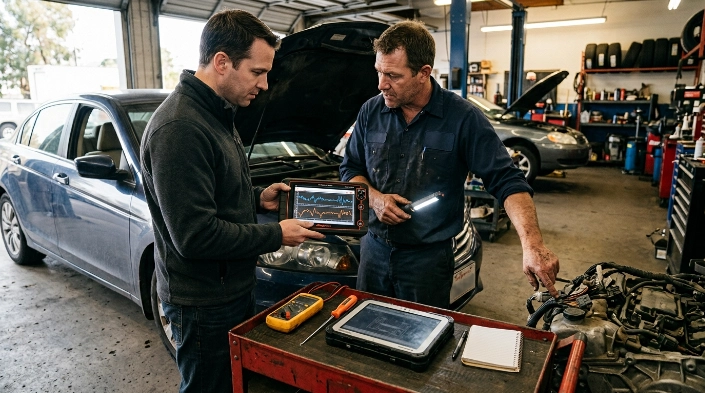
If your scanner shows P0715, start by saving the code and freeze-frame data. Then inspect the transmission connector and use live data to see whether the input-speed signal is missing, unstable, or implausible.
- Do not order a sensor from the code alone.
- Check wiring and connectors first.
- Compare transmission input and output speed data.
- Use specifications for your exact vehicle.
- Check manufacturer bulletins before expensive repairs.
- Avoid normal driving if the transmission is shifting harshly or stuck in limp mode.
As of 2026, modern transmission diagnostics depend heavily on scan data and vehicle-specific information. A basic code reader can identify P0715, but a scanner with transmission live data gives you far more useful evidence.
For me, that is the main lesson with this code: diagnose the signal before replacing the part. It is the best way to avoid turning a wiring repair into an unnecessary transmission bill.
