
How to Fix P0715: Input/Turbine Speed Sensor A Circuit

Quick Answer
To fix P0715, don’t replace the transmission speed sensor based on the code alone. Save the scan data, inspect the sensor wiring and connector, compare input-speed live data with engine and output speed, test the circuit to factory specifications, then repair the confirmed fault; you can also check your vehicle’s NHTSA record before buying parts.
Best diagnostic order
- Save scan data: Record P0715, related codes, and freeze-frame information before clearing anything.
- Inspect the harness: Look for corrosion, fluid intrusion, loose pins, heat damage, and rubbed-through wiring.
- Watch live data: Check whether transmission input speed responds smoothly while engine and vehicle speed change.
- Test the circuit: Use the correct wiring diagram and manufacturer specifications for your exact vehicle.
- Repair the cause: Fix wiring or connector faults first, or replace the sensor only after testing confirms failure.
Stop driving if
- The transmission slips badly, won’t select a gear, shifts violently, or the vehicle enters severely restricted operation.
P0715 can look like a simple sensor problem, but the trouble code only tells you which circuit the vehicle computer dislikes. A damaged wire, contaminated connector, failed sensor, software problem, or internal transmission issue can produce similar results.
I use a scan-first approach here. It reduces unnecessary parts replacement and gives you a much better chance of fixing the actual cause.
In This Guide
What Does P0715 Mean?
P0715 means the powertrain or transmission control module has detected a problem with the input/turbine speed sensor “A” circuit. It is a generic powertrain diagnostic trouble code, although the exact sensor design and repair procedure vary by vehicle.
Definition: A transmission input speed sensor measures how fast the transmission’s input shaft or turbine is rotating. The control module compares that signal with engine speed, transmission output speed, vehicle speed, and operating conditions to manage shifting.
The sensor may use a magnetic or electronic design, depending on the transmission. Its location can also range from an accessible spot on the transmission case to an internal location requiring much more labor.
P0715 therefore does not automatically mean “bad speed sensor.” The word “circuit” is important because wiring, connectors, power, ground, signal integrity, control-module software, and mechanical components can all matter.
How is P0715 different from P0716, P0717, and P0718?
| Code | General meaning | Diagnostic clue |
|---|---|---|
| P0715 | Input/turbine speed sensor “A” circuit | Start with the complete sensor circuit rather than assuming one failed component. |
| P0716 | Circuit range or performance | The signal may exist but appear implausible or outside the expected range. |
| P0717 | Circuit no signal | Focus closely on loss of signal, an open circuit, connector problems, or sensor failure. |
| P0718 | Circuit intermittent | Look for vibration, heat, loose terminals, damaged wiring, or an unstable sensor signal. |
What Symptoms and Causes Point to P0715?
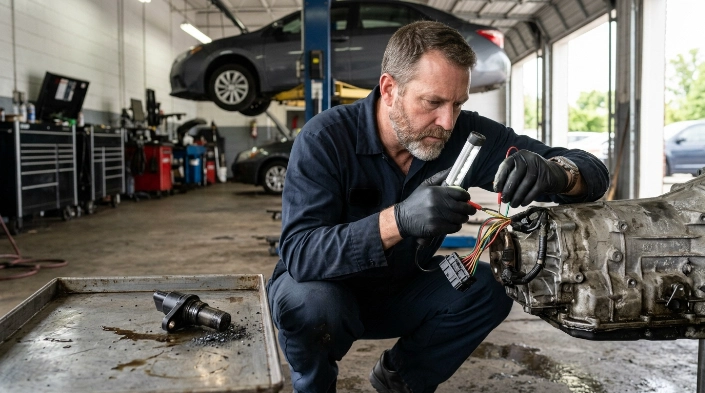
P0715 can produce anything from a warning light with few obvious symptoms to harsh shifting or restricted transmission operation. What you feel depends on how heavily the transmission controller relies on the missing or unreliable signal.
Common symptoms can include:
- Check-engine or transmission warning light
- Harsh, delayed, or unpredictable shifting
- Transmission stuck in one gear or a limited operating mode
- Failure to upshift or downshift normally
- Poor acceleration because the transmission isn’t selecting the expected ratio
- Possible speedometer or odometer irregularities on some vehicles
- Other transmission-related trouble codes stored with P0715
The most common mistake is assuming those symptoms prove the transmission itself has failed. An electrical connection that drops the input-speed signal can make a mechanically healthy transmission behave badly.
What usually causes P0715?
- Failed input/turbine speed sensor: The sensor may stop producing a usable signal.
- Damaged wiring: Heat, road debris, vibration, oil contamination, or rubbing can damage the harness.
- Connector problems: Corrosion, loose terminals, bent pins, or fluid intrusion can interrupt the circuit.
- Metal debris: A magnetic sensor can collect metallic material and produce an unreliable reading.
- Reluctor or mechanical damage: Damage to the component the sensor reads can disturb the signal.
- Control-module or software issue: Some vehicle-specific faults require updated programming instead of a new sensor.
- Internal transmission trouble: Mechanical problems can produce input-speed readings that don’t agree with expected operation.
Locksmith’s diagnostic note: don’t order a transmission sensor from the trouble code alone. Verify the VIN, transmission type, connector, and manufacturer service information before buying anything.
How Do You Diagnose P0715 With an OBD2 Scanner?
A capable OBD2 scanner is the best starting point because P0715 diagnosis depends on more than reading and clearing a code. You want freeze-frame information, related codes, and live transmission data whenever the vehicle supports them.
1. Scan every available module
Record P0715 before clearing anything. Also save transmission, engine, ABS, communication, and voltage-related codes because they can change the direction of your diagnosis.
- Write down whether P0715 is current, pending, or stored.
- Save freeze-frame engine speed, vehicle speed, temperature, and load data.
- Look specifically for P0716, P0717, P0718, output-speed codes, gear-ratio codes, and communication codes.
2. Inspect the sensor circuit before testing parts
Find the correct input/turbine speed sensor using vehicle-specific service information. Don’t assume the sensor you can see from underneath is sensor “A.”
Inspect these areas closely:
- Connector locks and terminal tension
- Green or white corrosion on terminals
- Transmission-fluid contamination inside connectors
- Harness sections touching exhaust or sharp brackets
- Crushed, stretched, melted, or rubbed-through wiring
- Poor grounds or low system voltage if other electrical codes are present
If you need factory information, use the manufacturer’s manual or official owner/service resources for your exact year and drivetrain. Never substitute a generic pinout for the vehicle’s wiring diagram.
3. Watch transmission input-speed live data
With the scanner connected, watch input or turbine speed while operating the vehicle under safe conditions. Compare that PID with engine RPM, output speed, commanded gear, and vehicle speed.
- Input speed stays at zero: Check for a lost signal, failed sensor, open wiring, or missing power/ground where applicable.
- Input speed jumps suddenly: Look for an intermittent connector, harness fault, contamination, or unstable sensor output.
- Input speed looks normal: Consider an intermittent fault, heat-related problem, software issue, or a condition that appears only under load.
- Several transmission signals are wrong: Check shared wiring, grounds, power supplies, communication faults, and module information before replacing individual sensors.
4. Test against manufacturer specifications
Use a digital multimeter and, when required, an oscilloscope to check the circuit. The correct test depends on whether the sensor is a two-wire magnetic design, Hall-effect sensor, or another manufacturer-specific setup.
Don’t copy a resistance or voltage specification from another vehicle. A number that’s correct for one transmission can be completely wrong for another.
Pro tip: disconnect modules exactly as the service information directs before resistance or continuity testing. Testing the wrong circuit configuration can damage electronics or give misleading readings.
Section Takeaway: A good P0715 diagnosis proves whether the signal, wiring, sensor, or control strategy is failing before any parts are replaced.
How Do You Fix P0715?
The correct P0715 repair depends on what failed during diagnosis. Start with the simplest confirmed fault and retest before moving deeper into the transmission.
Repair damaged wiring or connectors
If you find corrosion, loose terminals, damaged insulation, broken wires, or heat damage, repair the circuit correctly. A loose terminal can create the same code as an expensive sensor failure.
Avoid twisting wires together and covering them with household tape. Automotive wiring near a transmission faces heat, vibration, moisture, and chemicals.
Clean or replace the input speed sensor when testing supports it
If the sensor is accessible, inspect its tip and mounting area after following the manufacturer’s removal procedure. Some magnetic designs can collect metallic particles that interfere with a clean signal.
Replace the sensor if it fails the specified electrical or waveform test. Verify the exact part by VIN and transmission configuration before installation.
Inspect the reluctor or internal signal target
A new sensor cannot fix a damaged reluctor, excessive sensor gap, shaft problem, or internal component that prevents a stable speed signal. This is where an oscilloscope can be more useful than simply checking resistance.
Check for software updates and technical service bulletins
Not every P0715 repair is mechanical. For example, a confirmed 2022 Nissan Pathfinder service bulletin instructed technicians to check TCM programming and reprogram the module when applicable for a specific P0715 condition.
You can review the NHTSA-hosted Nissan service bulletin as an example of why vehicle-specific information matters. That procedure applies only to the vehicles and conditions identified in the bulletin.
Clear the code and confirm the repair
- Clear the diagnostic codes only after completing the repair.
- Start the vehicle and confirm normal transmission data.
- Perform the manufacturer-approved road-test conditions when safe.
- Watch input-speed data for dropouts or implausible changes.
- Rescan every relevant module after the drive.
If P0715 immediately returns, don’t keep clearing it. A repeat code means the underlying condition still exists or the diagnostic path missed something.
Safety note: transmission components and fluid can be extremely hot. Never work underneath a vehicle supported only by a jack.
Section Takeaway: Fix the proven failure, not the code description. Wiring repair, sensor replacement, programming, and internal transmission work are very different repairs.
Can You Drive With P0715 and What Does Repair Cost?
You shouldn’t ignore an active P0715 when the transmission is shifting poorly. A failed input-speed signal can leave the control module without information it needs for normal shift control.
A short trip for diagnosis may be reasonable if the vehicle shifts normally and no severe warning is present. Stop driving and arrange professional help if it slips, bangs into gear, won’t select a gear, overheats, or operates in a severely restricted mode.
AAA also recommends treating unusual shifting, hesitation, and slipping as transmission warning signs rather than continuing to drive until the problem gets worse. An AAA Approved Auto Repair resource can help locate a repair facility if the diagnosis is beyond your tools.
How much does P0715 repair cost?
There isn’t one reliable P0715 price because the code doesn’t identify the failed part. Labor also changes dramatically depending on whether the sensor is external, internal, or integrated into another transmission component.
As a September 2026 reference, RepairPal lists an average vehicle speed sensor replacement estimate of about $395 to $506. That is not a P0715-specific quote, and your input/turbine sensor repair may cost substantially less or more.
| Finding | Typical repair direction | Cost impact |
|---|---|---|
| Loose or damaged connector | Terminal or harness repair | Usually lower than internal transmission work |
| Failed accessible sensor | Sensor replacement | Depends heavily on part price and access |
| Software-related condition | Module programming | Requires compatible programming equipment |
| Internal sensor or mechanical fault | Transmission disassembly or internal repair | Potentially much higher because labor increases |
Cost note: get a vehicle-specific diagnosis before authorizing parts. Make, model, year, transmission type, labor rate, and region all affect the final price.
Why Does P0715 Come Back After Repair?
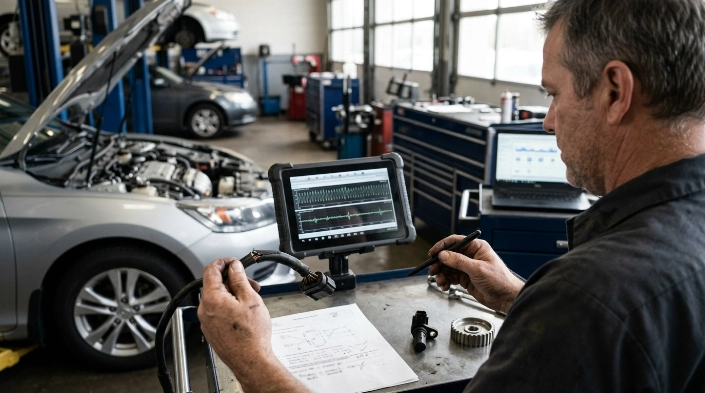
If P0715 returns after replacing the sensor, don’t assume the replacement is defective. A recurring code often means the original diagnosis focused on the component instead of the complete circuit.
Recheck these possibilities:
- The harness has an intermittent break that appears with vibration or heat.
- A connector terminal has weak tension even though it looks clean.
- The wrong sensor or transmission-specific part was installed.
- The sensor mounting surface or air gap is incorrect.
- The reluctor or internal component producing the speed signal is damaged.
- The control module requires updated software.
- Another transmission fault is causing implausible speed relationships.
Also compare the new scan data with the freeze-frame information saved before the first repair. If the code now sets under the same temperature, gear, load, or speed conditions, that pattern can narrow the remaining fault.
A technical service bulletin can be especially important at this stage. Manufacturer-specific software and transmission designs are why a generic trouble code should never be treated as a universal repair instruction.
P0715 Frequently Asked Questions
Can a bad transmission speed sensor cause P0715?
Yes. A failed input or turbine speed sensor can cause P0715, but the code doesn’t prove the sensor itself is defective. Damaged wiring, connector faults, signal-target problems, software issues, or internal transmission conditions can trigger the same circuit code.
Can low transmission fluid cause P0715?
Low fluid isn’t the first thing I would blame for an electrical circuit code. However, fluid loss, contamination, overheating, or internal transmission damage can accompany other problems, so fluid condition should be checked according to the manufacturer’s procedure.
Can I fix P0715 myself?
You can handle the initial scan, visual wiring inspection, connector checks, and some electrical testing if you have the correct service information. Stop if diagnosis requires opening the transmission, programming a control module, or testing circuits you’re not confident working around.
Where is the P0715 sensor located?
There is no universal location. The input/turbine speed sensor may mount externally in the transmission case, sit near the input shaft, or be located inside the transmission or valve-body area depending on the vehicle.
Will clearing P0715 fix the problem?
No. Clearing the code only erases stored diagnostic information and turns the warning light off temporarily if the fault isn’t currently detected. P0715 will normally return once the control module sees the underlying problem again.
What scanner data should I watch for P0715?
Start with transmission input or turbine speed, engine RPM, output speed, commanded gear, vehicle speed, and available freeze-frame data. A sudden dropout, zero reading, or implausible relationship can help identify whether the fault is electrical, intermittent, or mechanical.
Does P0715 mean I need a new transmission?
No. P0715 can result from something as localized as wiring or a failed sensor. Internal transmission problems are possible, but they should be confirmed through proper electrical, scan-data, and mechanical diagnosis before major repairs are authorized.
Final takeaway: The safest way to fix P0715 is to diagnose the input-speed circuit before replacing anything. Save your scan data, inspect the harness, verify live data, follow vehicle-specific specifications, and confirm the repair with a road test and final scan.
