
What Does P0740 Mean? Causes, Symptoms, Diagnosis & Fixes

Quick Answer
P0740 means your vehicle detected a problem in the torque converter clutch, or TCC, control circuit. It does not automatically mean the torque converter itself has failed, because wiring, connectors, the TCC solenoid, transmission fluid issues, or the transmission control system can also trigger the code. Before replacing parts, you can also check your VIN through the NHTSA recall lookup for applicable manufacturer recalls.
What P0740 usually points to
- TCC circuit fault: The control module sees an electrical problem in the torque converter clutch circuit.
- Damaged wiring: A broken, shorted, corroded, or loose connection can interrupt the solenoid circuit.
- Faulty TCC solenoid: The solenoid may fail electrically or stop responding correctly.
- Transmission issue: Fluid, valve-body, converter, or internal problems may contribute on some vehicles.
- Control-module issue: A PCM or TCM problem is possible, but it should not be assumed before circuit testing.
Best next step
- Record all stored codes and freeze-frame data, then diagnose P0740 using service information for your exact year, make, model, engine, and transmission.
Seeing P0740 on an OBD2 scanner can sound worse than it is. The important thing is understanding that the code identifies a system problem, not a guaranteed failed part.
My rule with diagnostic codes is simple: diagnose the circuit before buying the component named in the description. Below, I’ll explain what P0740 means, what causes it, how serious it can become, and how a technician normally narrows it down.
In This Guide
What Does P0740 Mean?
P0740 is a generic OBD-II powertrain diagnostic trouble code related to the torque converter clutch circuit. It commonly appears when the vehicle’s powertrain or transmission control module detects an electrical fault in the circuit used to operate the torque converter clutch.
The exact conditions that trigger P0740 vary by manufacturer. That is why a factory wiring diagram and vehicle-specific diagnostic procedure matter more than a generic parts list.
What is a torque converter clutch?
A torque converter transfers engine power into an automatic transmission through transmission fluid. Inside it, the torque converter clutch can lock the engine and transmission together more directly during suitable driving conditions.
Lockup reduces unnecessary slip and can improve efficiency. A TCC solenoid controls hydraulic pressure for that clutch on many conventional automatic transmissions.
P0740 vs. other torque converter clutch codes
| Code | General Meaning | Main Difference |
|---|---|---|
| P0740 | Torque converter clutch circuit malfunction | General TCC circuit fault |
| P0741 | TCC performance or stuck off | Commanded lockup is not performing as expected |
| P0742 | TCC stuck on | Clutch may remain applied when it should release |
| P0743 | TCC solenoid circuit electrical | More specifically identifies an electrical fault |
| P0744 | TCC circuit intermittent | Fault appears and disappears |
These codes are related, but they aren’t interchangeable. Diagnose the exact codes stored in your vehicle rather than assuming they all require the same repair.
What Causes the P0740 Code?

P0740 can have several causes because the TCC depends on electrical controls, hydraulic pressure, and mechanical components. A bad torque converter is only one possibility.
- Damaged wiring: Chafed wiring, corrosion, heat damage, or an open circuit can prevent the solenoid from receiving the correct command.
- Loose or contaminated connectors: Transmission connectors live in a harsh environment and can develop poor electrical contact.
- Faulty TCC solenoid: An internal electrical failure can stop the solenoid from controlling clutch pressure correctly.
- Internal transmission harness problem: Some transmissions place solenoids and wiring inside the pan or transmission case.
- Transmission fluid problem: Incorrect, low, degraded, or contaminated fluid may contribute to hydraulic problems on certain vehicles.
- Valve-body or hydraulic fault: Proper electrical commands won’t help if hydraulic pressure cannot reach the clutch correctly.
- Torque converter clutch failure: The clutch itself can wear or fail mechanically.
- PCM or TCM fault: Control-module problems are possible but should be confirmed after other circuit checks.
Transmission fluid deserves special attention, but don’t automatically perform a flush because P0740 appeared. AAA notes that automatic transmissions can require highly specific fluids and service procedures, so follow the manufacturer’s requirements rather than using a universal approach.
For general maintenance information, see AAA’s automatic transmission fluid service guidance.
Technician’s note: Never substitute transmission fluid based only on color or bottle claims. Verify the exact specification required for your vehicle.
What Symptoms Can P0740 Cause?
Some vehicles with P0740 show little more than a check engine light. Others develop noticeable transmission or drivability symptoms.
- Check engine or malfunction indicator light
- Higher engine RPM during steady highway driving
- Reduced fuel economy
- Unusual shifting behavior
- Shudder or vibration during lockup
- Transmission running hotter than normal
- Stalling or roughness when stopping on some vehicles
- Fail-safe or reduced-performance transmission operation on certain models
Symptoms depend on how the manufacturer designed the transmission and what actually failed. An open solenoid circuit may behave differently from a mechanically damaged converter clutch.
That variation is another reason to scan every available module. A basic scanner may display P0740 while a more capable tool can reveal related transmission codes and live data.
How Serious Is P0740, and Can You Keep Driving?
P0740 shouldn’t be ignored, even if the car still drives normally. A TCC that cannot operate correctly can increase converter slip, heat, and fuel consumption.
Short, gentle driving may be possible when the only symptom is a steady check engine light. The safer choice changes if the transmission starts slipping, overheating, banging into gear, stalling, or entering fail-safe mode.
Stop driving and arrange diagnosis if:
- The transmission is slipping badly.
- The vehicle struggles to move in Drive or Reverse.
- You smell overheated or burnt transmission fluid.
- A transmission temperature warning appears.
- The vehicle stalls unexpectedly when slowing or stopping.
- The transmission enters a severe reduced-performance mode.
It’s also worth checking for manufacturer communications or recalls when a transmission problem appears. NHTSA provides searchable recall, investigation, complaint, and manufacturer communication resources.
Safety note: If transmission behavior makes vehicle speed or acceleration unpredictable, avoid normal traffic until the problem has been inspected.
How Is P0740 Diagnosed?
A proper P0740 diagnosis starts with scan data and the factory diagnostic procedure. Replacing the torque converter or solenoid immediately can waste money if the real problem is a damaged connector.
1. Scan every available module
Record P0740 plus every other stored, pending, or transmission-specific code. Save freeze-frame information before clearing anything.
2. Check basic transmission condition
- Look for visible leaks.
- Verify fluid level only using the correct vehicle procedure.
- Confirm the fluid specification.
- Note burnt odor, severe discoloration, or contamination.
3. Inspect wiring and connectors
A technician checks the transmission harness for damaged insulation, corrosion, loose terminals, oil intrusion, and connector problems. Circuit continuity and resistance are then compared with factory specifications.
4. Test the TCC solenoid circuit
The correct electrical test depends on the transmission design. Some manufacturers specify resistance testing, while others require scan-tool commands, voltage checks, or waveform analysis.
Pro tip: Don’t use a generic resistance number from the internet. Solenoid specifications and connector terminals vary between transmissions.
5. Compare commanded and actual operation
With an advanced scanner, a technician may monitor TCC command, slip speed, engine RPM, transmission input speed, temperature, and other data. This helps separate an electrical command problem from a hydraulic or mechanical failure.
This is where good diagnosis saves money. P0740 tells you where to start looking, not which component to order.
How Do You Fix P0740, and What Can It Cost?
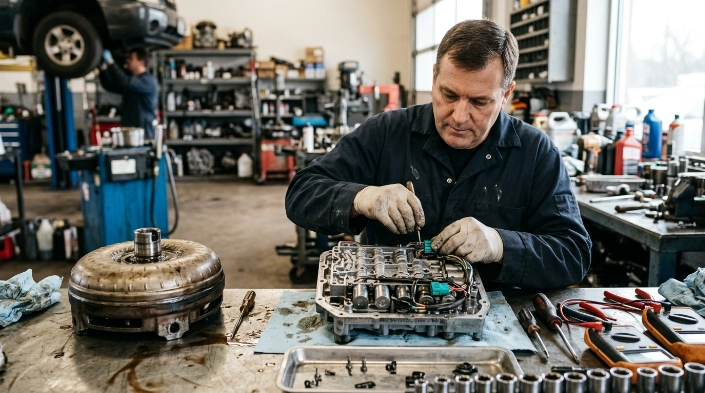
The correct P0740 repair depends entirely on what testing finds. A corroded connector may require a comparatively minor repair, while an internally damaged torque converter can require transmission removal.
| Diagnosis | Typical Repair Direction | Cost Level |
|---|---|---|
| Damaged connector or external wiring | Repair wiring or terminals | Usually lower |
| Faulty TCC solenoid | Replace solenoid or related solenoid assembly | Moderate, depending on access |
| Internal harness or valve body issue | Transmission pan or valve-body service | Moderate to high |
| Failed torque converter | Torque converter replacement | Higher due to labor |
| Internal transmission damage | Internal repair, rebuild, or replacement | Potentially highest |
As of 2026, a straightforward transmission-solenoid repair can fall in the several-hundred-dollar range on some vehicles. Torque converter work can move into four figures because the transmission often has to be removed.
Those are broad examples, not quotes. Labor rates, transmission design, parts availability, drivetrain layout, vehicle age, and regional pricing can change the final bill substantially.
Don’t treat a fluid change as a guaranteed P0740 repair either. AAA’s guidance on automatic transmission fluids emphasizes using the manufacturer’s specified fluid and proper service method.
Repair note: Ask for the diagnostic findings before approving an expensive converter or transmission replacement. A P0740 code by itself doesn’t prove either part has failed.
P0740 Frequently Asked Questions
Can low transmission fluid cause P0740?
Low transmission fluid can interfere with hydraulic operation and may contribute to torque converter clutch problems on some vehicles. However, because P0740 often relates to the TCC circuit, verify wiring and electrical operation instead of assuming fluid is the only cause.
Will changing transmission fluid fix P0740?
Not necessarily. Fresh fluid cannot repair a broken wire, failed solenoid coil, damaged connector, worn converter clutch, or faulty control circuit.
Can I drive with code P0740?
Some vehicles remain driveable with only a warning light, but continued driving can increase heat or worsen an existing transmission problem. Stop driving if you notice severe slipping, overheating, stalling, harsh engagement, or difficulty moving the vehicle.
Does P0740 mean I need a new torque converter?
No. Wiring faults, connectors, a TCC solenoid, an internal harness, hydraulic problems, and control-module issues can all be involved, so the converter should be condemned only after testing.
Can a bad TCC solenoid cause P0740?
Yes. A failed torque converter clutch solenoid is one common diagnostic possibility because the control module monitors the circuit used to operate that solenoid.
Will clearing P0740 fix the problem?
Clearing the code only erases stored diagnostic information and turns the warning light off temporarily. If the fault remains, the control module will usually detect it again and reset the code.
Can a basic OBD2 scanner diagnose P0740 completely?
A basic scanner can often retrieve P0740, but complete diagnosis may require transmission-module codes, bidirectional controls, live TCC data, a digital multimeter, and factory wiring information. Advanced tools are especially helpful when the problem is intermittent.
The takeaway: P0740 means the torque converter clutch control system needs diagnosis, not that your transmission automatically needs replacement.
Start by saving the scan data, checking for related transmission codes, and following the service procedure for your exact vehicle. Fixing a wiring or solenoid problem early can prevent unnecessary parts replacement and help you avoid turning a manageable fault into a larger transmission repair.
