
P0740 Repair Cost: What You’ll Pay in 2026

Quick Answer
P0740 repair cost can range from a relatively inexpensive wiring, fluid, or torque converter clutch solenoid repair to more than $2,000 if the torque converter must be replaced. The code means the vehicle has detected a problem in the torque converter clutch control circuit, but it does not automatically mean the transmission is bad. Before approving an expensive repair, have the vehicle properly diagnosed because several faults can trigger the same code. AAA also recommends addressing transmission warning signs early.
Typical P0740 Cost Possibilities
- Diagnosis: Expect to pay for scan-tool testing and electrical checks before replacing parts.
- Fluid service: Often roughly $100-$300 when incorrect, low, or degraded fluid contributes to the problem.
- Wiring repair: A damaged connector or wire may be one of the less expensive outcomes if access is easy.
- TCC solenoid: Roughly $150-$1,000 or more, depending on transmission design and labor access.
- Torque converter: A reasonable planning range is roughly $700-$2,200+, because transmission removal may be required.
- Internal transmission damage: Costs can rise into several thousand dollars if rebuilding or replacement becomes necessary.
Best Next Step
- Get the stored codes, transmission data, wiring, fluid condition, and TCC operation checked before authorizing a converter or complete transmission replacement.
If your scanner just displayed P0740, the repair estimate can look intimidating. I’ve seen owners assume the words “torque converter” automatically mean a four-figure transmission repair.
That assumption can waste money. This guide explains what P0740 means, what commonly causes it, and what different repair paths may cost in 2026.
In This Guide
What Does the P0740 Code Mean?
P0740 means the vehicle has detected a malfunction in the torque converter clutch circuit. It is a generic OBD-II powertrain trouble code used on many automatic-transmission vehicles.
The torque converter transfers engine power to an automatic transmission. Inside it, a torque converter clutch, or TCC, can lock the converter during certain driving conditions.
- PCM: The powertrain control module that manages engine and, on some vehicles, transmission functions.
- TCM: The transmission control module on vehicles using a separate transmission computer.
- TCC solenoid: An electrically controlled valve that helps apply or release the converter clutch.
- OBD-II scanner: The diagnostic tool used to read P0740 and related trouble codes.
When the control module commands the clutch circuit and sees an unexpected electrical response, P0740 may be stored. Wiring, connectors, the solenoid, control electronics, and transmission-related faults can all require investigation.
Does P0740 automatically mean the torque converter is bad?
No. That is one of the most expensive assumptions you can make with this code.
A faulty TCC solenoid, damaged harness, poor connector, fluid issue, or control-circuit problem can produce a P0740-related complaint. Diagnosis should come before parts replacement.
Locksmith’s note: I frequently connect scan tools while dealing with modern vehicle electronics. A stored transmission code tells me where investigation should begin, not which expensive part should immediately be replaced.
How is P0740 different from nearby transmission codes?
P0740 belongs to a family of torque converter clutch codes. Related codes can provide important diagnostic context.
- P0740: Torque converter clutch circuit malfunction.
- P0741: TCC performance or stuck-off problem.
- P0742: TCC stuck on.
- P0743: TCC electrical circuit fault.
- P0744: Intermittent TCC circuit problem.
Always record every stored and pending code before clearing anything. Multiple transmission codes can change the diagnostic path considerably.
How Much Does P0740 Cost to Repair in 2026?
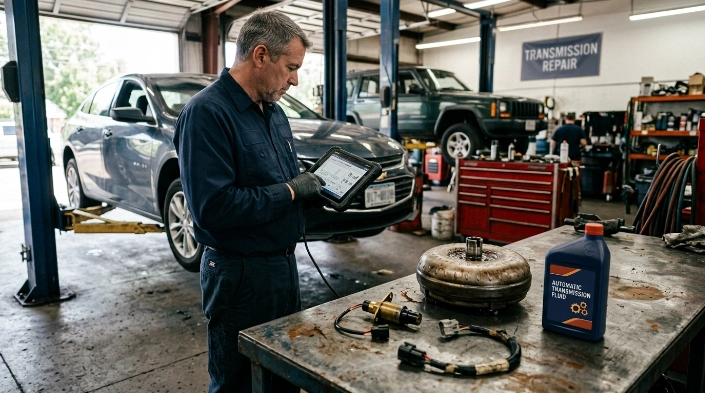
A P0740 repair can cost from a few hundred dollars for a simpler fault to $2,000 or more when major transmission labor is required. Your vehicle, transmission design, location, and actual failure determine the final bill.
Here is a practical 2026 budgeting comparison rather than a quote for any specific vehicle.
| Possible Repair | Planning Range | Why Cost Varies |
|---|---|---|
| Transmission diagnosis | Varies by shop | Scan time, electrical testing, road testing, live data |
| Fluid or filter service | About $100-$300 | Fluid type, capacity, filter design, service procedure |
| Wiring or connector repair | Often a few hundred dollars | Location of damaged wiring and diagnostic labor |
| TCC solenoid repair | About $150-$1,000+ | Some solenoids are easy to reach; others require major disassembly |
| Torque converter replacement | About $700-$2,200+ | Transmission removal creates substantial labor cost |
| Transmission replacement | Several thousand dollars | Vehicle, transmission type, OEM/remanufactured unit and labor |
The important number is not the cheapest or most expensive row. It is the price of repairing the fault that testing actually confirms.
Why can a torque converter replacement cost so much?
The torque converter itself is not always extraordinarily expensive. Access is what makes the repair costly.
On many vehicles, technicians must remove or substantially lower the transmission to replace the converter. Labor can therefore exceed the price of the component.
Pro tip: before accepting a torque converter replacement, ask what testing confirmed converter failure and whether the TCC circuit, wiring, solenoid, fluid, and valve-body operation were checked first.
Section Takeaway: P0740 does not have one fixed repair price. The correct diagnosis can be the difference between a modest electrical repair and a major transmission job.
What Causes P0740 and Changes the Repair Price?
The repair price depends primarily on which part of the TCC system failed. Several problems can produce similar symptoms, so replacing a converter based only on the code is risky.
1. Damaged wiring or connectors
Transmission wiring operates in a harsh environment. Heat, oil contamination, corrosion, road debris, and vibration can damage connectors or harnesses.
A wiring repair may be inexpensive when the damaged area is accessible. Internal transmission wiring can require substantially more labor.
2. Faulty torque converter clutch solenoid
The TCC solenoid controls hydraulic operation based on electrical commands. If its coil or internal mechanism fails, the clutch may not respond correctly.
- Some solenoids can be accessed after removing the transmission pan.
- Some are integrated into a larger solenoid assembly.
- Others require valve-body removal or additional transmission disassembly.
That access difference explains why two vehicles with the same P0740 code can receive dramatically different estimates.
3. Transmission fluid problems
Low, contaminated, degraded, or incorrect automatic transmission fluid can affect hydraulic operation. Fluid condition also provides clues about internal transmission health.
Do not assume a fluid change will fix every P0740. Burnt fluid or significant debris can instead point toward deeper problems.
4. Valve-body or hydraulic problems
The valve body directs pressurized transmission fluid. Wear, contamination, sticking valves, or hydraulic leakage can interfere with converter-clutch operation.
These faults require more detailed transmission testing. They can also cost more than a basic electrical repair.
5. Torque converter clutch failure
A worn or damaged converter clutch may fail to hold correctly. Shuddering, excess slip, heat, or unusual transmission behavior may appear with the fault.
Converter replacement usually requires significant labor. That is why confirming the failure matters.
6. Control-module problems
A PCM or TCM fault is possible, but it should not become the first guess. Power, ground, wiring, connectors, and commanded operation should be tested first.
Module replacement may also require programming or vehicle-specific setup. Never order one solely because P0740 appeared on a generic scanner.
Section Takeaway: start with diagnosis, not the most expensive component. P0740 can originate in electrical, hydraulic, or mechanical parts of the TCC system.
How Should P0740 Be Diagnosed Before Repair?
A proper P0740 diagnosis should verify the code, inspect the transmission system, and test TCC operation before expensive parts are replaced. A basic code reader identifies the fault family but does not prove which component failed.
I recommend keeping the original scan results before clearing codes. Freeze-frame data and companion codes can give a technician useful clues.
- Scan all modules: Record P0740 plus related transmission and engine codes.
- Check fluid: Confirm the correct level and inspect its condition according to the manufacturer’s procedure.
- Inspect wiring: Look for damaged connectors, corrosion, chafed wiring, poor terminal contact, or obvious harness damage.
- Review live data: A capable scanner can help compare commanded TCC operation with actual transmission behavior.
- Test the electrical circuit: The technician may perform resistance, continuity, voltage, or other manufacturer-specified checks.
- Evaluate hydraulic/mechanical operation: If electrical testing passes, the diagnosis may move toward the valve body, converter, or internal transmission.
The correct specifications vary by make, model, year, engine, and transmission. That is why universal resistance values or button-by-button procedures should not be trusted.
Pro tip: use the VIN when obtaining repair information. The same model may use different transmissions, solenoids, fluid specifications, and diagnostic procedures.
Can a cheap OBD-II scanner diagnose P0740?
A basic scanner can usually read the P0740 powertrain code. That makes it useful for discovering why the check-engine light came on.
Professional diagnosis may require transmission live data, manufacturer-enhanced codes, electrical testing, or bidirectional controls. A basic scanner alone cannot confirm every possible failure.
Should you clear P0740 and see if it returns?
Clearing the code without recording diagnostic information first can erase useful clues. Save the code and freeze-frame information when your scanner provides it.
If the code is cleared after testing, monitor whether it returns. A recurring P0740 deserves proper diagnosis rather than repeated clearing.
Can You Drive With a P0740 Code?
A vehicle with P0740 may still drive, but you should not assume continued driving is harmless. A converter clutch that cannot operate correctly can increase transmission heat and may affect drivability.
AAA identifies slipping, hesitation, unusual noises, burning smells, and abnormal shifting as transmission warning signs that deserve attention.
- Stop driving and seek help if the transmission slips severely.
- Avoid continued driving if you smell burning transmission fluid.
- Get prompt diagnosis if shifting becomes harsh or unpredictable.
- Watch for overheating or transmission-temperature warnings.
- Do not ignore stalling when slowing or stopping.
If the car only has a check-engine light and otherwise behaves normally, the situation may be less urgent. Even then, arrange diagnosis before turning a manageable fault into a larger problem.
You can also enter your VIN on the NHTSA recall lookup to check whether any open safety recalls apply to your vehicle. A trouble code itself does not prove that a recall exists.
Locksmith’s note: if the vehicle is slipping badly, overheating, stalling, or losing normal drive engagement, I would arrange professional inspection rather than continuing to drive it simply because the car still moves.
How Can You Avoid Overpaying for a P0740 Repair?

The best protection against an unnecessary P0740 repair is asking for the diagnosis behind the estimate. A code is evidence of a problem, but it is not a parts-replacement instruction.
Ask what failed
A good estimate should identify the suspected fault and explain how the technician reached that conclusion. “It has P0740” is not enough justification for replacing an entire transmission.
- Was the TCC solenoid electrically tested?
- Was the harness checked for opens or shorts?
- Was transmission fluid inspected?
- Were related codes present?
- Was TCC command or slip data reviewed?
- What evidence indicates converter or internal transmission failure?
Compare the complete estimate
Compare parts, labor, fluid, gaskets, programming, taxes, diagnostic charges, and warranty coverage. A lower headline price may exclude necessary work.
The AAA Auto Repair network is one place owners can use when looking for repair facilities. You can also compare reputable independent transmission specialists with dealership estimates.
Check warranty and recall coverage first
Before paying for a major repair, check your vehicle’s remaining factory, extended, or powertrain warranty. Coverage depends on your vehicle and warranty terms.
Also check manufacturer campaigns and NHTSA recall information using the VIN. Do not assume a generic P0740 code qualifies for free repair.
Be cautious with instant transmission replacement recommendations
A complete replacement may be justified when testing confirms widespread internal damage. However, current transmission replacement costs can reach several thousand dollars, making confirmation especially important.
For perspective, current national estimates for complete transmission replacement are far higher than common fluid, wiring, or solenoid repairs. The financial gap makes accurate diagnosis valuable.
Section Takeaway: ask for test results and a detailed estimate before approving major work. Spending money on diagnosis can prevent spending much more on an incorrect repair.
P0740 Repair Cost FAQ
How much does it usually cost to fix code P0740?
P0740 repair cost varies widely. A simpler wiring, fluid, or solenoid problem may cost a few hundred dollars, while torque converter replacement can reach roughly $700-$2,200 or more depending on the vehicle and labor required.
Does P0740 mean I need a new transmission?
No. P0740 identifies a torque converter clutch circuit problem, not a confirmed failed transmission. Wiring, connectors, the TCC solenoid, fluid condition, control electronics, hydraulic faults, or the converter itself should be evaluated before a complete transmission is condemned.
How much does a torque converter clutch solenoid cost to replace?
A broad planning range is around $150-$1,000 or more. The solenoid itself may not be expensive, but labor varies because some transmissions provide relatively easy access while others require valve-body work or substantial disassembly.
Can low transmission fluid cause P0740?
Fluid level and condition can affect transmission and converter-clutch operation, so they should be checked during diagnosis. However, finding P0740 does not prove that low fluid is the cause, and adding fluid without confirming the correct level and specification can create other problems.
Can I fix P0740 myself?
A DIY owner can read codes and visually inspect accessible wiring or connectors. Electrical testing, transmission live-data analysis, valve-body work, and torque converter replacement require greater skill, correct service information, and vehicle-specific tools.
Will changing transmission fluid fix P0740?
Sometimes a fluid-related issue contributes to poor converter-clutch operation, but a fluid service is not a guaranteed P0740 repair. A failed solenoid, electrical circuit, converter, valve body, or internal transmission fault will still require specific repair.
Is P0740 expensive to fix?
It can be, but not every P0740 is expensive. The cost depends on whether the problem is a connector or wiring issue, a TCC solenoid, a hydraulic fault, the torque converter, or broader internal transmission damage.
The bottom line: diagnose P0740 before buying parts.
Start with the stored codes, fluid condition, wiring, and TCC operation. If a shop recommends a torque converter or complete transmission, ask what testing confirmed that repair before approving the bill.
