
P0750 Symptoms: What This Shift Solenoid Code Means

Quick Answer
P0750 means the vehicle has detected a malfunction involving transmission shift solenoid A. Common P0750 symptoms include hard or delayed shifting, failure to shift properly between lower gears, limp mode, reduced acceleration, increased fuel use, and a Check Engine Light. You can also check your vehicle’s recall and manufacturer communication history through NHTSA while diagnosing the problem.
Common Signs of P0750
- Check Engine Light: The PCM or TCM stores the transmission fault and usually switches on the warning light.
- Hard shifting: Gear changes may feel unusually harsh or abrupt.
- Delayed shifts: Engine speed may rise before the transmission changes gears.
- Stuck gear: Some vehicles may remain in one gear or enter a protective limp mode.
- Poor acceleration: The vehicle may feel sluggish because the transmission cannot select the expected ratio.
- Higher fuel use: Driving in the wrong gear can increase engine speed and fuel consumption.
Before Replacing Parts
- Confirm the code with an OBD2 scanner, inspect transmission fluid condition, and check related codes before assuming the solenoid itself has failed.
If your OBD2 scanner shows P0750, don’t treat the code as an automatic instruction to replace a transmission solenoid. The code identifies where the control system detected a problem, not necessarily which component caused it.
I’ve seen transmission fault codes become expensive when diagnosis starts with parts instead of evidence. This guide explains the symptoms, causes, severity, testing process, and repair possibilities in plain language.
In This Guide
What Does the P0750 Code Mean?
P0750 is a generic OBD2 powertrain code for a shift solenoid A malfunction. It applies to many vehicles with electronically controlled automatic transmissions, although the exact transmission design varies.
A shift solenoid is an electrically controlled valve. The transmission control system uses these solenoids to manage hydraulic fluid flow and help select the correct gear.
What does shift solenoid A do?
In many transmissions, shift solenoid A is involved in lower-gear changes, often including the first-to-second gear transition. You shouldn’t assume that layout applies to every vehicle.
Manufacturers use different valve bodies, solenoid arrangements, and control strategies. Always confirm the manufacturer’s service information for your exact year, make, model, engine, and transmission.
- PCM: The powertrain control module manages engine and transmission-related functions on many vehicles.
- TCM: The transmission control module manages transmission operation when a separate controller is used.
- Shift solenoid: An electromagnetic valve that controls transmission fluid through specific hydraulic passages.
- Valve body: The hydraulic control assembly that routes transmission fluid to clutches and other transmission components.
The controller expects transmission speed and gear behavior to respond when it commands a shift. P0750 can appear when the expected response does not occur.
Technician’s note: Don’t order a solenoid using the trouble-code description alone. Verify the transmission identification and manufacturer service information first.
What Are the Most Common P0750 Symptoms?

The most recognizable P0750 symptoms are shifting problems and a Check Engine Light. The exact behavior depends on the transmission and the type of failure.
Some vehicles show obvious symptoms immediately. Others may store the code before the driver notices a major difference.
1. Check Engine Light
The Check Engine Light is often the first clue. An OBD2 scanner may then reveal P0750 along with other transmission-related trouble codes.
Don’t diagnose P0750 in isolation if several codes are present. Related electrical or transmission codes can change the direction of the diagnosis.
2. Hard or harsh shifting
A transmission may shift with a noticeable jolt when fluid pressure isn’t being controlled as expected. The problem can be intermittent or happen during specific gear changes.
3. Delayed gear changes
You may press the accelerator and hear engine RPM rise before the next gear engages. That delay can feel like the transmission is hesitating.
Delayed engagement isn’t unique to P0750. Low fluid, internal wear, hydraulic problems, and other solenoid faults can cause similar behavior.
4. Transmission remains in one gear
Some control systems respond to a transmission fault by limiting normal shifting. Drivers often describe this as the vehicle being “stuck” in a particular gear.
This protective strategy is commonly called limp mode or fail-safe operation. Its exact behavior depends on the manufacturer.
5. Poor acceleration
A vehicle starting or remaining in an unsuitable gear may accelerate slowly. Engine RPM can also feel unusual for the vehicle’s road speed.
6. Increased fuel consumption
Fuel economy may drop if the transmission cannot select an efficient gear. The engine can run at higher RPM than normal during everyday driving.
7. No obvious driving symptom
Occasionally, P0750 can appear without an immediately noticeable shift complaint. That doesn’t mean you should ignore it.
An intermittent connector, developing electrical fault, or early hydraulic problem may only show under particular operating conditions.
| Symptom | What You May Notice | What It Suggests |
|---|---|---|
| Check Engine Light | Warning light with P0750 stored | Controller detected abnormal shift-solenoid operation |
| Harsh shifting | Noticeable bump or jolt | Pressure or shift control may be abnormal |
| Delayed shift | RPM rises before gear change | Hydraulic or solenoid response may be delayed |
| Stuck gear | Limited shifting or fail-safe operation | Transmission controller may be protecting the system |
| Poor fuel economy | Higher RPM during normal driving | Transmission may not be reaching the expected gear |
Section Takeaway: P0750 symptoms can range from only a warning light to severe shifting problems. The symptoms alone cannot prove that the solenoid itself needs replacement.
What Causes a P0750 Code?
P0750 can result from an electrical, hydraulic, fluid-related, or mechanical transmission problem. A failed shift solenoid is only one possibility.
That’s why replacing solenoid A immediately can waste money. Start with the easier checks and use scan data to narrow the fault.
Common causes include:
- Failed shift solenoid A: The solenoid may stick mechanically or fail electrically.
- Damaged wiring: Broken, rubbed-through, shorted, or corroded wiring can interrupt the circuit.
- Poor connector contact: Bent terminals, corrosion, moisture, or loose connections can create intermittent faults.
- Low transmission fluid: Insufficient fluid can interfere with normal hydraulic operation.
- Contaminated fluid: Dirty or degraded fluid can contribute to restricted hydraulic passages or valve movement.
- Valve-body problems: A sticking valve or hydraulic restriction can prevent the commanded shift from occurring properly.
- Internal transmission wear: Clutch or hydraulic problems can mimic a solenoid-control fault.
- Control-module problem: PCM or TCM failure is possible, but it should normally be considered after more common causes are tested.
Can dirty transmission fluid cause P0750?
Yes, fluid condition can be relevant because shift solenoids depend on controlled hydraulic flow. Contaminated fluid may contribute to restrictions or sticking components.
However, changing fluid is not a guaranteed P0750 repair. Burnt fluid or significant debris can also point toward a deeper transmission problem.
Technician’s note: Use the fluid type and checking procedure specified by the vehicle manufacturer. Some transmissions require a precise temperature and procedure to verify fluid level correctly.
How Serious Is P0750, and Can You Keep Driving?
P0750 should be treated as a significant transmission fault, especially when shifting is already abnormal. Continued driving may worsen drivability and can place additional stress on transmission components.
The safest choice depends on how the vehicle behaves. A warning light without obvious symptoms is different from a vehicle that slips, bangs into gear, overheats, or barely accelerates.
Stop driving and arrange professional help if:
- The vehicle cannot shift normally.
- The transmission slips heavily.
- You smell burnt transmission fluid.
- The vehicle enters a severely restricted limp mode.
- Acceleration becomes unpredictable.
- You notice a significant transmission-fluid leak.
- A transmission-temperature warning appears.
If you’re unsure whether the vehicle is safe to drive, having it inspected or transported is safer than experimenting on the road. AAA provides an Approved Auto Repair locator for drivers looking for participating repair facilities.
You can also search your VIN through NHTSA’s recall database. That helps identify open safety recalls and available manufacturer communications associated with a vehicle.
Remember that a recall lookup doesn’t diagnose P0750. It simply gives you useful vehicle-specific context before paying for repairs.
Technician’s note: If shifting becomes unpredictable or the transmission will not select gears normally, avoid unnecessary driving until the fault is diagnosed.
Section Takeaway: A P0750 code isn’t something to ignore. Driving risk depends on the symptoms, so severe shifting problems deserve prompt professional attention.
How Do You Diagnose P0750 Correctly?
Diagnosis starts by confirming the code, checking related codes, inspecting fluid, and evaluating the solenoid circuit before replacing components. Vehicle-specific service information matters because transmission designs differ.
An OBD2 scanner can tell you what the controller detected. It cannot automatically tell you which physical part failed.
A sensible P0750 diagnostic sequence
- Scan every available module. Record P0750 plus any related transmission, voltage, communication, or speed-sensor codes.
- Save freeze-frame information. Note operating conditions when the controller stored the fault.
- Check transmission fluid. Follow the manufacturer’s fluid-level procedure and look for leaks, contamination, or a burnt smell.
- Inspect accessible wiring. Look for damaged insulation, loose connectors, moisture, corrosion, and harness contact with hot or moving parts.
- Review live scan data. A capable scanner may show commanded gear, input speed, output speed, and transmission-related data.
- Test the electrical circuit. A qualified technician can use the correct wiring diagram and specifications to evaluate the solenoid circuit.
- Evaluate hydraulic or mechanical causes. If the circuit checks correctly, valve-body or internal transmission diagnosis may be required.
Can a basic OBD2 scanner diagnose P0750?
A basic scanner can usually read and clear generic powertrain codes. That’s enough to identify P0750, but often not enough for a complete transmission diagnosis.
More capable scan tools may display transmission live data and manufacturer-specific codes. Those extra details can help separate an electrical fault from a hydraulic or mechanical problem.
Don’t clear the code too early
Clearing P0750 before recording diagnostic information can erase useful evidence. Save codes and freeze-frame data first.
If the code returns immediately after clearing, an active electrical fault may be present. A code that returns only during certain driving conditions may require a more detailed road-test diagnosis.
Technician’s note: Avoid probing control-module or transmission circuits without the correct wiring diagram. Incorrect testing can damage terminals or electronic components.
Section Takeaway: P0750 diagnosis should confirm whether the problem is electrical, hydraulic, fluid-related, or mechanical. The trouble code alone does not prove the solenoid is defective.
How Is a P0750 Code Fixed?
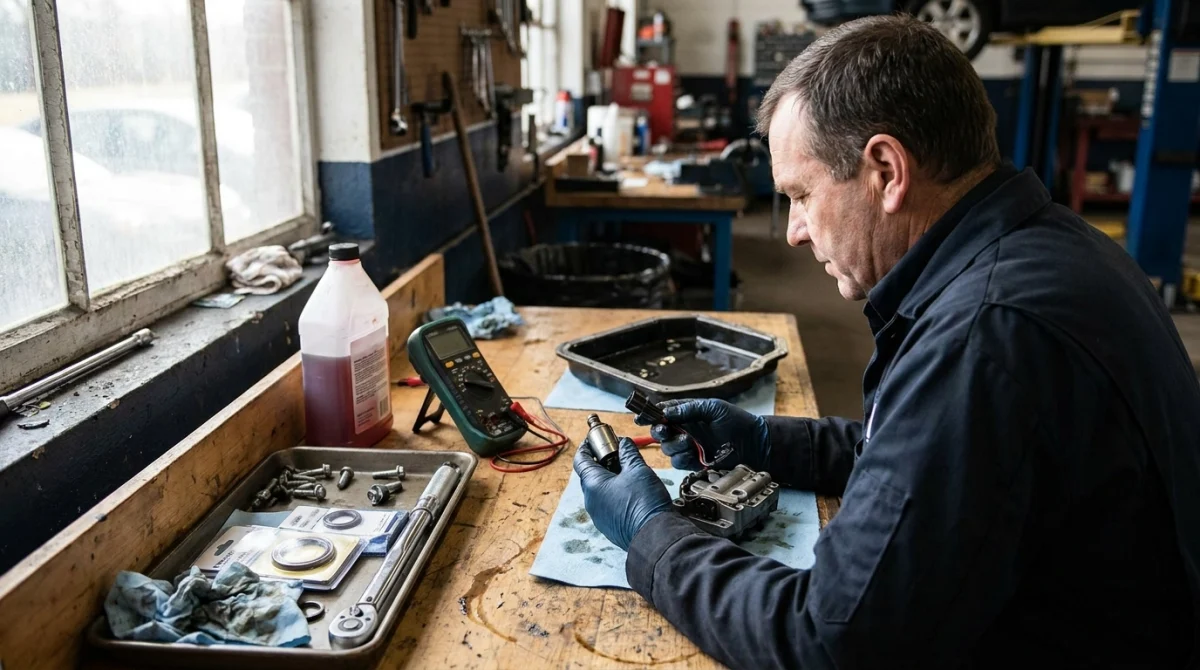
The correct P0750 repair depends on what testing finds. There is no single repair that applies to every vehicle showing this code.
Simple external wiring problems may be relatively straightforward. Internal transmission or valve-body problems require much more labor.
Possible repairs include:
- Repairing damaged wiring or terminals.
- Cleaning or securing an electrical connector when appropriate.
- Correcting a transmission-fluid leak.
- Servicing transmission fluid according to manufacturer requirements.
- Replacing a confirmed faulty shift solenoid.
- Repairing or replacing a valve-body component.
- Repairing internal transmission damage.
- Updating or diagnosing the control module when manufacturer procedures identify a software or module issue.
Should you replace shift solenoid A yourself?
That depends heavily on the transmission. Some solenoids can be reached after removing the transmission pan, while others require much more disassembly.
Correct fluid, cleanliness, tightening procedures, seals, transmission identification, and service information all matter. A small mistake can create another transmission problem.
| Repair Situation | Typical Difficulty | Best Approach |
|---|---|---|
| Visible damaged connector | Low to moderate | Verify circuit and repair correctly |
| Fluid leak or incorrect level | Varies | Find leak and follow manufacturer fluid procedure |
| Confirmed solenoid failure | Moderate to high | Use transmission-specific service information |
| Valve-body fault | High | Professional transmission diagnosis recommended |
| Internal transmission damage | Very high | Transmission specialist diagnosis |
How much does fixing P0750 cost?
There isn’t one reliable price because the underlying problem can range from wiring damage to internal transmission work. Labor rates, vehicle design, parts availability, and location also change the total.
Ask the shop to diagnose the cause before approving major transmission work. A written estimate should separate diagnostic labor, parts, fluid, and repair labor when possible.
Technician’s note: Get a vehicle-specific diagnosis before buying a solenoid or valve body. Parts compatibility can depend on VIN, transmission code, production date, and calibration.
Section Takeaway: Fix the cause of P0750 rather than replacing the part named in the code. Proper testing can prevent unnecessary transmission repairs.
P0750 Frequently Asked Questions
Can low transmission fluid cause P0750?
Low transmission fluid can contribute to abnormal hydraulic operation and shifting problems, so fluid level should be checked during diagnosis. However, P0750 can also result from wiring, connector, solenoid, valve-body, or internal transmission faults.
Will P0750 cause the transmission to slip?
It can appear alongside slipping or delayed engagement, but those symptoms don’t confirm a failed shift solenoid. Low fluid, worn clutches, hydraulic problems, and other transmission faults can produce similar behavior.
Can dirty transmission fluid trigger P0750?
Contaminated or degraded fluid can interfere with hydraulic control and contribute to sticking valves or solenoids. Fluid condition is therefore an important diagnostic check, but a fluid service won’t fix every P0750 fault.
Can I drive with a P0750 code?
Driving may be possible when symptoms are mild, but continuing to drive with harsh shifts, slipping, overheating, or restricted gear operation can be risky. If transmission behavior is significantly abnormal, arrange diagnosis rather than continuing normal driving.
Can a bad battery cause P0750?
Low system voltage can create unusual electronic faults, so battery and charging-system problems should be considered when several unrelated codes appear together. A P0750 that repeatedly returns after normal voltage is restored still requires transmission-specific diagnosis.
Does P0750 always mean shift solenoid A is bad?
No. P0750 identifies a malfunction associated with the shift-solenoid A system, but the actual cause may be wiring, connectors, fluid condition, hydraulic restrictions, valve-body problems, internal transmission faults, or less commonly a control issue.
Will clearing P0750 fix the problem?
Clearing the code only removes the stored diagnostic information and warning light temporarily. If the underlying fault remains, P0750 will usually return when the controller detects the problem again.
If P0750 has appeared on your scanner, record all codes before clearing anything. Check the fluid and obvious wiring issues, then use vehicle-specific diagnostic information or have a qualified transmission technician test the system.
The important part is simple: diagnose the cause before replacing the solenoid. That approach gives you the best chance of fixing the shifting problem without buying unnecessary parts.
