
What Does P1101 Mean? Causes, Symptoms, and How to Fix It

Quick Answer
P1101 is a manufacturer-specific powertrain trouble code. On many General Motors vehicles, P1101 means Intake Air Flow System Performance, indicating that measured or calculated airflow isn’t matching what the engine control module expects. GM service information published through NHTSA’s manufacturer communications database confirms this definition for affected Chevrolet and related GM applications.
What to check first
- Confirm the definition: P1101 is manufacturer-specific, so verify the code for your exact year, make, model, and engine.
- Inspect the intake: Look for loose ducts, disconnected hoses, damaged seals, or obvious air leaks.
- Check related codes: Codes such as P0101, P0171, P0172, P0299, or P0506 can give important diagnostic clues.
- Review live data: A capable OBD2 scanner can show mass airflow, fuel trims, throttle position, and other useful readings.
- Don’t replace parts blindly: A P1101 code doesn’t automatically mean the mass airflow sensor has failed.
Important
- If the engine has severely reduced power, stalls, or runs poorly, diagnose the problem before continuing normal driving.
If your OBD2 scanner just displayed P1101, don’t assume you need a new sensor. This code is better treated as a clue that the engine’s airflow readings aren’t behaving as expected.
I approach P1101 by checking the vehicle-specific definition first, then looking at the entire intake path. That prevents an expensive guessing game with sensors and throttle-body parts.
In This Guide
What Does the P1101 Code Mean?
On applicable GM vehicles, P1101 means Intake Air Flow System Performance. The engine control module has detected an airflow relationship that falls outside its expected operating range.
P1101 is not a universal code with the same definition on every manufacturer. Codes beginning with P1 are generally manufacturer-specific, so your vehicle information matters.
What is an OBD2 trouble code?
An OBD2 diagnostic trouble code is information stored by a vehicle’s computer after it detects a monitored condition outside the expected range. A scanner retrieves that code through the diagnostic connector.
The code identifies a system or fault category. It usually doesn’t identify the failed component by itself.
AAA’s OBD diagnostic information also explains that trouble codes provide technicians with clues used to identify the underlying problem. That’s the right way to think about P1101.
What does P1101 mean on Chevrolet and GM vehicles?
GM service bulletins identify P1101 as Intake Air Flow System Performance on several Chevrolet, GMC, Buick, and Cadillac applications. However, the affected components and diagnostic path vary by vehicle.
For example, a GM bulletin covering 2016–2019 Chevrolet Cruze models with the 1.4L LE2 engine lists P1101 alongside P0101, P0171, P0172, and P0300.
Another bulletin covering certain 2018–2022 Chevrolet Equinox, Malibu, and GMC Terrain applications lists P1101 with possible reduced engine power.
- P0101: Mass Air Flow Sensor Performance
- P0171: Fuel Trim System Lean
- P0172: Fuel Trim System Rich
- P0299: Engine Underboost
- P0300: Engine Misfire Detected
- P0506: Idle Speed Low
- P1101: Intake Air Flow System Performance
Section Takeaway: P1101 describes an airflow performance problem on applicable GM vehicles. It does not prove that one particular sensor or component has failed.
What Symptoms Can P1101 Cause?
A check engine light may be the only obvious symptom. Other vehicles can have noticeable drivability problems depending on the source of the airflow fault.
Possible symptoms include:
- Check engine light: The malfunction indicator lamp may remain illuminated after P1101 is stored.
- Reduced engine power: Some GM service bulletins associate P1101 with reduced-power complaints.
- Hesitation: Unexpected airflow can affect engine response during acceleration.
- Rough or unstable idle: An intake leak or airflow problem can disturb idle control.
- Stalling: A significant intake or charge-air fault may cause severe drivability symptoms.
- Poor acceleration: Turbocharged applications may feel weak if a charge-air connection has separated.
Don’t diagnose P1101 from symptoms alone. Several fuel, ignition, boost, and intake faults can create similar behavior.
That’s where an OBD2 scanner becomes useful. Freeze-frame data and related codes can show what the engine was doing when the fault occurred.
What Causes a P1101 Code?
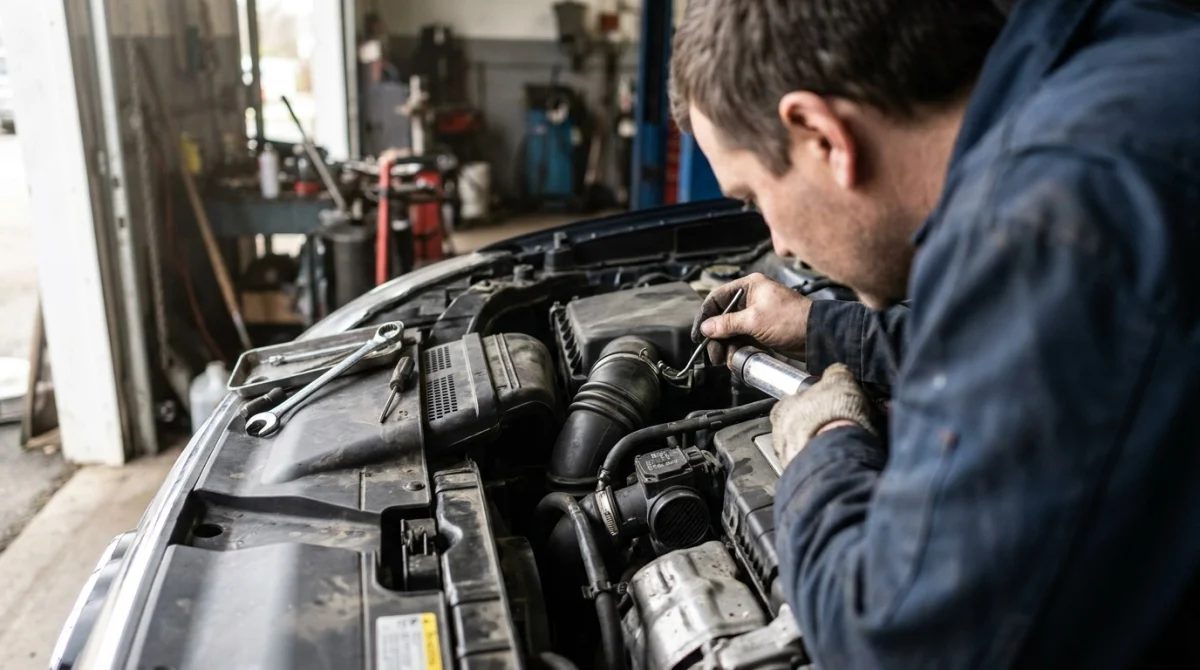
P1101 can have several causes because the engine computer evaluates airflow as a system. The correct cause depends heavily on the vehicle and engine.
GM’s own service information demonstrates why parts shouldn’t be replaced based on the code alone.
1. Intake or charge-air leaks
An air leak can make actual airflow differ from the value expected by the engine computer. Loose clamps, split ducts, seals, and disconnected pipes all deserve inspection.
A GM preliminary-information bulletin covering several turbocharged Buick, Cadillac, Chevrolet, and GMC vehicles specifically tells technicians to inspect for a missing or damaged O-ring in a charge-air cooler connection.
Technician’s note: Leak testing should follow the manufacturer’s service procedure, especially on turbocharged intake systems.
2. Charge-air cooler tube separation
GM documented another specific condition on certain 2018–2022 Equinox, Malibu, and Terrain applications. The charge-air cooler outlet tube could separate from the throttle-body connection.
The bulletin instructs technicians to inspect the tube, retaining clip, throttle body, and sealing components rather than automatically replacing the MAF sensor.
3. Air filter or air-cleaner installation problems
Even something around the air-cleaner assembly can matter. GM documented an improperly installed air-cleaner element bracket on certain Cruze applications.
The condition could distort or misalign the filter assembly and allow an improper seal at the intake duct.
4. Contaminated or faulty airflow measurement
The mass airflow sensor, commonly called the MAF sensor, measures incoming air on vehicles that use one. Contamination, wiring problems, connector faults, or a failed sensor can produce incorrect data.
Still, a MAF-related code doesn’t automatically condemn the sensor. GM explicitly warns against replacing the MAF sensor unless diagnosis shows it is damaged or causing the fault.
5. Throttle-body or intake-system problems
The throttle body controls incoming airflow based on accelerator demand and engine-management commands. Deposits, mechanical problems, air leaks, or electronic faults may influence calculated airflow.
Use scan data before replacing it. Commanded throttle position, actual throttle position, MAF readings, fuel trims, and related codes can help narrow the fault.
Section Takeaway: The most useful P1101 diagnosis checks the complete airflow path first. Loose connections and leaks can imitate an expensive sensor failure.
How Do You Diagnose P1101?
Start with the scan report rather than clearing the code immediately. Stored information can provide clues that disappear once codes and adaptive data are erased.
I use a system-first diagnostic order for codes like P1101.
- Verify the exact code definition. Enter the correct year, make, model, and engine into your scanner or service-information system.
- Record all codes. Write down current, pending, and history codes before clearing anything.
- Review freeze-frame data. Note RPM, engine load, airflow, fuel trims, speed, and temperature when available.
- Inspect the air-intake path. Check the air box, filter seating, ducts, clamps, hoses, seals, and throttle-body connection.
- Inspect charge-air plumbing. Turbocharged engines also need the intercooler and charge pipes checked for separation or leakage.
- Check electrical connections. Inspect MAF, throttle-body, and relevant pressure-sensor connectors for damage or poor contact.
- Review live scanner data. Look for readings that don’t agree with engine speed, load, throttle position, and fuel-trim behavior.
- Follow vehicle-specific service information. Manufacturer diagnostic procedures should determine the final testing and repair path.
Technician’s note: Don’t perform a smoke or pressure test beyond the limits specified for your vehicle’s intake system. Use the manufacturer’s procedure and suitable equipment.
What can related codes tell you?
Companion trouble codes can turn a broad airflow problem into a much more focused diagnosis. Read every stored code before deciding what to repair.
| Code | GM Description | Diagnostic Direction |
|---|---|---|
| P0101 | Mass Air Flow Sensor Performance | Compare MAF readings with intake condition and expected airflow. |
| P0171 | Fuel Trim System Lean | Look closely for unmetered air and other lean-running causes. |
| P0172 | Fuel Trim System Rich | Review airflow measurements, fueling data, and related sensors. |
| P0299 | Engine Underboost | Inspect turbocharger charge-air plumbing and connections. |
| P0300 | Engine Misfire Detected | Determine whether airflow problems are contributing to misfires. |
| P0506 | Idle Speed Low | Check airflow control, throttle operation, and intake integrity. |
Technical service bulletins can provide another clue. NHTSA provides access to manufacturer communications and technical service information for many vehicles.
Section Takeaway: Read P1101 together with freeze-frame data, companion codes, and physical intake-system findings. The code alone isn’t enough to justify replacing a component.
Can You Drive With a P1101 Code?
Whether you should continue driving depends on how the vehicle behaves. A steady check engine light with normal operation is different from reduced power, stalling, or severe hesitation.
Use these symptoms as practical warning signs:
- Stop and seek diagnosis promptly: The engine stalls, loses substantial power, or becomes difficult to control safely.
- Avoid hard acceleration: The vehicle has a boost leak, unusual noises, or obvious intake plumbing damage.
- Arrange service soon: The check engine light remains on even though the vehicle seems to drive normally.
- Don’t ignore a flashing light: A flashing malfunction indicator can indicate a more urgent engine problem and should be treated seriously.
AAA recommends professional evaluation when the check engine light appears and advises reaching a safe location when the light flashes during operation.
You can also enter your VIN into NHTSA’s recall lookup to check whether your vehicle has an unrepaired safety recall. A diagnostic code or technical service bulletin isn’t automatically a recall.
Safety note: If the vehicle can’t accelerate predictably, stalls in traffic, or displays a manufacturer warning telling you to stop, follow the owner’s manual and arrange appropriate service or towing.
How Is P1101 Fixed?
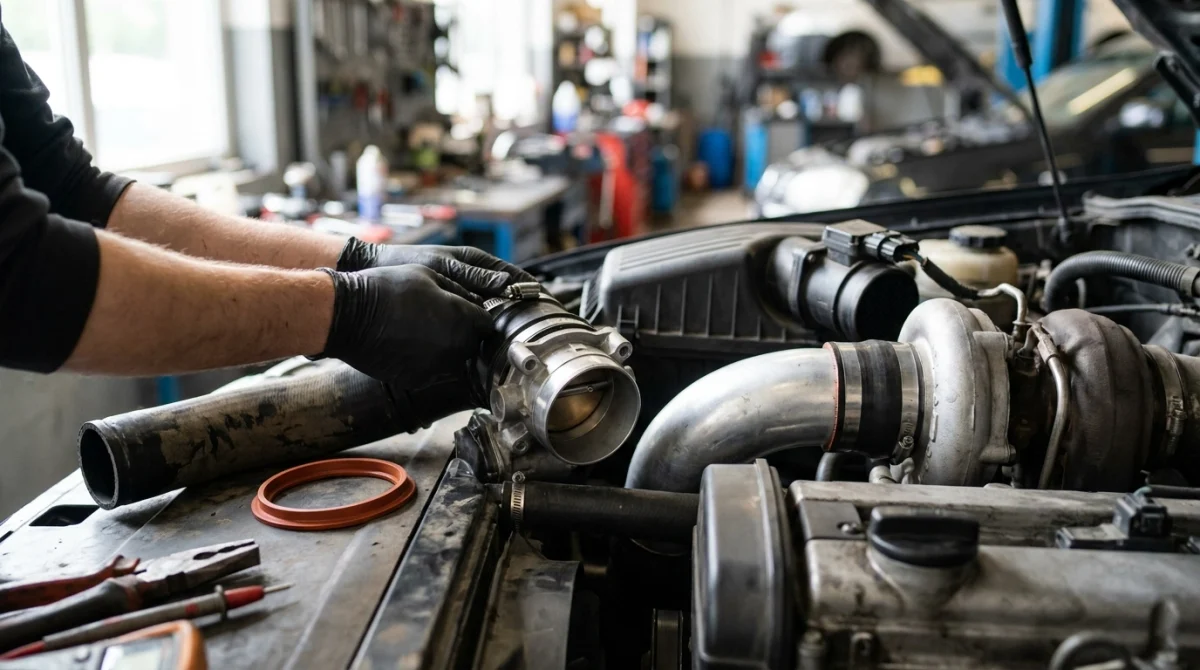
The correct P1101 repair is whatever fixes the verified airflow fault. There isn’t one universal part that solves this code.
Depending on the diagnosis, repairs may include:
- Reseating or replacing a damaged air-intake duct
- Correcting an improperly installed air filter or air-cleaner assembly
- Repairing a leaking intake connection
- Replacing a damaged charge-air tube or seal
- Repairing damaged wiring or connectors
- Cleaning a serviceable contaminated component when manufacturer procedures allow it
- Replacing a MAF sensor only after testing confirms it is faulty
- Repairing or replacing a damaged throttle-body component when diagnosis supports it
One particularly useful GM bulletin covers certain Equinox, Malibu, and Terrain vehicles with P1101. It says the MAF sensor and throttle body should be replaced only if they’re damaged or found to be the cause.
That advice applies to good diagnostics in general. Test first, replace second.
How much does a P1101 repair cost?
There isn’t a reliable single price because P1101 can result from anything from a loose connection to a damaged intake component. Labor rates and parts prices also vary by vehicle, location, and repair facility.
A diagnostic inspection should come before a repair estimate. Ask the shop what tests confirmed the failed component rather than approving parts based only on the stored code.
Technician’s note: On model-specific repairs, confirm parts by VIN and manufacturer catalog information before ordering. Engine options within the same model year can use different components.
P1101 Frequently Asked Questions
Is P1101 a MAF sensor code?
Not exactly. On applicable GM vehicles, P1101 means Intake Air Flow System Performance. The MAF sensor can be involved, but intake leaks, air-filter housing problems, charge-air connections, wiring, and other airflow issues can also cause the code.
Can a dirty air filter cause P1101?
An air-filter or air-cleaner problem can contribute to abnormal airflow, but don’t assume the filter itself is responsible. GM has documented certain applications where improper air-cleaner installation affected sealing and was associated with P1101.
Can an intake leak cause P1101?
Yes, an intake or charge-air leak can be relevant on vehicles where P1101 represents airflow-system performance. GM has documented missing seals and separated charge-air connections in specific applications, so checking for leaks is an important diagnostic step.
Can I clear P1101 with an OBD2 scanner?
A compatible scanner may be able to erase the stored code, but clearing it doesn’t repair the underlying condition. Record the codes and freeze-frame data first, then diagnose the cause. P1101 may return if the airflow problem remains.
Does P1101 mean I need a new throttle body?
No. A throttle-body issue is only one possibility. GM service information specifically cautions against replacing the throttle body or MAF sensor on certain applications unless inspection and testing show the component is damaged or responsible.
Why did P1101 appear with P0299?
P0299 indicates an underboost condition on applicable GM vehicles. When it appears with P1101 on a turbocharged engine, inspect the charge-air system carefully because a disconnected or leaking charge pipe can affect both boost pressure and measured airflow.
Is P1101 the same on every vehicle?
No. P1101 is manufacturer-specific, so its exact definition can vary. Always verify the code using your vehicle’s year, make, model, engine, and reliable service information before diagnosing or buying parts.
What Should You Do After Seeing P1101?
Start by confirming what P1101 means for your exact vehicle. On many GM applications, it means Intake Air Flow System Performance and points you toward the intake and airflow-management system.
Next, save the scan data and inspect the complete air path before replacing anything. Pay special attention to loose ducts, seals, air-filter installation, charge-air connections, and related trouble codes.
A good OBD2 scanner helps you find the direction of the problem. Proper testing identifies the repair.
