
Key Fob Not Detected With a New Battery: What to Check and How to Fix It

If your car says the key fob is not detected but battery is new, the problem is usually not the battery itself. In the shop, I’d treat this as a signal problem first and a battery problem second. That means checking battery fit, contacts, the spare fob, and the vehicle’s own start-detection system before you assume the fob is dead.
A fresh battery can still fail to solve the issue for a few simple reasons: it may be the wrong size, installed backward, not making solid contact, or not actually delivering power. In other cases, the car’s receiver, antenna, or 12V battery is the real cause. The good news is that you can usually narrow it down in a few minutes.
What “Key Fob Not Detected” Usually Means
On a push-button start vehicle, “key not detected,” “key not found,” or a similar warning means the car is not getting a valid signal from the fob when it tries to authorize starting. That does not always mean the coin battery is dead. It can also mean the car and fob are having trouble communicating, or that the fob is only working well enough for the remote lock/unlock buttons but not for passive start authorization.
Some cars use a backup start method that can read the fob through close contact or a passive induction area even when the fob battery is weak. That’s why a vehicle may unlock from the button on the fob but still refuse to start, or the reverse. The detection system for starting is often more sensitive than the lock/unlock buttons.
For general safety guidance on what to do when a vehicle won’t start or behaves unexpectedly, NHTSA’s driver safety resources are a useful reference point. For model-specific start and backup procedures, the owner’s manual still matters most.
The Most Likely Causes, in the Right Order
When the battery is new and the fob still isn’t detected, I’d rank the likely causes like this:
- Wrong battery type or wrong orientation
- Poor contact inside the fob
- A replacement battery that is weak or defective
- A problem with only one fob, not the vehicle
- Vehicle-side issues, such as a weak 12V battery or receiver problem
- Synchronization or reprogramming issues
- Internal fob damage from water, drops, or worn parts
That order matters because it keeps you from jumping straight to expensive fixes. I’ve seen owners replace a fob or pay for programming when the real issue was a coin battery sitting slightly crooked inside the shell.
Quick Checks You Can Do in 5 Minutes
1) Confirm the battery number and direction
Open the fob and look at the battery itself. The battery code usually starts with CR, such as CR2032 or CR2025. If you installed a battery that is close in size but not exact, the fob may close up but still not make reliable contact.
Also check polarity. The positive and negative sides must match the markings inside the fob. A battery installed backward can make the fob completely invisible to the car.
2) Reseat the battery so it sits firmly
Even with the correct battery, a loose fit can cause the same symptom. Make sure the battery snaps under the retaining tabs and sits flat. If it rocks, shifts, or sits too shallow, the terminals may not touch it consistently.
3) Try the spare fob
This is the fastest diagnostic test you have. If the spare works normally, the vehicle is probably fine and the original fob is the problem. If both fobs fail, shift your attention to the car, not the battery.
4) Try the backup start position
Many vehicles have a backup start method that works when the fob battery is weak or the fob is not being detected. Some cars want the fob placed against a marked spot on the steering column, center console, or start button area. Others use a specific slot. Check the owner’s manual for the exact procedure.
If the car starts only in the backup position, that usually means the fob is still transmitting enough for close-range emergency recognition, but the normal passive keyless entry detection path is weak or failing. If the car does not start even in the backup position, that points more strongly to a dead fob, a wrong or poorly installed battery, or a vehicle-side issue such as the 12V system or start authorization hardware.
For a quick visual example of the concept, this emergency-start demonstration shows how many vehicles use a passive induction or close-contact backup method.
Step-by-Step Fixes for the Fob Itself
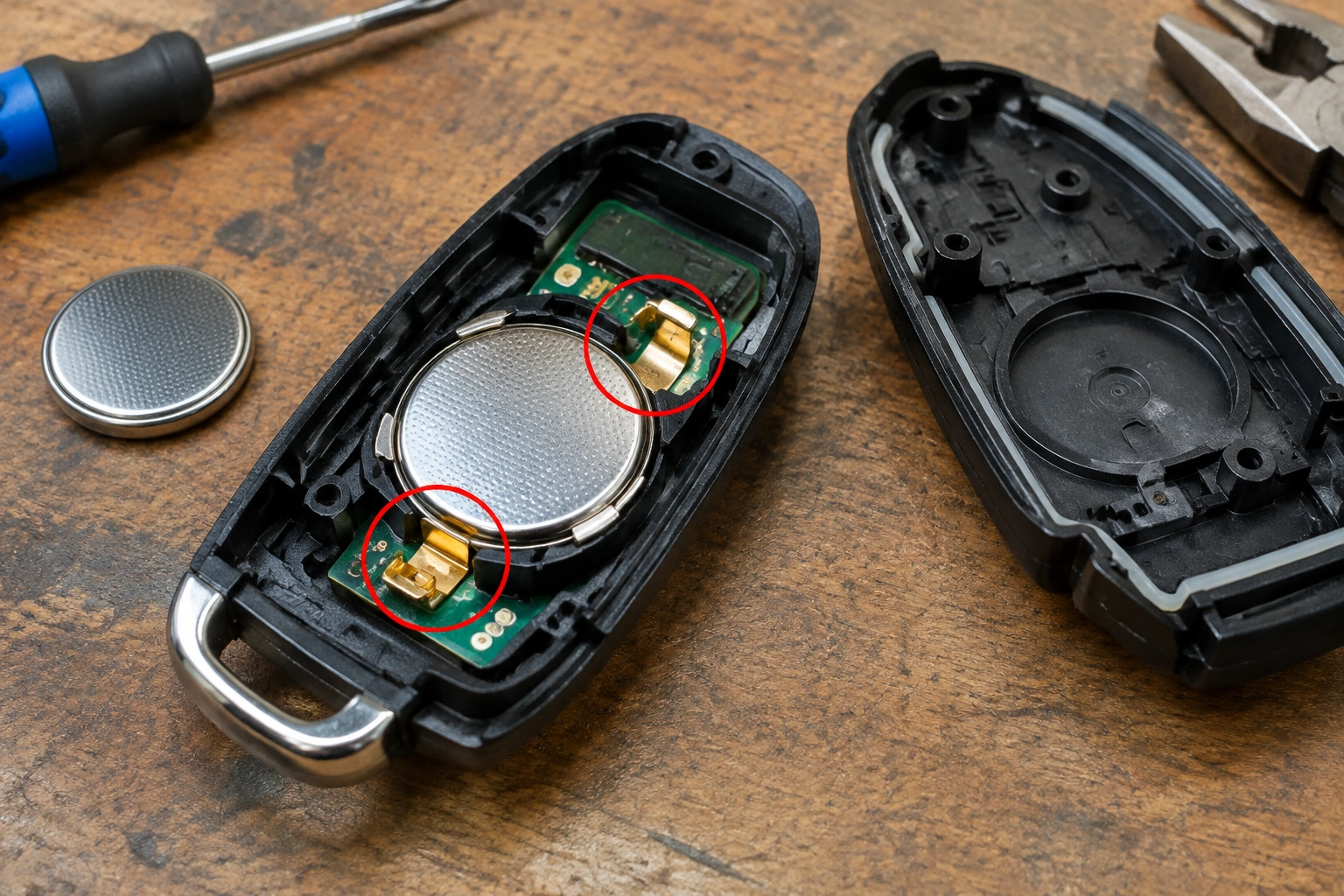
Check the contacts, not just the battery
A lot of fobs fail because the battery terminals inside the shell are bent, dirty, or weak. If the contacts don’t press firmly against the battery, the fob may work once and fail the next time.
Look for:
– bent metal tabs
– white or green corrosion
– dirt in the battery pocket
– a cracked shell that lets the battery move around
If you see corrosion, clean it gently with a dry cotton swab or a little isopropyl alcohol on a swab, then let it dry completely before reassembling. If a metal tab is flattened, you may be able to bend it slightly back into position, but don’t overdo it. A broken contact usually means replacement is the better path.
Check for water or drop damage
If the fob was washed, dropped in a puddle, or cracked on the pavement, the battery may be innocent. Water damage often causes intermittent behavior first: the fob works one day and fails the next, or it unlocks the doors but won’t start the car.
A damaged circuit board, loose solder joint, or broken internal button can all cause “not detected” warnings even with a fresh battery. Those are possible causes, not guaranteed ones, but if the shell is damaged and the fob behavior is inconsistent, replacement is often more practical than repeated battery swaps.
Verify the battery is actually good
A new battery can still be the wrong one, especially if it is the wrong size, a low-quality counterfeit, installed backward, or not seated firmly enough to make contact. It can also be defective out of the package.
If you have another device that uses the same battery type, or a battery tester, check it. If not, the simplest test is to try a second new battery from a different pack or brand. If the battery is the correct CR code but still seems loose or off-center, that points more to fit or contact trouble than to a dead fob.
RAC notes that the battery code usually starts with CR, which helps you buy the right type quickly, and that the positive and negative polarity must be correct during installation. Their general key-fob guidance is useful here: RAC key fob troubleshooting advice.
How to Tell if the Problem Is the Car, Not the Fob
If one fob works and the other doesn’t, the problem is usually isolated to the bad fob. If neither fob works, the car itself is more suspect.
That points to a few vehicle-side issues:
Weak 12V car battery
A weak 12V battery can cause strange smart-key behavior even when the car still has enough power for lights or accessories. That is a common possibility, not a universal rule, but it can happen before the car shows obvious starting problems. The vehicle may not fully wake up the receiver system, which means the fob signal never gets recognized.
If you’ve also noticed slow cranking, dim lights, or other odd electrical behavior, the 12V battery becomes a stronger suspect.
Receiver or antenna problem
The car uses receiver antennas to detect the smart key. If one of those antennas fails, the vehicle may not see the fob unless it is very close to a specific area. That can look like a fob issue when it’s really a car-side communication problem.
Immobilizer or start authorization issue
The immobilizer is the security system that decides whether the engine can start. If it is not reading the fob correctly, the car may unlock normally but still refuse to start. That distinction helps you separate remote lock/unlock behavior from passive start authorization.
Emergency Start and Backup Entry Methods
If the car won’t detect the fob, don’t keep hammering the start button over and over. Use the backup method the manufacturer designed for that situation.
Common backup methods include:
– placing the fob against the start button
– holding the fob in a marked area on the steering column or console
– inserting the fob into an emergency slot
The exact procedure varies by model, so the owner’s manual is the authority here. Do not force the fob into a slot unless the manual specifically says to use one. If the manual gives a proximity start method, follow it exactly.
This backup method is valuable because it helps you separate a detection-path problem from a fully dead key or vehicle-side failure. If the car starts only in the emergency position, the fob is usually still close enough to be recognized in backup mode, but the normal detection path needs attention. If it does not start at all, the issue is more likely a dead or misinstalled battery, a damaged fob, or a vehicle-side fault.
Comparison Table: What the Symptoms Usually Point To
| What you notice | What it often means | Best next step |
|---|---|---|
| Battery is new, but fob won’t start car | Battery may be wrong, backward, loose, or defective | Recheck battery type, orientation, and contacts |
| Spare fob works, original does not | Original fob likely has a hardware issue | Inspect for damage or replace the original fob |
| Neither fob works | Vehicle-side issue more likely | Check 12V battery and backup start method |
| Fob unlocks doors but won’t start car | Start authorization or detection issue | Try emergency start procedure |
| Works only intermittently | Loose contacts, water damage, or weak battery | Inspect shell, contacts, and battery fit |
When Reprogramming Might Be Needed
Reprogramming is worth considering when the fob looks physically fine, the battery is correct, and the contacts are solid, but the car still refuses to recognize it. That can happen after certain repairs, memory loss, or internal communication faults.
Before you assume reprogramming will fix it, a dealer or automotive locksmith may need to diagnose whether the problem is actually the fob, the vehicle receiver, or the immobilizer system. Reprogramming will not fix:
– a cracked circuit board
– corroded battery contacts
– a dead transmitter
– water-damaged electronics
So if the fob is visibly damaged, replacement usually makes more sense than trying to “program around” broken hardware.
When to Replace the Fob vs. Repair It
Repair the fob if:
– the shell is intact
– the issue seems to be contact-related
– the battery fit is loose but the electronics still work
– the fob is only failing intermittently
Replace the fob if:
– it has been exposed to water
– the circuit board is damaged
– the shell is cracked and won’t hold the battery firmly
– the fob has already failed after a correct battery and contact check
If you’re choosing between repair and replacement, ask a simple question: does the fob still behave like a working device with one weak point, or does it behave like a damaged unit with multiple symptoms? That answer usually points you in the right direction.
When to Consult a Locksmith
If the spare fob doesn’t work, the backup start method fails, or you suspect the vehicle-side system is involved, it’s time to bring in help. A dealer can diagnose the vehicle’s security system, but an automotive locksmith often provides a practical option for many key fob and smart-key problems, depending on the vehicle and local service availability.
A locksmith is especially useful when:
– you need a diagnostic check on the fob itself
– the fob needs reprogramming
– you want a replacement and want to compare service options
– you’re not sure whether the issue is the key, the car, or both
If you’re comparing dealer service and locksmith service, think in terms of access and speed. Dealers may be the right fit for some model-specific security work, while locksmiths often handle everyday fob failures efficiently.
Troubleshooting Summary: What the Results Mean
Use the results of your tests to narrow the fault:
- Wrong battery, backward battery, loose battery fit, or defective replacement battery: reopen the fob and correct the installation.
- Spare fob works: the original fob is the problem.
- Neither fob works: suspect the vehicle, especially the 12V battery or receiver system.
- Backup start works but normal detection does not: the fob or detection path needs further diagnosis.
- Backup start does not work either: the battery, fob hardware, or vehicle-side system needs closer inspection.
- Visible damage, water exposure, or intermittent operation: replacement is often more practical than repeated battery changes.
- Everything checks out but the car still won’t recognize the fob: reprogramming or professional diagnosis is the next step.
The main thing is not to assume “new battery” means “battery problem solved.” In key fob troubleshooting, the battery is only one part of the system. Once you test the spare fob, battery fit and contact, the vehicle’s 12V battery, and the backup start method in that order, the real cause usually becomes much clearer.
FAQ
Why does my car say the key fob is not detected with a new battery?
The battery may be the wrong type, installed backward, loose, or defective. If the spare fob also fails, the issue may be vehicle-side, such as the 12V battery, receiver, or immobilizer system.
Can a new battery still be the wrong one?
Yes. A replacement battery can be the wrong size, a poor-quality counterfeit, installed backward, or not seated firmly enough to make contact. Any of those can mimic a bad fob.
Why does my fob unlock the doors but not start the car?
Remote lock/unlock and passive start authorization are not always equally sensitive. The fob may still have enough power for the buttons but not enough signal for the car to recognize it for starting.
What does it mean if the car starts only in backup mode?
That usually means the fob can still be recognized at very close range, but the normal detection path is weak or failing. It points to a fob battery/contact issue or a vehicle-side detection problem.
Should I reprogram the key fob after replacing the battery?
Usually no. A battery change alone typically does not require reprogramming. Reprogramming becomes more likely when the fob is physically fine but the car still will not recognize it.
Can a locksmith replace or reprogram my key fob?
Often yes, depending on the vehicle and local service options. For some models, a dealer may still be the better first stop for diagnosis, especially if the problem may be on the vehicle side.
