
Why Your Car Key Fob Works Intermittently and How to Fix It

A car key fob that works intermittently is one of those problems that looks random until you break it down. One minute it unlocks the doors from across the driveway, and the next it only works when you’re standing right next to the driver’s door — or not at all. The fob is telling you something about its battery, its buttons, its signal, or the car itself.
The good news: intermittent behavior usually gives you a better diagnosis trail than a dead fob does. A completely failed fob can be caused by a lot of things, but a fob that works sometimes often points to a weak battery, worn contacts, interference, or a vehicle-side issue that shows up under certain conditions.
Fastest Diagnosis Path
If you want the shortest route to a fix, try this order:
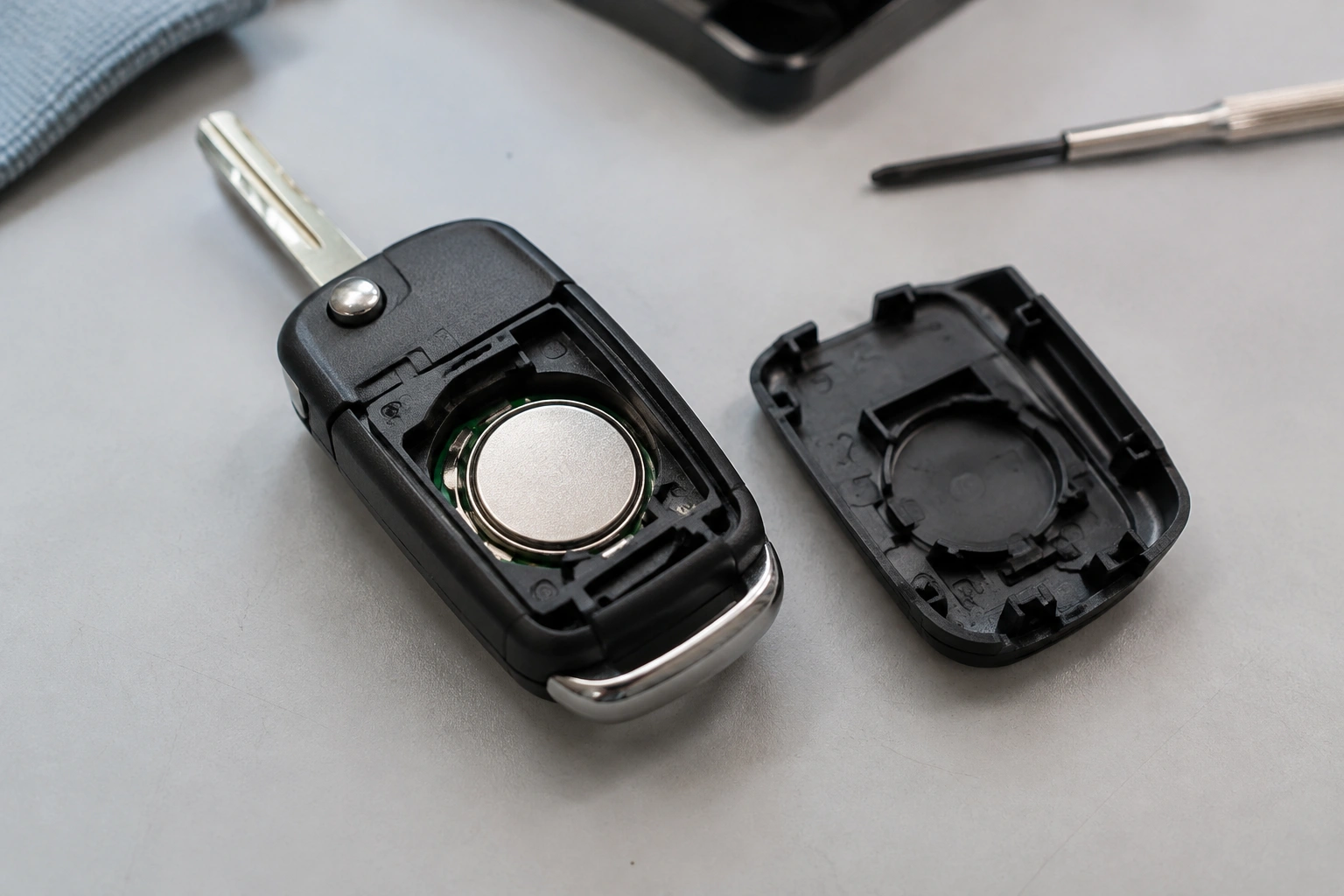
- Replace the key fob battery
- Test the spare fob
- Check the car battery and recent power loss
- Test for interference or range issues
- Consider reprogramming or professional diagnosis
That sequence keeps you from jumping to a full replacement before you’ve ruled out the most common causes.
What Intermittent Key Fob Operation Usually Means
Intermittent operation means the remote keyless entry system is not failing in a clean, all-or-nothing way. The fob may:
- work only at close range
- work after several button presses
- work only for lock but not unlock, or vice versa
- work after sitting for a while, then stop again
- work in one location but not another
That pattern matters. If the fob works close to the car but not from the house, the issue may be range, interference, or a weak battery. If one button is reliable and another is flaky, that often points to worn button pads or internal contact issues. If both your main fob and spare act up, the car’s receiver, car battery, or synchronization may be involved.
For context, RAC notes two practical checks before assuming the fob is broken: make sure you are not too far from the vehicle, and remember that a common cause is a battery that has run out of charge and needs replacing. You can read that guidance here: RAC’s key fob troubleshooting advice.
The Most Likely Causes, in the Right Order
When a car key fob works intermittently, the most useful order is the one that leads to a specific next test:
- Weak key fob battery — replace it first, then retest the fob in a few locations around the car.
- Worn buttons, dirty contacts, or moisture damage — if one button fails more than the others, inspect the fob body and battery compartment.
- Interference or poor signal range — if it works near the car but not farther away, move to an open area and compare results.
- Vehicle battery or electrical voltage issues — if both fobs are unreliable, check the car battery and recent jump-start or battery-replacement history.
- Reprogramming or synchronization problems — this is more likely after a battery disconnect, flat battery, or power loss.
- Failing receiver or internal fob damage — consider this when the basic checks don’t change the pattern.
That order is meant to narrow the problem quickly, not just list possibilities.
Step 1: Replace the Key Fob Battery First
A weak battery is the first thing to check. It can still power the fob enough to work sometimes, but not consistently.
Signs that point toward the fob battery include:
- shorter working range than usual
- the need to press the button more than once
- inconsistent response after the car sits for a while
- the fob working better when held right next to the vehicle
If your fob battery is old, replace it before anything else. Use the battery type specified in your owner’s manual or on the old battery itself. After replacement, test the fob several times in different spots around the car, not just once in the driveway.
If the fob improves for a day or two and then becomes unreliable again, that can point to worn button pads, corroded contacts, or a cracked solder joint inside the fob.
Step 2: Test a Spare Fob to Separate Fob Problems from Vehicle Problems
This is the quickest isolation test you have.
If your spare key fob works normally and the original does not, the original fob is the problem. If both fobs behave the same way, the issue is more likely on the vehicle side.
That simple comparison helps separate:
- fob battery or fob hardware problems from
- vehicle receiver, car battery, or programming issues
A useful real-world example: if one fob unlocks the car every time from the driveway and the other only works after several presses, the failing fob likely has an internal issue. If both fobs only work when you stand next to the door, think range, interference, or low vehicle voltage before you blame both remotes.
Step 3: Check for Button Wear, Dirt, Moisture, or Internal Damage
A fob can look fine on the outside and still have worn or dirty internal contacts. If a button only works when pressed hard, that’s a strong clue. Sticky buttons, a mushy feel, or a button that responds only sometimes often means the rubber pad is worn or the contact underneath is dirty.
Here’s a practical check:
- remove the battery
- inspect the battery compartment for corrosion or moisture
- look for cracked plastic, loose seams, or signs the fob was dropped
- check whether the buttons feel uneven or slow to spring back
If the fob got wet, don’t keep pressing buttons and hoping it will recover. Moisture can spread corrosion across the circuit board. If the problem started after a drop, internal solder joints or the battery holder may be cracked even if the shell still looks intact.
Light cleaning may help if the issue is dirt or residue, but be careful. Don’t soak the circuit board or use anything that leaves liquid inside the case. If the inside is corroded or greenish, that’s usually a repair-or-replace situation, not a battery-only fix.
Step 4: Check the Car Battery and Vehicle Power Health
A weak car battery can cause more than slow cranking. Low voltage can also affect remote locking, unlocking, and remote start behavior. If the vehicle’s electrical system is unstable, the receiver may not respond consistently to the fob signal.
Watch for these signs:
- the car is slow to start
- interior lights seem dim
- electronic features act odd after sitting overnight
- the problem appears after a dead battery or jump-start
If both fobs are acting strange and the car battery is weak, the car battery deserves attention. If the issue started right after battery replacement or a power loss event, a reset or resynchronization may also be worth considering.
For a broader look at what “not detected” behavior can mean, our guide on why your car says the key fob is not detected covers the battery and vehicle-side checks in more detail.
Step 5: Rule Out Interference and Range Issues
Before you assume the fob is failing, pay attention to where the problem happens.
A fob that works in the driveway but not inside a garage, parking structure, or near a building full of electronics may be running into interference or reduced signal range. Nearby radio equipment, other vehicles, metal walls, and even some home electronics can weaken the signal enough to make the fob seem unreliable.
Try this:
- test the fob in an open area
- test it beside the driver’s door, then from a few steps away
- try it with the car parked in a different location
- compare behavior near home versus at work or in a parking garage
If the fob only works when you’re standing very close to the car, that does not prove the fob is dead. It may still be sending a weak signal that the vehicle can only catch at short range.
Step 6: Consider Reprogramming or Resynchronization
Reprogramming is most likely to help when the problem starts right after a battery disconnect, dead battery, jump-start, or other power loss. In those cases, the fob and vehicle may simply need to be brought back into sync.
It is less likely to be the main issue if:
- the fob has been intermittent for a long time without any power event
- only one button is failing
- the problem clearly follows the fob itself rather than the car
- the battery replacement made no difference and there was no recent power loss
Some vehicles allow simple owner-level sync steps; others require a scan tool or a locksmith/dealer procedure. Follow the owner’s manual for your exact vehicle.
For related symptoms where the car recognizes the fob inconsistently, see why a key fob is not detected intermittently.
Quick Comparison: What the Symptoms Usually Point To
| Symptom pattern | Most likely cause | What to do next |
|---|---|---|
| Works sometimes, shorter range than usual | Weak key fob battery | Replace the battery first |
| One button works, another does not | Worn button or dirty contact | Inspect, clean, or repair the fob |
| Both fobs misbehave | Car battery, receiver, or vehicle-side issue | Check vehicle battery and test further |
| Works near the car but not farther away | Range or interference | Test in open area and different locations |
| Problem started after battery replacement or dead battery | Reprogramming or resynchronization issue | Follow vehicle-specific sync steps |
| Buttons need hard pressing | Worn pads or internal damage | Consider repair or replacement |
When Repair Is Enough and When Replacement Makes More Sense
A battery replacement is enough when the fob is otherwise clean, dry, and physically intact, and the symptoms improve right after the swap.
Repair makes more sense when:
- the buttons feel worn but the board is still good
- the battery contacts are dirty or slightly corroded
- the shell is cracked but the electronics still respond
Replacement makes more sense when:
- the fob has water damage
- the buttons are badly worn
- the board is visibly corroded
- the fob still acts up after battery, cleaning, and resync checks
If you’re deciding between repairing and replacing, ask one simple question: is the problem in the battery or shell, or is the electronics side already damaged? Once the board is compromised, a new fob is often the cleaner long-term fix.
When to Consult a Locksmith
Call a locksmith or dealer when the problem persists after the basic checks, especially if:
- both your main and spare fobs are intermittent
- the vehicle battery is healthy but the issue remains
- the fob seems to need reprogramming
- there is water damage or internal corrosion
- the receiver or vehicle-side system may be at fault
An auto locksmith is often the practical middle ground for diagnosis, reprogramming, and replacement. A dealer can also help, especially if the vehicle uses a more restricted programming process.
If you’re not sure whether the car side or fob side is failing, our guide on why your key fob is not detected but the car still starts is a useful next read.
How to Keep the Problem From Coming Back
Once you get the fob working again, a few habits can help keep it reliable:
- replace the fob battery at the first sign of reduced range
- keep the fob dry and out of pockets with loose coins or keys
- avoid pressing damaged buttons repeatedly
- use the spare fob occasionally so you know it still works
- address a weak car battery promptly
FAQ
Why does my key fob work sometimes and not others?
That usually points to a weak fob battery, worn buttons, interference, or a vehicle-side issue. The pattern of when it fails matters as much as the failure itself.
Can a car battery cause a key fob to act up?
Yes. Low vehicle voltage can affect remote locking, unlocking, and remote start, especially if the battery is weak or recently discharged.
Do I need to reprogram the fob after changing the battery?
Not always. It is more likely after a battery disconnect, dead battery, or power loss. If there was no such event, reprogramming is less likely to be the main fix.
What if the fob works only when I’m close to the car?
That often points to weak signal strength, interference, or a weakening battery in the fob. Test it in an open area before replacing the whole unit.
Should I replace the whole fob or just the battery?
Replace the battery first unless the fob is visibly damaged, wet, or heavily worn. If the symptoms remain after that, move on to cleaning, resyncing, or replacement.
Is it safe to keep driving if the fob is intermittent?
Usually yes, if you still have a physical backup method and the car can be started reliably. But don’t ignore a weak car battery or a failing fob if it affects unlocking or starting.
What if both my fobs do the same thing?
That points away from the original fob and toward the vehicle battery, receiver, or a synchronization issue.
Can interference really make a fob seem broken?
Yes. Parking structures, buildings, and nearby electronics can weaken the signal enough that the fob appears intermittent when the hardware itself is still okay.
When should I stop troubleshooting and call for help?
If battery replacement, spare-fob testing, and basic inspection don’t solve it, or if there’s moisture damage, a weak car battery, or a suspected receiver issue, it’s time to involve a locksmith or dealer.
