
Immobilizer Light Flashing with Key Fob: What It Means and How to Fix It

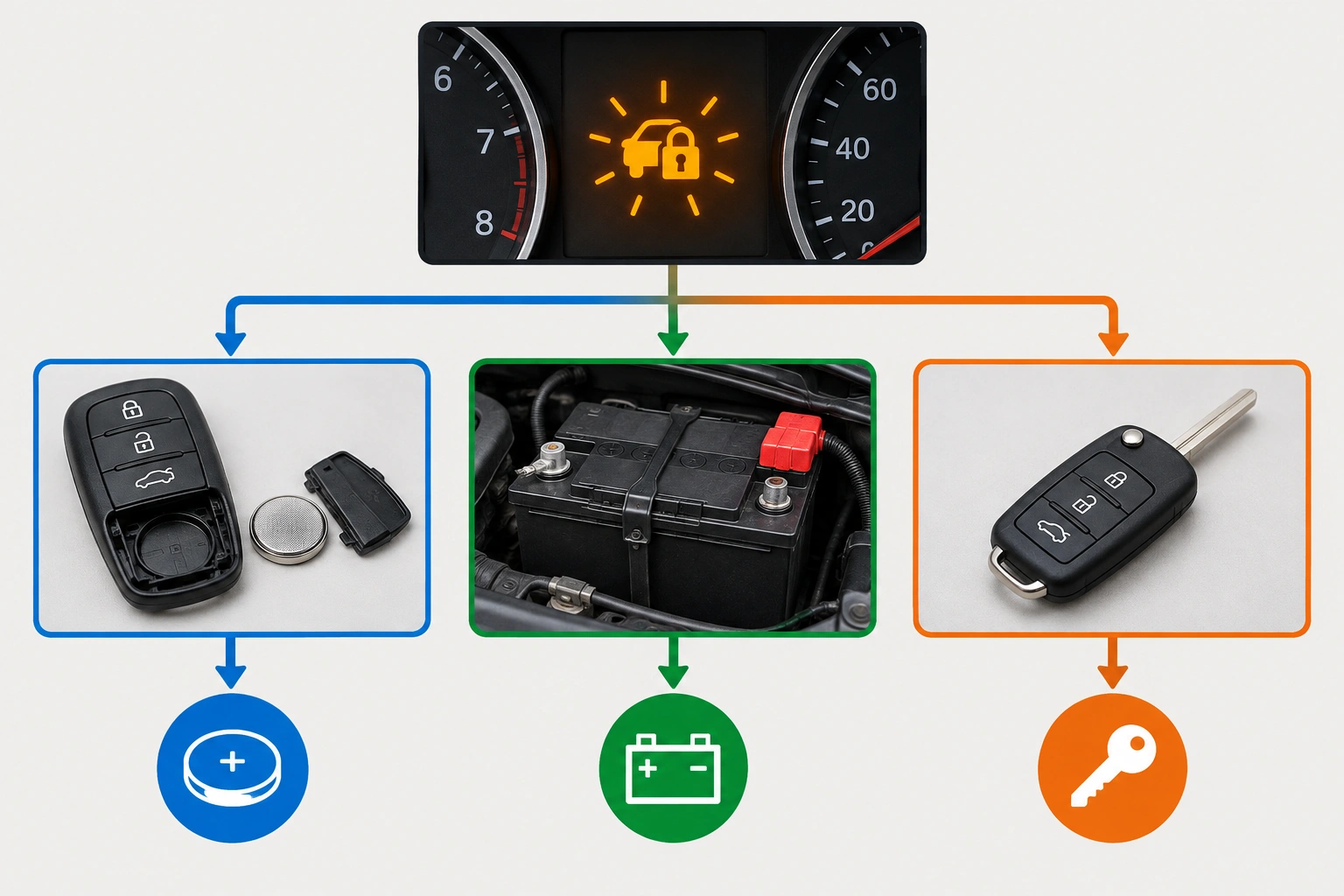
If your immobilizer light is flashing and the car won’t start, the problem is usually not random. The vehicle is telling you it does not fully recognize the key, the transponder signal, or the security system’s handshake with the car.
I’m Jason Carter, and when I was working on cars in the shop, this was one of the most frustrating no-start complaints for owners because the symptoms can overlap. A weak key fob battery, a weak car battery, a bad spare-key chip, or a fault in the antenna ring can all look similar from the driver’s seat.
The good news: there’s a sensible order to check things. If you follow it, you can often tell whether you’re dealing with a simple battery issue or a deeper immobilizer problem before you pay for programming or parts.
What a flashing immobilizer light usually means
On many vehicles, the immobilizer or security light flashes when the car is not satisfied that the correct key is present. The key fob contains a transponder chip that communicates with the ECU, and when the ECU detects the correct key, it allows the engine to start. If that communication fails, the light may flash and the engine may crank without starting.
That said, the exact meaning varies by make and model. Some cars flash the light only when the ignition is off. Others flash during cranking if the key is not being recognized. A few vehicles will also flash the light after a battery disconnect or voltage drop, even if the key itself is fine.
A useful rule: if the light flashes and the car starts normally, the issue may be intermittent or limited to the remote side of the fob. If the light flashes and the engine won’t fire, treat it as a key-recognition or immobilizer fault until proven otherwise.
Common immobilizer light flash patterns and what they usually suggest
Because the light behavior varies by vehicle, the flash pattern matters as much as the warning itself.
- Flashing with the key on, before cranking: often means the system is not recognizing the key yet, or it is waiting for a valid transponder signal.
- Flashing only while cranking: usually points to an active key-recognition failure, weak voltage, or an immobilizer handshake problem.
- Solid light that stays on: on some vehicles, this suggests a stored immobilizer fault, a failed key read, or a module issue rather than a simple temporary glitch.
- Light flashing after a battery disconnect or jump-start: may indicate the system needs to reinitialize, or that low voltage has triggered a fault that now needs diagnosis.
- Light flashing and then going out when the engine starts: often means the system is seeing the key normally and may be showing a brief self-check.
If your owner’s manual explains the light differently for your model, follow that first. The pattern is a clue, not a universal rule.
Quick diagnosis: key, car battery, or immobilizer?
Before you replace anything, look at the symptoms together. That gives you a much better clue than the warning light alone.
| Symptom | More likely cause | What to check first |
|---|---|---|
| Remote buttons work poorly, but car starts | Key fob battery issue | Replace the fob battery |
| Dash is dim, clicking sound, electronics weak | Vehicle battery issue | Check battery voltage and terminals |
| Main key fails, spare key works | Key/transponder issue | Use the spare key and replace or reprogram the bad one |
| Both keys fail, light keeps flashing | Vehicle-side immobilizer fault | Check antenna ring, ignition switch, wiring, or module |
| Problem comes and goes after a battery drain | Low-voltage or temporary glitch | Charge the car battery and retry |
| Starts after a reset, then fails again | Intermittent recognition fault | Expect deeper diagnosis |
Here’s the fastest decision path:
-
Do the locks and remote buttons work normally?
If not, the key fob battery may be weak. That does not prove the immobilizer is the only problem, but it’s a strong clue. -
Does the dash look weak or dim?
If the cluster is sluggish, the starter clicks, or lights fade hard when you turn the key, the vehicle battery may be too low for the immobilizer system to communicate properly. -
Try the spare key.
This is the quickest way to separate a key problem from a car problem. -
If both keys fail, think vehicle-side fault.
That points you toward the antenna ring, ignition switch, wiring, or immobilizer module rather than the fob battery alone.
Most likely causes, from common to less common
1. Weak or dead key fob battery
This is the easiest place to start. A weak fob battery can make the remote functions act flaky, and in some vehicles it can also interfere with the immobilizer handshake if the signal is too weak. One practical clue: if the doors unlock inconsistently or the key only works when you’re very close to the car, the fob battery is worth replacing.
That said, the remote battery and the transponder chip are not the same thing. On many vehicles, the chip that starts the car is passive, so a dead remote battery may not stop the engine by itself. That’s why a fob battery is a good first check, but not the only one.
2. Weak vehicle battery
A weak car battery can cause low-voltage communication problems that look like a key issue. If the dash is dim, the starter only clicks, or the vehicle sat for a while before this started, test the car battery before blaming the fob.
This is especially common after jump-starts, long storage, or repeated failed start attempts. Low voltage can confuse modules that need a clean signal to recognize the key.
3. Transponder recognition problem
If the key’s chip is damaged, missing, or not being read correctly, the immobilizer may reject it. This is where the spare key becomes so useful. If the spare works immediately, the vehicle side is probably fine and the original key is the likely culprit.
4. Antenna ring or transceiver coil fault
Many vehicles read the key chip through an antenna ring or transceiver coil around the ignition area or start button. If that reader fails, the car may not detect the key even though the key itself is good.
A common clue is an intermittent no-start that gets worse over time. The car may start one day and refuse the next, especially if the steering column or ignition area has been bumped, worn, or repaired before.
5. Immobilizer module, ECU, or programming problem
If both keys fail and the battery is healthy, the issue may be in the immobilizer module, ECU communication, or key programming. This is less common than a weak battery or bad key, but it becomes more likely when the light keeps flashing no matter which key you use.
Step-by-step fixes to try at home
1. Replace the key fob battery
If the remote functions are weak, replace the battery with the correct type for your fob. Make sure the battery is installed in the right orientation and the contacts are clean.
If the fob has been dropped, opened incorrectly, or exposed to moisture, inspect it carefully. A fresh battery won’t help if the internal board is damaged.
For a simple background check on how immobilizer warnings relate to the key’s battery and transponder signal, the explanation in this immobilizer reset guide matches what I’ve seen in the shop: the first thing to check is whether the battery in the remote key is running low, because a weak battery can keep the fob from sending a strong enough signal to the immobilizer system.
2. Check the vehicle battery
If the dash is dim or the car has been sitting, test the battery or try a known-good jump from another battery source. Clean any corrosion from the terminals and make sure the clamps are tight.
If the battery is weak enough to make the starter slow or the electronics unstable, don’t keep hammering the key. Low voltage can keep the immobilizer from completing its check.
3. Try the spare key
Use the spare key exactly as you would the main one. Don’t assume it will fail just because the main key did.
- If the spare key works: the original key or its transponder is the likely problem.
- If both keys fail: the car-side reader, wiring, module, or programming is more likely.
- If the spare works only sometimes: you may be dealing with an intermittent ignition-side fault or a worn key.
4. Do a simple reset attempt
For some vehicles, a basic reset can clear a temporary glitch. A practical sequence is:
- Lock the car
- Wait a minute or two
- Unlock it
- Try starting again with the key fully seated or held in the correct recognition area
If your vehicle has a passive backup start method or an emergency key recognition location, check the owner’s manual for the exact procedure and where the key needs to be held or placed. On push-button systems, some vehicles require the key to be inside the cabin and positioned in a specific spot for the backup reader to see it.
If the car starts after this but the light returns later, don’t assume it’s fixed. That usually means the system is still borderline.
5. Disconnect and recharge only if the battery is clearly weak
If the vehicle battery is low, charging it fully is more useful than repeated short jump-starts. A fully charged battery gives the immobilizer system a better chance to communicate normally.
I would not recommend disconnecting the battery just to “reset” everything unless the owner’s manual or service information says that’s appropriate for your vehicle. Some cars lose learned settings or create new problems when power is removed.
If the battery replacement or no-start fault was followed by a flashing security light, the vehicle may need a scan-tool check or immobilizer relearn rather than another simple reset.
How to test the spare key and read the result
The spare key is one of the best diagnostic tools you have because it cuts the problem in half.
If the spare key starts the car immediately, the original key is the likely issue. That can mean a failed transponder, damaged key shell, or programming problem. In that case, a locksmith or dealer can usually tell you whether the key needs repair, replacement, or reprogramming.
If both keys fail the same way, the problem is probably not the fob battery. Look at the ignition reader, antenna ring, wiring, immobilizer module, or ECU communication.
If one key works only when the car battery is freshly charged, that points back to voltage. The key may be fine, but the vehicle is too weak to complete the security check consistently.
Key fob battery vs. vehicle battery: how to tell the difference
This is where a lot of people get misled.
A key fob battery problem usually shows up first in the remote functions: weak unlock range, delayed button response, or a fob that only works when very close to the car. The car may still start if the transponder chip is being read normally.
A vehicle battery problem usually affects the whole car. You may see dim lights, slow cranking, clicking, warning lights that flicker, or electronics that reset. If the battery voltage is low enough, the immobilizer may not trust the signal or may not complete its handshake.
A good comparison: if the fob buttons are weak but the dash is strong, think fob battery. If the dash is weak and the starter sounds tired, think vehicle battery first.
When the car still won’t start: signs of a deeper fault
If you’ve tried the spare key, checked the battery, and the immobilizer light still flashes, the problem is probably deeper than a simple battery swap.
Watch for these signs:
- Both keys behave the same
- The car starts intermittently, then refuses again
- The security light flashes every time you crank
- The ignition area has been repaired, damaged, or worn
- The issue began after a battery replacement, jump-start, or electrical repair
Those patterns fit a failing antenna ring, ignition switch, wiring issue, or immobilizer module problem better than a dead fob battery.
When to Consult a Locksmith
A locksmith is often the right call when the problem seems key-related rather than vehicle-wide.
Call a locksmith if:
- The spare key works and the main key doesn’t
- The key shell is damaged
- The transponder may need programming
- You need a replacement key cut and coded
- The vehicle uses a system a locksmith can program without dealer-only tools
Some vehicles can be handled with straightforward key programming, while others require dealer-level scan tools or an immobilizer relearn procedure. A dealer may still be necessary for certain makes and newer security systems, but a locksmith can be the faster option when the issue is clearly on the key side and the vehicle supports that level of service.
If the car has both keys failing or the immobilizer module may need a manufacturer-specific relearn, the dealer or a shop with the right scan tool is usually the better next step.
Can you keep trying to start the car?
You can try a few sensible checks, but don’t keep cranking it over and over. Repeated failed starts can drain the battery further and make the original problem harder to diagnose.
If the car starts intermittently, I would avoid a long drive until the cause is clear. An intermittent immobilizer fault can leave you stranded again without warning.
If the vehicle will not start after the spare key, battery check, and basic reset attempt, it’s smarter to stop and get proper diagnosis than to keep guessing.
FAQ
Can a dead key fob battery cause the immobilizer light to flash?
It can, depending on the vehicle. A weak fob battery may reduce the signal enough that the car doesn’t recognize the key properly, especially if the system is already sensitive or the battery in the car is also weak.
Can I drive with the immobilizer light flashing?
If the car starts and runs normally, some vehicles may just be showing a temporary warning. But if it’s flashing with a no-start or intermittent-start symptom, don’t assume it’s safe to keep driving until you know what’s wrong.
Why does the spare key work when the main key doesn’t?
That usually means the vehicle side is fine and the original key is the problem. The main key may have a damaged transponder, a programming issue, or physical wear.
Will replacing the key fob battery fix everything?
Not always. It’s a good first step, but if the car battery is weak or the immobilizer reader is failing, a new fob battery won’t solve the root cause.
Do I need a dealer for immobilizer reprogramming?
Sometimes, yes. Some vehicles allow a locksmith to handle key programming, while others require dealer-level tools or manufacturer-specific procedures.
How do I know if the problem is the car battery?
If the dash is dim, the starter clicks, or the car has been sitting and the electronics seem weak, the vehicle battery is a strong suspect. That’s especially true if the immobilizer light started flashing after a battery drain or jump-start.
What if my car has a backup key recognition spot?
Check the owner’s manual for the emergency key recognition location or procedure. On some vehicles, the key must be held in a specific place for the backup reader to detect it.
If the battery was just replaced, why is the immobilizer light still on?
Some vehicles may need a relearn or scan-tool procedure after a battery replacement or voltage loss. If the light stays on and the car won’t start, the issue may be more than a simple reset.
