
How to Know If a Key Fob Receiver Is Bad: A Practical Troubleshooting Guide

If your key fob suddenly stops locking the doors, only works at arm’s length, or fails on both the main fob and the spare, the receiver in the car starts looking suspicious. But I’d still resist blaming the receiver first. Weak fob batteries, a bad fob, a blown fuse, or low vehicle voltage can all create the same complaint.
The goal here is simple: help you narrow the problem without throwing parts at it. We’ll work from the cheapest checks to the more likely vehicle-side failures, so you can decide whether this is a battery swap, a fuse issue, a reprogramming problem, or a receiver/module repair.
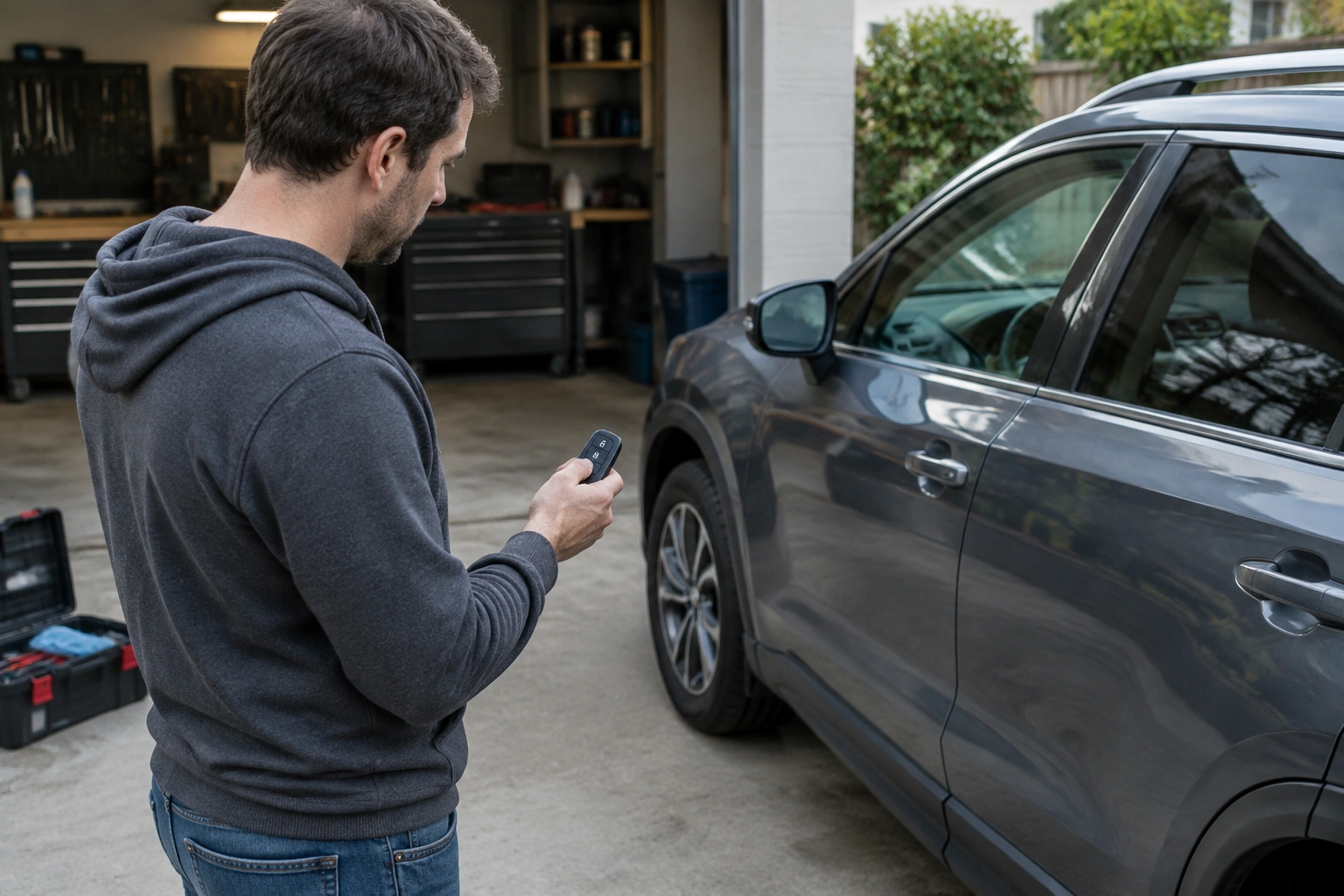
Quick answer: what points to a bad receiver?
A bad key fob receiver is more likely when:
- Neither fob works, but both fobs have fresh batteries.
- The fob works only very close to the car or only intermittently.
- The vehicle’s locks, keyless entry, or push-to-start behavior changed suddenly after a battery disconnect, electrical issue, or water intrusion.
- The car doesn’t respond to any remote, but the fob itself still seems to transmit.
- Reprogramming doesn’t restore function, and fuses and vehicle battery voltage check out.
That said, a receiver problem is only one possibility. A dead fob battery can look almost identical at first, and some vehicles use related modules like the body control module, so the failure may not be the receiver alone.
What the key fob receiver actually does
Your key fob sends a coded radio signal when you press lock, unlock, trunk, or panic. The car’s remote keyless entry system receives that signal, checks whether the code matches, and then tells the vehicle to respond.
If that communication chain breaks, you can get symptoms like:
- no lock/unlock response
- short-range operation
- delayed or intermittent response
- push-to-start recognition problems in some vehicles
That’s why a receiver issue can affect all fobs, while a bad battery or damaged fob usually affects just one remote.
For a deeper look at receiver-related symptoms, our guide on key fob receiver problem symptoms breaks down the common vehicle-side signs.
The most likely causes, in order
Here’s the order I’d use in a driveway diagnosis:
- Dead or weak key fob battery
- Bad individual key fob
- Low vehicle battery voltage
- Blown fuse or related power issue
- Programming mismatch
- Receiver or body control module fault
That order matters because it keeps you from replacing a receiver when the real problem is a battery or a fuse.
Step 1: check the key fob battery and the spare fob
This is the fastest way to separate a fob problem from a car problem.
Replace the battery first if:
- the fob is old
- the range has been getting worse over time
- the fob works only when you’re standing right next to the car
A weak fob battery often causes short range before it causes total failure. In many vehicles, the remote may still send a signal, but it’s too weak for reliable reception.
Then test the spare fob
If your spare works normally, that’s a strong clue the original fob is the issue, not the receiver. If both fobs fail, the odds shift toward the vehicle-side system.
A quick comparison
- One fob fails, spare works: suspect the original fob or its battery
- Both fobs fail: suspect the car-side system, including fuse, receiver, BCM, or power supply
If you want a separate walkthrough on battery-related causes, see can a bad car battery cause key fob problems.
Step 2: look for vehicle-side clues
If the car itself is having electrical trouble, the remote system can act dead even when the fob is fine.
Signs the problem may be in the car
- dash lights seem weak or erratic
- the car battery is old or recently discharged
- multiple electrical features are acting up
- the remote stopped working after a jump start, battery replacement, or battery disconnect
A weak car battery can mimic receiver failure because modules may not wake up or communicate reliably. That’s especially true on newer vehicles with more networked electronics.
A blown fuse can do the same thing. If the fuse feeding the remote entry system, BCM, or related module is open, the car may ignore all fobs even though the remotes themselves are transmitting normally.
Step 3: test the receiver with a simple no-tools sequence
This is the most useful way to narrow down a receiver issue without special equipment.
- Stand close to the driver’s door with the spare fob. Press lock and unlock once each and watch for a response.
- Step back a few feet and try again. If the response gets weaker or stops, note the distance where it fails.
- Move to the front, rear, and passenger side of the vehicle. Try lock and unlock from each spot with the spare fob.
- Repeat the same test with the main fob. If the spare works better than the main fob, that points more toward the main fob than the receiver.
- Compare close-range versus longer-range response. If the car responds only when you are very close, that can point to a weak fob battery, interference, or a receiver sensitivity issue.
- Try the test again after a short pause. If the response is inconsistent from one attempt to the next, that leans toward an intermittent vehicle-side issue rather than a completely dead remote.
How to read the results
- Spare fob works at normal distance, main fob does not: likely a bad main fob or weak battery
- Both fobs work only very close to the car: suspect weak fob batteries, interference, or a receiver sensitivity problem
- Both fobs fail at every distance: suspect fuse, vehicle battery, receiver/module, or programming
- Response changes from one side of the car to another: that can suggest receiver placement, interference, or a weak signal path
Push-to-start clue
In a push-to-start vehicle, there’s an important distinction: the car may still recognize the fob for starting when it’s held near the start button, even if the remote buttons don’t work. That can help separate a remote-keyless-entry problem from a broader transponder or authentication issue.
Receiver problem vs. battery, fob, fuse, or car battery
Here’s a practical way to compare the usual suspects.
| Symptom | More likely cause | Why |
|---|---|---|
| One fob fails, spare works | Bad fob or weak fob battery | The car responds to the other remote |
| Both fobs fail, but batteries are fresh | Receiver, fuse, BCM, or vehicle power issue | The problem is likely on the car side |
| Works only inches from the car | Weak fob battery, interference, or receiver sensitivity issue | Signal is too weak or not being read reliably |
| Works sometimes, not others | Intermittent receiver, wiring, or low vehicle voltage | Failure pattern changes with conditions |
| No remote response after battery disconnect | Programming or module issue | The system may need to relearn the fobs |
| Push-to-start still starts when fob is near button | Remote-entry issue more likely than transponder failure | The car can still detect the fob in one mode |
If you’re trying to separate a dead car battery from a fob issue, our article on how a bad car battery can cause key fob problems goes deeper into that overlap.
Step 4: check fuses and simple reset or reprogramming possibilities
Before you assume the receiver is dead, check the fuse related to the remote entry system, BCM, or keyless entry circuit. Use the owner’s manual or fuse box diagram so you’re looking at the right one.
A fuse check is worth doing because it can create the exact same symptom as a failed receiver: no response from any fob.
When reprogramming may help
If the car doesn’t recognize the fob after a battery disconnect, replacement, or electrical event, reprogramming may restore communication. Some vehicles can be sensitive to code mismatches, and a pairing issue can stop the receiver from recognizing the fob correctly.
That said, reprogramming helps only when the hardware is still functional. If the receiver module or BCM has actually failed, programming won’t bring it back.
For a related issue, see can changing a key fob battery erase programming. In many cases, the battery change itself isn’t the real problem, but the fob may need to be re-synced afterward.
When it is probably the receiver or BCM
At this point, the receiver or BCM becomes more likely if all of these are true:
- both fobs have fresh batteries
- the spare fob fails too
- the vehicle battery is healthy
- the relevant fuse is good
- reprogramming didn’t help
- the problem affects all remote functions, not just one button
A body control module issue can look a lot like a receiver failure because the BCM often handles keyless entry logic or talks to the receiver. In some vehicles, the receiver and BCM are closely tied together, so the symptom may be “no remote response” even though the actual failed part is a different module.
A real-world example
I’ve seen cars where both fobs stopped working after a battery disconnect. The owner assumed both remotes died at once, but the real issue was a programming or module communication fault. In another case, the locks came back after a fuse replacement, which ruled out the receiver completely.
That’s why symptom pattern matters more than guesswork.
When to consult a locksmith
Bring in a professional if:
- you’ve already tested the spare fob and battery
- the vehicle fuse is good
- the car battery is healthy
- reprogramming didn’t restore function
- the vehicle needs dealer-level tools for module coding
A locksmith or automotive technician can often use an OBD-II scanner or manufacturer-level equipment to check body module faults, verify whether the fob is transmitting, and determine whether the car-side module is actually receiving the signal.
If the vehicle is a push-to-start model and you’re worried about being stranded, don’t wait too long to confirm you still have a working backup method.
Repair options and typical cost paths
I won’t pretend there’s one universal price, because the fix depends on the vehicle and the failed part. But the repair paths usually break down like this:
- Key fob battery replacement: usually about $5 to $20
- Spare fob testing: free if you already have one
- Fuse replacement: often about $5 to $30 for the fuse itself, or more if diagnosis is included
- Reprogramming: commonly about $50 to $150, though some vehicles cost more
- Receiver or BCM replacement: often $150 to $600+ for the part and labor, and sometimes more on vehicles that require coding
- Professional diagnosis: often $75 to $150+, depending on shop rates and whether dealer-level scanning is needed
Those are only rough ranges. Vehicle make, model, and whether the receiver is separate or built into another module can change the total a lot.
The trade-off is simple: DIY checks cost less, but they stop short when the problem is inside the module network. Professional diagnosis costs more up front, but it can save money if you’d otherwise replace the wrong part.
For general vehicle electrical context, NHTSA’s vehicle safety and recall resources are a useful place to check if a broader electrical issue or service campaign applies to your vehicle. If you want a broader consumer perspective on repair decisions, Edmunds also has helpful ownership and repair guidance.
Quick decision checklist
Use this sequence before you buy parts:
- Replace the key fob battery.
- Test the spare fob.
- Check whether the car battery is weak.
- Inspect the relevant fuse.
- Try reprogramming if the vehicle recently lost power or lost sync.
- If all fobs still fail, suspect the receiver or BCM.
- If the vehicle needs coding or deeper electrical diagnosis, consult a locksmith or technician.
Bottom line
If you’re trying to figure out how to know if key fob receiver is bad, the biggest clue is this: multiple fobs fail the same way after the easy checks are ruled out. That pattern points away from the remote itself and toward the car-side system.
Work in order, not by hunch. Battery, spare fob, vehicle battery, fuse, then programming. If those don’t solve it, the receiver or BCM moves to the top of the list.
FAQ
Can a bad key fob battery look like a bad receiver?
Yes. A weak fob battery can reduce range or cause intermittent operation, which can look very similar to a receiver problem at first.
If the spare fob works, is the receiver bad?
Usually no. If the spare works normally, the original fob is the more likely problem.
Does a receiver always mean a separate part?
Not always. On some vehicles, the receiver function is built into another module, such as the BCM, so there may not be a separate receiver to replace.
Will replacing the battery fix key fob programming?
Usually not by itself. Battery replacement may restore normal operation, but some vehicles still need the fob to be re-synced or reprogrammed after a power event.
How much does it cost to diagnose a key fob receiver problem?
Diagnosis is commonly in the $75 to $150+ range, but the price depends on the shop and the vehicle.
