
Key Fob Not Working? How to Tell If You Need a New One or Just a Battery

If your key fob suddenly stops unlocking the doors, starts working only sometimes, or won’t let the car start, don’t assume the fob is dead right away. In a lot of cases, the fix is simpler: a weak battery, dirty contacts, a low vehicle battery, or a lost sync.
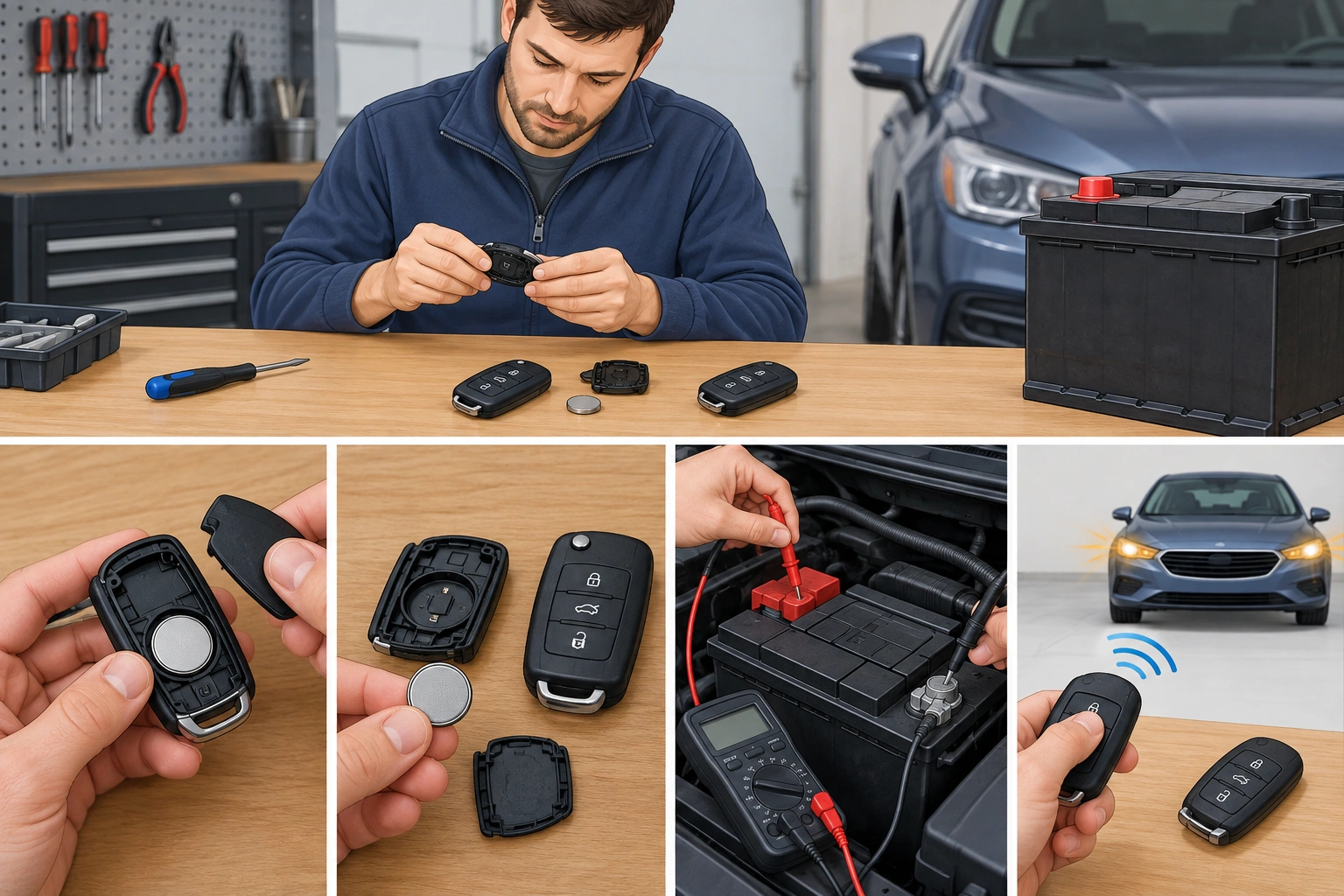
Here’s the fastest rule of thumb I use when helping drivers sort this out:
- If the fob works only when you stand very close to the car, the battery is a strong suspect.
- If a spare fob works normally, the original fob is the problem.
- If both fobs fail at the same time, look at the car battery or the vehicle’s receiver system before buying anything.
That order matters because key fobs can fail for very different reasons. A dead coin-cell battery is cheap and common. A cracked case, water damage, or failed transmitter usually means repair or replacement. And sometimes the fob is fine, but the car isn’t reading it.
Common Signs the Battery Is Weak vs. the Fob Is Broken
A weak battery and a damaged fob can look similar at first, but the symptoms usually point in different directions.
Signs that point to a weak battery
These are the clues I’d take seriously first:
- The range drops off before the fob quits completely.
- You have to press the button more than once.
- The fob works intermittently, especially when you’re close to the car.
- The car starts if you hold the fob near the start button or place it in the backup sensing area.
That last one is especially useful on push-to-start vehicles. If the car recognizes the fob only when it’s placed close to the start button or in the manufacturer’s backup location, the battery may be too weak for normal remote use even though the transponder chip still communicates well enough for emergency starting.
Signs that point to a broken fob
These symptoms are more consistent with damage inside the fob:
- The buttons feel mushy, stuck, or uneven.
- The case is cracked or won’t stay closed.
- The fob was dropped hard, crushed, or exposed to water.
- The battery is new, but nothing works.
- The fob worked after a battery change and then failed again quickly.
If the shell is damaged but the electronics still respond, repair may be possible. If the internal transmitter is faulty, replacement is usually the practical answer.
First Checks Before You Buy a Replacement
Before spending money, run through the cheapest tests first. These take a few minutes and can save you from ordering the wrong part.
Try the spare fob
If you have a second key fob, test it on the same vehicle. If the spare works, that points to a problem with the original fob rather than the car.
Check the car battery
A weak vehicle battery can mimic key fob trouble. If the car’s battery is low, the receiver may not respond properly, and the car may act as if the fob is dead. This is especially worth checking if the doors are sluggish, the dash is dim, or the car has been sitting.
Test at close range
Stand right next to the driver’s door and press the lock or unlock button. If the fob only works very close to the car, that often suggests a weak battery or a reduced signal, not necessarily a dead fob.
Inspect the battery contacts
Open the fob carefully and look for corrosion, bent contacts, or a battery installed the wrong way. A fresh battery won’t help if it isn’t making solid contact.
For a quick visual reference on the vehicle-security side of the issue, the NHTSA’s vehicle theft and security resources are a useful place to understand how immobilizer-based systems are meant to work.
Step-by-Step Fixes to Try at Home
If the fob still seems like the likely culprit, work through the basics in this order.
1) Replace the coin-cell battery
This is the first fix worth trying if the battery is old or the fob has become intermittent. Use the exact battery type listed for your fob, and make sure it sits flat in the holder.
A wrong battery size or a battery installed upside down can make a good fob seem dead.
2) Clean the contacts
If the battery terminals look dull, dirty, or lightly corroded, clean them gently with a dry cotton swab or a soft cloth. Avoid scraping aggressively. The goal is better contact, not polished metal.
3) Reassemble the case correctly
A fob case that doesn’t snap shut evenly can shift the battery or keep the buttons from pressing properly. If the shell is cracked, that’s a warning sign the problem may come back even after a battery change.
4) Test again from a normal distance
After the battery swap, step back and try the lock and unlock buttons from the distance you normally use. A healthy fob should not require you to stand right next to the door every time.
5) Try the vehicle’s emergency start method if needed
If your car has push-button start and the battery is dead, many vehicles still allow a backup start by placing the fob near the start button or in a designated sensing area. Check your owner’s manual for the exact method for your model.
That backup method is a clue, too: if the car starts only in the emergency location, the fob battery is likely weak even if the transponder still works.
How to Tell Whether the Problem Is the Fob or the Vehicle
This is the part that keeps people from replacing a good fob unnecessarily.
When the fob is likely at fault
- One fob works and the other does not.
- A battery change improves the problem only briefly.
- The fob has visible damage, water exposure, or worn buttons.
When the vehicle may be at fault
- Both fobs stop working at the same time.
- The car battery is weak or recently disconnected.
- The vehicle’s locks, receiver, or immobilizer system seems inconsistent.
If both fobs fail together, I would not jump straight to a replacement. That pattern usually means the issue is on the vehicle side, not in two separate fobs.
When a Battery Replacement Is Enough
A battery replacement is usually the right move when the fob is:
- intermittent rather than completely dead,
- weak at normal range,
- old enough that the battery could simply be worn out,
- still able to start the car in a backup sensing position.
In many cases, changing the battery restores normal operation without any further work. Some vehicles may need a re-sync after a battery change, but many do not. If your fob still fails after a fresh battery, that’s when I’d look at programming or internal damage.
When the Fob Can Be Repaired vs. When It Should Be Replaced
Not every bad fob needs to be thrown away.
Repair may make sense if:
- the buttons are worn but still functional,
- the battery contacts are loose,
- the shell is cracked but the electronics still work,
- the issue seems limited to the case or battery holder.
Replacement is the better call if:
- the fob has been water-damaged,
- the internal transmitter has failed,
- the fob was lost or stolen,
- the case is badly broken and the electronics are no longer reliable,
- a fresh battery and contact cleaning did nothing.
If your fob was lost or stolen, replacement is not optional. A lost or stolen fob usually needs to be replaced, and proof of ownership is commonly required.
Do You Need to Reprogram or Pair the Fob?
Sometimes yes, sometimes no.
A battery swap alone does not always require reprogramming. But if the fob stops communicating with the vehicle, or if you replace the entire fob, programming may be needed.
You should expect programming if:
- the original fob is being replaced,
- the vehicle no longer recognizes the fob,
- a used or aftermarket fob is being added,
- the system lost sync after battery issues or electrical problems.
If the car has a physical key blade, that key also needs to be cut.
Replacement Options: OEM, Aftermarket, Used, Dealer, or Locksmith
Here’s the practical comparison most owners need:
| Option | Best for | Trade-off |
|---|---|---|
| Battery replacement | Weak or intermittent fob | Cheapest, but only helps if the battery is the issue |
| Repairing the existing fob | Broken case, worn buttons, loose contacts | Can be economical, but not useful for failed electronics |
| OEM replacement | Exact fit and better compatibility | Usually costs more |
| Aftermarket replacement | Lower upfront cost | Compatibility and quality can vary |
| Used fob | Budget-conscious replacement projects | Often still needs programming and may not be reliable |
| Dealer replacement | Vehicles with dealer-only programming or strict compatibility needs | Usually the most expensive route |
| Automotive locksmith | Faster local help and programming support | Availability varies by vehicle and location |
A few practical rules can help you decide:
- Choose OEM if your vehicle is newer, push-to-start, or picky about programming. It usually costs more, but it’s the safer choice when compatibility matters.
- Be cautious with aftermarket fobs if you need guaranteed reliability. They can work well on some vehicles, but quality and programming support vary.
- Used fobs are the riskiest option if you need fast, hassle-free results. They may still need unlocking, reprogramming, or a compatible part number, and not every used fob can be reused.
- Dealer-only programming is more likely on newer vehicles, smart keys, and some push-to-start systems. If a locksmith says they can’t program your model, the dealer may be the only practical route.
- A locksmith is often the better value when they can cut and program on site. That can save time compared with ordering parts and scheduling a dealership visit.
A dealer can be the safest path when your vehicle has tight security requirements or you want an OEM part with factory programming. An automotive locksmith is often the better balance of speed and cost when they support your make and model.
Cost and Time Expectations
Prices vary by vehicle, part type, and who does the work, but these rough USD ranges can help you plan:
- Battery replacement: about $2 to $15 for the battery itself, or roughly $10 to $30 if you pay someone to install it.
- Fob repair: about $20 to $100 for minor case, button, or contact repairs; more if internal electronics are damaged.
- Reprogramming / re-syncing: about $50 to $150 in many cases, though some vehicles can run higher.
- Dealer replacement: often about $150 to $500+ depending on the vehicle and whether cutting and programming are included.
- Locksmith replacement: often about $100 to $300, sometimes less for simpler keys and sometimes more for smart keys or luxury vehicles.
Time expectations are usually just as important:
- Battery swap: often 10 to 20 minutes
- Minor repair: often same day
- Reprogramming: often 15 to 60 minutes
- Dealer replacement: sometimes same day, but it can take longer if the part must be ordered
- Locksmith replacement: often same day, especially if they stock the right fob
If you’re deciding whether to keep troubleshooting or buy a new fob, the key question is this: did the battery change restore normal function? If not, and especially if the fob has visible damage or the car no longer recognizes it, replacement becomes a much stronger possibility.
When to Consult a Locksmith
Call a locksmith or dealer if any of these apply:
- the fob was lost or stolen,
- you tried a fresh battery and it still will not work,
- both fobs stopped working,
- the car won’t recognize the fob for starting,
- there is water damage or broken internal parts,
- you need a replacement fast and don’t want to wait on dealer parts.
A locksmith is often the best middle ground when you need programming help without dealer pricing or dealership wait times.
What to Do If the Fob Battery Is Dead and You Need to Drive Now
If the battery dies at the wrong time, don’t panic.
For many push-to-start cars, the backup start method lets the car detect the fob at very close range even when the battery is weak or dead. Check the owner’s manual for the exact location or procedure. Some vehicles want the fob held against the start button; others use a marked sensing spot.
If your fob has a hidden physical key, use that to unlock the door. Then use the vehicle’s backup start method to get moving.
Bottom Line
If your key fob stopped working, don’t replace it blindly. Test the spare, check the car battery, try a fresh coin-cell battery, and inspect the contacts and case. If that doesn’t solve it, the problem may be reprogramming, internal damage, or a vehicle-side issue.
That quick sequence usually tells you whether you need a battery, a repair, a re-sync, or a new fob — without wasting money on the wrong fix.
FAQ
How do I know if my key fob battery is dead?
A dead or weak battery usually shows up as shorter range, intermittent operation, or needing to stand very close to the car. If the fob works only in a backup sensing spot on a push-to-start vehicle, the battery is a strong suspect.
Can a key fob be repaired?
Sometimes. Loose contacts, a cracked shell, or worn buttons can often be repaired. If the internal transmitter or electronics are damaged, replacement is usually the better option.
Does a key fob need to be reprogrammed after a battery change?
Not always. Many fobs work normally after a battery swap, but some vehicles need a re-sync or reprogramming if the fob loses communication with the car.
Is it cheaper to go to a locksmith or a dealer?
A locksmith is often cheaper and faster if they can support your vehicle. A dealer may be the better choice for newer vehicles, OEM parts, or models that require dealer-only programming.
Can I use a used or aftermarket key fob?
Sometimes, but it depends on the vehicle. Used and aftermarket fobs can be lower-cost options, but compatibility and programming support vary, so they’re riskier than OEM parts.
What if both of my key fobs stop working?
If both fobs fail at the same time, the issue is often with the car battery, receiver, or immobilizer system rather than both fobs at once.
