
How to Replace a Lost Car Key Without the Original: What to Do, What It Costs, and Which Option Fits Your Car

Losing a car key is frustrating, but the replacement process is usually manageable once you identify the key type and choose the right service path. The fastest fix for one vehicle may be a mobile automotive locksmith. Another may require dealer programming, proof of ownership, and a tow. The difference comes down to what your car uses: a basic mechanical key, a transponder key, a remote key, or a smart key.
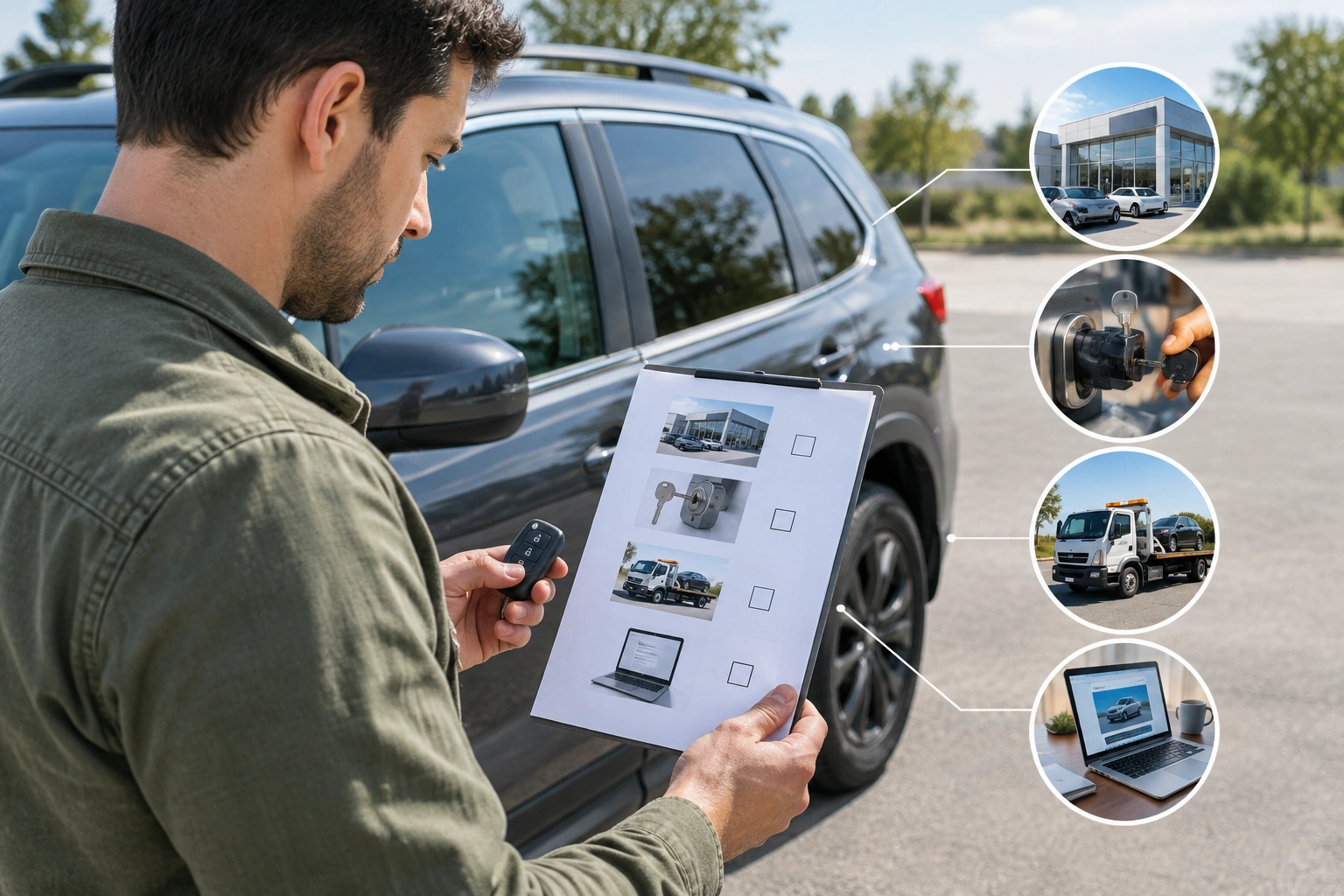
If you are standing in a parking lot right now, the goal is not to guess. The goal is to avoid buying the wrong replacement, wasting time on incompatible parts, or paying for towing when mobile service would have been enough.
What to do first when you realize the key is gone
Before you call anyone, pause and check the obvious places: pockets, bags, jacket liners, desk drawers, kitchen counters, and the last place you parked. If the car is unlocked, make sure it stays secure while you look. If it is locked and you are stranded somewhere unsafe, call roadside assistance first.
If you have a fob with a hidden mechanical key, use that hidden blade to open the door if needed. A dead fob or missing battery can look like a lost key problem when it is really a power issue. Depending on the vehicle and fob type, checking or replacing the battery may solve the problem, and some fobs can be reprogrammed rather than replaced outright. AARP’s key fob repair and replacement tips
If you find a spare, that changes everything. A working spare usually means you can drive the car to a locksmith or dealer, which is cheaper and faster than an all-keys-lost situation.
Identify the type of key you lost
This step matters because replacement methods are not the same.
Mechanical key
This is the simplest kind: a plain metal key with no chip. Older cars often use it for door locks and ignition. A locksmith can often cut a replacement on the spot, even if you do not have the original.
Transponder key
A transponder key looks like a normal key, but it has a chip inside. The chip must match the vehicle’s immobilizer system before the engine will start. Cutting alone is not enough.
Remote key or key fob
This type usually opens doors remotely and may also start the car if inserted into an ignition or used with a push-button system. Some have a hidden blade inside for emergency entry. Depending on the vehicle, replacement may involve cutting, programming, or both.
Smart key
This is the most electronic option. The car detects the key nearby and allows push-button starting. Smart keys almost always require pairing to the vehicle, and replacement can be more involved than with a basic key.
Consumer Reports notes that the old “copy a blank at the hardware store” approach is mostly gone for many newer vehicles with push-button start or keyless entry, though some basic mechanical keys can still be duplicated that way. That is why identifying the key type early saves time and money. Consumer Reports on replacing a car key fob
Check whether you still have a spare key
If you have one working spare, replacement is usually easier in three ways:
- You can move the car if needed.
- Programming is often simpler when the vehicle already recognizes a valid key.
- You can compare the old key’s shape, buttons, and part number before ordering.
If every copy is gone, expect more friction. You may need proof of ownership, VIN-based ordering, and a service provider with the right programming tools. That is where costs rise.
A practical rule: if you have a spare, try to duplicate it before you are down to zero. It is almost always cheaper to make a backup from a working key than to replace every key after both are lost.
Gather the information you need before calling
Have this ready before you call a dealer, locksmith, or roadside provider:
- Year, make, model, and trim
- VIN
- Whether the car is parked at home, work, or somewhere else
- Whether you have any working key at all
- Whether the key is mechanical, transponder, remote, or smart
- Whether the car starts with a push button or a traditional ignition
- Proof of ownership and personal ID
Good Sam notes that dealerships often ask for the VIN, proof of insurance, and personal ID to protect against fraud when replacing keys or fobs. Good Sam’s lost car key checklist
That list is not busywork. It helps the service provider confirm the correct blank, chip, or fob before you pay for anything.
Compare your replacement options
Here is the practical trade-off between the main choices:
| Option | Best for | Speed | Cost | Towing needed? | Programming capability |
|---|---|---|---|---|---|
| Automotive locksmith | Mechanical keys, many transponder keys, some remotes and fobs | Often fastest | Often lower than dealer | Usually no | Often yes, depending on vehicle |
| Dealer | Smart keys, brand-specific systems, some all-keys-lost cases | Can be slower | Often highest | Sometimes yes | Yes, usually with OEM tools |
| Roadside assistance | Unsafe location, lockout, towing needs | Fast for transport | Varies by plan | May be included | No direct programming |
| Online purchase | People who already know the exact part | Fast to order, slower to finish | Can be lower upfront | No | Not by itself; still needs cutting/programming |
AAA says that if you need a traditional key replaced, an automotive locksmith can often come to you and make a key on the spot, even without the original. For more advanced keys like a key fob, transponder key, or smart key, AAA notes that some situations may require dealer programming or towing, but locksmith capability varies by vehicle and equipment, so a dealer is not always the only option. AAA’s guidance on lost car keys
Understand what must be cut, programmed, or both
This is where people waste the most money.
If you lost a mechanical key
The locksmith cuts a new blade. No programming is usually needed.
If you lost a transponder key
The blade may need cutting, and the chip must be programmed to the immobilizer. If the chip is not paired correctly, the key may turn the ignition but still fail to start the engine.
If you lost a remote key or smart key
The replacement may need both physical cutting and electronic pairing, or just pairing if the vehicle uses a hidden emergency blade. The exact process depends on the make and model.
CARFAX notes that some automakers allow DIY programming at home, but the process varies by brand and usually involves a sequence of ignition and button actions. In many cases, you need access to the vehicle and a way to turn the ignition on and off. CARFAX on lost key fob replacement
That is the key decision: if your vehicle supports owner programming, DIY may work. If it does not, forcing the issue only delays the fix.
How much a lost car key replacement usually costs
Costs vary widely by vehicle, key type, and whether you need cutting, programming, towing, or a dealer-only part. As a rough planning guide:
- Traditional mechanical key work: about $100 to $150
- Basic transponder key replacement: often about $150 to $300
- Remote key or key fob replacement: about $200 to $400+
- Smart keys and some all-keys-lost jobs: often higher, and sometimes significantly more depending on brand and programming requirements
Those figures are broad, not universal. A simple replacement with an existing spare is usually cheaper than an all-keys-lost situation, and OEM parts, dealer programming, emergency service, or towing can move the total well above the ranges above. Good Sam reports those ranges and also notes that timing can vary depending on parts availability and programming needs. Good Sam on lost key costs and timing
What pushes the price up:
- All keys lost instead of one spare available
- OEM versus aftermarket parts
- Dealer programming fees
- Towing
- Special immobilizer or smart-key systems
- Emergency service after hours
A useful rule: the more your car depends on encrypted pairing, the less “just cut me a key” applies.
Step-by-step: how to replace a lost car key
Here is the cleanest path.
1) Confirm the key type
Look at the old key if you still have it, or check the owner’s manual and your vehicle’s start system.
2) Gather the VIN and ownership documents
Have your ID, registration, and proof of insurance ready. If you are calling a dealer, expect to verify ownership.
3) Decide whether you need mobile service, a safe place to meet, or towing
If the car can be serviced where it sits, a mobile locksmith may save time and towing costs. If you are parked in a busy lot, on a roadside shoulder, or anywhere the vehicle cannot be safely worked on, move to a safer location if possible and call roadside assistance first. If the key system requires dealer-level tools, towing may be the better path.
4) Choose OEM or aftermarket carefully
OEM parts usually cost more but tend to be the safer compatibility choice. Aftermarket parts can save money, but only if they match the correct frequency, chip, and vehicle platform.
5) Order or cut the key
Mechanical keys are cut. Transponder, remote, and smart keys may also need programming.
6) Program and test
Test door locks, remote functions, and engine start. Do not stop at “the buttons work.” The engine-side immobilizer function matters too.
7) Make a spare immediately
Once the car is running again, duplicate the new key while the system is fresh and the details are in front of you.
What changes when all keys are lost
“All keys lost” is the expensive version of this problem.
If you still have one working key, replacement is usually simpler because the vehicle can often be accessed and verified more easily. If every key is gone, the provider may need to:
- Verify ownership more carefully
- Use the VIN to source the correct key
- Access immobilizer data
- Program from scratch
- Tow the vehicle if on-site work is not possible
That is why many drivers are surprised by the quote. They expected a duplicate key price, but they actually need a full recovery process.
When towing is required and when mobile service can come to you
Towing makes sense when:
- The vehicle cannot be unlocked or accessed safely
- The key system requires dealer-only equipment
- The car must be at the dealer for programming
- The vehicle is in a secure lot that does not allow on-site work
Mobile service makes sense when:
- The car is accessible
- The key type is supported by the locksmith’s equipment
- You want to avoid towing
- You need the fastest same-day option
If you are stranded at work, at a store, or in a driveway, mobile service is often the most practical first call.
Common mistakes that slow everything down
These are the ones I see most often:
- Buying the wrong blank or fob because the trim level was not checked
- Ordering a key online without confirming the chip type or frequency
- Assuming a transponder or smart key will work without programming
- Calling only the dealer when a locksmith could have handled it sooner
- Forgetting proof of ownership and delaying the appointment
- Paying for towing before confirming whether on-site service is possible
The biggest money leak is guessing. A few minutes spent matching the part to the vehicle usually saves a second purchase.
When to Call an Automotive Locksmith
Call an automotive locksmith when you want the fastest path for a lost mechanical key, many transponder keys, or a replacement with on-site cutting and programming. It is also the better first call when the car is parked somewhere you can reach, you have proof of ownership ready, and you want to avoid towing if possible.
If the vehicle uses a smart key system, all keys are lost, or the brand requires dealer-only pairing, a locksmith can still be worth calling first to confirm whether they can handle it. That quick check may save you a tow.
FAQs
Can I replace a lost car key without the original?
Yes. Pop-A-Lock says you can still get a replacement without the original. In many cases, the provider uses the VIN and ownership documents to create a new key. Pop-A-Lock on replacing without the original
Do I need to tow my car to the dealer?
Not always. Some keys can be replaced by a mobile automotive locksmith. Towing is more likely when the key is a smart key, the vehicle needs dealer-specific programming, or the car cannot be serviced on-site.
Can a locksmith make a key for my car?
Often, yes. A locksmith can usually handle many traditional keys and, depending on the vehicle and the locksmith’s equipment, may also be able to cut and program some transponder, remote, or smart keys.
How long does replacement take?
It can be quick for a basic key, but timing varies by vehicle, part availability, and programming needs. Some replacements are same-day; others take longer if parts must be ordered or the vehicle needs dealer-level service.
Can I order a replacement key online?
Yes, but only if you are certain about compatibility. Online buying can save money, but the wrong chip, frequency, or blank shape can turn a bargain into a second purchase.
What if my key fob is dead, not lost?
Check the battery first. AARP recommends replacing the battery before assuming the fob itself needs replacement. Some fobs can also be reprogrammed rather than replaced. AARP on key fob repair and replacement
Do replacement keys always need programming?
No. Mechanical keys usually do not. Transponder keys, remote keys, and smart keys often do, but the exact requirement depends on the vehicle.
A lost car key is inconvenient, but it is solvable. The fastest route is the one that matches your key type, your documents, and whether you still have a spare.
