
Can an OBD2 Scanner Read ABS Codes?

Quick Answer
Yes, an OBD2 scanner can read ABS codes, but only if it supports your vehicle’s anti-lock braking system. Basic code readers usually access engine and emissions faults, while compatible multi-system scanners can communicate with the ABS module. Before buying a scanner, check its coverage for your exact make, model, year, and ABS functions.
What You Need to Know
- Basic scanner: Usually reads engine-related diagnostic trouble codes, not ABS faults.
- ABS-capable scanner: Communicates with the anti-lock braking system on supported vehicles.
- Multi-system scanner: May read ABS, airbag, transmission, and other module codes.
- Vehicle compatibility: Coverage varies by make, model, year, and available diagnostic functions.
- Code interpretation: A trouble code identifies a detected fault or condition, not necessarily a failed part.
Before You Start
- Check whether the scanner explicitly lists ABS diagnostics for your vehicle.
- If the ABS or brake warning light is on, don’t assume an engine-only scan will identify the problem.
If you’ve plugged in a scanner and found no codes while the ABS warning light remains on, the tool may simply be unable to access the right module.
I’ll explain how ABS scanning works, how to recognize a compatible tool, and what to do when a scan returns no results. I’ll also cover the safety issues that matter before you clear any brake-related fault.
In This Guide
How Does an OBD2 Scanner Read ABS Codes?
An OBD2 scanner reads ABS codes when its hardware and software can communicate with the vehicle’s anti-lock braking system module. A basic engine-code reader may connect through the same diagnostic port but still lack access to ABS information.
What is an ABS code?
An ABS code is a diagnostic trouble code (DTC) stored by the vehicle’s anti-lock braking system or a related control module. It indicates that the system detected an electrical, sensor, communication, or operating condition that needs investigation.
The ABS helps prevent the wheels from locking during hard braking. Depending on the vehicle, its control system monitors wheel-speed sensors and controls hydraulic components to manage braking pressure.
When the system detects a fault, it may illuminate the ABS warning light and store a diagnostic code. That code gives you a starting point for troubleshooting.
Why can’t every OBD2 reader access ABS?
OBD2 is commonly associated with standardized engine and emissions diagnostics, but a vehicle can have many additional electronic modules. ABS, airbag, transmission, and body-control systems may require manufacturer-specific diagnostic access.
A scanner needs the right communication support, software coverage, and access to the relevant module. Simply having a standard 16-pin diagnostic connector doesn’t guarantee that every system is available.
- Engine module: Manages engine operation and reports many emissions-related faults.
- ABS module: Monitors the anti-lock braking system and reports supported brake-control faults.
- SRS module: Manages the supplemental restraint system, including airbags and related safety components.
- Body-control module: Handles selected electrical functions, which may include locks, lighting, and other equipment.
These systems are separate diagnostic targets, even when a single scanner can access several of them.
For a technical explanation of enhanced diagnostics, see the OBDLink guide to vehicle-specific diagnostic coverage. It explains why supported modules and functions vary by vehicle.
Which Types of OBD2 Scanners Can Read ABS Codes?
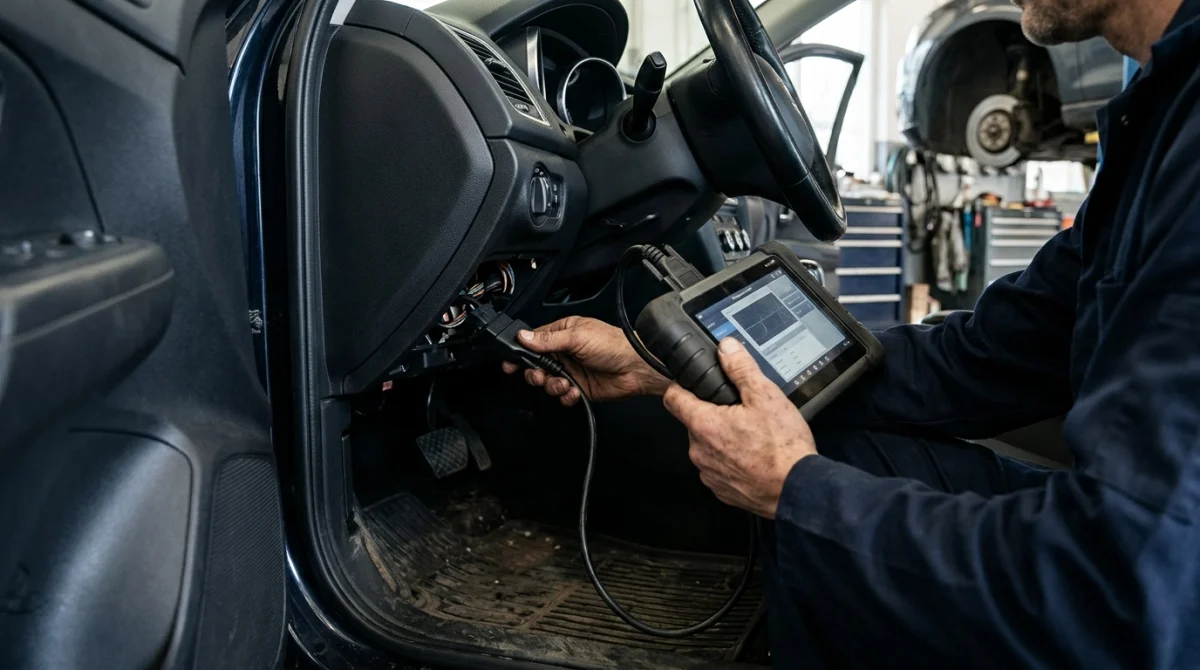
Look for a scanner that explicitly supports ABS diagnostics for your vehicle. A tool advertised as an OBD2 scanner, by itself, does not necessarily include ABS access.
Basic engine-code readers
Basic readers are useful for checking the check-engine light, retrieving supported powertrain codes, and viewing selected emissions data. Most aren’t designed to scan the ABS module.
If your only goal is to investigate an ABS warning, a basic engine reader may not be enough. An empty engine-code report doesn’t prove the braking system is fault-free.
ABS and multi-system scanners
ABS-capable scanners can access supported anti-lock braking system codes. Multi-system tools may also cover SRS, transmission, steering, and other modules, depending on the device and vehicle.
Some advanced scanners offer more than reading codes. Depending on the vehicle, they may provide live sensor data, bidirectional tests, service functions, or ABS bleeding routines.
Those additional features aren’t universal. Reading ABS codes doesn’t automatically mean a scanner can activate components, perform an automated bleed, or complete a calibration.
| Scanner type | ABS code access | Typical capabilities |
|---|---|---|
| Basic OBD2 reader | Usually no | Supported engine and emissions codes |
| ABS-specific scanner | Yes, for listed vehicles | ABS fault-code retrieval and possibly selected data |
| Multi-system scanner | Yes, if supported | Several modules, with features varying by vehicle |
| Professional diagnostic tool | Often, with vehicle-specific coverage | May include live data, active tests, and service procedures |
How do you choose the right scanner?
Before purchasing, verify these details in the manufacturer’s compatibility information:
- Vehicle coverage: Your exact make, model, and model year.
- ABS code reading: Explicit support for retrieving ABS diagnostic trouble codes.
- Live data: Wheel-speed readings or other ABS parameters, if needed.
- Code clearing: Support for clearing ABS faults after the underlying problem is repaired.
- Service functions: ABS bleeding, actuator tests, or calibrations only if your repair requires them.
Expert tip: Confirm the exact vehicle and supported ABS functions before ordering a scanner. A manufacturer’s general compatibility claim may not guarantee every diagnostic feature on your particular vehicle.
Section takeaway: Choose a scanner based on verified ABS coverage, not just its OBD2 label or advertised number of functions.
How Do You Scan a Car for ABS Codes?
You can scan for ABS faults at home if you have a compatible scanner and follow the tool’s instructions. The exact menu names and connection procedures vary by scanner and vehicle.
Step 1: Confirm that your scanner supports ABS
Check the user manual or official compatibility list first. If the tool only supports engine and emissions diagnostics, switching between menus won’t make it read the ABS module.
Step 2: Park safely and connect the scanner
- Park on a level surface away from traffic.
- Apply the parking brake and follow the vehicle manufacturer’s instructions.
- Locate the diagnostic connector, commonly found beneath the dashboard.
- Connect the scanner and switch the ignition to the state specified in its instructions.
Keep the vehicle stationary while retrieving codes unless a specific diagnostic procedure requires otherwise. Never attempt live-data checks that involve driving while watching a handheld scanner yourself.
Step 3: Select the ABS system
Choose the vehicle information and open the ABS, brake-control, or chassis diagnostics menu. The wording depends on the scanner and the manufacturer’s system design.
If the scanner offers only an engine or generic OBD2 scan, it may not support ABS access. Check the manual before assuming that a communication failure means the vehicle’s module is defective.
Step 4: Read and record the codes
Retrieve the stored ABS codes and save or photograph the results. Record any code description, status, and available freeze-frame or live-data information before clearing anything.
A code’s exact meaning can depend on the vehicle manufacturer. Use vehicle-specific service information rather than relying solely on a generic description displayed by the scanner.
Step 5: Diagnose before replacing parts
Use the code as a diagnostic lead, then inspect the relevant wiring, connectors, sensor signals, and other components as directed by reliable service information. A wheel-speed sensor code, for example, doesn’t automatically prove the sensor itself has failed.
Locksmith’s note: Just as a key fob fault can involve its battery, wiring, or vehicle receiver, a diagnostic code often points to a system or circuit rather than identifying one guaranteed replacement part.
For safety-related guidance, consult the National Highway Traffic Safety Administration and the service information for your specific vehicle.
What Can ABS Codes Tell You?
ABS codes can help narrow a braking-system problem to a sensor circuit, electrical supply, communication issue, or control-system component. The information available depends on the vehicle and the scanner’s diagnostic coverage.
Common ABS fault categories
- Wheel-speed sensor faults: The module detects an unexpected signal, missing reading, or circuit problem.
- Wiring and connector faults: Damaged wiring, corrosion, poor connections, or an open or shorted circuit can interrupt signals.
- Low-voltage faults: Battery or charging-system problems can interfere with electronic module operation.
- Hydraulic control faults: The system reports a problem involving supported pump, valve, or control functions.
- Module communication faults: One module may be unable to communicate properly with another system.
These are fault categories, not a universal list of code meanings. The exact diagnostic definition and repair procedure depend on the make, model, year, and stored code.
Can an ABS scanner show live wheel-speed data?
Some compatible scanners display live readings from individual wheel-speed sensors. Comparing those readings can help a technician identify an inconsistent signal or a wheel whose reported speed differs from the others.
However, live data isn’t available for every vehicle or scanner. A missing reading can also reflect a coverage limitation, an unsupported parameter, or a communication problem rather than a confirmed failed sensor.
Does an ABS code mean the brakes have failed?
Not necessarily, but you shouldn’t dismiss it. Depending on the fault, conventional braking may remain available while the anti-lock function or other stability-related features become limited or unavailable.
If the red brake warning light stays on, the pedal feels unusual, braking performance changes, or you notice a fluid leak, stop driving when safe and arrange professional assistance. Don’t rely on a scanner alone to determine whether the vehicle is safe to drive.
The AAA Auto Repair resource can help you find general vehicle-maintenance guidance, but vehicle-specific brake diagnosis should follow the manufacturer’s procedures.
Section takeaway: ABS codes narrow the search, but proper diagnosis requires checking the system and confirming the cause before replacing parts.
Why Won’t Your Scanner Read ABS Codes?
If your scanner finds engine codes but cannot retrieve ABS codes, the most likely explanation may be a scanner or compatibility limitation. A communication problem or fault in the vehicle’s diagnostic system is also possible.
Common reasons for an unsuccessful scan
- Unsupported scanner: The device only reads engine and emissions codes.
- Limited vehicle coverage: The scanner supports ABS on some models but not yours.
- Outdated software: An update may be needed for supported vehicle-specific diagnostics.
- Incorrect selection: You selected generic OBD2 instead of the supported ABS module.
- Power or connection issue: Low battery voltage, a connector problem, or a fuse fault may prevent communication.
- Module or network fault: The ABS controller or vehicle communication network may have a problem.
What should you check first?
Start with the simple checks before assuming an expensive module has failed.
- Confirm ABS coverage for your exact vehicle.
- Check the scanner’s software version and update instructions.
- Follow the correct ignition and connection procedure.
- Inspect the diagnostic connector for visible damage, without forcing or shorting its terminals.
- Check battery condition and relevant fuses using the vehicle’s service information.
- Try a compatible professional scan tool if communication still fails.
If a compatible tool also cannot communicate with the ABS module, further electrical and network diagnosis may be necessary. Avoid replacing the ABS control module simply because one scan attempt failed.
Section takeaway: Verify compatibility and basic electrical conditions first; a failed scan does not automatically mean the ABS module is defective.
Can You Clear ABS Codes With an OBD2 Scanner?
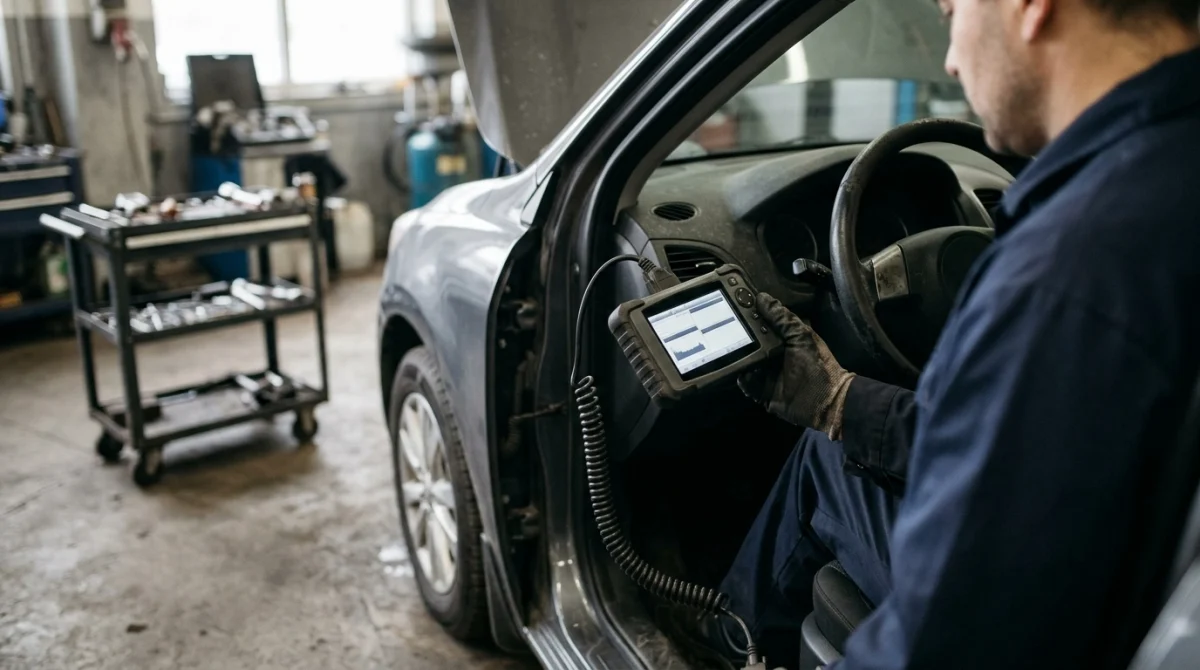
Yes, some ABS-capable scanners can clear supported codes, but only after the cause has been diagnosed and repaired. A basic engine-code reader generally cannot clear faults from an ABS module it cannot access.
When should you clear an ABS code?
Record the original codes before clearing them, because the information may help with diagnosis. Once the repair is complete, follow the scanner’s instructions and the vehicle manufacturer’s verification procedure.
Some faults return immediately if the underlying condition remains. Others may require a successful system self-check or a prescribed test before the warning light goes out.
Will clearing a code fix the ABS problem?
No. Clearing a diagnostic code removes or resets stored information where the system permits it; it doesn’t repair a damaged sensor, restore a broken wire, or correct a hydraulic fault.
Don’t clear codes just to hide an ABS warning before a trip or inspection. A warning light that returns needs proper diagnosis, and safety-related faults should not be ignored.
Expert tip: If the ABS warning remains on after a repair, have the system rescanned and verify the repair rather than repeatedly erasing the code.
Also distinguish code clearing from special service operations. ABS bleeding, actuator activation, and steering-angle calibration may require separate functions and vehicle-specific procedures.
Section takeaway: Use code clearing as part of a verified repair, not as a substitute for one.
Frequently Asked Questions
Can a cheap OBD2 scanner read ABS codes?
Some affordable scanners can read ABS codes, but price alone doesn’t determine compatibility. Check the manufacturer’s supported-vehicle list and confirm ABS diagnostics for your exact make, model, and year before purchasing.
Can a Bluetooth OBD2 scanner read ABS codes?
Yes, if the adapter, connected app, and vehicle-specific software all support ABS diagnostics. Many basic Bluetooth adapters and apps focus on engine data, so confirm module coverage rather than assuming wireless connectivity provides full-system access.
Can an OBD2 scanner read ABS codes without the check-engine light?
Yes. The ABS module can store a fault and illuminate the ABS warning light without triggering the check-engine light. You need a scanner that can access the ABS system to retrieve those codes.
Will an ABS scanner work on every car?
No. Coverage varies by vehicle make, model, year, market, and diagnostic function. A scanner might read ABS codes on one vehicle but lack support for another, even when both use an OBD2 connector.
Can an ABS code identify a bad wheel-speed sensor?
It can identify a fault involving a wheel-speed sensor circuit or signal, but it doesn’t always prove the sensor itself is defective. Wiring damage, connector corrosion, a damaged tone ring, or other mechanical and electrical issues may produce similar symptoms.
Can I drive with the ABS warning light on?
An illuminated ABS warning can mean the anti-lock function is unavailable, even if conventional braking remains. If the red brake warning light also appears, the pedal feels abnormal, or braking performance changes, stop when safe and arrange professional assistance.
Do I need an ABS scanner or a professional mechanic?
An ABS-capable scanner can help you retrieve codes and narrow down the problem. If the fault involves hydraulic components, intermittent electrical signals, module communication, or an unfamiliar repair procedure, a qualified technician may be needed to confirm the cause and verify safe operation.
Final Takeaway: Choose an OBD2 Scanner That Supports ABS
An OBD2 scanner can read ABS codes, but only when its diagnostic capabilities match the vehicle. Basic engine readers often lack this access, while compatible ABS and multi-system scanners can provide fault codes and, on supported vehicles, additional diagnostic data.
Before buying a tool, verify its exact vehicle coverage and the functions you need. If the ABS warning light is on, retrieve the codes, investigate the underlying fault, and confirm the repair rather than simply clearing the warning.
For brake-related problems, safety comes first. If braking performance changes or a red brake warning appears, stop when safe and seek qualified assistance.
