
CR1620 Key Fob Battery: Which Cars Use It and How to Replace It

A CR1620 is a 3V lithium manganese dioxide coin cell that measures 16 mm across and 2.0 mm thick. It is common in Honda remote-head keys from roughly the 2013-2020 era and in some Mazda and Subaru remotes. Always confirm by reading the code on the old battery before you buy.
Most people only learn their fob takes a CR1620 when the remote stops working and they pop the case open. It is a smaller cell than the CR2032 most drivers know, and it is easy to grab the wrong size at the store because CR1616, CR1620, and CR1632 look almost identical.
This guide covers the CR1620 specs, the vehicles that commonly use it, which substitutes are safe, and a simple replacement process.
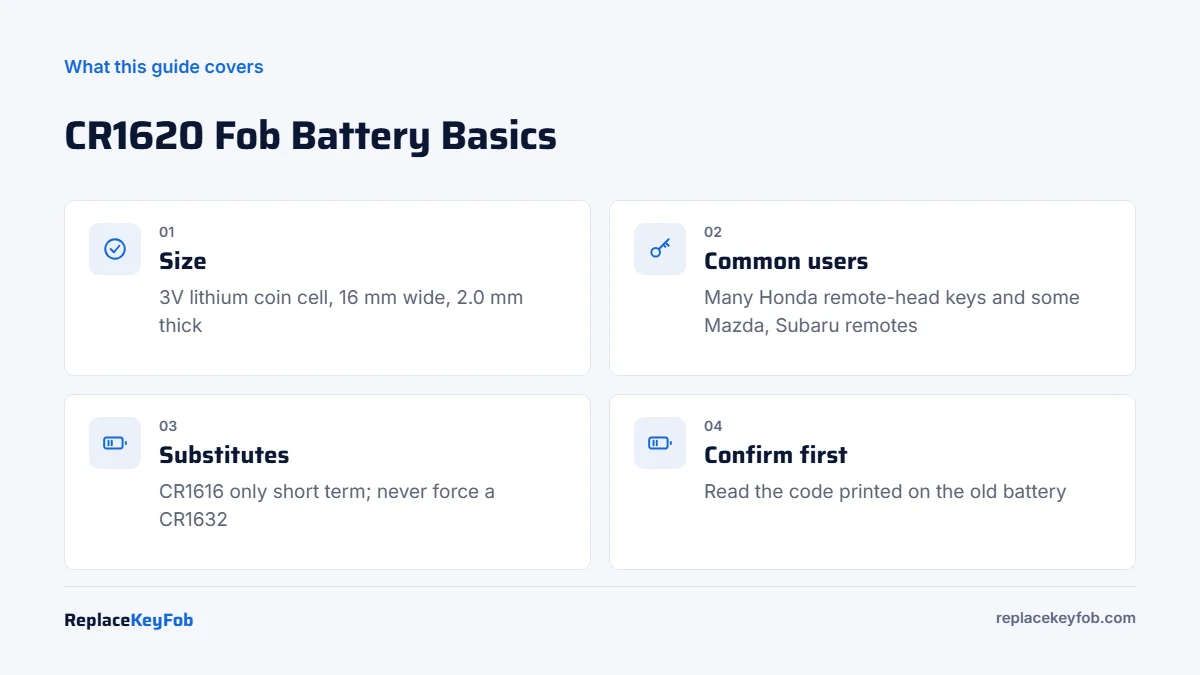
What a CR1620 Battery Is
The name is a code, not a brand. Under the IEC naming system used by every major battery maker:
- C = lithium manganese dioxide chemistry
- R = round (coin) shape
- 16 = 16 mm diameter
- 20 = 2.0 mm thickness
Every CR1620 from Panasonic, Energizer, Duracell, Maxell, or Murata has the same size and the same 3V nominal voltage. Capacity is typically around 70-80 mAh depending on the maker, which is less than half of what a CR2032 holds. That smaller reserve is one reason CR1620 fobs can need a new cell a bit sooner than larger-cell fobs.
CR1620 Specs at a Glance
| Spec | CR1620 |
|---|---|
| Chemistry | Lithium manganese dioxide (Li-MnO2) |
| Nominal voltage | 3.0V |
| Fresh open-circuit voltage | About 3.2-3.3V |
| Diameter | 16 mm |
| Thickness | 2.0 mm |
| Typical capacity | Roughly 70-80 mAh (varies by brand) |
| Other codes you may see | DL1620, ECR1620, BR1620 (different chemistry, not ideal for fobs) |
DL1620 (Duracell) and ECR1620 (Energizer) are the same CR1620 under a brand prefix. A BR1620 uses a different lithium chemistry with a slightly lower working voltage and lower drain capability, so it is not the best pick for a remote that sends radio bursts. Stick with a CR-coded cell.
Which Cars Use a CR1620 Key Fob Battery?
Battery size is decided by the fob design, not the car brand as a whole. One automaker can use three or four different cells across its lineup and model years. With that in mind, these are the most common CR1620 users:
- Honda remote-head keys, roughly 2013-2020: The flip-free keys with lock/unlock buttons built into the head on many Accord, Civic, CR-V, HR-V, Fit, and Crosstour trims commonly take a CR1620. Earlier Honda remote-head keys (around 2008-2012) usually take the thinner CR1616, and Honda push-button smart keys usually take a CR2032.
- Some Acura remote-head keys from a similar era, since they share Honda hardware. Acura smart keys typically use a CR2032.
- Many Mazda keyless remotes, especially older flip-key and separate remote designs.
- Some Subaru keyless remotes from the late 2000s and early 2010s.
Because fob hardware changes mid-generation and differs by trim, treat this list as a starting point. For brand-specific steps, see our Honda key fob battery replacement guide and the key fob battery size chart.
How to Confirm Your Fob Needs a CR1620
- Read the old battery. The code is printed on the flat positive (+) side. This is the most reliable check.
- Check the owner’s manual. Look in the index under “keyless remote,” “remote transmitter,” or “battery replacement.”
- Measure if the printing is worn. A cell about 16 mm wide and 2 mm thick is a CR1620. If it is about 1.6 mm thick, it is a CR1616; about 3.2 mm thick, a CR1632.
CR1620 vs CR1616 vs CR1632: Can You Substitute?
All three share the 16 mm diameter and 3V output. Only thickness and capacity differ, and thickness is what matters in a tight fob case.
| Battery | Thickness | Approx. capacity | Use in a CR1620 fob? |
|---|---|---|---|
| CR1616 | 1.6 mm | About 50-55 mAh | Emergency only; may lose contact |
| CR1620 | 2.0 mm | About 70-80 mAh | Correct fit |
| CR1632 | 3.2 mm | About 120-140 mAh | No; too thick, can crack the case or bend contacts |
A CR1616 can work for a few days in a pinch if the contacts still press firmly, but a loose cell causes intermittent button presses. Replace it with the correct CR1620 as soon as you can. Never force a CR1632 into a CR1620 slot. For the full picture on coin cells, see our lithium coin battery guide.
What You Need
- One new CR1620 from a known brand
- A small flat screwdriver, plastic pry tool, or a coin (many Honda keys have a pry slot)
- Optional: a soft cloth to protect the case from scratches
CR1620 3V Lithium Coin Battery
Confirm the code on your old battery first, then pick a name brand with a clear date code. A 2-pack gives you a spare for a second fob.
As an Amazon Associate, ReplaceKeyFob earns from qualifying purchases.
How to Replace a CR1620 Key Fob Battery
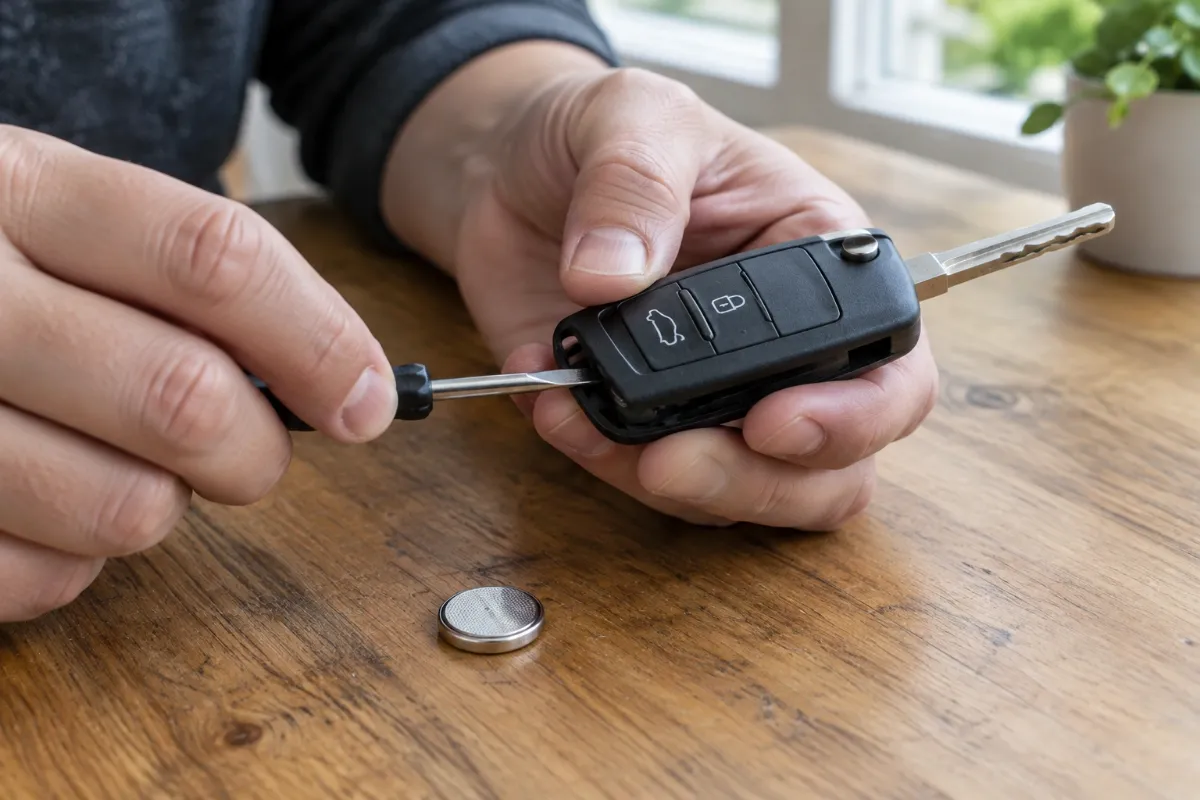
- Find the seam or pry slot. On most Honda remote-head keys there is a small notch along the edge of the head. Remove any screw first if your fob has one.
- Separate the halves gently. Twist a small flat blade or coin in the notch and work around the seam. Do not lever hard against the circuit board.
- Note the orientation. Look at which side faces up before removing the old cell. On most fobs the positive (+) side with the printing faces you, but follow the marking inside the case.
- Remove the old cell. Slide it out with a fingernail or plastic tool. Avoid metal tools across both contacts.
- Insert the new CR1620. Handle it by the edges so skin oils do not coat the faces. Seat it fully under the clip.
- Snap the case back together and press each button while near the car to confirm lock, unlock, and trunk work.
On most vehicles, including most Honda and Mazda models, a battery swap does not erase the fob’s programming. If you want more detail on polarity, see our key fob battery polarity guide.
If the Fob Still Doesn’t Work
- Check polarity. An upside-down cell is the most common mistake.
- Check the contacts. A flattened contact tab may not touch a thinner cell. Bend it up very slightly with a plastic tool.
- Test the new battery. Cells that sat on a shelf for years can be weak. A multimeter should read about 3.0V or higher.
- Check the button pads. Worn rubber pads or a cracked solder joint can mimic a dead battery.
Our guide to a key fob not working after battery replacement walks through each fix. If the remote truly lost its pairing, start with how to program a key fob.
When to Call a Dealer or Locksmith
A CR1620 swap is a DIY job for almost everyone. Call a pro if the fob was dropped in water, the circuit board is cracked, or the remote still fails after a confirmed-good battery. In 2026, a dealer or locksmith battery swap typically costs about $10-$25 if you want it done for you, while diagnosing or replacing and programming a Honda remote-head key typically runs about $100-$300 depending on the model and who does the work.
Signs Your CR1620 Is Running Low
- You have to press lock or unlock more than once.
- The remote only works when you are close to the car.
- The remote LED, if your key has one, is dim or does not light.
- The remote works on warm afternoons but fails on cold mornings.
Because a CR1620 holds only about 70-80 mAh, the gap between the first warning sign and a dead remote can be short. A fresh cell reads about 3.2-3.3V on a multimeter; below roughly 2.9V at rest, replace it. If you own two keys, change both batteries at the same time so the spare is ready when you need it.
Buying Tips for CR1620 Batteries
- Stick with name brands such as Panasonic, Energizer, Duracell, Maxell, or Murata.
- Check the date code on the package. Coin cells slowly lose charge on the shelf, and a small cell has little to spare.
- Avoid unbranded bulk lots, where old stock and counterfeits are more common.
- Store spares safely in their packaging, at room temperature, and out of reach of children. A swallowed coin cell can cause serious internal injury.
Frequently Asked Questions
No. Both are 3V lithium coin cells, but a CR2032 is 20 mm wide and 3.2 mm thick, while a CR1620 is 16 mm wide and 2.0 mm thick. A CR2032 will not fit a CR1620 fob.
Yes. DL1620 is Duracell’s name and ECR1620 is Energizer’s name for the same CR1620 size and chemistry. They are interchangeable.
Only as a short-term fix. The CR1616 is 0.4 mm thinner, so contact can be loose and it holds less energy. Replace it with a CR1620 soon.
Typically about 2-4 years, depending on how often you use the remote and how hot the car gets. Smaller cells like the CR1620 tend to sit at the lower end of that range.
Usually not. Honda remote-head keys keep their pairing when the battery is replaced. If buttons still fail, check polarity and contacts before assuming a programming issue.