
What Is an Engine Immobilizer and How Does It Work?

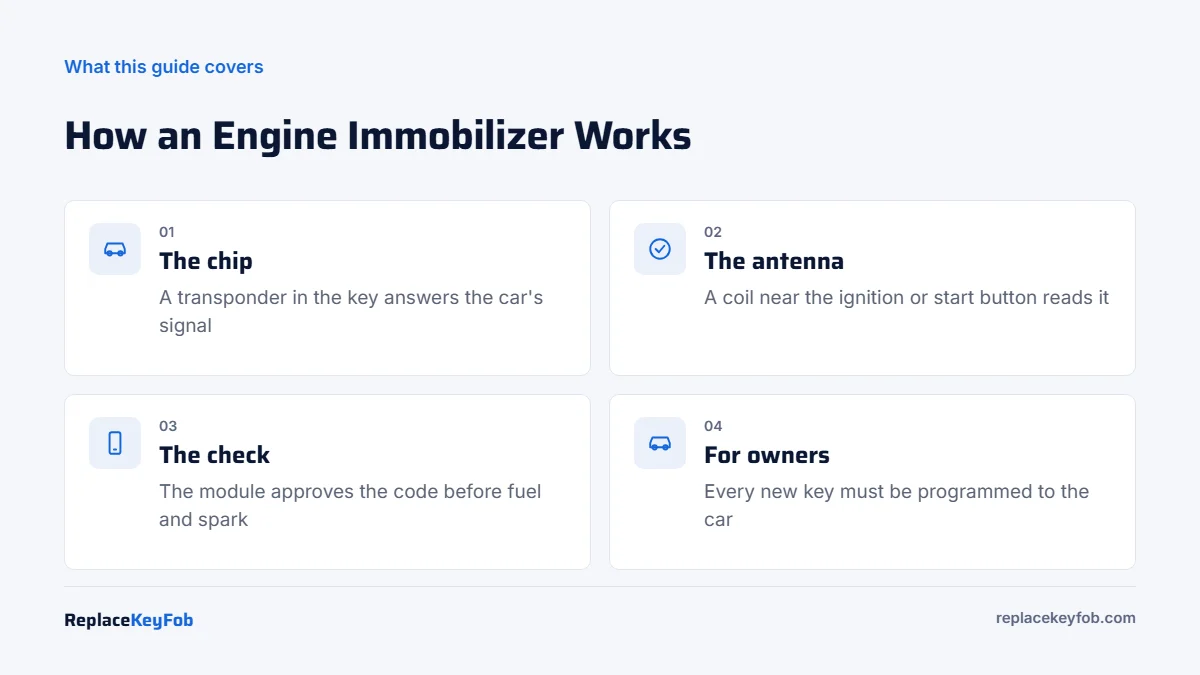
An engine immobilizer is an anti-theft system that stops the engine from running unless the car recognizes your key. A chip in the key answers a coded signal from an antenna near the ignition or start button. If the code checks out, the engine computer allows fuel and spark; if not, the car will not start or stalls within seconds.
Almost every car sold in the US for the last two decades has an immobilizer, even if the owner has never heard the word. It is the reason a copied metal key can unlock the door but not start the engine, and the reason a new key has to be programmed to the car. Understanding how it works makes key problems much easier to diagnose.
This guide explains the parts, the sequence of events when you turn the key or press start, the names different brands use, and what it all means when you need a new key. For adding keys, see our guide to programming a key fob yourself.
The parts of an immobilizer system
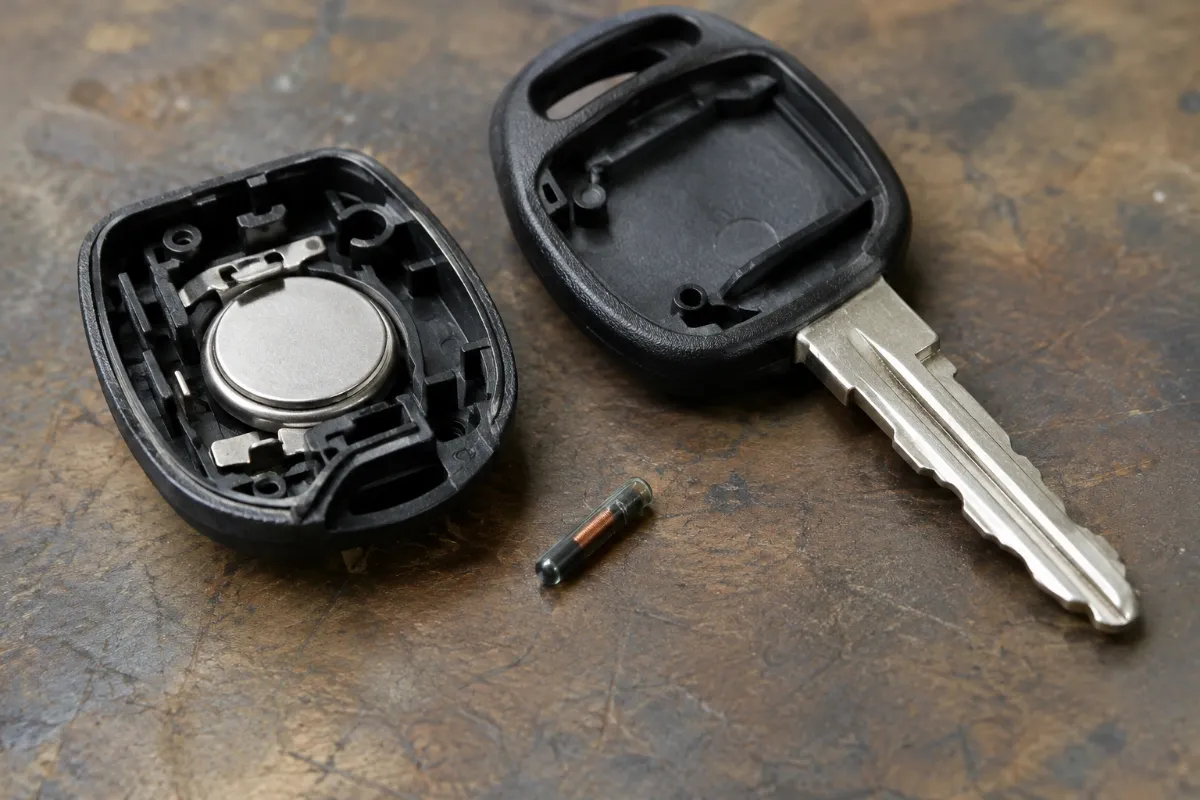
- Transponder chip. A small chip in the key head or smart fob. Most are passive: they have no battery of their own and are powered by the antenna’s field, which is why a key with a dead fob battery can often still start the car when held in the right spot.
- Antenna (reader coil). A coil around the ignition lock cylinder on turn-key cars, or near the start button or a backup slot on push-button cars. Smart key cars also have antennas in the doors and cabin to detect the fob.
- Immobilizer control unit. The logic that stores the IDs of authorized keys. Depending on the brand and year, it is a separate module or built into the engine computer, the body control module or the instrument cluster.
- Engine control module (ECM or PCM). The engine computer that waits for permission before it runs the injectors, ignition or starter.
- Security light. A dash indicator, often a key or car-with-padlock symbol, that shows the system’s status.
How an engine immobilizer works, step by step
- You turn the key to ON or press the start button.
- The antenna sends out a low-frequency field (commonly around 125 kHz on many systems) that powers the transponder chip.
- The chip replies with its ID. Most modern systems use challenge-response cryptography: the car sends a random challenge, and the key must return the correct encrypted answer, so simply recording the reply does not work.
- The immobilizer unit compares the answer with its list of authorized keys.
- If it matches, the immobilizer sends an approval to the engine computer, often as another coded message rather than a simple on/off signal.
- The engine starts. If the key is not recognized, the starter may not engage, or the engine starts and stalls after a second or two, and the security light flashes.
On smart key cars, the process is the same, but the car first finds the fob in the cabin using the door and interior antennas, then confirms it by radio before allowing the start button to work.
Immobilizer names by brand
| Brand | Common system names | Notes |
|---|---|---|
| Ford, Lincoln, Mercury | PATS (Passive Anti-Theft System), SecuriLock | Many models let owners add a key with two working keys |
| GM: Chevrolet, GMC, Buick, Cadillac | VATS (Pass-Key), Passlock, Passkey III, later integrated systems | VATS used a resistor pellet in the key; Passlock read the ignition cylinder |
| Chrysler, Dodge, Jeep, Ram | SKIM, SKREEM, Sentry Key | Key programming often needs a PIN or timed access |
| Toyota, Lexus | Engine Immobiliser System, Smart Key System | Master and valet keys on older models |
| Nissan, Infiniti | NATS (Nissan Anti-Theft System), Intelligent Key | PIN-based programming on many models |
| Honda, Acura | Immobilizer System | Key registration with a tool |
| Volkswagen, Audi | Immobilizer generations often called Immo 2 to Immo 5 | Key data is shared across several modules |
| BMW | EWS, then CAS, then FEM/BDC | Later systems are dealer or specialist work |
A short history
Early systems appeared in the 1980s and 1990s. GM’s VATS, first used on the Corvette in the mid-1980s, read a resistor in the key blade. Chip-based transponder keys spread through the 1990s. European Union rules made immobilizers standard on new cars from the late 1990s, and Canada required them on new vehicles from 2007. The US never mandated them, but most manufacturers fitted them anyway.
That gap mattered: many Hyundai and Kia models sold in the US with turn-key ignitions over roughly the 2011 to 2022 model years did not have engine immobilizers, which led to a wave of thefts and a software update program from the manufacturers. If you own one of those vehicles, ask a dealer whether the update applies to yours.
Key types that work with an immobilizer
- Transponder key: a plastic-head key with a chip and no buttons. The chip talks to the immobilizer; the blade turns the ignition.
- Remote head or flip key: chip and remote buttons in one unit. The chip and the remote are separate circuits and are often programmed separately.
- Smart key: stays in your pocket. It is detected by antennas around the car and confirmed by the immobilizer before the start button works.
- Phone or card key: on some newer cars, a phone or NFC card acts as the key, with the same authorization check behind it.
Immobilizer vs alarm
A car alarm makes noise and may flash lights when someone forces entry. An immobilizer is silent and stops the engine from running. Many cars have both, and the fob controls both, which is why a fob problem can look like an alarm problem. Our article on how a key fob can cause security system problems explains the overlap.
What it means for you
- Every new key must be programmed. Cutting a blade is not enough. The transponder or smart key has to be added to the immobilizer’s list.
- Losing all keys costs more. The car needs a working key or special access to authorize a new one. See programming a key without a working key.
- A flashing security light means the key was not recognized. Read our guide to a flashing immobilizer light, then how to reset the immobilizer system.
- A dead fob battery is not fatal. Because the chip is passive, most cars have a backup spot where the fob can still be read. See car will not start with a dead key fob battery.
OBD2 Key Programmer With Immobilizer Support
A tool that supports your vehicle’s immobilizer can add new keys through the OBD2 port. Check the coverage list for your exact make, model and year first.
As an Amazon Associate, ReplaceKeyFob earns from qualifying purchases.
Frequently Asked Questions
An antenna near the ignition or start button powers a chip in the key and asks it for a code. If the immobilizer recognizes the answer, it tells the engine computer to allow fuel and spark. If not, the engine will not start or will stall.
Look for a key or padlock security light on the dash when you turn the ignition on, a thick plastic key head, or an immobilizer section in the owner’s manual. Most cars built since the early 2000s have one.
Usually not. Most transponder chips are passive and powered by the antenna. The fob battery runs the remote buttons and keyless detection.
Factory immobilizers check the key at start-up. They are designed not to shut off an engine that is already running.
Yes. Aftermarket immobilizers, alarm systems with starter-kill and hidden kill switches can be installed on cars that lack a factory system.