
How to Fix P0113 Without Replacing the Wrong Part

To fix P0113, scan live IAT data first, then inspect the intake air temperature sensor connector, wiring, and air intake path. P0113 usually means the PCM sees high voltage from the IAT circuit, often from an unplugged sensor, open wire, corroded connector, or failed sensor. :contentReference[oaicite:1]{index=1}
You searched this because the check engine light came on, the scanner showed P0113, and now you want the fastest safe fix.
The key is simple: do not replace the intake air temperature sensor until you confirm the circuit fault. This takes about 7 minutes to read.
P0113 is not saying the air is too hot. It means the IAT sensor circuit signal is too high for the PCM to trust.
P0113 Code Meaning and Why It Sets
P0113 means “Intake Air Temperature Sensor 1 Circuit High Input.” The engine computer stores the code when the IAT sensor signal rises above the expected range.
The IAT sensor helps the PCM adjust fuel delivery, ignition timing, and emissions controls. RepairPal explains that the sensor provides air temperature data needed for air-fuel ratio and spark timing control. :contentReference[oaicite:2]{index=2}
Most IAT sensors use a negative temperature coefficient thermistor. Mitsubishi service information explains that resistance drops as intake air temperature rises, and sensor voltage changes with that resistance. :contentReference[oaicite:3]{index=3}
- High voltage can mean an open circuit.
- High voltage can mean a disconnected sensor.
- High voltage can mean damaged terminals.
- High voltage can mean a failed IAT sensor.
- High voltage can come from the MAF sensor on some vehicles.
Do this first: compare the scan tool IAT reading with outside temperature before buying parts.
How to Fix P0113 Step by Step
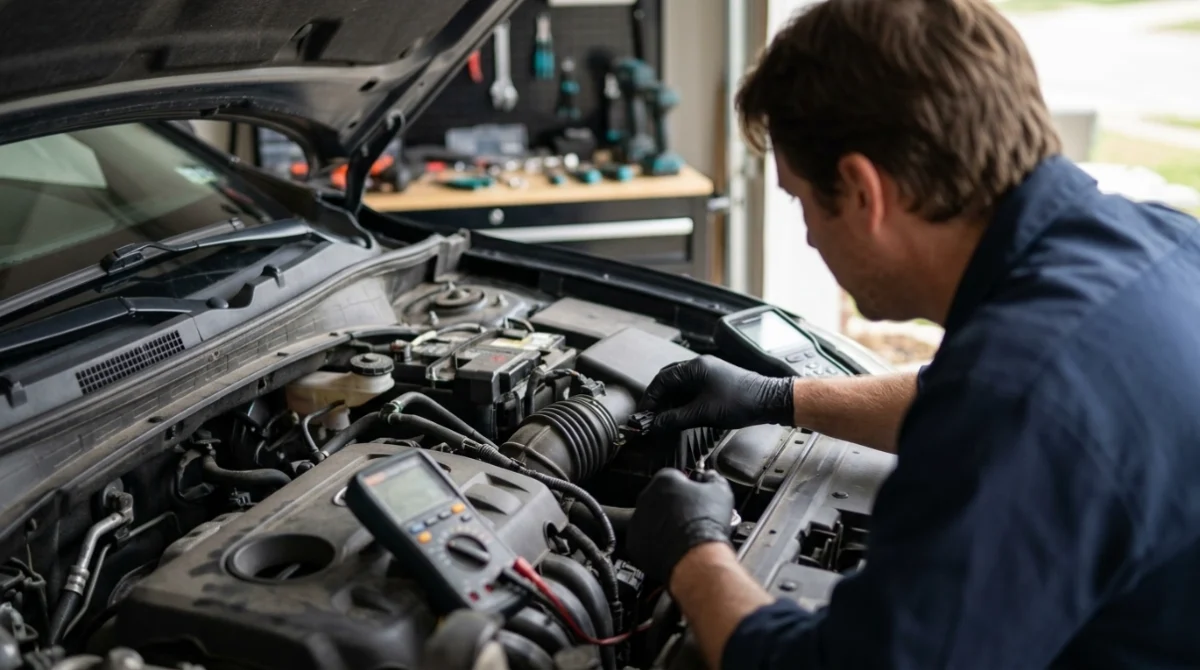
Start with diagnosis, not replacement. P0113 often comes from a connector or wiring fault, so a new sensor will not fix every case.
California Air Resources Board explains that OBD II stores detected malfunction data so a repair technician can find and fix the problem. That is why the scan data matters before repair. California OBD II system fact sheet :contentReference[oaicite:4]{index=4}
- Scan for all codes, not only P0113.
- Read live IAT temperature data.
- Inspect the IAT or MAF connector.
- Check for broken, rubbed, or pulled wires.
- Test reference voltage and ground.
- Replace the failed sensor only after testing.
- Clear the code and confirm it stays off.
If the scanner shows an impossible cold reading, the PCM is likely seeing an open or high-voltage signal. Mitsubishi service data lists P0113 when IAT voltage stays 4.6 volts or higher, matching an intake temperature of -40°F or lower. :contentReference[oaicite:5]{index=5}
Unplugged IAT sensors and loose MAF connectors are common after air filter or intake work.
P0113 Diagnosis Before Buying Parts
The best P0113 repair starts with three checks: live data, connector condition, and circuit voltage. These checks separate a bad sensor from a bad wire.
With key on and engine off, the intake air temperature reading should sit near outside air temperature on a cold engine. A reading far below normal points toward high circuit voltage, not hot intake air.
| Test result | Likely cause | Next action |
|---|---|---|
| IAT reads -40°F or similar | Open circuit or unplugged sensor | Inspect connector and wiring |
| IAT reading jumps when harness moves | Loose terminal or broken wire | Repair connector or harness |
| Sensor resistance is open | Failed IAT sensor | Replace sensor or MAF assembly |
| Multiple sensor codes appear | Shared ground or PCM circuit issue | Trace power and ground circuits |
The table shows why one code does not mean one part. The wire path matters as much as the sensor.
Common P0113 Causes Ranked by Likelihood
The most common P0113 causes sit near the air intake duct. Heat, vibration, oil residue, and recent air filter work can disturb the connector or harness.
AutoZone lists the IAT sensor, wiring harness, electrical connectors, and PCM as possible causes. It also notes that PCM failure is less likely when P0113 appears alone. :contentReference[oaicite:6]{index=6}
- Loose connector: common after intake service.
- Corroded terminals: common in wet engine bays.
- Broken wire: common near hot or moving parts.
- Failed IAT sensor: common after age, impact, or moisture.
- Dirty air filter: can affect readings and airflow.
- Faulty MAF assembly: common when IAT is built in.
- PCM fault: rare when no other circuit codes appear.
What most people don’t think to ask is whether the IAT sensor is separate. On many vehicles, the IAT sensor sits inside the mass airflow sensor, so the repair path changes.
Mitsubishi P0113 diagnostic information shows a manufacturer-level process that checks scan data, connector condition, sensor resistance, and voltage before parts replacement. :contentReference[oaicite:7]{index=7}
What Most People Get Wrong About P0113
Most people see “intake air temperature” and assume the engine is overheating. That is the wrong starting point.
P0113 points to the sensor circuit, not the real air temperature. The PCM receives an electrical signal that does not match expected operating conditions.
Do not clear P0113 and ignore it. The light can return, and cold-start fueling can suffer when the PCM trusts bad air temperature data.
- Wrong belief: P0113 means hot intake air.
- Correct view: P0113 means high input voltage.
- Wrong belief: The IAT sensor is always bad.
- Correct view: Wiring and connector faults can trigger the same code.
- Wrong belief: Clearing the code fixes the repair.
- Correct view: Clearing only erases stored data until the fault returns.
RepairPal lists common misdiagnoses, including replacing the IAT sensor when the real fault is a dirty air filter, poor connection, chafed wiring, or MAF issue. :contentReference[oaicite:8]{index=8}
When P0113 Needs a Mechanic

You need a mechanic when the basic checks do not prove the fault. Circuit testing requires care because damaged terminals can create new problems.
A Stellantis technical communication hosted by NHTSA shows that P0113 can come from a terminal push-out or spread terminal at the IAT connector sensor return circuit. That confirms why connector inspection matters. NHTSA-hosted P0113 connector bulletin :contentReference[oaicite:9]{index=9}
Use this decision guide before spending money:
- If the sensor is unplugged, reconnect it and retest.
- If terminals are green or loose, repair the connector.
- If wiring is rubbed through, repair the harness.
- If resistance is open, replace the IAT sensor.
- If IAT is built into the MAF, test the MAF assembly.
- If multiple 5-volt codes appear, diagnose shared circuits.
The safest next move is one small check: open the hood and confirm the IAT or MAF connector is fully seated.
P0113 is a high-voltage IAT circuit code, so the fix starts with connector, wiring, live data, and voltage checks before replacing parts.
As vehicles keep combining sensors inside MAF assemblies, accurate diagnosis will save more money than guessing.
Take 2 minutes now and check whether the IAT or MAF connector is loose, damaged, or unplugged.
Frequently Asked Questions
Can I drive with a P0113 code?
You can drive short distances with P0113 if the engine runs normally and the check engine light is solid. Fix it soon because wrong intake air temperature data can affect fuel control, cold starts, and emissions readiness.
Will a dirty air filter cause P0113?
A dirty air filter can contribute to intake sensor problems, but P0113 is an electrical high-input code. Check the air filter, yet focus first on the IAT sensor connector, wiring, and live scan data.
Where is the IAT sensor located?
The IAT sensor is often in the air intake tube, air cleaner housing, intake manifold, or mass airflow sensor. Check your vehicle service information because sensor location changes by engine design.
Why does P0113 come back after replacing the sensor?
P0113 comes back after sensor replacement when the fault is in the connector, wiring, ground, or MAF assembly. Inspect terminal fit, corrosion, and harness damage before replacing the same part again.
Do I need to reset the check engine light after fixing P0113?
Yes, clear the code after the repair, then drive until the monitor runs. The real proof is that live IAT data reads normally and P0113 does not return after a complete warm-up cycle.
