
How to Charge an AGM Car Battery Correctly

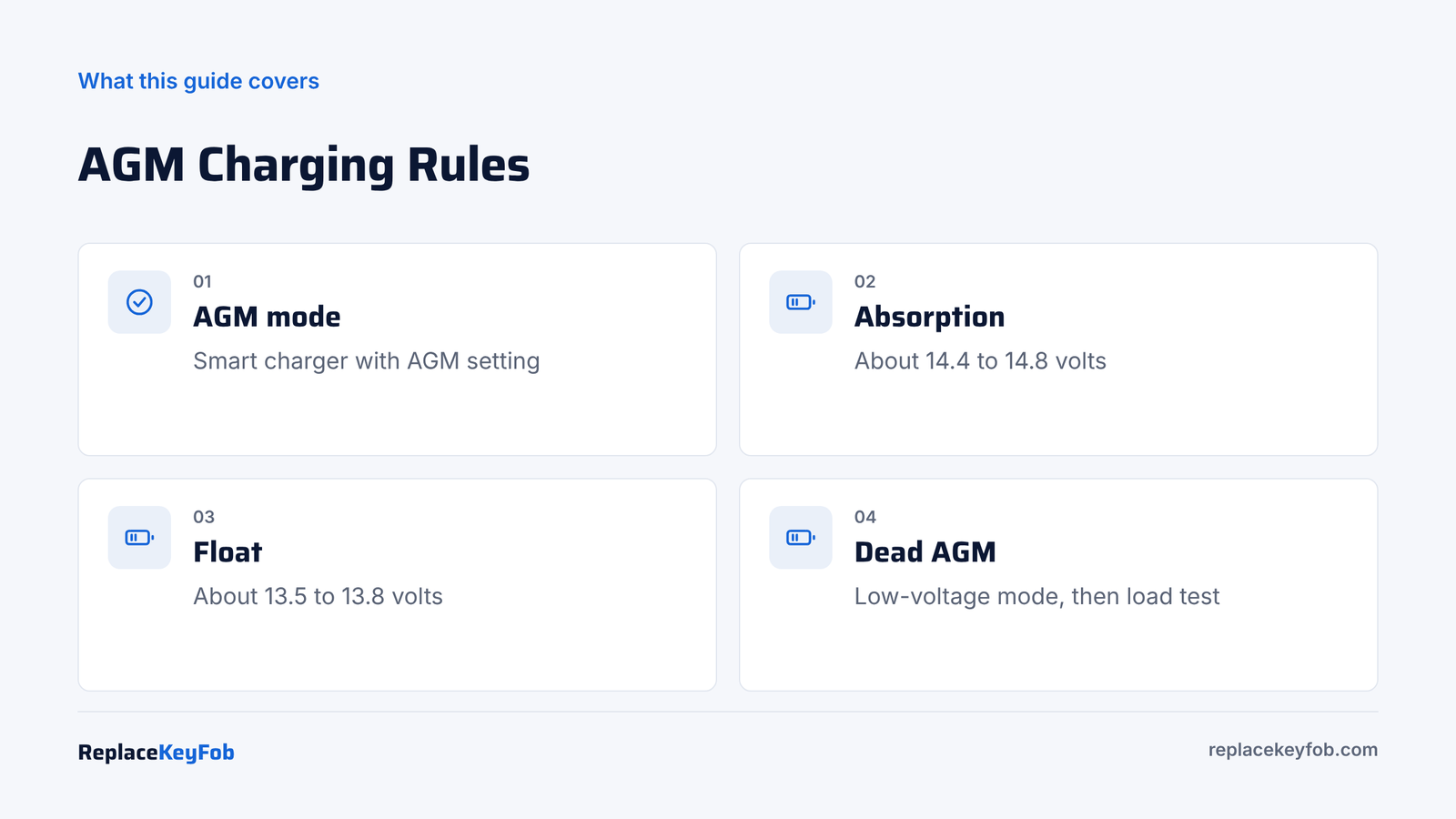
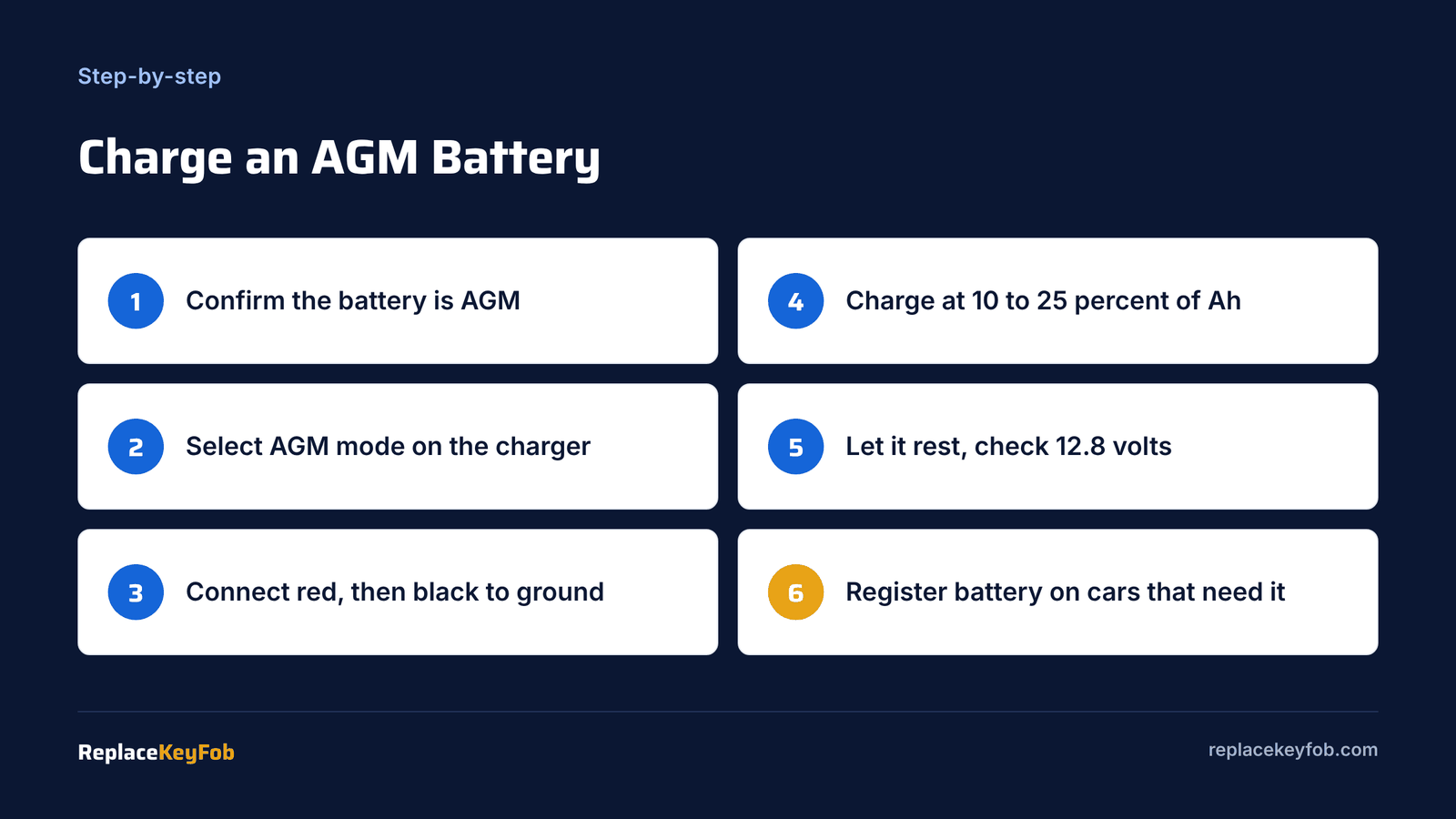
To charge an AGM battery, use a smart charger set to AGM mode. It charges at about 14.4 to 14.8 volts in the absorption stage, then drops to a float of about 13.5 to 13.8 volts. Connect red to positive and black to negative or ground, charge at a rate of about 10 to 25 percent of the battery’s amp-hour rating, and avoid old chargers with no voltage control.
Absorbed glass mat (AGM) batteries are now common in start-stop cars, luxury cars and vehicles with heavy electrical loads. They are sealed, spill-proof and handle deep cycling better than flooded batteries. They also cost more, and they are less forgiving of overcharging. Because the electrolyte is held in glass mats, an AGM battery that is overcharged can vent and dry out, and that damage is permanent.
The good news is that any modern smart charger with an AGM mode handles this correctly. This guide covers the voltages, the steps, how to rescue a dead AGM, and the extra steps on cars such as the Audi A6 and BMWs that keep the battery in the trunk and expect registration.
How to Tell if Your Battery Is AGM
- The label says AGM, Absorbed Glass Mat, or sometimes “Start-Stop” or “Platinum”.
- There are no removable caps on the top.
- Your car has an auto start-stop feature; most use AGM or EFB batteries.
- The owner’s manual or the original battery specifies AGM.
If you are unsure, see AGM vs flooded batteries for more ways to tell.
AGM Charging Voltages
| Charge stage | What happens | Typical AGM voltage |
|---|---|---|
| Bulk | Constant current until voltage rises | Up to about 14.4 to 14.8 V |
| Absorption | Voltage held while current tapers | About 14.4 to 14.8 V |
| Float or maintain | Holds the full battery | About 13.5 to 13.8 V |
| Resting (full, after charging) | No charger connected | About 12.8 to 12.9 V |
Exact values vary by battery maker, so check the label or the maker’s website. What matters most is that the charger does not keep the battery above about 15 volts for long.
What You Need
- A smart charger with an AGM mode, sized at roughly 10 to 25 percent of the battery’s amp-hour rating (for example, 6 to 15 amps for a 60 Ah battery)
- Safety glasses and gloves
- A multimeter to check resting voltage
- A wire brush for the terminals
Smart Charger With AGM Mode
A multi-stage charger with a dedicated AGM setting controls absorption and float voltage so the battery is not overcharged. Check that it lists AGM, has temperature compensation and a low-voltage recovery mode.
As an Amazon Associate, ReplaceKeyFob earns from qualifying purchases.
For maintainers made for these batteries, see best battery maintainers for AGM batteries.
Step-by-Step: Charging an AGM Battery
- Ventilate and protect yourself. Wear glasses and charge in an open space. AGM batteries rarely vent, but they can if overcharged.
- Inspect the battery. Do not charge if it is bulging, cracked or very hot. A swollen AGM case usually means internal damage.
- Clean the terminals so the charger reads voltage accurately.
- Connect with the charger unplugged. Red to positive. Black to negative if the battery is out, or to a bare metal ground or the marked ground point if it is in the car.
- Select AGM mode. Some chargers label it “AGM”, others “AGM/Cold” or a snowflake icon for winter use. Do not use the flooded or standard mode, which may undercharge, or a high-voltage repair mode unless the battery maker allows it.
- Choose the rate. 4 to 10 amps suits most car AGM batteries.
- Plug in and let it run. The charger moves from bulk to absorption to float automatically.
- Wait for full. The charger shows a full or maintain indicator. A half-drained 60 Ah battery takes about 4 to 6 hours at 6 to 10 amps.
- Unplug, then remove the clamps: black first, then red.
- Check resting voltage after an hour or more. About 12.8 volts is full for most AGM batteries.
How to Charge an AGM Battery That Is Dead
A run-down AGM below about 10.5 volts can be hard to charge, because many smart chargers will not start if voltage is too low. They see the battery as missing or faulty.
- Measure the voltage. Above about 10.5 volts, a normal AGM mode usually starts.
- Use a low-voltage or force mode. Many good chargers have a mode for deeply discharged batteries. Follow the charger’s instructions, and stay nearby.
- Charge slowly. Use a lower rate, about 2 to 4 amps, for the first few hours.
- Watch temperature. If the battery gets hot to the touch, stop.
- Load test after charging. An AGM that sat flat for weeks may have lost much of its capacity. A free test at a parts store tells you if it is still usable.
Avoid the old trick of connecting the dead AGM in parallel with a good battery just so the charger “sees” voltage, unless your charger’s maker describes it. It can cause high current between the batteries.
AGM Batteries in the Trunk: Audi, BMW and More
Many recent Audi A6, A7 and A8 models, many BMWs and several Mercedes models keep the AGM battery in the trunk or under the cargo floor.
- Charge at the under-hood jump terminals. The maker designs them for charging and jumping. The positive is under a red cap; the negative is a marked ground stud.
- Keep the vent tube connected if the battery has one.
- Do not charge with the engine running while also on a charger.
- Register a replacement. If you replace the AGM, the car’s battery management system usually needs to know. See how to register a car battery with a scan tool.
For BMW-specific access, see how to open a BMW trunk manually.
AGM vs EFB: Do Not Mix Them Up
Many start-stop cars use an Enhanced Flooded Battery (EFB) instead of AGM. EFB batteries look sealed but are a flooded design with improved plates. Most smart chargers charge EFB on the standard or flooded setting, while AGM needs the AGM setting. Read the label before you choose the mode. If your car came with EFB, you may upgrade to AGM of the same group size, but do not downgrade from AGM to EFB or flooded.
Charging Through the Car vs on the Bench
- In the car: keeps your settings and is the easiest choice. Use the under-hood jump points if the battery is in the trunk, and turn off all accessories. Close the doors so interior lights and modules go to sleep.
- On the bench: useful for a deeply dead battery you want to watch closely, or one under a seat. Remove negative first, then positive, and lift it level.
Either way, check that the charger’s clamps grip clean metal. A poor connection makes the charger misread voltage and can end the charge early.
Why Old Chargers Are Risky for AGM
Older manual chargers often have only a fixed output and no voltage limit. Left on, they can push an AGM battery above 15 volts. That heats the battery, forces gas out through the safety valves, and dries the mats. Once the electrolyte is lost, the battery cannot be refilled. If you only have an old charger, use it for short periods only, check voltage often, and stop at full.
Charging AGM in Cold or Hot Weather
- Cold: batteries accept charge more slowly in cold. A charger with temperature compensation raises voltage slightly in the cold, and many AGM modes include a cold setting. Do not charge a frozen battery; bring it indoors to thaw first.
- Heat: charging in high heat should use slightly lower voltage. Temperature-compensated chargers handle this automatically.
Troubleshooting Table
| Problem | Cause | Fix |
|---|---|---|
| Charger shows error, will not start | Voltage too low or bad connection | Clean clamps, use low-voltage mode |
| Charger never reaches full | Sulfated or worn battery | Load test; replace if it fails |
| Battery gets hot | Internal short or wrong mode | Stop charging, check mode, test battery |
| Full on charger, dies overnight | Parasitic drain or failing cell | Measure drain, test battery |
| Start-stop stays disabled | Battery not registered or low | Charge fully, register battery |
Mistakes to Avoid
- Using standard or flooded mode on an AGM.
- Running high-voltage desulfation cycles that the battery maker does not approve.
- Charging a bulging or cracked AGM.
- Fitting a flooded battery to replace an AGM. It will not last in a start-stop car.
- Skipping registration on cars that need it.
When to Replace and What It Costs
An AGM battery typically lasts about 4 to 6 years. If a fully charged AGM rests below about 12.5 volts, cranks slowly or fails a load test, replace it. Typical 2026 US prices are about $200 to $380 for the battery, plus registration on many European cars. See car battery replacement cost for more.
Frequently Asked Questions
Only if it has an AGM mode or regulates voltage to AGM levels. Old manual chargers can overcharge an AGM and damage it permanently.
Typically about 14.4 to 14.8 volts during absorption and about 13.5 to 13.8 volts on float. Check your battery maker’s specs.
Use a smart charger with a low-voltage or force mode at a low rate, watch the temperature, and load test the battery afterward.
About 4 to 8 hours for a typical car AGM at 6 to 10 amps, depending on how flat it is.
On many A6 generations the battery is in the trunk. Connect a smart charger in AGM mode to the under-hood jump terminals, red to the positive post and black to the ground stud.