
How to Fix P0430: Causes, Diagnosis, and Repair Steps

Quick Answer
To fix P0430, first confirm the code with an OBD2 scanner, then check Bank 2 for exhaust leaks, misfires, fuel-mixture problems, oxygen-sensor faults, and catalytic converter damage. Don’t replace the converter until you’ve diagnosed the cause, because a failing engine or sensor can damage a new converter too. For general warning-light guidance, see AAA’s check engine light guidance.
Quick P0430 Fixing Process
- Scan all codes: Record P0430 plus any misfire, fuel-trim, or oxygen-sensor codes.
- Check Bank 2: Confirm which side of your engine is Bank 2 using factory information.
- Inspect the exhaust: Look for leaks, cracked pipes, damaged wiring, and loose connections.
- Review live data: Compare upstream and downstream oxygen-sensor behavior after the engine reaches operating temperature.
- Repair the cause: Fix engine, sensor, wiring, leak, or converter problems confirmed by testing.
Before Buying Parts
- Don’t assume P0430 automatically means the Bank 2 oxygen sensor is bad.
- Don’t install a catalytic converter until active misfires or rich-running problems are corrected.
When P0430 appears on an OBD2 scanner, many drivers immediately assume they need a catalytic converter. I’ve seen that assumption turn an expensive diagnosis into an even more expensive parts-swapping exercise.
P0430 needs a systematic approach. This guide explains what the code means, what usually causes it, how to diagnose it, and how to choose the correct repair in 2026.
In This Guide
What Does the P0430 Code Mean?
P0430 means “Catalyst System Efficiency Below Threshold, Bank 2.” Your vehicle’s powertrain control module has determined that the catalyst on Bank 2 isn’t performing within its expected range.
Bank 2 is the engine bank that doesn’t contain cylinder number one. This distinction applies mainly to engines with two cylinder banks, such as many V6 and V8 engines.
Definition: A catalytic converter is an emissions-control device in the exhaust system. It converts harmful exhaust compounds into less harmful gases before they leave the tailpipe.
The engine computer evaluates catalyst performance using information from oxygen sensors positioned around the converter. You’ll often hear these called upstream and downstream O2 sensors.
The upstream sensor monitors exhaust before the catalyst. The downstream sensor helps the computer evaluate what happens after exhaust passes through the catalyst.
Why does the computer set P0430?
A healthy catalytic converter changes the exhaust gas composition as gases move through it. That causes downstream sensor activity to look different from upstream activity under the conditions used by the vehicle’s catalyst monitor.
If the computer sees behavior consistent with insufficient catalyst efficiency, it may store P0430. The check engine light can then illuminate.
That doesn’t prove the converter itself caused the failure. The computer is reporting what it detected, not telling you which component to replace.
What symptoms can appear with P0430?
- Check engine light: This is often the first or only obvious symptom.
- Failed emissions inspection: An active catalyst-efficiency code may prevent a vehicle from passing applicable emissions testing.
- Poor acceleration: A physically restricted or damaged converter can affect exhaust flow.
- Reduced fuel economy: This may occur when an engine problem contributing to P0430 also affects combustion.
- Unusual exhaust smell: Some exhaust or catalyst problems can produce noticeable odors.
- Rattling underneath: A damaged converter substrate can sometimes break apart internally.
A vehicle can also run normally while storing P0430. That’s why scan data and proper testing matter more than symptoms alone.
What Causes a P0430 Code?
The catalytic converter is a common suspect, but it’s not the only possibility. Anything that changes exhaust composition or produces misleading sensor data can complicate catalyst monitoring.
I treat P0430 as a diagnosis problem first. I don’t treat it as a parts-ordering instruction.
1. A worn or damaged catalytic converter
The converter can lose its ability to process exhaust effectively over time. Physical damage, contamination, overheating, or prolonged engine problems can shorten its useful life.
A converter can also fail because of another unresolved problem. Installing another converter without correcting that cause risks repeating the failure.
2. Engine misfires
Misfires can send unburned fuel and excess oxygen into the exhaust. That can disturb oxygen-sensor readings and place additional thermal stress on the converter.
If your scanner shows P0300 or cylinder-specific P0301-P0308 codes with P0430, diagnose the misfire first. Don’t ignore it because the catalyst code looks more expensive.
3. Rich or lean air-fuel mixture
An engine running too rich uses more fuel than intended. An engine running too lean has too much air relative to fuel.
Either condition can affect exhaust chemistry. Look for fuel-trim codes, intake leaks, injector problems, pressure issues, or inaccurate airflow measurements.
4. Exhaust leaks
An exhaust leak can allow outside air into areas where oxygen sensors measure exhaust content. That extra oxygen may distort the information sent to the computer.
Pay close attention to manifold connections, gaskets, flanges, flex sections, and piping near Bank 2. Small leaks can be difficult to hear.
5. Faulty oxygen sensor or wiring
A slow, biased, contaminated, or electrically faulty sensor can provide misleading information. Damaged wiring or connectors can produce similar problems.
Don’t replace a downstream sensor simply because P0430 mentions catalyst efficiency. Test its circuit and response first.
6. Oil or coolant entering the combustion chamber
Oil burning and internal coolant leaks can contaminate exhaust components. They can also damage a replacement converter if the underlying engine problem remains.
- Watch for unexplained oil consumption.
- Check for persistent exhaust smoke.
- Investigate unexplained coolant loss.
- Look for related misfire codes.
- Inspect spark plugs when appropriate.
Technician’s note: Before spending money on a converter, ask whether the condition that damaged the original converter has been identified.
Section Takeaway: P0430 can be caused by the converter, but engine, exhaust, oxygen-sensor, and wiring faults must also be considered.
How Do You Diagnose P0430 Correctly?
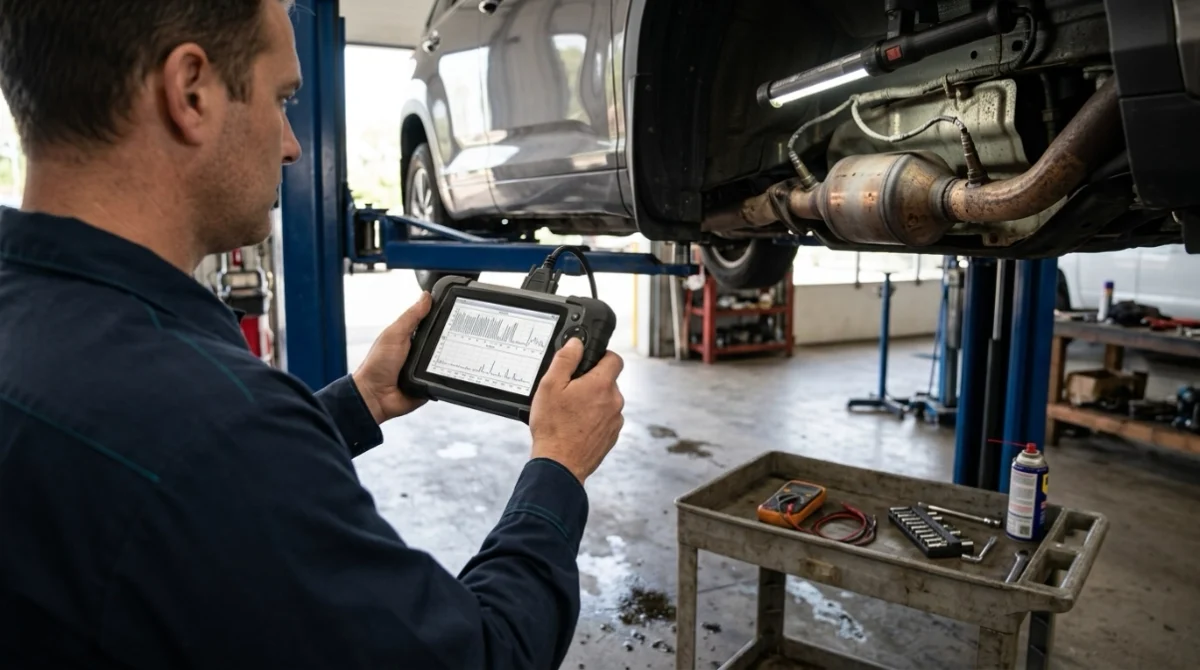
The best P0430 diagnosis starts with information, not replacement parts. Your goal is to determine why the computer believes Bank 2 catalyst efficiency is below its threshold.
Step 1: Scan every stored code
Connect an OBD2 scanner and record stored, pending, and permanent codes when your tool supports them. Don’t erase anything yet.
Other codes can change the entire diagnosis.
- Misfire codes: Investigate combustion problems before condemning the converter.
- Fuel-trim codes: Check for rich or lean running conditions.
- O2 sensor codes: Test the affected sensor and circuit.
- Airflow codes: Incorrect airflow data can affect fueling.
- Temperature-related codes: Engine operating temperature can affect emissions monitoring.
Save freeze-frame information if your scanner displays it. Freeze-frame data records operating conditions around the time the fault was detected.
Step 2: Confirm which side is Bank 2
Never guess Bank 2 by standing in front of the vehicle and choosing a side. Engine orientation and cylinder numbering vary by manufacturer.
Use factory service information or a reliable repair database. Identify cylinder one first, then locate the opposite bank.
Step 3: Inspect the Bank 2 exhaust system
With the exhaust cool, visually inspect accessible components. Look for damage before moving into electronic testing.
- Cracked exhaust manifold
- Loose flange connections
- Failed gaskets
- Damaged flex pipe
- Impact damage to the converter
- Corroded exhaust sections
- Damaged O2 sensor wiring
- Loose or contaminated connectors
An exhaust leak before or near an oxygen sensor deserves attention. Repair confirmed leaks before judging catalyst efficiency.
Step 4: Check live oxygen-sensor data
Allow the engine to reach normal operating temperature before interpreting catalyst-related live data. Catalyst monitoring depends on specific operating conditions.
Compare the Bank 2 upstream and downstream sensor signals using a scanner that can graph data. Sensor type and expected behavior vary between vehicles.
A traditional narrowband upstream oxygen sensor often changes rapidly as the engine computer corrects fuel mixture. A healthy downstream signal is generally more stable when the converter is storing and releasing oxygen effectively.
If upstream and downstream patterns appear unusually similar, reduced catalyst oxygen-storage capacity becomes more likely. That observation still needs to be interpreted using vehicle-specific service information.
Technician’s note: Wideband air-fuel sensors don’t behave like old narrowband O2 sensors, so don’t apply a generic voltage test to every vehicle.
Step 5: Check fuel trims and engine operation
Look at short-term and long-term fuel trim if your scanner supports them. Large corrections can point toward a mixture problem that deserves diagnosis before converter replacement.
Also investigate rough running, misfire counters, abnormal airflow data, or unusual coolant temperature readings. A catalyst can’t correct an engine that isn’t burning fuel properly.
Step 6: Confirm converter condition
A professional technician may use scan-tool graphs, temperature comparisons, emissions testing, pressure testing, or other manufacturer-approved procedures. The right test depends on the vehicle and symptom.
A severely restricted converter may create drivability problems that an efficiency code alone doesn’t explain. That’s a different failure mode and may require exhaust backpressure testing.
| Diagnostic Finding | What It Suggests | Next Step |
|---|---|---|
| P0430 only, engine runs normally | Catalyst efficiency or monitoring issue | Check leaks and compare sensor data |
| P0430 plus misfire codes | Combustion fault may be contributing | Repair misfire first |
| P0430 plus O2 circuit code | Sensor, wiring, or connector problem possible | Test circuit before replacing parts |
| Visible exhaust leak | Sensor readings may be affected | Repair leak and retest |
| Confirmed weak catalyst with no upstream fault | Converter replacement may be justified | Verify correct emissions-compliant part |
Section Takeaway: Diagnose P0430 in layers—codes, Bank 2 identification, leaks, engine operation, sensor data, and finally converter performance.
How Do You Fix P0430?
The correct P0430 fix depends on what testing finds. Clearing the code without repairing the cause isn’t a repair.
Fix exhaust leaks
Repair confirmed leaks around the Bank 2 manifold, flanges, gaskets, flex pipe, or related exhaust sections. Then clear the fault according to the appropriate service procedure and retest.
Give the vehicle enough driving time to rerun its catalyst monitor. Clearing codes resets readiness information on many vehicles.
Repair misfires or fuel-control problems
Resolve active misfires before installing a catalytic converter. The same applies to confirmed rich or lean operation.
The underlying repair could involve ignition, fuel, intake, sensor, mechanical, or wiring problems. Diagnose those systems instead of assuming one universal P0430 repair.
Repair oxygen-sensor wiring
Exhaust heat makes oxygen-sensor wiring vulnerable. Look for melted insulation, chafing, damaged terminals, corrosion, and poor connector engagement.
Repair wiring using an appropriate method for the circuit and environment. Keep repaired wiring safely away from hot exhaust components.
Replace a faulty oxygen sensor only when testing supports it
A confirmed bad Bank 2 sensor should be replaced with a compatible part. Verify sensor position, electrical connector, and vehicle application before ordering.
Don’t rely on appearance alone. An oxygen sensor can look normal externally while producing inaccurate or slow data.
Replace the catalytic converter when failure is confirmed
If testing confirms inadequate catalyst performance and no other fault explains P0430, replacement may be necessary. Use a converter that meets the emissions requirements applicable to your vehicle and location.
Confirm fitment using the vehicle’s year, make, model, engine, emissions specification, and VIN when required. Don’t assume two similar-looking converters are interchangeable.
You can review general vehicle safety and recall information through the NHTSA recall lookup. A recall search isn’t a substitute for P0430 diagnosis, but checking your VIN for unresolved recalls is sensible during major repair planning.
Technician’s note: Converter fitment and emissions certification can vary by vehicle and jurisdiction, so verify the exact application before purchase.
Clear the code and confirm the repair
After the confirmed fault is repaired, clear codes when appropriate. Then drive the vehicle under normal conditions until required monitors can rerun.
Scan it again afterward. A repair isn’t complete just because the check engine light remains off for five minutes.
Can You Drive With a P0430 Code?
You may sometimes be able to drive a vehicle with a steady check engine light and P0430, especially when it runs normally. You shouldn’t assume that makes the underlying problem harmless.
AAA advises drivers to address a steady check engine light promptly. A flashing check engine light can indicate a more serious problem that deserves immediate attention.
Stop driving or limit driving if you notice:
- A flashing check engine light
- Severe engine misfires
- Major loss of power
- Strong burning or unusual exhaust odors
- Excessive exhaust heat
- Engine stalling
- Unusual noises from the converter
A misfiring engine can send unburned fuel into the exhaust. That can create extreme converter temperatures and increase the chance of expensive damage.
If the car is shaking, losing substantial power, or behaving abnormally, move to a safe location and arrange professional help. Don’t continue driving merely because your scanner displays only a five-character code.
AAA’s current check engine light information also distinguishes between steady and more urgent warning-light conditions.
How Much Does It Cost to Fix P0430?
P0430 repair cost varies widely because the code doesn’t identify one failed part. A small exhaust leak and a failed catalytic converter can produce the same diagnostic trouble code.
Diagnosis should come before budgeting for the most expensive possibility.
| Possible Repair | Cost Pattern | Why It Varies |
|---|---|---|
| Diagnostic testing | Usually lower than major parts replacement | Labor rate and testing required |
| Exhaust leak repair | Low to substantial | Gasket versus damaged manifold or pipe |
| Oxygen sensor repair | Moderate on many vehicles | Sensor type and accessibility |
| Misfire or fuel-system repair | Highly variable | Underlying engine fault determines cost |
| Catalytic converter replacement | Often the most expensive outcome | Vehicle, converter design, labor, and emissions specification |
AAA notes that catalytic converter replacement can run into the thousands of dollars on some vehicles. Its published guidance gives a broad parts-and-labor range of roughly $1,000 to $4,000, depending on vehicle and location.
You can review that cost discussion in AAA’s catalytic converter cost guide. Treat any national range as a budgeting reference rather than a quote for your vehicle.
Cost note: Get a vehicle-specific diagnosis and written estimate before authorizing a converter replacement.
Is an aftermarket catalytic converter okay?
An aftermarket converter can be appropriate when it meets the legal emissions requirements for the vehicle and jurisdiction. The cheapest universal component isn’t automatically the right choice.
Before ordering, verify compatibility and required emissions certification. Your VIN and under-hood emissions label can help identify the correct specification.
Can I save money by replacing the O2 sensor first?
Not if testing doesn’t show a sensor fault. Replacing an inexpensive part simply because it’s cheaper is still wasted money when that part isn’t causing the code.
I’ve seen this pattern with diagnostic work many times: a driver buys the easiest part first, clears the code, and P0430 returns. Testing usually costs less than repeating guesses.
For broader vehicle safety research, the Insurance Institute for Highway Safety provides independent vehicle safety information. Emissions-system repair procedures themselves should come from manufacturer-specific service information.
P0430 Frequently Asked Questions
Does P0430 always mean a bad catalytic converter?
No. P0430 means the computer detected catalyst efficiency below its expected threshold on Bank 2. Exhaust leaks, engine misfires, mixture problems, sensor faults, wiring issues, or an aging converter can contribute, so diagnosis should happen before replacement.
Can a bad O2 sensor cause P0430?
Yes, a faulty oxygen sensor or its wiring can sometimes contribute to P0430 by supplying inaccurate information. However, replacing an O2 sensor without testing it first is a common parts-swapping mistake.
Can an exhaust leak cause P0430?
Yes. A leak can introduce outside air into the exhaust and interfere with oxygen-sensor readings. Inspect manifolds, flanges, gaskets, pipes, and flex sections around the Bank 2 catalyst and sensors.
Is P0430 the same as P0420?
The codes describe similar catalyst-efficiency problems on different engine banks. P0420 normally refers to Bank 1, while P0430 refers to Bank 2.
Can I clear P0430 and keep driving?
You can erase the stored code with many OBD2 scanners, but erasing it doesn’t repair the cause. If the fault remains, the catalyst monitor can detect it again and the check engine light may return.
How long does it take for P0430 to come back?
There’s no universal number of miles. The vehicle must meet its programmed conditions for running the catalyst monitor, so P0430 may return quickly or only after several trips and suitable operating conditions.
Can a tune-up fix P0430?
A generic tune-up isn’t a guaranteed P0430 repair. If worn ignition components are causing a confirmed misfire that contributes to catalyst problems, repairing that fault can help, but the converter may still need evaluation.
Final takeaway: The best way to fix P0430 is to diagnose why Bank 2 catalyst efficiency appears low before replacing anything.
Start with a complete OBD2 scan, fix active engine and exhaust faults, evaluate oxygen-sensor data, and replace the catalytic converter only when testing supports that decision. That approach protects your repair budget and gives the replacement the best chance of lasting.
