
How to Fix P0442: Small EVAP Leak Diagnosis Guide

Quick Answer
P0442 means your vehicle has detected a small leak in the evaporative emissions system. Start by checking the fuel cap, then inspect EVAP hoses and connections before testing the purge valve, vent valve, and system with smoke. An OBD2 scanner can help confirm the check-engine fault, but the code itself doesn’t identify the exact leaking part.
P0442 Fix Order
- Scan the vehicle: Confirm P0442 and check for related EVAP trouble codes.
- Check the fuel cap: Reinstall it correctly and inspect its seal for cracks, dirt, or damage.
- Inspect EVAP lines: Look for disconnected, split, pinched, or deteriorated hoses and fittings.
- Test the valves: Check whether the purge and vent valves seal when commanded closed.
- Smoke-test the system: Use an EVAP-approved smoke machine when the leak isn’t visible.
- Verify the repair: Clear the code and confirm that the EVAP monitor completes without P0442 returning.
Before Buying Parts
- Don’t replace a purge valve, vent valve, or charcoal canister just because P0442 is stored. Find the leak first.
If your OBD2 scanner shows P0442, the good news is that the problem usually belongs to the emissions system rather than an internal engine failure. The frustrating part is that a tiny vapor leak can be harder to locate than a larger, obvious failure.
I’ve found that the best approach is simple: test in order instead of throwing parts at the car. This guide explains what P0442 means, what commonly causes it, and how to confirm the repair.
In This Guide
What Does the P0442 Code Mean?
P0442 means the powertrain control module detected a small leak in the evaporative emissions system. The EVAP system captures gasoline vapors instead of allowing them to escape directly into the atmosphere.
Ford’s published OBD-II code information describes P0442 as an evaporative emission system leak detected, specifically a small leak. The code points to a system that can’t hold the pressure or vacuum expected during its self-test.
Ford’s official OBD-II code list also distinguishes P0442 from codes for large and very small EVAP leaks.
What is the EVAP system?
The evaporative emissions system is a sealed network that controls fuel vapor. Major components can include the fuel tank, fuel cap, charcoal canister, purge valve, vent valve, pressure sensor, and connecting vapor lines.
- Fuel cap: Seals the fuel filler opening on vehicles that use a removable cap.
- Charcoal canister: Temporarily stores fuel vapors.
- Purge valve: Allows stored vapors to enter the engine when commanded.
- Vent valve: Controls airflow into and out of the EVAP system during operation and testing.
- EVAP lines: Carry vapor between the tank, canister, valves, and engine.
- Fuel-tank pressure sensor: Helps the computer monitor pressure changes on many vehicles.
What symptoms come with P0442?
Many vehicles drive normally with P0442. Often, the check-engine light is the only symptom you’ll notice.
You may also notice a fuel-vapor smell if the leak is significant enough or located near an accessible EVAP connection. A strong raw-fuel smell deserves prompt inspection because liquid fuel leakage is a different and more serious concern.
Section Takeaway: P0442 identifies a small EVAP-system leak, not a specific failed component. Diagnosis is necessary before replacing parts.
What Causes a P0442 Small EVAP Leak?
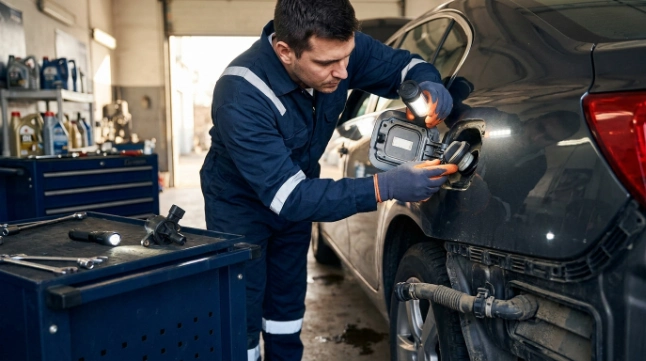
P0442 can come from any EVAP component or connection that prevents the system from sealing correctly. A fuel-cap problem is worth checking first, but it isn’t the only possible cause.
- Loose fuel cap: The cap may have been installed incorrectly after refueling.
- Damaged cap seal: A hardened, cracked, dirty, or distorted gasket may leak vapor.
- Cracked EVAP hose: Age, heat, road debris, or previous repairs can damage vapor lines.
- Loose connection: A quick-connect fitting may not be fully seated.
- Leaking purge valve: A purge valve that doesn’t seal can upset the EVAP leak test.
- Leaking vent valve: A vent valve that remains open may prevent the system from sealing.
- Damaged charcoal canister: Cracks in the housing or connections can create a leak.
- Filler-neck problem: Corrosion or sealing damage may allow vapor to escape on some vehicles.
Manufacturer guidance supports looking beyond the cap. A General Motors service bulletin covering P0442 diagnosis tells technicians to inspect purge connections, lines, purge-valve operation, vent-valve operation, and the complete EVAP system for sealing problems.
Technician’s note: don’t order a purge valve or canister based on the code description alone. Confirm the failing area with testing first.
Why does P0442 sometimes appear after refueling?
The timing can be a clue. If P0442 appeared soon after filling the tank, inspect the fuel cap or capless filler system before doing deeper testing.
Dirt on a sealing surface can matter too. Clean the mating surface carefully and make sure nothing prevents a proper seal.
How Do You Diagnose P0442 With an OBD2 Scanner?
Use the scanner to confirm P0442 and look for related codes before touching any parts. An OBD2 code is a diagnostic clue, not a command to replace a component.
AAA’s OBD diagnostic code resource explains that trouble codes help identify the system involved while further diagnosis determines the underlying fault.
1. Scan for all stored and pending codes
Record P0442 and any accompanying codes. Related purge, vent, pressure-sensor, or larger-leak codes can change your diagnostic direction.
- P0440 may indicate a broader EVAP malfunction.
- P0441 relates to incorrect purge flow.
- P0446 relates to vent-control faults.
- P0455 indicates a larger EVAP leak.
- P0456 generally indicates a very small EVAP leak.
2. Inspect the fuel cap and filler area
Remove the cap and inspect its sealing surface. Look for cracks, hardening, deformation, contamination, or obvious physical damage.
If the cap seems sound, reinstall it according to the vehicle manufacturer’s instructions. Don’t assume every cap must click a certain number of times because cap designs vary.
3. Inspect EVAP hoses and connections
Follow accessible vapor lines from the engine area toward the canister and tank. Look closely around bends, brackets, quick-connect fittings, and areas exposed to heat.
- Disconnected fittings
- Cracked rubber elbows
- Split plastic lines
- Pinched hoses
- Damaged seals
- Canister cracks
A 2022 GM diagnostic bulletin specifically advises checking EVAP connections for correct installation and examining lines for damage or wear. It recommends smoke testing when visual inspection doesn’t reveal the leak.
The GM P0442 diagnostic bulletin hosted by NHTSA also notes that purge and vent valve problems can contribute to a small-leak code.
4. Test the purge and vent valves
A capable bidirectional scan tool may let a technician command EVAP valves open and closed. The exact test procedure depends on the vehicle.
The important question is whether each valve moves and seals correctly. A valve can still click electrically while leaking mechanically.
Technician’s note: follow the service information for your exact year, make, model, and engine before commanding EVAP components with a scan tool.
5. Perform an EVAP smoke test
A smoke test is often the fastest way to find a small leak that you can’t see. An EVAP-approved smoke machine introduces low-pressure test vapor so escaping smoke can reveal the leak location.
Inspect the cap or filler seal, lines, fittings, canister, valves, and tank-area connections during the test. Some faults appear only under certain pressure or vacuum conditions.
6. Clear P0442 and verify the repair
After fixing the confirmed leak, clear the diagnostic trouble code if appropriate. Then drive the vehicle until its EVAP monitor has another opportunity to run.
Don’t confuse a cleared code with a completed repair. If P0442 returns after the monitor runs, the leak or sealing problem remains.
Section Takeaway: scan first, inspect the simple sealing points, test the valves, then smoke-test the system. That order reduces unnecessary parts replacement.
Can You Fix P0442 Yourself?
You can handle several early P0442 checks yourself, but deeper EVAP testing may require professional equipment. Your stopping point should depend on your tools and how confidently you can verify a repair.
| Diagnostic Step | Typical Tools | DIY Level | What It Can Confirm |
|---|---|---|---|
| Read P0442 | OBD2 scanner | Easy | Stored and pending trouble codes |
| Fuel-cap inspection | Flashlight | Easy | Visible cap or sealing damage |
| EVAP-line inspection | Flashlight and basic tools | Easy to moderate | Disconnected or visibly damaged lines |
| Valve command test | Bidirectional scan tool | Moderate to advanced | Purge and vent response |
| EVAP smoke test | EVAP-rated smoke machine | Advanced | Location of small hidden leaks |
Replacing an obviously damaged cap or reconnecting an accessible hose can be reasonable DIY work. Stop if diagnosis requires lifting the vehicle, working near the fuel tank, or testing unfamiliar emissions components.
Safety note: never use improvised smoke, open flame, or an ignition source to search for a fuel-vapor leak.
How Much Does It Cost to Fix P0442?
The cost varies because P0442 describes a leak condition rather than one failed part. A simple sealing problem may cost little, while professional diagnosis and a failed canister or valve can cost substantially more.
As a broad 2026 budgeting guide, a replacement fuel cap may be in the roughly $15–$40 parts range. Professional EVAP diagnosis or smoke testing can commonly fall around $80–$200 before repairs, depending on labor rates and location.
Valve, hose, filler-neck, and charcoal-canister repairs can range from under $100 to several hundred dollars. Vehicle design, parts choice, accessibility, and local labor rates make universal pricing unreliable.
Technician’s note: ask the shop what testing confirmed the leak before approving multiple EVAP parts. A proper diagnosis can cost less than replacing several good components.
Can You Drive With a P0442 Code?

A vehicle with only P0442 will often remain drivable, but the code shouldn’t be ignored. P0442 relates to emissions-system integrity, and an active check-engine light can also affect emissions-inspection results.
AAA recommends diagnosing check-engine warnings promptly because the light can represent issues ranging from a loose fuel cap to more significant engine or emissions faults.
A steady check-engine light with normal vehicle operation is different from a flashing light. If the light flashes, the engine runs poorly, power drops, or you smell strong raw fuel, stop treating the situation as a routine P0442 repair.
NHTSA’s discussion of onboard diagnostics explains that OBD systems monitor emission-related components, including evaporative-system leaks.
P0442 Frequently Asked Questions
Will tightening the gas cap fix P0442?
It can if the cap wasn’t sealing correctly. Inspect the cap and filler sealing surface first, but don’t assume the cap is responsible if P0442 returns after the EVAP monitor reruns.
Will P0442 clear itself?
The check-engine light may turn off after the vehicle completes enough successful self-tests, depending on the manufacturer. An OBD2 scanner can clear the code sooner, but clearing it doesn’t repair the leak.
Can a bad purge valve cause P0442?
Yes. A purge valve that doesn’t seal when the computer expects it to can prevent the EVAP system from holding the required vacuum or pressure during leak testing.
Can a bad vent valve cause P0442?
Yes. A vent valve that remains open or fails to seal can create the same basic condition as a small physical leak, so valve testing may be necessary after visible hoses and seals pass inspection.
Do I need a smoke test for P0442?
Not always. Check the cap, accessible lines, and connections first, but smoke testing becomes especially useful when P0442 keeps returning and no visible leak can be found.
What is the difference between P0442 and P0455?
Both relate to EVAP leakage, but P0442 indicates a small leak while P0455 generally indicates a much larger leak. The diagnostic approach overlaps, although a larger leak may be easier to locate visually.
Should I replace the charcoal canister for P0442?
Only if testing shows the canister itself leaks or has another confirmed failure. Replacing an expensive canister solely because P0442 is stored is parts swapping, not diagnosis.
The best way to fix P0442 is to work from evidence. Confirm the code, inspect easy sealing points, test the EVAP valves, and use smoke testing when necessary.
If the code returns after the basic checks, have the EVAP system tested rather than replacing parts at random. A small leak can take patience to find, but once you locate the actual fault, the repair is usually straightforward.
