
How to Fix P0750: Shift Solenoid A Malfunction

Quick Answer
To fix P0750, first confirm the code with an OBD2 scanner, check the transmission fluid, inspect the wiring and connectors, and test the Shift Solenoid A circuit. Do not replace the solenoid just because P0750 appears. The AAA diagnostic code translator explains why trouble codes should be treated as diagnostic clues rather than automatic proof that a specific part has failed.
Quick P0750 Troubleshooting Steps
- Scan all codes: Look for related transmission, voltage, communication, and speed-sensor codes.
- Check transmission fluid: Verify the correct level and look for severely contaminated or burnt-smelling fluid.
- Inspect the wiring: Look for damaged insulation, loose plugs, corrosion, oil intrusion, or broken terminals.
- Test the circuit: Verify power, ground, wiring continuity, and solenoid resistance using service information for your vehicle.
- Confirm the failure: Replace a solenoid only after testing supports that diagnosis.
- Recheck after repair: Clear the code, test-drive the vehicle safely, and scan again.
Important
- If the transmission slips, bangs into gear, stays in one gear, or will not move normally, avoid unnecessary driving and have it inspected.
P0750 can look intimidating when it appears on an OBD2 scanner, especially if the transmission has started shifting strangely. I’ve learned from years of vehicle electrical troubleshooting that the fastest repair usually starts with testing, not parts swapping.
This guide explains what P0750 means, what can trigger it, how to diagnose it, and how to decide whether the problem is electrical, hydraulic, mechanical, or software-related.
In This Guide
What Does the P0750 Code Mean?
P0750 is a powertrain diagnostic trouble code associated with a malfunction involving Shift Solenoid A or its control circuit. The exact transmission component identified as “A” depends on the vehicle and transmission design.
A shift solenoid is an electrically controlled valve used by an automatic transmission to manage hydraulic fluid flow. That fluid pressure helps the transmission apply the correct clutch packs or other internal components for a requested gear.
Definition: An OBD2 diagnostic trouble code is a stored identifier that points technicians toward a system where the vehicle detected an abnormal condition. It does not automatically identify the failed part.
That distinction matters with P0750. A damaged solenoid can trigger the code, but so can wiring faults, connection problems, hydraulic issues, or control-module problems.
The symptoms may include:
- Check engine light
- Transmission warning message
- Delayed or harsh shifting
- Transmission stuck in one gear
- Failure to upshift or downshift normally
- Reduced acceleration
- Limp or fail-safe mode
- Poor fuel economy caused by incorrect gear operation
Some vehicles may store P0750 before the driver notices a major shift problem. Others can develop obvious symptoms almost immediately.
As of 2026, modern vehicles also vary greatly in how much transmission data a basic scanner can access. A generic code reader may show P0750 while a manufacturer-capable scan tool reveals more useful transmission-module information.
Technician’s note: never assume two vehicles use the same Shift Solenoid A location, resistance specification, or test procedure. Always match your diagnostic information to the exact year, make, model, engine, and transmission.
What Causes a P0750 Code?
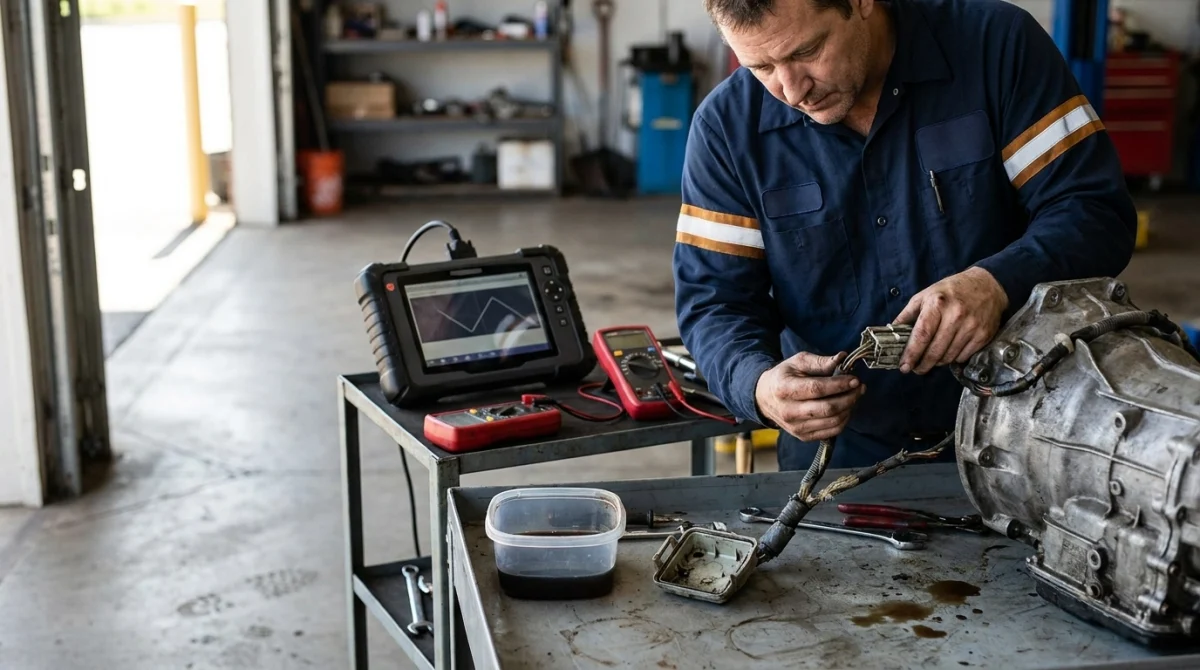
P0750 appears when the vehicle detects a problem with the operation or electrical control of the relevant shift-solenoid circuit. The failure does not have to be inside the solenoid itself.
Common P0750 Causes
- Faulty shift solenoid: The solenoid may stick mechanically or fail electrically.
- Damaged wiring: Chafing, heat damage, broken wires, or short circuits can interrupt solenoid control.
- Connector problems: Bent terminals, corrosion, loose pins, or fluid contamination can create intermittent faults.
- Transmission fluid problems: Incorrect level or badly contaminated fluid can affect hydraulic operation.
- Restricted hydraulic passages: Debris or valve-body problems can stop commanded pressure changes from occurring correctly.
- Valve body faults: Wear or sticking valves can produce symptoms that resemble solenoid failure.
- Control-module or software issue: In some vehicle-specific cases, programming or module-related faults can contribute.
- Internal transmission damage: Mechanical problems can prevent the expected gear change even when the electrical circuit works.
One mistake I often see in electrical troubleshooting is treating the component named in a trouble code as the automatic replacement part. That approach can turn a wiring problem into an unnecessary repair bill.
Vehicle-specific information matters here. Manufacturer technical service information may identify known wiring, software, or transmission issues that change the recommended diagnostic path.
You can also use the NHTSA investigations and recall resources to research manufacturer communications and safety-related information for a particular vehicle.
Pro tip: use your VIN when researching vehicle-specific information. Similar models can have different engines, transmissions, wiring layouts, and control software.
How Do You Diagnose P0750 Correctly?
Start by confirming the code and gathering evidence before disconnecting parts. A systematic diagnosis separates an electrical problem from a hydraulic or mechanical transmission fault.
1. Scan the Entire Vehicle
Read all available modules, not only the engine computer. Record P0750 plus any related transmission, voltage, network, speed-sensor, pressure, or solenoid codes.
Do not immediately clear them. Freeze-frame or failure-record data can show vehicle speed, temperature, voltage, and operating conditions when the fault appeared.
2. Check the Transmission Fluid
Follow the manufacturer’s procedure because transmission-fluid checks differ between vehicles. Some transmissions do not have a conventional dipstick.
Look for:
- Fluid level outside the specified range
- Severe discoloration
- Burnt odor
- Visible contamination
- Signs of leakage
Fluid condition can provide useful clues, but appearance alone cannot prove that a transmission needs rebuilding.
3. Inspect the Harness and Connectors
Inspect accessible transmission wiring closely. Pay special attention to areas near hot exhaust parts, brackets, road debris, previous repairs, and places where the harness bends.
Check connectors for damaged locks, backed-out terminals, corrosion, moisture, or transmission-fluid intrusion.
4. Test the Electrical Circuit
Use a digital multimeter and the correct wiring diagram for the vehicle. Test only according to manufacturer specifications.
Depending on the system, diagnosis may include:
- Solenoid resistance testing
- Power-supply checks
- Ground-circuit checks
- Continuity testing
- Short-to-ground checks
- Short-to-voltage checks
- Voltage-drop testing
Never apply battery voltage directly to an unknown transmission circuit unless the service procedure specifically instructs you to do so.
5. Use Bidirectional Testing When Supported
A capable professional scan tool may command certain transmission solenoids while monitoring data. This can help determine whether the control module is issuing commands and whether the transmission responds.
Tool support varies by vehicle. A generic Bluetooth OBD2 adapter may not provide these transmission-specific functions.
Section Takeaway: Diagnose P0750 as a system fault, not automatically as a failed solenoid. Scan data, wiring checks, fluid condition, and vehicle-specific service information should point you toward the actual cause.
How Do You Fix P0750?
The correct P0750 repair depends on what your diagnosis finds. There is no single repair that applies to every vehicle.
If You Find Damaged Wiring
Repair the affected wiring using an automotive-grade method suitable for the location. Also correct whatever caused the damage, such as rubbing against a bracket or exposure to excessive heat.
Clean or repair damaged connector terminals when manufacturer procedures allow it. Replace connectors that cannot maintain reliable terminal contact.
If the Shift Solenoid Tests Faulty
Replace the solenoid according to the manufacturer’s service procedure. On some transmissions, individual solenoids are serviceable without replacing the complete valve body.
Other designs integrate solenoids into a larger assembly. Confirm the correct component before ordering anything.
If Fluid Condition or Hydraulic Operation Is the Problem
Correct the fluid level only with the specified transmission fluid. Using an incorrect fluid can create new shift problems.
If debris, valve-body wear, or internal hydraulic faults are suspected, the transmission may require professional inspection rather than a simple fluid service.
If Software or a Control Module Is Involved
Check manufacturer service information before condemning the transmission computer. Some vehicles can have software updates or manufacturer-specific diagnostic procedures related to transmission faults.
Before paying for a major repair, search your vehicle by VIN using the NHTSA recall lookup. The database can show open safety recalls and related manufacturer information.
After the Repair
- Reconnect everything securely.
- Verify the correct fluid level when applicable.
- Clear the diagnostic codes.
- Start the engine and watch for immediate faults.
- Perform a safe road test when the vehicle is operating normally.
- Rescan all relevant modules.
- Confirm that P0750 does not return.
A code that returns immediately often points toward an unresolved electrical fault. A code returning only under certain driving conditions may require deeper testing with live data.
Repair note: transmission repairs can affect vehicle movement and safety. If you’re uncertain about circuit testing, fluid procedures, or internal transmission work, use a qualified repair facility.
Section Takeaway: Fix the fault your testing proves. P0750 may require a wiring repair, connector repair, solenoid replacement, hydraulic service, valve-body work, software correction, or deeper transmission diagnosis.
Can You Drive With a P0750 Code?
Driving with P0750 is not something I recommend ignoring. Whether the vehicle can be driven safely depends on how the transmission is behaving.
Stop unnecessary driving and arrange an inspection if you notice:
- Severe slipping
- Violent or unpredictable gear changes
- Loss of forward or reverse movement
- Transmission overheating warnings
- The vehicle repeatedly entering limp mode
- Unusual mechanical noises
- A burning smell
- Fluid leaking heavily underneath the vehicle
If the vehicle appears to drive normally, that still does not prove the problem is harmless. An intermittent electrical or hydraulic fault can worsen without much warning.
AAA advises drivers that diagnostic trouble codes provide clues to the underlying problem rather than automatically proving a particular repair. Their guidance also recommends professional evaluation when a warning light indicates a vehicle fault.
If you suspect a defect affecting multiple vehicles, you can review NHTSA safety investigations and manufacturer communications.
Safety note: if your vehicle cannot accelerate, shift, or maintain speed predictably, moving it in traffic can create a hazard. A tow may be safer than attempting to drive it to a shop.
DIY Diagnosis vs Professional Repair

Basic P0750 checks are within reach of an experienced DIY owner. Deeper electrical, hydraulic, and internal transmission diagnosis usually requires better tools and vehicle-specific information.
| Task | DIY Suitability | Typical Tools | Main Limitation |
|---|---|---|---|
| Read and record P0750 | Good DIY starting point | OBD2 scanner | Basic scanners may miss transmission-module data |
| Visual wiring inspection | Usually DIY-friendly | Light, basic hand tools | Internal harnesses may require disassembly |
| Electrical circuit testing | Intermediate to advanced | Multimeter, wiring diagram | Incorrect testing can damage circuits |
| Bidirectional solenoid testing | Usually advanced | Vehicle-capable professional scanner | Support varies by make and transmission |
| Valve-body diagnosis | Professional recommended | Advanced scan and service equipment | Requires hydraulic and transmission knowledge |
| Internal transmission repair | Professional work | Specialized transmission tools | Complex disassembly and precise measurements |
Repair cost varies widely by vehicle, labor rates, access to the solenoid, and whether the fault is external or internal. A wiring repair and a transmission overhaul are completely different jobs, even though both could ultimately be associated with P0750.
Ask for a diagnosis before approving major transmission work. A good estimate should explain what testing was performed and why the recommended repair addresses the code.
If you need a shop, the AAA Approved Auto Repair network provides a searchable directory that includes facilities offering transmission and diagnostic services.
Cost note: request a written estimate before repair. Labor time, parts availability, fluid requirements, programming, and transmission design can all change the final price.
P0750 Frequently Asked Questions
Can low transmission fluid cause P0750?
Low or incorrect transmission fluid can contribute to hydraulic problems and abnormal shifting, but P0750 should not automatically be blamed on fluid level. Check the fluid using the manufacturer procedure, then continue diagnosis if the code remains.
Does P0750 always mean Shift Solenoid A is bad?
No. P0750 can also result from damaged wiring, poor electrical connections, hydraulic problems, valve-body issues, control faults, or other transmission problems. Test the circuit and transmission operation before replacing the solenoid.
Can an OBD2 scanner fix P0750?
An OBD2 scanner can identify and clear P0750, but clearing the code does not repair the underlying fault. More capable scanners can provide transmission data and bidirectional tests on supported vehicles, which can make diagnosis much easier.
Will disconnecting the battery clear P0750?
Battery disconnection may erase some stored information on certain vehicles, but it does not repair the problem that caused P0750. It may also reset vehicle settings or learned values, so use the manufacturer-approved procedure instead of disconnecting power just to hide a code.
Can dirty transmission fluid cause a shift-solenoid code?
Contaminated fluid can affect hydraulic components and solenoid operation, especially when debris restricts fluid passages. However, fluid appearance alone cannot confirm the cause of P0750. Electrical and hydraulic testing should still be performed.
Can I replace Shift Solenoid A myself?
That depends on the transmission. Some solenoids are accessible after removing the transmission pan, while others sit inside complex valve-body assemblies. Confirm the service procedure, fluid specification, component identification, and required relearn steps before starting.
What should I do if P0750 comes back after replacing the solenoid?
Stop replacing parts and return to diagnosis. Check the harness, connector terminals, power and ground circuits, valve body, transmission operation, and manufacturer service information. A returning code often means the original root cause was never corrected.
P0750 is best solved with evidence, not guesswork. Start with a complete scan, verify fluid condition, inspect the wiring, and test the circuit using specifications for your exact vehicle.
If the transmission shifts unpredictably or the diagnosis points inside the transmission, have a qualified technician inspect it before driving farther. You can also use NHTSA’s vehicle recall lookup to check your VIN for applicable safety recalls before paying for repairs.
