
Jeep Lost Car Key: What to Do, What It Costs, and How to Get a Replacement Fast

Losing a Jeep key is frustrating because the fix is rarely as simple as cutting a new metal key. The right path depends on whether you had a traditional key, a transponder key, a key fob, or a smart key—and whether you still have a spare.
The good news: in many cases, you can replace a Jeep key without the original, but the exact process depends on the key type and model year. The faster you identify the key type and gather your vehicle information, the sooner you can decide between a dealer, an automotive locksmith, or an online replacement service.
What to Do First After Losing a Jeep Key
Before you spend money on a replacement, slow the situation down for five minutes and check the basics:
- Search the last places you used the Jeep. Keys often turn up in a jacket pocket, store counter, gym bag, or between car seats.
- Check whether you have a spare. If you do, duplicate it first; that is usually the fastest and cheapest path.
- If you lost all keys, decide who to call next. For many Jeep models, a mobile automotive locksmith can replace and program the key on-site. For newer push-button-start Jeeps or dealer-only systems, call the dealer.
- Keep the Jeep secure. If the lost key might be connected to your address, workplace, or a labeled fob, treat it like a security issue and consider reprogramming or replacing the key sooner rather than later.
- Figure out whether the vehicle is drivable. If you have no working key at all, towing may become part of the plan.
- Gather your VIN and ownership documents. That saves time whether you call a dealer or a locksmith.
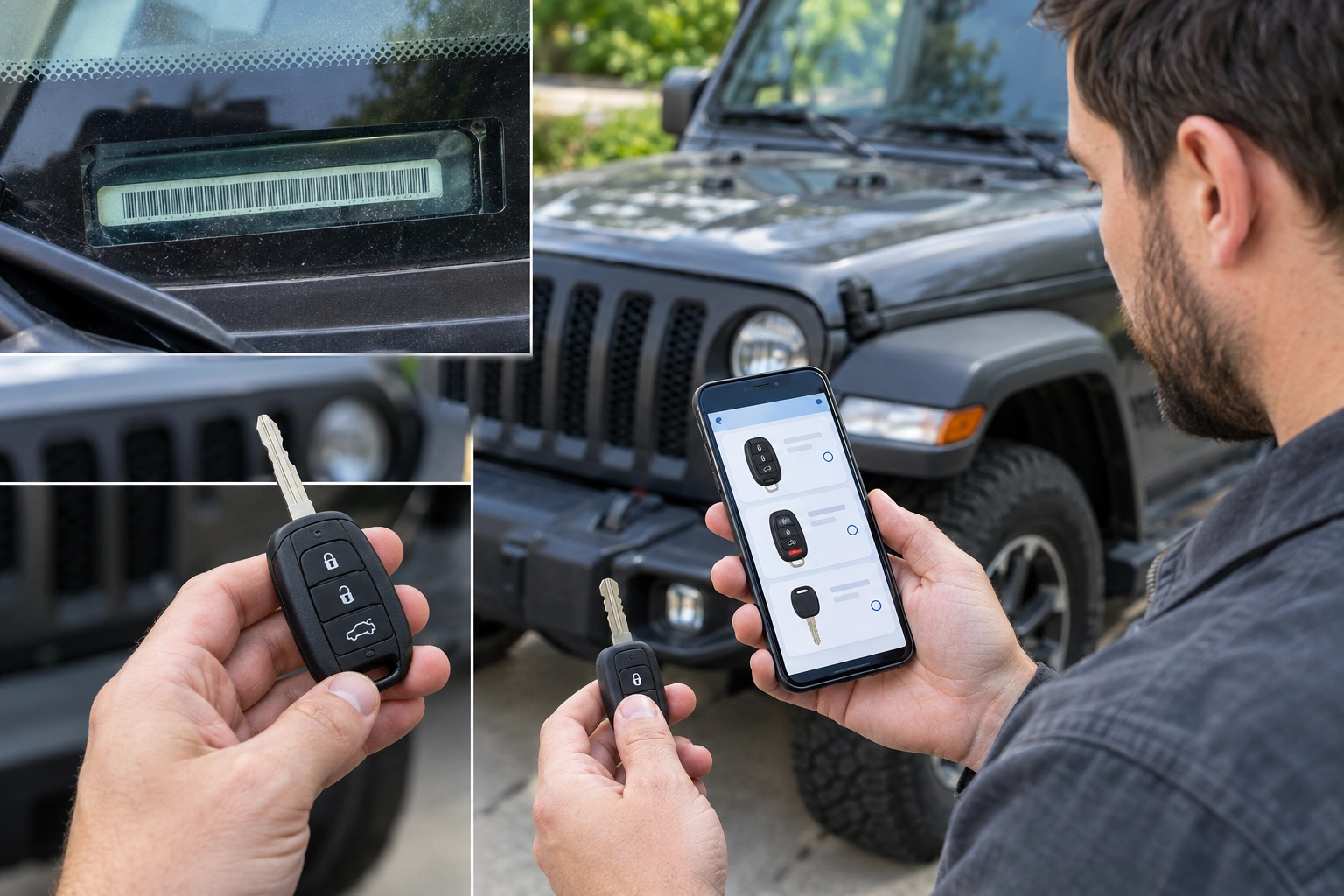
If you already have a spare, the fastest move is usually to make a duplicate before that spare becomes your only key. If you’ve lost the only working key, the process becomes more involved because the replacement has to be cut or matched and then programmed to the vehicle’s security system.
[Image 1 here]
Identify Which Jeep Key Type You Have
The key type determines almost everything: cost, programming, and whether a locksmith can help on-site.
Traditional metal key
Older Jeep models may use a simple mechanical key. Common examples include many older Jeep Cherokee, Grand Cherokee, Wrangler, and Liberty models from earlier generations, especially before widespread immobilizer systems became standard. These are the easiest to replace because they do not usually require electronic programming.
Transponder key
A transponder key looks like a regular key, but it contains a chip that communicates with the immobilizer. Many Jeep models from the late 1990s through the 2010s may use this style, depending on trim and ignition system. The car may crank but not start if the chip is not recognized.
Key fob
Some Jeep models use a remote fob for lock, unlock, and panic functions. Depending on the model year, the fob may also contain the transponder or smart-key electronics. This is common on many newer Jeep Cherokee, Grand Cherokee, Wrangler, Compass, and Renegade trims.
Smart key or proximity key
With a smart key, the vehicle detects the fob nearby and allows push-button start. Many newer Jeep Grand Cherokee, Wagoneer, Cherokee, and some Wrangler trims use this setup. These replacements are usually more expensive and more dependent on programming tools.
A quick rule of thumb: if your Jeep has push-button start, expect a more complex and more expensive replacement than an older keyed ignition.
If you are unsure, check the owner’s manual, look at the ignition style, or compare your model year against your original key. A dealership or locksmith can often identify the correct blank or fob from the VIN.
What You Need Before Ordering a Replacement
Have this information ready before you place an order or book service:
- VIN
- Year, make, model, and trim
- Proof of ownership
- Photo ID
- Whether you have a working spare
- Whether the Jeep uses push-button start
- Any existing key code or key tag, if you still have it
Providers usually accept some combination of registration, title, or insurance plus a government-issued photo ID. Requirements can vary, but those are the documents most commonly requested when ordering a replacement or programming a new key.
Perkins Motors specifically advises having your VIN ready before visiting for a lost Jeep Wrangler key replacement. That matters because the VIN helps the provider match the correct key blank, fob, and programming method. You can read that guidance here: VIN-ready lost Jeep key replacement advice.
Replacement Options: Dealer vs. Locksmith vs. Online
Here is the practical comparison most Jeep owners need.
| Option | Best for | Pros | Trade-offs |
|---|---|---|---|
| Dealer | Exact OEM match, newer smart keys, warranty-sensitive owners | Strong compatibility, access to factory systems, good for complex programming | Often higher cost, may require towing, may take longer if the part must be ordered |
| Automotive locksmith | Fast replacement, lost-all-keys situations, mobile service | Can often come to you, may avoid towing, usually faster than dealer scheduling | Not every model/year is serviceable, especially if tools or security access are limited |
| Online replacement | Budget-conscious owners who already know the exact part | Can be cheaper upfront, convenient ordering | Wrong part risk, programming still needed in many cases, may still require locksmith or dealer assistance |
In general, a locksmith is often the cheapest and fastest option for traditional keys, many transponder keys, and some fobs, especially if you have lost all keys and need mobile service. A dealer is more often the right choice for newer smart keys and push-button-start systems that require more specialized programming or factory access.
Online ordering can save money, but only if you already know the exact key type and are comfortable handling the follow-up cutting or programming.
One caution: a low-cost online key is not a complete solution if no one can program it to the vehicle. The savings can disappear if you still need a separate service call.
How Jeep Key Programming Works
Programming is the step that turns a cut key or new fob into a working key for your Jeep.
When programming is needed
- Traditional mechanical key: usually no programming
- Transponder key: usually programming required
- Key fob with remote functions: often programming required
- Smart key/proximity fob: almost always programming required
DIY programming vs. professional programming
Some Jeep keys can be programmed by the owner, but that depends on the model year and system design. If a Jeep supports owner programming, the process may be straightforward. If not, the vehicle may need a locksmith or dealer tool to pair the new key with the immobilizer.
In practical terms:
– Older mechanical keys are often a cut-only job.
– Some older Jeep transponder systems may allow limited owner programming, but many still need professional equipment.
– Most fobs and nearly all smart keys require professional programming, especially if all keys are lost.
The risk with DIY attempts is not just wasted time. Failed programming attempts can leave you stuck in the driveway with a part that still does not start the Jeep. If you only have one chance to get back on the road quickly, professional programming is usually the safer bet.
Why the immobilizer matters
The immobilizer is the anti-theft system that checks whether the key is authorized. If the chip or fob is not recognized, the Jeep may lock out starting even if the blade turns or the buttons work.
What Changes If You Lost All Jeep Keys
This is the hardest version of the problem.
If you still have one working key, a replacement is usually simpler because the new key can often be added while the vehicle is already accessible. When all keys are lost, the provider may need to access security data, verify ownership, and use more specialized equipment.
That usually means:
– Higher cost
– More time
– More paperwork
– Sometimes towing, sometimes not
Whether towing is necessary depends on the Jeep and the service provider. A mobile locksmith can often handle many lost-key jobs on-site if the model is supported and the locksmith has the right tools. Towing is more likely when the Jeep uses a newer smart-key system, when the provider cannot program the vehicle at your location, or when the dealer requires the vehicle to be present for security access.
A typical lost-all-keys process looks like this:
1. Confirm ownership and vehicle details.
2. Identify the correct key type and blank/fob.
3. Cut the new key or prepare the fob.
4. Program the key to the Jeep.
5. Test lock, unlock, panic, and starting functions.
If you lost all keys, do not assume the cheapest online fob will solve it. The real challenge is not just getting the part—it is getting the vehicle to accept the part.
Step-by-Step: How to Get a Replacement Jeep Key Fast
Use this order to avoid extra delays:
- Confirm the key type. Check whether you need a metal key, transponder key, fob, or smart key.
- Find your VIN. This helps match the right blank and programming method.
- Check for a spare. If one exists, use it to simplify programming and avoid towing.
- Choose the provider. Compare dealer, locksmith, and online options based on your Jeep’s year and your timeline.
- Verify ownership requirements. Have your ID, registration, title, or insurance documents ready if asked.
- Order or schedule the replacement. Make sure the provider confirms compatibility with your exact model year.
- Cut and program the key. Cutting alone is not enough for many Jeep keys.
- Test every function. Check unlock, lock, panic, remote start if equipped, and engine start.
If you are trying to get back on the road today, a mobile automotive locksmith is often the most efficient route when your Jeep is not too new or too security-restricted for on-site service.
Typical Cost and Time Estimates
Exact pricing depends on model year, key type, and who does the work, but these are realistic estimates for the U.S. market:
Traditional key
- Dealer: about $25 to $100
- Locksmith: about $20 to $80
- Online blank only: about $10 to $40 before cutting
Transponder key
- Dealer: about $100 to $250
- Locksmith: about $80 to $200
- Online blank or shell: about $20 to $80 before cutting and programming
Key fob
- Dealer: about $150 to $350
- Locksmith: about $120 to $300
- Online replacement: about $40 to $150 before programming
Smart key / proximity key
- Dealer: about $250 to $600+
- Locksmith: about $200 to $500
- Online replacement: about $80 to $250 before programming
These are broad industry-style estimates, not Jeep-fixed prices. Actual cost can move up or down based on model year, whether you have a spare, whether all keys are lost, and whether the vehicle needs dealer-level programming.
Time also varies:
– Duplicate with a spare present: often the quickest
– Dealer replacement: may be same day if the part is in stock, or longer if it must be ordered
– Online replacement: fast to order, but final completion depends on cutting and programming
– Lost-all-keys service: usually slower because ownership verification and security steps are involved
Kelley Blue Book notes that older keys, usually from the mid-1990s or before, are simple to replace, while newer keys require more effort and sometimes dealership service. That is a general industry reference, not a Jeep-specific pricing rule, but it matches what many Jeep owners see: the newer the security system, the more the replacement depends on programming rather than just cutting metal. Read more here: KBB on car key replacement complexity.
Common Mistakes to Avoid
The most expensive mistakes are usually the simplest ones:
Buying the wrong key blank
Jeep model years and trims can use different key types. A key that looks right may still be wrong internally.
Assuming cutting is enough
For transponder and smart keys, cutting the blade does not finish the job.
Ordering before confirming compatibility
Online listings can be vague. Verify that the part matches your exact year, model, and ignition system.
Skipping proof-of-ownership prep
If the provider asks for documents and you do not have them, the job stalls.
Waiting to make a spare
The cheapest time to get a duplicate is before you lose the only working key.
Troubleshooting a New Jeep Key That Won’t Work
If the replacement arrives but the Jeep still does not respond, check these likely causes:
- Wrong part number or incompatible fob
- Programming not completed
- Weak or dead battery in the fob
- Blade cut incorrectly
- Immobilizer pairing not finished
- Vehicle battery issue affecting communication
If the buttons work but the engine will not start, the problem is often programming rather than cutting. If nothing works at all, the battery in the fob or the vehicle may be part of the issue. A locksmith can usually separate a dead battery problem from a pairing problem quickly.
Practical Examples of Jeep Key Replacement Scenarios
Scenario 1: You lost one key, but you have a spare
This is the easiest case. Use the spare to keep driving, then have a duplicate made. A locksmith is often the most convenient option if you want same-day service.
Scenario 2: You lost the only key to a push-button-start Jeep
Expect a more complex replacement. You will likely need the VIN, proof of ownership, and professional programming. A dealer or advanced automotive locksmith is usually the realistic route.
Scenario 3: You found an online replacement fob at a lower price
That can work if the part is correct, but do not forget the follow-up. You may still need cutting and programming, which can erase the savings if you have to pay extra later.
Scenario 4: Your Jeep is parked somewhere you cannot access easily
Mobile locksmith service can save time and avoid towing, provided your model is supported.
When to Call an Automotive Locksmith
Call a locksmith when you need speed, convenience, or on-site help and you have already confirmed that your Jeep’s key type is serviceable outside the dealership. That is especially useful if:
– the Jeep is stranded
– you have no spare
– you want to avoid towing
– you need a duplicate key programmed quickly
– you have a transponder key, many fobs, or some smart-key jobs that can be handled with mobile equipment
A dealership still makes sense for some newer or more security-sensitive systems, but a locksmith is often the better first call when time matters.
Final Takeaway
If you have a jeep lost car key situation, the fastest path is to identify the key type, gather the VIN and ownership documents, and choose the replacement route that matches your Jeep’s security system. Older mechanical keys are straightforward. Transponder keys, fobs, and smart keys usually need programming, and lost-all-keys jobs are more involved than spare-key replacements.
If you want the quickest next step, figure out whether you still have a working spare. That single detail usually decides whether this is a simple duplicate job or a full security-based replacement.
FAQ
Can you replace a Jeep key without the original?
Usually yes, but it depends on the key type and model year. Traditional keys are simplest. Transponder keys, fobs, and smart keys may still be replaced without the original, but they usually need programming.
Do you need to tow a Jeep to replace a lost key?
Not always. A mobile locksmith can often handle many Jeep key replacements on-site. Towing is more likely for newer push-button-start models, dealer-only programming, or situations where the vehicle cannot be serviced remotely.
Can a locksmith program a Jeep key?
Often yes, especially for many transponder keys and some fobs. Some newer smart keys or security-restricted models may still require a dealer or advanced programming equipment.
Is dealer replacement always better than locksmith replacement?
Not always. Dealers are often the safest choice for newer smart keys and factory-specific systems, but locksmiths are frequently faster and cheaper for many standard replacements.
What documents do I need for Jeep key replacement?
Most providers ask for a photo ID plus proof of ownership such as registration, title, or insurance. Requirements vary, so it helps to have more than one document available.
