
Key Fob Not Detected While Driving: What It Means and What to Do Next

If your dashboard suddenly says the key fob is not detected while driving, take a breath. In many vehicles, that warning means the car is having trouble verifying the fob’s signal—not that the engine is about to die right this second. Most cars keep running after a “key fob not detected” warning, but a low vehicle battery or an electrical fault can create broader problems, including restart trouble and, in rare cases, a shutdown if the system loses enough power.
That matters because the biggest risk is not always an immediate stall. More often, the car may refuse to restart after you shut it off, or it may start acting up again the next time you try to drive. I’ve seen plenty of drivers panic, shut the car off in the wrong place, and then discover they can’t get it going again.
A quick way to think about it: if the car is running normally and only the detection warning is showing, you usually have time to get to a safe place and troubleshoot. If the warning appears along with dim lights, weak cranking, multiple electrical warnings, or rough running, the problem may be bigger than the fob itself.
What the warning actually means
A “key not detected” message usually means the vehicle cannot confirm communication with the smart key system. That can happen even when the fob is physically inside the car. The car is looking for a valid signal from the fob so it can keep the immobilizer and push-button start system happy.
In plain English: the car usually can’t confirm the fob, not that it will immediately stop running.
That does not automatically mean the fob is dead. It may be weak, blocked, out of sync, or being drowned out by interference. It can also point to a car-side issue, like a low vehicle battery or a receiver problem.
For a broader look at how smart-key systems behave and how drivers should think about warning lights, the NHTSA vehicle safety resources are a useful starting point.
What to do right away if the warning appears
If the car is still running, focus on staying safe first and diagnosing second.
-
Keep driving normally if traffic conditions are safe.
Don’t slam on the brakes or shut the vehicle off just because the message appeared. If the car is already moving fine, the immediate concern is usually whether it will restart later.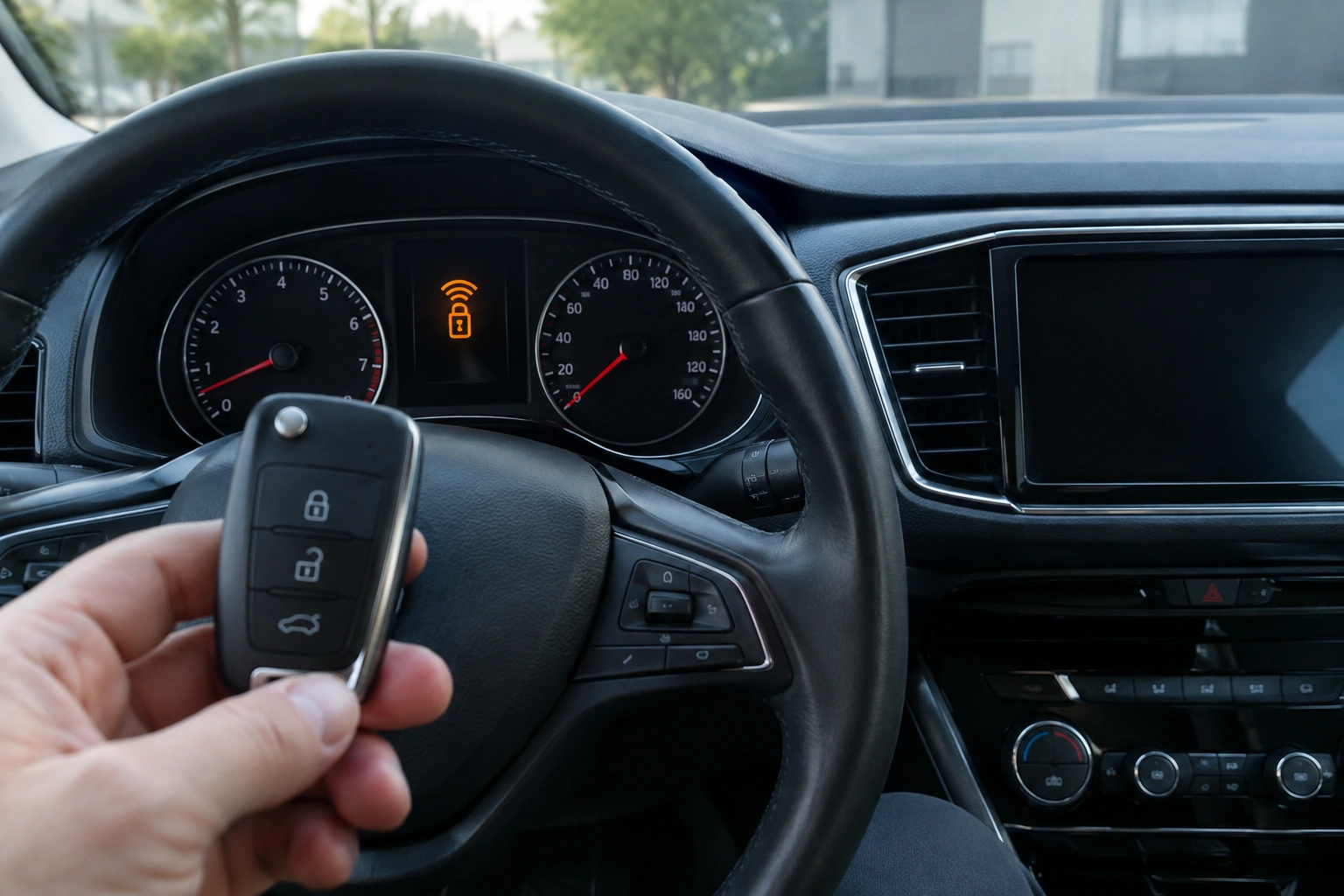
A key fob warning usually points to a communication problem, not instant shutdown. -
Move the fob away from clutter.
If the fob is in a bag, cupholder, or pocket with a phone, metal objects, or another key fob, separate it. Signal interference is a real possibility. -
Hold the fob closer to the start button area.
In many push-button start vehicles, moving the fob near the start button or the designated emergency start area can help the car detect it. -
Watch for other symptoms.
If the dash starts lighting up with battery warnings, the lights dim, or the car feels weak, head to a safe stop sooner rather than later. -
Do not turn the car off unless you have a plan to restart it.
This is the mistake that strands people. If the system is already struggling to see the key, shutting down in the wrong place can turn a warning into a tow.
If you’re unsure whether your car has a backup start procedure, check the owner’s manual before you need it. Many push-button start systems include one, but the exact method is model-specific.
The most likely causes, in order of what I usually check first
Here’s the practical order I’d use when a driver says the car can’t detect the fob.
| Likely cause | What it usually feels like | Quick clue |
|---|---|---|
| Weak key fob battery | Intermittent warning, car detects the fob only when it’s close | Fob works better near the start button |
| Signal interference | Warning comes and goes in a parking garage, near electronics, or with items packed around the fob | Moving the fob fixes it |
| Low vehicle battery | Multiple electrical oddities, dim lights, weak starts, random dash messages | Other systems act weird too |
| Failing key fob | Buttons may still work sometimes, but detection is unreliable | New battery doesn’t solve it |
| Receiver or antenna issue | Good fob, fresh battery, but the car still misses it | Problem persists in different locations |
A weak fob battery is the most common easy fix, but I would not ignore the vehicle battery. A low car battery can create all kinds of unstable electronic behavior, including detection issues. If the battery is old, the car has been sitting, or you’ve noticed slow cranking lately, that deserves attention.
For a general comparison of how modern vehicles handle smart access and convenience features, Car and Driver’s technology coverage can help you understand the system at a high level, though your owner’s manual is still the final word for your car.
How to tell whether it’s the fob battery, the vehicle battery, or interference
This is the part that saves time.
Weak key fob battery
A weak fob battery often shows up as intermittent detection. The car may recognize the fob only if you hold it very close to the start button or place it in the emergency detection spot. Buttons may still work at short range, but the signal is too weak for consistent communication.
Vehicle battery problem
If the car battery is the real issue, the fob warning is usually not the only clue. You may see dim interior lights, slower cranking, warning lamps, or other odd electrical behavior. In that case, replacing the fob battery alone may not help at all.
Interference issue
Interference is often the easiest to test because it changes quickly. If the warning disappears when you move the fob away from your phone, another key fob, a metal case, or a stack of items in your bag, you’ve probably found the culprit.
A useful rule: if the problem changes based on where the fob is placed, think interference or weak fob battery. If the problem comes with broader electrical symptoms, think vehicle battery or charging system.
Step-by-step fixes you can try first
Use this order. It avoids wasting time and keeps you from replacing parts too early.
1. Separate the fob from other electronics
Take the fob out of a crowded pocket or bag. Move it away from phones, magnetic accessories, and other fobs. Then see whether the warning clears.
2. Try the fob in a different spot
If your car has a known emergency detection location, use it. Some vehicles want the fob near the start button, while others use a marked area in the center console, steering column, or cupholder zone. The owner’s manual matters here because the exact location and method are vehicle-specific.
3. Replace the fob battery if symptoms fit
If the fob works only at very close range, or the warning is intermittent and gets worse over time, replacing the battery is a smart first repair. It’s a low-cost, low-risk step compared with replacing the whole fob.
Do not assume a new battery solves everything, though. If the warning returns immediately, keep going down the list.
4. Check the vehicle battery next
If the car has been slow to start, the lights look weak, or multiple electronics are acting strangely, the vehicle battery may be the real issue. A shop or parts store can usually test it quickly.
How to start or restart the car if the fob is not detected
Many push-button start vehicles have a backup method built in. The exact steps depend on the model, so the owner’s manual is the authoritative source for the exact emergency start location and method. In some vehicles, the fob must touch the start button or a marked backup spot for the car to read it.
A common emergency method is to hold the fob directly against the start button or place it in the designated backup area while pressing the brake and start button. Some systems use a passive induction loop near the button or steering column to read the fob’s immobilizer chip without relying on the fob battery.
That said, do not guess. Some vehicles use a slot, some use a marked spot, and some use a different sequence entirely. Check the owner’s manual or the manufacturer’s support pages for your exact model.
If you want a practical example: a driver sees the warning after the fob has been tossed into a bag with a phone and metal items. They stop in a safe place, move the fob to the backup location, and the car recognizes it again. That points to either interference or a weak fob battery, not necessarily a failed fob.
When the problem points to a failing fob, antenna, or receiver
If you replace the fob battery and the warning keeps coming back, the issue may be on the vehicle side or inside the fob itself.
Watch for these signs:
- The car detects the fob only in one very specific spot
- The warning happens even with a fresh fob battery
- The problem shows up in multiple locations, not just one parking area
- The fob works inconsistently even when the battery is new
- Other smart-key functions are also unreliable
At that point, the likely suspects are the fob transmitter, the vehicle’s receiver, or the antenna system. This is where a simple battery swap stops being enough.
When it’s safe to keep driving and when to stop
If the car is running normally, the warning is isolated, and there are no other electrical symptoms, you can usually continue to a safe destination. Just assume the real risk is restart failure, not instant shutdown.
Pull over and get help sooner if any of these happen:
- The car loses power or runs rough
- Multiple warning lights appear
- Lights dim or electronics behave erratically
- The car starts only intermittently
- You are about to shut the car off in an unsafe place and are not sure it will restart
A good rule from the driver’s seat: if the problem is only the fob warning, you usually have some flexibility. If the warning is part of a larger electrical failure, treat it as urgent.
When to replace the fob battery, call a mechanic, or contact a dealer or locksmith
Replace the fob battery first if the warning is intermittent and the car works better when the fob is held close to the start button. That is the most efficient first move.
Call a mechanic if the vehicle battery seems weak, the car has other electrical symptoms, or the warning appears alongside charging-system concerns. That’s a car-side diagnosis, not just a fob issue.
Contact a dealer or locksmith if:
- The replacement battery does not fix it
- The fob needs replacement or reprogramming
- The backup start method works only temporarily
- You suspect the receiver or smart-key system needs diagnosis
When to consult a locksmith
A locksmith is often the fastest option when the issue is clearly fob-related and you need a replacement or programming help. A dealer may be the better choice for some OEM-specific procedures, especially if the vehicle’s smart-key system is picky about programming or parts compatibility.
If you’re stuck between the two, ask one simple question: do you need a new or programmed fob, or do you need diagnosis of the vehicle’s detection system? If it’s the first, a locksmith may be the quicker route. If it’s the second, a dealer or qualified mechanic may be better equipped.
FAQ
Can I keep driving if the car says the key fob is not detected?
Usually, yes, if the car is already running normally. The bigger concern is whether it will restart later. Don’t shut it off in an unsafe place unless you know you have a backup start method.
Will the car shut off while driving?
In many vehicles, no. The warning often means the car cannot verify the fob, but it may keep running until you turn it off. Still, if the car starts losing power or showing other electrical issues, stop safely and get help. In rare cases, a low vehicle battery or electrical failure can cause broader problems.
Is it more likely to be the fob battery or the car battery?
A weak fob battery is a common first suspect, but a low vehicle battery can also trigger detection problems. If other electrical symptoms are present, check the car battery sooner.
What if the warning goes away after I move the fob?
That usually points to interference or a weak fob battery. Try separating the fob from phones, metal objects, and other electronics before assuming the fob is bad.
Do all cars have a backup start method?
No. Many push-button start vehicles do, but the procedure varies by model. Your owner’s manual is the best source for the exact steps.
When should I stop trying DIY fixes?
If the warning keeps returning after a battery change and simple interference checks, or if the car shows broader electrical symptoms, it’s time for professional diagnosis.
