
What Should Long-Term Fuel Trim Be While Driving?

Quick Answer
While driving, long-term fuel trim (LTFT) is generally healthiest when it stays near 0%, with readings around -5% to +5% commonly considered a good sign. Readings between -10% and +10% can be acceptable depending on the vehicle, engine load, and driving conditions. Persistent values beyond roughly ±10% deserve investigation, while values approaching or exceeding ±20% suggest a more significant fueling or air-measurement problem.
How to interpret your driving readings
- Near 0%: The engine computer needs little long-term correction to maintain its target air-fuel mixture.
- Positive LTFT: The computer has learned to add fuel, which can point to unmetered air, low fuel delivery, or inaccurate sensor readings.
- Negative LTFT: The computer has learned to reduce fuel, potentially because of excess fuel delivery or incorrect sensor information.
- Highway cruising: Compare readings at a steady speed and load rather than judging a brief fluctuation during acceleration.
- Large corrections: Investigate persistent readings beyond ±10%, especially when accompanied by warning lights, rough running, or poor fuel economy.
For a more reliable diagnosis, compare LTFT with short-term fuel trim (STFT), engine load, and stored diagnostic trouble codes. Always use your vehicle manufacturer’s specifications when available.
When I look at OBD2 scanner readings, I don’t judge long-term fuel trim by one number alone. The key is understanding how much correction the engine computer has learned while the vehicle operates under different driving conditions.
This guide explains normal LTFT readings while driving, what positive and negative percentages mean, and how to distinguish a normal adjustment from a problem worth diagnosing.
In This Guide
- What should LTFT normally read while driving?
- Why does long-term fuel trim change while driving?
- What do positive and negative LTFT readings mean?
- How do you check LTFT with an OBD2 scanner?
- What causes high or low LTFT while driving?
- How should you diagnose abnormal readings?
- Frequently asked questions
What Should LTFT Normally Read While Driving?
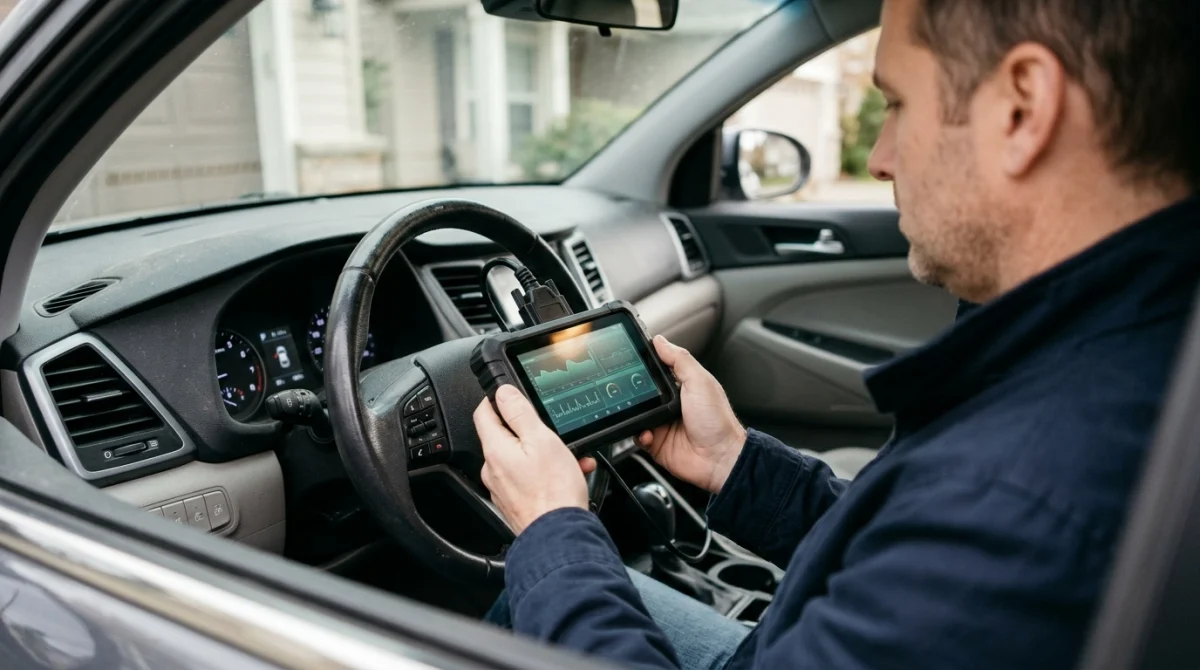
Long-term fuel trim is generally expected to remain close to 0% during steady driving, although the exact normal range varies by vehicle. As a practical screening guide, readings from -5% to +5% are reassuring, and values between -10% and +10% may still be reasonable.
The engine control module (ECM) adjusts fueling to compensate for conditions that affect the air-fuel mixture. LTFT records learned corrections rather than measuring the amount of fuel flowing through the injectors directly.
What do different LTFT percentages tell you?
| LTFT reading | Practical interpretation |
|---|---|
| -5% to +5% | Generally a reassuring correction range. |
| -10% to -5% or +5% to +10% | Often acceptable, but worth comparing with the vehicle’s usual behavior. |
| -20% to -10% or +10% to +20% | A substantial correction that merits further checks if persistent. |
| Below -20% or above +20% | A strong correction that may indicate a fueling, air-measurement, or sensor issue. |
These are general diagnostic guidelines, not universal manufacturer limits or automatic failure thresholds. Some vehicles use different fuel-trim strategies, and the meaning of a reading depends on operating conditions.
Is LTFT supposed to be exactly 0% on the highway?
No. An LTFT reading of 0% is not required for an engine to operate correctly. A stable reading of +3% or -4%, for example, can be perfectly reasonable if the engine runs smoothly and other data looks normal.
During a highway drive, look for a consistent pattern rather than a perfect number. A reading that stays around +4% at steady speed is usually less concerning than one that remains at +18% under similar conditions.
Does LTFT change at different driving speeds?
Yes, it can. Engine load, airflow, fuel demand, temperature, and the computer’s learned correction strategy can all affect the reading you see on an OBD2 scanner.
- Steady cruising: Provides a useful baseline for comparison.
- Acceleration: Fuel control may change, and some scan tools may display delayed or less representative trim data.
- Deceleration: Fuel cut-off can make fuel-trim readings less useful for judging normal mixture control.
- Cold operation: The engine may not yet be in its normal closed-loop operating state.
Section takeaway: Aim for LTFT near 0%, but judge persistent corrections alongside vehicle-specific specifications and actual driving conditions.
Why Does Long-Term Fuel Trim Change While Driving?
LTFT changes because the engine computer learns how much fuel correction is needed to keep the mixture near its target. Unlike short-term fuel trim, which responds to immediate feedback, long-term fuel trim reflects corrections learned over time.
A key distinction matters here: LTFT is a correction percentage, not a direct measurement of engine health or fuel economy. A positive value doesn’t automatically mean a fuel pump is failing, and a negative value doesn’t prove an injector is leaking.
What is the difference between LTFT and STFT?
Long-term fuel trim (LTFT) is the learned adjustment the computer applies to fueling. Short-term fuel trim (STFT) is the more immediate adjustment made as the system responds to oxygen-sensor feedback during applicable operating conditions.
Think of STFT as the quick response and LTFT as the learned correction. Both readings are useful because one can help explain what the other is doing.
- LTFT at +12%, STFT near 0%: The computer may already have learned a substantial positive correction, so STFT doesn’t need to remain high.
- LTFT at +8%, STFT at +7%: The combined correction is substantial and deserves attention if it persists.
- LTFT at -6%, STFT at +2%: The immediate adjustment may be balancing a previously learned negative correction.
When both trims are available, their combined effect can offer a clearer picture than either number alone. However, their interaction depends on the vehicle’s control strategy and the conditions in which the data was captured.
Why can LTFT stay high after the original problem changes?
LTFT is learned over time, so it may not return to zero immediately after a repair or change in operating conditions. The computer needs appropriate operating conditions to relearn its corrections, and some vehicles maintain separate correction values for different operating ranges.
For example, fixing a vacuum leak may correct the underlying cause of positive fuel trim, but the stored learned value may remain for a while. Don’t assume a repair failed solely because LTFT hasn’t instantly returned to zero.
Also, avoid resetting fuel-trim adaptations just to make a high number disappear. Record the original readings and diagnostic trouble codes first, then follow the manufacturer’s diagnostic procedure.
Section takeaway: LTFT reflects learned fueling corrections, while STFT shows more immediate adjustments. Read both together to understand the pattern.
What Do Positive and Negative LTFT Readings Mean?
Positive LTFT means the engine computer has learned to add fuel, while negative LTFT means it has learned to subtract fuel. The direction helps narrow down the possible cause, but it doesn’t identify the faulty component by itself.
What does positive LTFT mean while driving?
A positive reading indicates that the computer is compensating for a mixture that appears leaner than its target. For example, +12% means the system has learned a positive fueling correction of approximately 12% under the conditions represented by that trim value.
Common possibilities include:
- Vacuum or intake leaks: Air entering the engine without being measured correctly can push fuel trim positive.
- Low fuel delivery: Insufficient fuel pressure or restricted delivery can contribute to a lean condition.
- Airflow sensor errors: An inaccurate mass airflow (MAF) reading can cause the computer to miscalculate engine airflow.
- Exhaust leaks: Certain leaks ahead of an oxygen sensor can introduce misleading oxygen readings.
- Other sensor or engine issues: Incorrect temperature information or other faults can affect fueling calculations.
Positive trim that becomes more pronounced at idle but improves during steady driving can suggest an intake leak. If trim rises under load instead, fuel delivery or airflow measurement deserves closer attention, although neither pattern proves a specific fault.
What does negative LTFT mean while driving?
Negative LTFT means the engine computer has learned to reduce fuel because feedback indicates that less fuel is needed to reach the target mixture. A reading of -15% represents a substantial learned reduction and deserves investigation if it persists.
Possible causes include:
- Excessive fuel delivery: Fuel pressure above the intended level or a leaking injector may contribute.
- Incorrect airflow data: A sensor that overestimates incoming air can influence fueling calculations.
- Evaporative emissions issues: A purge valve that allows excessive vapor into the intake can affect the mixture under certain conditions.
- Temperature sensor errors: Incorrect engine temperature information can affect fuel enrichment strategies.
- Operating-condition effects: Some negative readings occur temporarily during changing engine conditions and don’t necessarily indicate a fault.
Look for patterns across multiple operating conditions before replacing anything. A persistent negative correction paired with fuel odor, rough running, or poor economy calls for a proper diagnosis.
Should you add STFT and LTFT together?
Adding STFT and LTFT can provide a useful estimate of the combined correction when both values apply to the same operating condition. For example, LTFT at +8% and STFT at +6% suggest a substantial positive correction, but the percentages shouldn’t simply be treated as an exact measurement of the air-fuel ratio.
For a rough diagnostic estimate, technicians sometimes add the two percentages. A more mathematically accurate combined percentage is calculated as \((1+\text{LTFT}/100)(1+\text{STFT}/100)-1\), then multiplied by 100.
With +8% LTFT and +6% STFT, the combined correction is approximately +14.5%. This remains an estimate because scan data, correction strategies, and operating conditions vary by vehicle.
Section takeaway: Positive trim indicates learned fuel addition; negative trim indicates learned fuel reduction. Use the direction and operating pattern to guide testing, not to justify replacing a part without evidence.
How Do You Check LTFT With an OBD2 Scanner?
You can check LTFT using a compatible OBD2 scanner that displays live engine data. For useful results, compare the readings with the engine warmed up and running in a stable operating condition.
Which live data should you monitor?
For a basic fuel-trim check, start with LTFT and STFT, then add supporting parameters where your scanner provides them. You don’t need an expensive scan tool to begin, but enhanced data can make diagnosis easier.
- LTFT Bank 1: The learned correction for the first cylinder bank.
- LTFT Bank 2: The learned correction for the second bank, if the engine has one and the scanner supports it.
- STFT Bank 1 and Bank 2: Immediate corrections that help show how the system responds.
- Engine coolant temperature: Helps establish whether the engine has warmed up.
- Engine RPM and calculated load: Help you compare readings at similar operating conditions.
- MAF or MAP data: Can provide context about airflow and engine pressure when interpreted against vehicle specifications.
- Diagnostic trouble codes: Help identify monitored faults associated with unusual fuel-trim readings.
How should you take a useful driving reading?
- Connect the scanner safely. Locate the diagnostic connector and follow the scanner instructions before driving.
- Read stored codes first. Save confirmed, pending, and relevant freeze-frame information before clearing anything.
- Warm the engine normally. Wait until it reaches its normal operating temperature and enters the applicable closed-loop state.
- Record a stable baseline. Observe LTFT and STFT at a steady idle when safe and appropriate.
- Compare steady driving conditions. Have a passenger monitor the scanner or use a properly secured logging setup while you focus on driving.
- Review the pattern afterward. Compare the readings with engine load, RPM, bank differences, symptoms, and stored codes.
Safety note: Don’t handle a scanner or watch live data while driving. Use a passenger, a secure logging setup, or a stationary test procedure specified by the manufacturer.
Why can two OBD2 scanners show different readings?
Scan tools can differ in their supported parameters, update rates, display precision, and access to manufacturer-specific information. A basic reader may show only generic live data, while an advanced scanner may provide additional fuel-trim data for individual operating ranges.
Some vehicles also use multiple learned correction cells, so the value displayed depends on which parameter the tool reads. Check that you’re comparing the same bank, parameter, and operating condition before deciding that one reading is abnormal.
For additional diagnostic context, the AAA diagnostic trouble code resource explains how stored codes can help narrow down a vehicle problem. Remember that a code points toward a monitored condition; it doesn’t always identify the failed component.
Section takeaway: Reliable fuel-trim diagnosis starts with saved codes, a warmed engine, comparable operating conditions, and supporting live data.
What Causes High or Low LTFT While Driving?
Abnormal LTFT usually means the engine computer is compensating for a condition that affects the measured air-fuel mixture. The best next step depends on whether the correction is positive or negative, whether it changes with load, and whether other symptoms or codes are present.
Why is LTFT high at idle but normal while driving?
Positive LTFT that improves as engine speed increases can point toward an intake or vacuum leak. At idle, a small amount of unmetered air can represent a larger share of the engine’s total airflow than it does at higher speeds.
Consider these possibilities:
- Cracked or disconnected vacuum hoses.
- Leaks around the intake manifold or its gaskets.
- Problems with the PCV system, which routes crankcase gases back into the intake.
- Air leaks downstream of the MAF sensor.
This pattern is a diagnostic clue, not proof. Other issues can create similar readings, so confirm suspected leaks with suitable inspection or testing.
Why does LTFT rise during highway driving?
If positive LTFT becomes more pronounced under load, investigate whether the engine receives enough fuel and whether its airflow measurements remain accurate. The engine needs more fuel as demand increases, so a delivery problem may become easier to notice during acceleration or sustained load.
Potential causes include:
- Low fuel pressure or inadequate fuel volume.
- A restricted fuel filter, where the vehicle uses a serviceable filter.
- An inaccurate MAF sensor reading.
- Air leaks or other intake measurement problems.
- Exhaust leaks that affect oxygen-sensor feedback.
Fuel delivery shouldn’t be judged from LTFT alone. Compare the data with manufacturer-specified fuel pressure, airflow readings, and other relevant tests before choosing a repair.
Why are Bank 1 and Bank 2 fuel trims different?
On engines with two cylinder banks, different fuel-trim readings can help narrow the search. If one bank has much higher positive LTFT than the other, a problem affecting that bank may be more likely than a fault that affects the entire engine equally.
For example, Bank 1 at +14% and Bank 2 at +3% suggests a different pattern from both banks sitting near +14%. The first pattern may justify checking bank-specific intake leaks, injectors, exhaust leaks, and oxygen-sensor feedback.
However, bank numbering and sensor arrangements vary by engine. Confirm the manufacturer’s cylinder-bank layout before interpreting the results.
Can a bad oxygen sensor cause abnormal LTFT?
Yes, a faulty or biased oxygen sensor can contribute to incorrect fuel corrections. However, a sensor reporting a lean condition may be responding accurately to an actual intake leak, exhaust leak, or fuel-delivery problem.
Don’t replace an oxygen sensor just because LTFT is positive. Check its response, relevant fault codes, wiring, exhaust integrity, and the rest of the fuel-control system before deciding whether the sensor itself has failed.
As of 2026, the same principle still applies to modern OBD2 diagnosis: a live-data value helps identify a pattern, but the underlying cause needs confirmation.
Section takeaway: Changes in LTFT with engine load and differences between cylinder banks can help narrow down possible causes. Confirm the suspected fault before buying replacement parts.
How Should You Diagnose Abnormal Readings?

Start by identifying when the abnormal reading appears, then compare fuel trims with trouble codes and supporting data. This approach is more reliable than replacing parts based on a single percentage.
What should you check first?
Use this diagnostic sequence to organize your observations before seeking repairs.
- Document the reading. Record LTFT, STFT, engine temperature, RPM, and load.
- Check diagnostic codes. Save relevant stored and pending codes and freeze-frame data.
- Compare operating conditions. Determine whether the correction appears at idle, during steady cruising, or under load.
- Compare both banks. Where applicable, check whether the problem affects one bank or both.
- Inspect likely causes. Check intake plumbing, vacuum hoses, sensor connections, and other components relevant to the observed pattern.
- Confirm before repairing. Use the appropriate tests and vehicle-specific specifications to identify the underlying fault.
For background on check-engine warnings and diagnostic tools, see the AAA guide to the check engine light. A warning light can signal an emissions-related fault, but its severity depends on the specific code and symptoms.
LTFT diagnosis: common patterns compared
| Observed pattern | Possible direction for diagnosis |
|---|---|
| High positive trim mainly at idle | Check intake and vacuum leaks. |
| High positive trim under load | Check fuel delivery and airflow measurement. |
| One bank significantly more positive | Investigate bank-specific causes and sensor feedback. |
| Persistent negative trim | Check for excessive fueling, incorrect sensor data, or excess intake fuel vapor. |
| High trim with a rough-running engine | Review codes, misfire data, air leaks, and fuel delivery promptly. |
| Trim returns toward normal after a repair | Verify the repair under comparable conditions and check for remaining faults. |
These patterns help prioritize tests, but they aren’t a substitute for vehicle-specific diagnostic procedures. A single reading cannot establish that a component has failed.
When should you stop driving and seek help?
A modestly abnormal LTFT reading alone doesn’t automatically mean you must stop driving. However, severe symptoms or warning lights can change the urgency.
- Flashing check-engine light: Reduce risk by stopping in a safe place and arranging prompt professional assistance, especially if the engine misfires.
- Severe shaking or power loss: Pull over safely and avoid continuing to drive until the problem is assessed.
- Strong fuel smell or visible fuel leakage: Stop the engine when safe, stay away from ignition sources, and arrange professional assistance.
- Persistent high or low trim without severe symptoms: Arrange diagnosis soon, particularly if the vehicle also has a check-engine light or declining fuel economy.
Expert note: Fuel-pressure testing, injector testing, and some intake-leak tests require suitable equipment and procedures. Follow the manufacturer’s service information or have a qualified technician perform these checks.
Section takeaway: Diagnose the pattern, not just the number. A confirmed cause is more valuable than clearing a code or replacing a sensor without testing.
Frequently Asked Questions
Is +10% LTFT normal while driving?
+10% is near the upper edge of a commonly used general screening range, but it isn’t automatically a fault. If the reading stays there during steady driving, compare STFT, diagnostic codes, engine load, and the vehicle manufacturer’s specifications before deciding whether further testing is needed.
Is +15% long-term fuel trim bad?
Persistent +15% LTFT indicates a substantial learned correction and deserves investigation. Possible causes include unmetered air, inadequate fuel delivery, or inaccurate airflow measurement, but the number alone cannot identify which component is responsible.
Should LTFT change when I accelerate?
LTFT may change as the engine computer uses different learned corrections under changing conditions, although some vehicles retain or apply separate correction values for different operating ranges. Compare readings at similar RPM and load, and don’t interpret a brief acceleration reading in isolation.
Can high LTFT cause poor fuel economy?
High positive LTFT means the computer is adding fuel relative to its learned baseline, but that doesn’t automatically mean fuel economy will worsen by the same percentage. The underlying fault, driving conditions, engine operation, and actual fuel consumption all affect the result.
Does clearing codes reset long-term fuel trim?
Not necessarily. The effect of clearing codes or resetting adaptations varies by vehicle and scan tool, and some procedures can erase useful diagnostic information. Save codes and freeze-frame data first, then follow the manufacturer’s recommended procedure rather than resetting adaptations simply to obtain a lower reading.
Can LTFT be normal when the check-engine light is on?
Yes. A vehicle can have a diagnostic fault even when LTFT appears normal, because not every engine or emissions problem creates an abnormal fuel-trim value. Read stored and pending codes and investigate the relevant system rather than relying on fuel trim alone.
Is LTFT more important than STFT?
Neither is universally more important. LTFT shows learned corrections, while STFT shows more immediate responses during applicable feedback-controlled operation. Reading both together, alongside supporting data and diagnostic codes, usually provides a clearer picture than relying on either value alone.
Final Takeaway: What Should Your LTFT Be While Driving?
For most basic OBD2 checks, aim for long-term fuel trim near 0%, with -5% to +5% serving as a useful reassuring range. Readings within approximately ±10% can be reasonable, while persistent corrections beyond that range deserve closer attention.
Remember these three principles when checking your scanner:
- Judge the pattern: Compare steady driving, idle, and load where appropriate.
- Read both trims: Use LTFT and STFT together with relevant codes and live data.
- Confirm the cause: Test suspected problems before replacing parts or resetting learned values.
If your LTFT stays above +10% or below -10% during comparable driving conditions, use the reading as a reason to investigate rather than a verdict on a particular component. A systematic diagnosis can help you find the actual problem without unnecessary repairs.
For further guidance, consult your vehicle’s service information or a qualified automotive technician familiar with your engine and its fuel-control system.
Research limitation: General fuel-trim ranges are diagnostic guidelines, not universal manufacturer specifications. Vehicle-specific service information takes priority.
