
P0201 Causes: Why the Cylinder 1 Injector Circuit Fails

A P0201 code can appear suddenly with a check engine light, rough idle, engine hesitation, or a noticeable loss of power. It may also appear alongside a cylinder 1 misfire code, leaving you unsure whether the injector, wiring, or engine computer has failed.
The most common P0201 causes involve an electrical fault in the cylinder 1 fuel-injector circuit. However, replacing the injector without testing the circuit can waste money. This guide explains what the code means, the likely causes, warning signs, diagnostic steps, repair costs, and when professional help is the smarter choice.
Quick Answer
P0201 causes usually involve an electrical problem in the cylinder 1 fuel-injector circuit: damaged wiring, a loose or corroded connector, a failed injector coil, a blown fuse, poor power or ground, or a faulty PCM driver. The injector itself is possible, but wiring and connector faults should be checked before parts are replaced.
What Does the P0201 Code Mean?
P0201 means the powertrain control module, commonly called the PCM or engine computer, has detected a problem in the electrical circuit controlling the fuel injector for cylinder 1.
The scanner description may appear as:
- Injector circuit/open cylinder 1
- Cylinder 1 injector circuit malfunction
- Fuel injector 1 control circuit fault
- Cylinder 1 injector “A” circuit/open
The fuel injector is an electrically operated valve. The PCM turns it on and off in precise pulses so the engine receives the correct amount of fuel.
When the PCM sees an unexpected voltage or current reading, it stores P0201 and may turn on the check engine light. Manufacturer OBD documentation confirms that modern engine computers continuously monitor injector circuits for open circuits and other electrical faults.
The EPA’s explanation of onboard diagnostics notes that the OBD system stores information about detected malfunctions to help technicians diagnose the vehicle. However, the code identifies the affected circuit—not necessarily the exact failed part. (EPA NERL)
Is P0201 Related to the Key Fob or Immobilizer?
P0201 is generally not a key fob, transponder, or immobilizer code.
A weak key fob battery may stop remote locking or push-button starting from working correctly. An unprogrammed transponder key may cause a security light or a crank-no-start condition. Neither problem normally creates a cylinder 1 injector circuit code by itself.
The difference is important:
- A security problem often prevents the entire engine from starting.
- P0201 normally affects one injector circuit.
- A key programming problem may produce immobilizer or body-control codes.
- P0201 is an engine-control code.
Some vehicles disable fuel injection when the immobilizer rejects the key, but that usually affects multiple cylinders rather than only cylinder 1. Check all stored codes before assuming the key or injector is responsible.
The Most Common P0201 Causes
Several faults can interrupt the injector circuit. The following causes are arranged from common and relatively simple to less common and more expensive.
1. Damaged or Chafed Injector Wiring
Wiring damage is one of the most common causes of P0201.
The cylinder 1 injector wires may rub against:
- An engine bracket
- The alternator housing
- A coolant hose
- The intake manifold
- A valve cover
- Another wiring harness
- A sharp metal edge
Engine movement and vibration can slowly wear through the insulation. Once exposed, the wire may break, short to ground, or make intermittent contact.
A manufacturer bulletin published through NHTSA documented P0201 and cylinder 1 misfires caused by chafed injector wiring. The bulletin specifically instructed technicians to inspect the harness before replacing the injector or engine computer. (NHTSA)
2. Loose, Corroded, or Damaged Injector Connector
The electrical connector attached to the injector must remain clean and firmly locked.
P0201 may appear when the connector has:
- A broken retaining clip
- A terminal pushed backward
- Loose terminal tension
- Bent connector pins
- Green or white corrosion
- Water contamination
- Oil inside the connector
- Heat-damaged plastic
A loose terminal can work normally while the vehicle is parked but lose contact when the engine moves. This often produces an intermittent code that returns over bumps, during acceleration, or after the engine becomes warm.
3. Failed Cylinder 1 Fuel Injector Coil
Inside a typical electronic injector is a coil that creates a magnetic field when energized. If that coil burns out or develops an internal open circuit, the injector cannot respond correctly.
Possible signs of a failed injector coil include:
- P0201 returns immediately after being cleared
- Cylinder 1 remains dead or misfires constantly
- The injector does not produce a normal clicking sound
- Its resistance differs significantly from similar injectors
- The fault moves when the injector is transferred to another cylinder
Do not assume a clogged injector and an electrically failed injector are the same problem. A clogged injector may have restricted fuel flow while its electrical circuit remains normal. P0201 points primarily toward the circuit.
4. Short Circuit to Ground or Power
A damaged wire may touch the engine, body, battery voltage, or another circuit.
A short circuit can cause:
- A blown injector or engine-control fuse
- Multiple injector codes
- An immediate check engine light
- Engine stalling
- A no-start condition
- PCM driver protection mode
Replacing a blown fuse without finding the short may cause the new fuse to fail again.
5. Injector Power-Supply Problem
Many vehicles supply power to several injectors through a shared fuse, relay, or power wire. The PCM then switches each injector individually.
A failed power source can result from:
- A blown fuse
- A weak engine-control relay
- Corroded fuse-box terminals
- Low system voltage
- A damaged shared power wire
- A poor engine or battery ground
When several injector codes appear together, inspect the shared power supply before replacing individual injectors.
6. Poor Connection at the PCM
The injector control wire normally runs between the injector and the PCM. A poor connection at the computer can interrupt that circuit.
Possible problems include:
- A partially seated PCM connector
- A bent terminal
- Corrosion caused by water intrusion
- A terminal that has lost tension
- Previous damage from incorrect probing
- An improperly repaired wire near the PCM
This is less common than damage near the hot, vibrating engine, but it should be checked when the injector end of the circuit looks normal.
7. Faulty PCM Injector Driver
The PCM uses an internal electronic driver to control the injector. That driver can fail, but PCM failure is not the first possibility to investigate.
A damaged injector, shorted wire, reverse battery connection, water intrusion, or improper electrical testing can damage the driver.
Do not replace the PCM based on P0201 alone. The injector, power supply, wiring, terminals, and connector tension should be tested first. A replacement PCM may also require programming, security relearning, or key synchronization.
8. Water, Heat, Rodent, or Previous Repair Damage
Injector wiring lives in a harsh environment. Heat, moisture, oil, and vibration can weaken it over time.
Other possible causes include:
- Rodent-chewed wiring
- Pressure-washing damage
- An oil-soaked connector
- Wiring pinched after engine work
- A connector left loose after spark plug service
- Poorly installed aftermarket alarms or remote starters
- Incorrect wire splices from an earlier repair
Recent engine, starter, alternator, intake, or wiring work is an important clue.
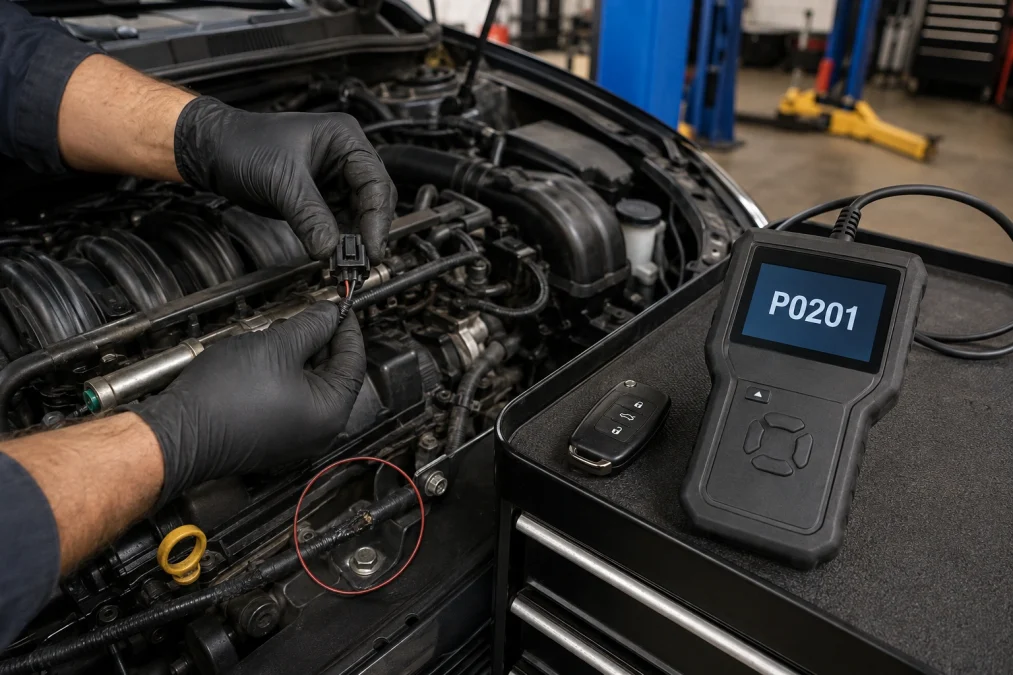
P0201 Symptoms and Warning Signs
Symptoms depend on whether the circuit fault is constant or intermittent.
Common warning signs include:
- Check engine light
- Rough or uneven idle
- Cylinder 1 misfire
- Hesitation during acceleration
- Reduced engine power
- Hard starting
- Increased fuel consumption
- Fuel smell from the exhaust
- Engine shaking
- Stalling
- Failed emissions inspection
P0201 may appear with related codes such as P0301 for a cylinder 1 misfire. Manufacturer service information has documented vehicles with P0201, rough running, and corresponding misfire codes. (NHTSA)
What Does a Flashing Check Engine Light Mean?
A flashing check engine light usually indicates an active misfire severe enough to risk overheating the catalytic converter.
Reduce speed and stop driving as soon as it is safe. Continuing to drive with a dead cylinder can allow unburned fuel and oxygen into the exhaust system.
A steady check engine light is generally less urgent, but the vehicle still needs diagnosis.
P0201 Cause and Diagnostic Clue Table
| Possible cause | Common clue | Recommended first check |
|---|---|---|
| Loose injector connector | Code appears after recent engine work | Confirm the connector is fully seated and locked |
| Corroded terminals | Intermittent fault, moisture, or visible discoloration | Inspect both sides of the connector |
| Chafed wiring | Code changes with engine movement or bumps | Follow the harness and inspect rubbing points |
| Broken wire inside insulation | Wiring looks normal but loses continuity | Perform a wiggle and voltage-drop test |
| Failed injector coil | Constant misfire and abnormal resistance | Compare injector readings with manufacturer specifications |
| Blown fuse or failed relay | Multiple injector codes or no-start | Test the injector power supply |
| PCM connector problem | Injector end tests normally | Inspect PCM terminals and circuit continuity |
| Failed PCM driver | Wiring and injector pass all tests | Perform bidirectional or oscilloscope testing |
| Low battery voltage | Several electrical codes appear together | Test the battery and charging system |
How a Technician Diagnoses P0201
A good diagnosis follows the circuit from the scanner data to the injector, wiring, and PCM. It does not begin by replacing the most expensive part.
1. Read All Codes and Freeze-Frame Data
Use an OBD2 scanner to record:
- All current codes
- Pending codes
- History codes
- Freeze-frame information
- Battery voltage
- Misfire data, when supported
Do not erase the codes before saving this information. Freeze-frame data shows the conditions present when the fault was detected.
Codes for multiple injectors may point toward a shared fuse, relay, ground, harness, or PCM power problem.
2. Confirm the Location of Cylinder 1
Cylinder numbering is not universal.
Cylinder 1 may be:
- On the front or rear bank
- On the passenger or driver side
- At either end of an inline engine
Use the vehicle’s service manual or OEM repair information. Guessing can lead to testing or replacing the wrong injector.
3. Inspect the Connector and Harness
Turn off the engine and ignition before disconnecting components.
Look for:
- Broken connector locks
- Bent or recessed terminals
- Moisture or corrosion
- Oil contamination
- Melted plastic
- Cracked insulation
- Wires rubbing against metal
- Repairs made with household connectors or tape
Manufacturer technical guidance shows that P0201 can be caused by connector damage, corrosion, loose terminals, high resistance, open wiring, or harness routing problems. (NHTSA)
4. Check Injector Power
Depending on the design, one injector terminal may receive power while the PCM controls the other side.
A technician may use:
- A digital multimeter
- A wiring diagram
- A test lamp approved for that circuit
- A fused jumper
- A noid light
- A lab scope
Do not use a heavy test light or apply battery voltage directly to an injector unless the manufacturer’s procedure specifically permits it. Some modern injector circuits use sensitive drivers and model-specific control strategies.
5. Test the Injector Pulse
A noid light can show whether a conventional port-injection circuit is receiving a switching command.
However, a noid light has limitations. It may confirm that a pulse exists without proving that the circuit can carry the correct current. It may also be unsuitable for some direct-injection systems.
Professional technicians often use an oscilloscope or current probe when a basic test produces unclear results.
6. Measure Injector Resistance When Appropriate
With the ignition off and the connector disconnected, a technician may measure injector resistance.
The reading must be compared with:
- Manufacturer specifications
- Other injectors of the same type
- Temperature-related specifications
A reading that is open, shorted, or significantly different from the others may indicate a failed coil.
Never assume one universal resistance specification fits every injector.
7. Perform a Wiggle Test
Intermittent faults can disappear while the vehicle is parked.
With suitable test equipment connected, a technician may gently move:
- The injector connector
- The branch harness
- The harness near brackets
- The PCM connector
- Previously repaired wiring
A sudden change in voltage, resistance, injector operation, or engine idle can reveal a hidden broken wire or loose terminal.
8. Swap Injectors Only When the Procedure Is Safe
On some port-injected engines, moving the cylinder 1 injector to another cylinder can help isolate the fault.
- If the code follows the injector, the injector is likely defective.
- If the code remains on cylinder 1, wiring or PCM control is more likely.
Manufacturer technical guidance has used this method after harness and connector checks. (NHTSA)
Injector swapping may require new O-rings, seals, intake removal, fuel-pressure relief, or injector coding. It is not a casual test on every vehicle.
9. Check Manufacturer Bulletins and Recalls
Some models have known injector harness or connector concerns.
Use the vehicle identification number with the NHTSA recall and manufacturer communications search to check for open recalls and relevant service information. A recall search can show whether a specific vehicle has an unrepaired safety recall, although ordinary technical service bulletins are not always free repairs. (NHTSA)
Expert Tip: Before buying an injector, photograph the connector and trace its wiring several inches in both directions. A loose terminal or rubbed wire can imitate a failed injector and may cost far less to repair.
Can You Drive With a P0201 Code?
Driving may be possible when the engine runs smoothly and the check engine light remains steady. However, delaying diagnosis is not recommended.
Stop driving and arrange service when:
- The check engine light flashes
- The engine shakes heavily
- The vehicle stalls
- Strong fuel odors are present
- Power drops suddenly
- Wiring is melted or smoking
- A fuse repeatedly blows
- The engine will not start
A severe misfire can damage the catalytic converter. A shorted circuit can also affect the PCM or shared injector power supply.
Typical P0201 Repair Costs
The total cost depends on the vehicle, engine design, accessibility, diagnostic time, and failed component. The following are broad U.S. planning ranges, not guaranteed quotes.
| Repair or service | Approximate cost range |
|---|---|
| Diagnostic testing | $100–$220 |
| Injector connector or terminal repair | $100–$350 |
| Minor wiring repair | $150–$450 |
| Larger harness repair or replacement | $400–$1,500+ |
| Port fuel injector replacement | $250–$700 |
| Direct fuel injector replacement | $450–$1,200+ |
| Fuse or relay replacement | $50–$250 |
| PCM testing or programming | $150–$400 |
| PCM replacement and programming | $900–$2,500+ |
A low-cost connector repair may solve the same code that another shop misdiagnoses as an injector or PCM failure.
Ask for a written estimate that separates:
- Diagnostic labor
- Replacement parts
- Programming
- Seals and hardware
- Additional recommended work
- Warranty coverage
The FTC’s auto repair guidance recommends asking how a shop charges for diagnosis, requesting a written estimate, comparing repair warranties, and considering a second opinion for complicated or expensive repairs. (Consumer Advice)
Part Quality and Durability Considerations
The cheapest injector is not always the best value.
OEM Injectors
Original equipment injectors usually provide the closest match for:
- Electrical resistance
- Fuel flow
- Spray pattern
- Connector fit
- Calibration requirements
They may cost more, but fit and performance are generally predictable.
Quality Aftermarket Injectors
A reputable aftermarket injector can be a reasonable option when it meets the vehicle’s specifications and includes a clear warranty.
Confirm the exact:
- Year
- Make
- Model
- Engine size
- Fuel system
- Part number
- Production date or VIN break
Used Injectors
A used injector may save money, but its mileage, contamination history, and electrical condition are usually unknown.
Used injectors are a higher-risk choice when labor is expensive or intake components must be removed twice.
Wiring Repair Quality
A durable wiring repair should use:
- Automotive-grade wire
- Correct wire gauge
- Sealed connections where required
- Proper terminal tools
- Heat-resistant protection
- Secure harness routing
Twisted wires covered only with electrical tape may fail again because of heat, oil, moisture, and vibration.
When to Call a Professional Locksmith or Dealership
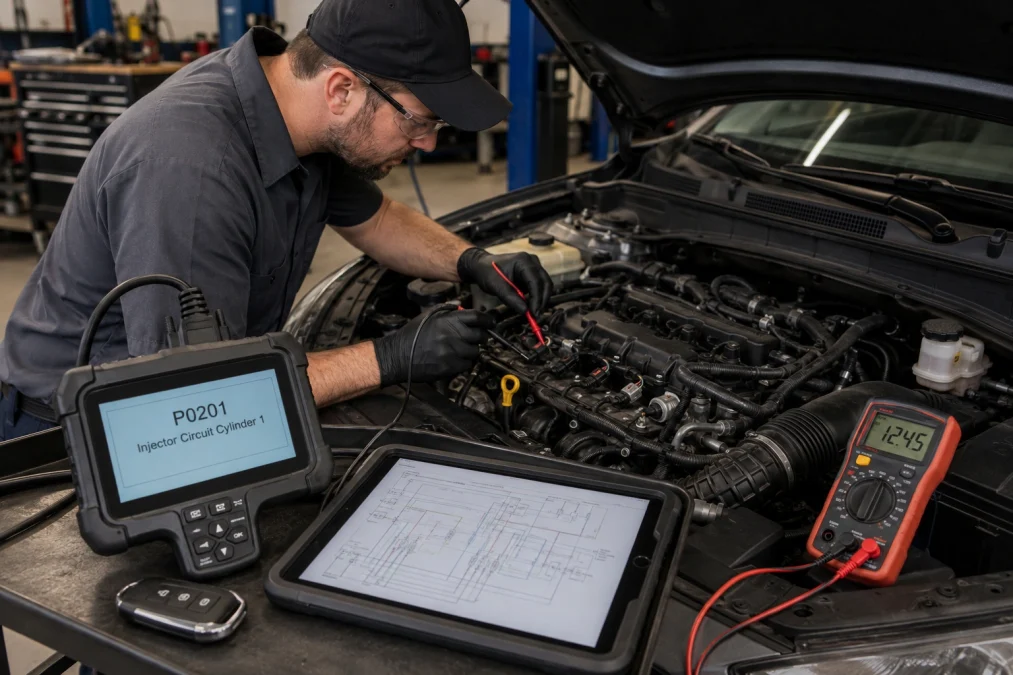
P0201 usually requires an automotive repair technician rather than a locksmith. The best service provider depends on the actual symptoms.
Call an Independent Repair Shop When:
- The engine runs rough or misfires
- P0201 is the main stored code
- Wiring damage is visible
- The injector needs electrical testing
- You want a lower-cost alternative to dealership labor
- The vehicle is outside its factory warranty
Choose a shop experienced with electrical diagnosis and your vehicle’s engine system.
Call a Dealership When:
- The vehicle is under warranty
- A manufacturer bulletin may apply
- The injector requires calibration or coding
- PCM programming is needed
- The vehicle uses a complex direct-injection system
- An intermittent problem has resisted normal diagnosis
- A recall or service campaign may cover the repair
Call an Automotive Locksmith When:
A locksmith is appropriate when the vehicle also has a genuine access or security problem, such as:
- Lost or damaged transponder key
- Unrecognized smart key
- Immobilizer warning
- Key programming failure
- Ignition lock damage
- Vehicle lockout
A locksmith generally does not repair fuel injectors or engine wiring. However, a qualified automotive locksmith can determine whether a no-start condition is related to the key system instead of the P0201 fault.
Common Mistakes Car Owners Should Avoid
- Replacing the injector immediately: Wiring and connector problems can produce the same code.
- Assuming P0201 means a clogged injector: The code primarily identifies an electrical circuit problem.
- Testing the wrong cylinder: Confirm the manufacturer’s cylinder numbering.
- Clearing codes before recording them: Save freeze-frame and related codes first.
- Ignoring a flashing check engine light: A severe misfire can damage the catalytic converter.
- Replacing the PCM too early: PCM failure is possible but less common than wiring, connector, or injector faults.
- Installing an injector without new seals: Damaged or reused seals may cause fuel or vacuum leaks.
- Probing terminals with oversized tools: This can spread the terminal and create a new intermittent connection.
- Using an injector test method meant for another engine: Port injection and direct injection may require different procedures.
- Blaming the key fob: A weak key fob battery does not normally create a single-cylinder injector circuit code.
- Accepting an expensive repair without test results: Ask what voltage, resistance, continuity, or waveform tests confirmed the failed part.
FAQs
What is the most common cause of P0201?
Damaged wiring, a loose injector connector, corrosion, and failed injector coils are common causes. Wiring and terminal problems should be inspected before the injector or PCM is replaced.
Does P0201 always mean the cylinder 1 injector is bad?
No. The injector may be defective, but P0201 can also come from an open wire, short circuit, connector problem, blown fuse, power-supply fault, or PCM driver failure.
Can a clogged injector cause P0201?
A clogged injector usually causes a fuel-delivery or misfire problem rather than an electrical circuit code. An injector can be both clogged and electrically faulty, but the circuit must be tested.
Can a bad spark plug cause P0201?
A bad spark plug can cause a cylinder 1 misfire, but it does not normally create an injector circuit code. P0201 points toward the injector’s electrical control circuit.
Can a weak battery cause P0201?
Low voltage may contribute to electrical codes, especially when several systems are affected. Test the battery and charging system, but a recurring cylinder-specific code usually needs closer injector-circuit diagnosis.
Will disconnecting the battery clear P0201?
Disconnecting the battery may temporarily erase the code on some vehicles, but it will not repair the fault. The code will return when the PCM detects the problem again.
Is P0201 expensive to fix?
It can be inexpensive when the cause is a loose connector or minor wire repair. Costs rise when injector replacement, harness replacement, intake removal, PCM programming, or direct-injection service is required.
Conclusion
The most likely P0201 causes are damaged wiring, a loose or corroded injector connector, an internally failed injector, or a problem with the circuit’s power and control path. PCM failure is possible, but it should be considered only after the rest of the circuit has passed proper testing.
Do not replace the injector based only on the scanner description. Record all codes, confirm cylinder 1, inspect the harness carefully, and ask for electrical test results before approving an expensive repair.
When the engine is shaking, the check engine light is flashing, or fuel odors are present, stop driving and arrange professional diagnosis. Choose an experienced automotive repair shop or dealership for injector-circuit work, and use an automotive locksmith only when a separate key, immobilizer, or vehicle-access problem is involved.
