
P0203 Symptoms: What Car Owners Should Watch For Before Paying for Repairs

When your check engine light comes on and an OBD2 scanner shows code P0203, it can feel confusing. You may notice rough driving, shaking, poor fuel economy, or trouble starting the car. These are common P0203 symptoms, and they usually point to a problem in the cylinder 3 fuel injector circuit.
That may sound technical, but the idea is simple. Your engine has fuel injectors that spray fuel into each cylinder. Code P0203 means the computer sees an electrical problem with the injector for cylinder 3. This guide explains the symptoms, what they may mean, what to check first, how key fob or security issues can sometimes confuse the situation, and when to call a repair shop, locksmith, or dealership.
Quick Answer
P0203 symptoms often include a check engine light, rough idle, engine shaking, misfires, poor acceleration, reduced fuel economy, fuel smell, hard starting, or stalling. The code usually means the cylinder 3 fuel injector circuit has an electrical fault, bad injector, wiring problem, connector issue, or possible engine computer problem.
What Does Code P0203 Mean?
Code P0203 stands for Cylinder 3 Injector Circuit Malfunction.
Your vehicle’s engine control module, often called the ECM or PCM, controls each fuel injector. When the computer sends a signal to the cylinder 3 injector, it expects the circuit to respond correctly. If the signal is too high, too low, open, shorted, or missing, the computer may set P0203.
In plain English, the car is saying:
“I cannot properly control or read the fuel injector circuit for cylinder 3.”
This does not always mean the injector itself is bad. It may be caused by:
- A failed cylinder 3 fuel injector
- Damaged injector wiring
- A loose or corroded connector
- A short circuit
- An open circuit
- A weak battery or voltage issue
- A failing engine control module, though this is less common
Because P0203 is an electrical injector circuit code, guessing can get expensive. A scan tool gives the starting point, but testing confirms the real cause.
Common P0203 Symptoms
P0203 symptoms can range from mild to serious. Some drivers only notice a check engine light. Others feel the car shake badly or struggle to accelerate.
Check Engine Light
The most common symptom is the check engine light.
The light may stay solid if the problem is moderate. It may flash if the engine is misfiring badly. A flashing check engine light is more serious because unburned fuel can damage the catalytic converter.
Do not ignore a flashing check engine light. Slow down, avoid hard acceleration, and get the vehicle checked as soon as possible.
Rough Idle
A rough idle is another common sign. The engine may feel uneven when you are stopped at a light or parked with the engine running.
You may feel:
- Shaking through the steering wheel
- Uneven engine rhythm
- Vibration in the seat or floor
- RPMs moving up and down
This happens because cylinder 3 may not be getting the right fuel spray. When one cylinder does not fire correctly, the engine loses balance.
Engine Misfire
P0203 often appears with misfire symptoms. A misfire means the fuel and air mixture in a cylinder did not burn correctly.
A misfire may feel like:
- Jerking while driving
- Engine stumble
- Hesitation when pressing the gas
- A popping or uneven sound from the engine
Sometimes P0203 appears with a related code like P0303, which means cylinder 3 misfire. When both codes appear together, the injector circuit becomes a strong suspect.
Poor Acceleration
If cylinder 3 is not receiving fuel correctly, the engine may lose power. The car may feel slow when merging onto a highway or climbing a hill.
You may press the gas pedal and notice the vehicle does not respond normally. This can be unsafe in traffic, especially when you need quick acceleration.
Poor Fuel Economy
A faulty injector circuit can reduce fuel economy. If the injector does not open correctly, the engine may run poorly. If it sticks or leaks, it may use too much fuel.
You may notice:
- Fewer miles per gallon
- More frequent gas station visits
- Fuel smell near the vehicle
- Black smoke in severe rich-running cases
Fuel economy problems can have many causes, so P0203 should be diagnosed along with other data from the scan tool.
Hard Starting or No Start
Some drivers notice the car takes longer to start. In more serious cases, the engine may crank but not start.
This is where car owners sometimes confuse an injector problem with a key fob, immobilizer, or starter issue.
A simple rule helps:
- If the engine does not crank at all, think battery, starter, key fob, ignition switch, or security system.
- If the engine cranks but runs rough or does not stay running, think fuel, spark, air, compression, or injector control.
- If the security light stays on, the key fob, transponder, or immobilizer may need attention.
Modern vehicles use electronic keys, immobilizers, and anti-theft systems. For theft prevention and key security basics, the NICB vehicle theft prevention tips are useful for car owners who want to reduce vehicle access risks.
Stalling
A vehicle with P0203 may stall at idle or while slowing down. This is more likely if the injector circuit problem is constant instead of intermittent.
Stalling can be dangerous. If the engine stalls in traffic, move to a safe location and avoid repeated driving until the issue is checked.
Fuel Smell
A fuel smell is a warning sign. It may mean the injector is leaking, the engine is running too rich, or unburned fuel is entering the exhaust.
If you smell strong fuel, do not keep driving. Fuel leaks and heavy fuel odor can create a fire risk.
P0203 Symptoms Checklist
| Symptom | What It May Mean | How Serious Is It? |
|---|---|---|
| Check engine light | Computer detected injector circuit fault | Moderate |
| Flashing check engine light | Active misfire may damage catalytic converter | High |
| Rough idle | Cylinder 3 may not be firing smoothly | Moderate |
| Engine shaking | Misfire or uneven combustion | Moderate to high |
| Poor acceleration | Engine power reduced by injector fault | Moderate |
| Hard starting | Fuel delivery or electrical control problem | Moderate |
| Fuel smell | Possible rich condition or fuel leak | High |
| Stalling | Engine cannot run smoothly | High |
| Poor fuel economy | Injector may not be operating correctly | Low to moderate |
Why P0203 Symptoms Can Be Confusing
P0203 can feel like several other problems. A car owner may think the vehicle needs a new key fob, battery, starter, or fuel pump. Sometimes that is true, but not always.
For example, a weak key fob battery may stop the doors from unlocking or may cause push-button start trouble. But it usually does not cause code P0203 by itself.
A P0203 code points more toward the engine’s fuel injector circuit. Still, because modern vehicles have many linked electronic systems, it is smart to look at the full symptom pattern.
Key Fob Problem vs. P0203 Problem
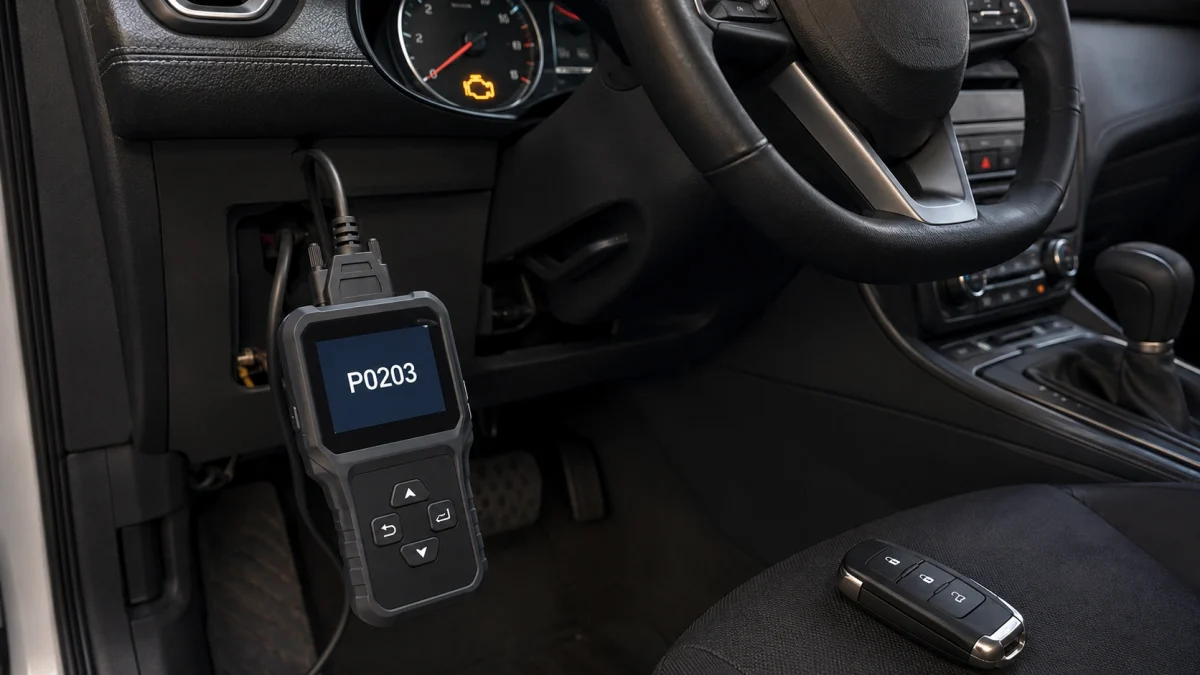
A key fob or immobilizer issue often causes:
- Doors not locking or unlocking
- Push-button start not recognizing the key
- Security light flashing
- “Key not detected” message
- Engine not cranking
- Remote start not working
P0203 usually causes:
- Check engine light
- Rough running after start
- Engine misfire
- Poor acceleration
- Fuel smell
- Stalling
- Cylinder 3 injector circuit code on a scanner
If your car starts but runs badly, P0203 is more likely related to the injector circuit than the key fob. If your car will not unlock, will not detect the key, or shows an immobilizer warning, a locksmith or dealership may need to inspect the key system.
What Causes P0203 Symptoms?
P0203 symptoms happen when the cylinder 3 injector circuit does not work as expected. The injector may not receive the proper command. It may not respond. Or the computer may detect an electrical reading outside the normal range.
Bad Cylinder 3 Fuel Injector
The injector may fail internally. It may become stuck, clogged, shorted, or open.
A bad injector can cause rough idle, misfires, fuel smell, and poor power. But before replacing it, a technician should test the injector and compare it with other cylinders.
Damaged Wiring
Injector wiring lives in a hot, vibrating engine bay. Over time, wires can become brittle, rubbed, pinched, or damaged by oil, heat, rodents, or past repair work.
A wiring problem may cause symptoms that come and go. The engine may run fine one day and rough the next.
Loose or Corroded Connector
The injector connector for cylinder 3 must fit tightly. Corrosion, broken locking tabs, moisture, or loose pins can interrupt the signal.
This is one of the first things a technician should inspect because it may be cheaper than replacing the injector.
Electrical Short or Open Circuit
An open circuit means the electrical path is broken. A short circuit means electricity is going where it should not.
Both can trigger P0203. Testing with a multimeter or noid light can help confirm whether the injector is receiving the correct signal.
Engine Computer Issue
A failed PCM or ECM driver can cause P0203, but this is usually less common than wiring, connector, or injector failure.
Do not replace the engine computer without proper testing. Computer replacement can be expensive and may require programming, security matching, or dealership-level tools.
How Serious Are P0203 Symptoms?
P0203 should be taken seriously. The car may still run, but driving too long can create bigger problems.
Possible risks include:
- Catalytic converter damage from misfires
- Poor fuel economy
- Engine hesitation in traffic
- Stalling
- Fuel odor or fire risk in severe cases
- More expensive repairs later
If the check engine light is flashing, the vehicle shakes badly, or you smell fuel, stop driving and have it inspected.
If the light is solid and the car runs mostly normal, you may be able to drive carefully to a repair shop. Avoid long trips and hard acceleration.
What to Check First When You Notice P0203 Symptoms
You do not need to be a mechanic to do a few safe first checks. These steps can help you avoid spending money in the wrong place.
1. Read All Codes With an OBD2 Scanner
Do not look only at P0203. Check for other codes too.
Common related codes may include:
- P0303 for cylinder 3 misfire
- Fuel trim codes
- Battery voltage codes
- Other injector circuit codes
- Immobilizer or security system codes
A basic OBD2 scanner can read engine codes, but some key, immobilizer, and security codes may need a more advanced scan tool.
2. Notice When the Symptoms Happen
Write down when the problem appears.
For example:
- Only during cold starts
- Only after the engine warms up
- Only when accelerating
- Only after rain or a car wash
- Only after recent repair work
- Only after battery replacement or jump-starting
These details help a technician find intermittent wiring or connector problems faster.
3. Check for Obvious Wiring Damage
With the engine off and cool, look near the fuel injector area. Do not pull hard on wires.
Watch for:
- Chewed wires
- Melted insulation
- Loose connectors
- Oil-soaked plugs
- Broken plastic clips
- Green or white corrosion
Do not unplug random engine connectors while the ignition is on. That can create new codes or damage sensitive electronics.
4. Check Battery and Charging Health
Low voltage can create strange electrical symptoms. A weak battery may also make key fob, push-button start, and scan tool readings confusing.
If the car recently needed a jump-start, the battery should be tested. A weak battery can cause starting problems even when the key fob is fine.
5. Do Not Clear the Code Too Early
Clearing the code before diagnosis can erase useful data. A technician may need freeze-frame data, which shows engine conditions when the code was stored.
You can write down the code, mileage, symptoms, and warning lights before clearing anything.
Can a Bad Key Fob Cause P0203 Symptoms?
Usually, no. A bad key fob does not normally cause a cylinder 3 injector circuit code.
A key fob helps with locking, unlocking, remote start, and immobilizer authorization. P0203 is about the engine computer controlling the fuel injector circuit.
However, the two can overlap in confusing ways.
For example:
- A weak key fob battery may cause “key not detected.”
- A bad transponder may prevent starting.
- A remote start issue may make you think the engine has a fuel problem.
- A weak vehicle battery may cause both key recognition problems and engine electrical problems.
If your car has both P0203 and key-related symptoms, diagnose them separately. Replacing the key fob will not fix a bad injector circuit. Replacing an injector will not fix an immobilizer problem.
DIY Diagnosis vs. Professional Diagnosis
Some checks are safe for car owners. Others are better left to a trained technician.
| Task | DIY Friendly? | Best Option |
|---|---|---|
| Read OBD2 code | Yes | Basic scan tool |
| Check key fob battery | Yes | Owner’s manual or parts store |
| Inspect visible wiring | Sometimes | Only with engine off and cool |
| Test injector resistance | Maybe | DIY if experienced |
| Back-probe injector connector | No for most owners | Repair shop |
| Test PCM injector driver | No | Advanced technician |
| Program replacement key fob | Depends on vehicle | Locksmith or dealership |
| Replace engine computer | No | Dealership or qualified shop |
The FTC auto repair basics recommend being prepared before authorizing repairs, including understanding estimates and asking questions. That is especially important when a code like P0203 could come from several different parts.
Expected Repair Costs for P0203 Symptoms
Repair cost depends on the cause, vehicle model, labor rate, and part quality.
Here are broad U.S. cost ranges:
| Possible Repair | Estimated Cost Range |
|---|---|
| Diagnostic scan and testing | $80–$180 |
| Injector connector repair | $75–$250 |
| Wiring repair | $100–$500+ |
| Fuel injector replacement | $150–$600+ |
| Multiple injector service | $400–$1,200+ |
| Engine computer diagnosis | $150–$300 |
| PCM/ECM replacement and programming | $700–$2,000+ |
These are general estimates. Luxury vehicles, turbo engines, and hard-to-access injectors can cost more.
The cheapest repair is not always the best repair. A low-cost injector may fail early or create poor spray performance. A proper diagnosis may save money by preventing unnecessary part replacement.
Battery, Key Fob, and Starting Issues That Can Look Similar
Because ReplaceKeyFob.com focuses on vehicle access and key systems, it is worth clearing up a common confusion.
A car that will not start may have an engine problem, a key problem, or a power problem.
Signs It May Be a Key Fob or Immobilizer Issue
Look for these signs:
- “Key not detected” message
- Security light flashing
- Doors do not respond to the remote
- Push-button start works only when the fob touches the start button
- Remote start fails but the engine runs normally with the key inside
- The spare key works but the main key does not
Many owner’s manuals explain emergency start steps and key battery replacement. For example, Toyota notes in its owner resources that a depleted electronic key battery can affect smart key and wireless remote operation in some vehicles.
Signs It Is More Likely P0203
Look for these signs:
- Engine starts but shakes
- Car runs rough
- Check engine light stays on
- Scanner shows P0203
- Scanner also shows P0303
- Fuel smell or misfire symptoms appear
In this case, replacing a key fob battery may not solve the problem.
When to Call a Professional Locksmith or Dealership
Call a professional locksmith or dealership when the problem involves vehicle access, immobilizer security, lost keys, damaged fobs, or programming.
A qualified automotive locksmith may help with:
- Lost car key replacement
- Key fob programming
- Transponder key programming
- Key duplication
- Broken key extraction
- Ignition lock problems
- Emergency lockouts
- Some smart key issues
A dealership may be better when:
- Your vehicle requires OEM-only programming
- The car needs security module replacement
- Warranty coverage may apply
- A recall or software update is involved
- The key system must be matched to factory records
The ALOA guidance on hiring a professional locksmith is a helpful reminder to choose trained locksmiths carefully, especially for security-related work.
For P0203 itself, a general repair shop or dealership technician usually handles fuel injector circuit diagnosis. But if the vehicle also has key recognition, immobilizer, or remote start problems, an automotive locksmith may be part of the solution.
When to Check for Recalls or Service Information
Sometimes electrical or driveability problems may be related to known vehicle issues. It is smart to check whether your vehicle has open recalls before paying for repairs.
You can use the NHTSA recall lookup with your VIN to see open safety recalls. A recall does not automatically mean your P0203 problem is covered, but it is a good step before authorizing expensive work.
Also ask the repair shop if there are technical service bulletins, software updates, or known injector wiring issues for your specific year, make, model, and engine.
Expert Tip
Expert Tip: Before replacing the cylinder 3 injector, ask the technician whether they tested the connector, wiring, injector resistance, and injector command signal. Many P0203 repairs fail because the injector is replaced before the circuit is tested.
Common Mistakes Car Owners Should Avoid
- Replacing the key fob to fix P0203. A key fob usually does not cause an injector circuit code.
- Clearing the code before saving information. Freeze-frame data can help find the real cause.
- Driving with a flashing check engine light. This can damage the catalytic converter.
- Buying the cheapest injector online. Poor-quality injectors may cause more problems.
- Ignoring wiring damage. A broken wire can look like a bad injector.
- Replacing the engine computer too soon. PCM failure is possible but less common.
- Assuming one code tells the whole story. Always check for related codes.
- Using an unqualified locksmith for security programming. Bad programming can cause lockouts or key recognition problems.
- Overlooking battery voltage. Weak vehicle batteries can create confusing electrical symptoms.
How a Technician May Diagnose P0203
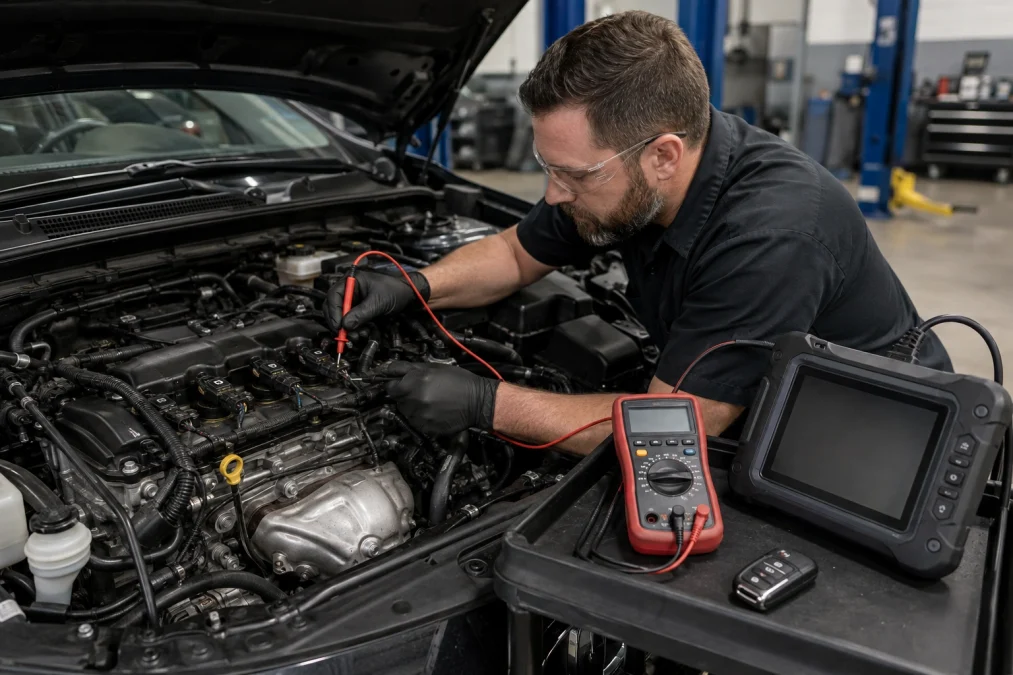
A proper diagnosis usually follows a process. This helps avoid guesswork.
Step 1: Confirm the Code
The technician scans the vehicle and confirms P0203. They also look for related misfire, voltage, or fuel system codes.
Step 2: Check Freeze-Frame Data
Freeze-frame data shows what was happening when the code appeared. It may show RPM, engine temperature, speed, and load.
Step 3: Inspect Cylinder 3 Injector and Connector
The technician checks for loose plugs, corrosion, broken tabs, damaged wires, and oil contamination.
Step 4: Test Injector Resistance
A multimeter can help compare the cylinder 3 injector with other injectors. A reading far outside the normal range may point to a failed injector.
Step 5: Check Power and Control Signal
The injector needs proper power and computer control. A noid light, scope, or scan tool may be used to test the injector pulse.
Step 6: Check Wiring Continuity
If the injector is good, the technician may test the wiring from the injector to the PCM.
Step 7: Consider PCM Testing
Only after other causes are ruled out should PCM driver problems be considered.
Can You Keep Driving With P0203 Symptoms?
It depends on how the car behaves.
You may drive a short distance to a repair shop if:
- The check engine light is solid
- The engine runs mostly smooth
- There is no fuel smell
- The car does not stall
- Acceleration feels safe
Do not keep driving if:
- The check engine light is flashing
- The engine shakes badly
- You smell fuel
- The car stalls
- The vehicle has very poor power
- The engine sounds abnormal
When in doubt, tow the vehicle. A tow bill can be cheaper than catalytic converter or engine damage.
How P0203 Relates to Vehicle Security and Locksmith Decisions
P0203 is an engine performance code, not a locksmith code. Still, car owners often face both problems at the same time because modern vehicles are heavily electronic.
For example, you may have:
- A weak vehicle battery
- A key fob battery warning
- A check engine light
- A remote start failure
- A rough-running engine
Remote start may stop working when the check engine light is on. That does not always mean the remote or key fob is bad. Many vehicles disable remote start when engine faults are stored.
Before buying a new fob, ask:
- Does the car start normally with the key inside?
- Does the spare key work better?
- Is the check engine light on?
- Does the scanner show engine codes like P0203?
- Is there a security or immobilizer warning?
If the issue is access-related, call a locksmith or dealership. If the issue is engine-related, call a repair shop. If both are present, explain both problems before approving repairs.
Repair, Replacement, or Reprogramming: What Do You Actually Need?
P0203 may require repair, replacement, or diagnosis. Key fob issues may require battery replacement, reprogramming, or a new fob. These are different services.
You May Need Injector Circuit Repair If:
- P0203 returns after clearing
- Cylinder 3 misfires
- Wiring is damaged
- The connector is loose or corroded
- The injector fails electrical testing
You May Need Key Fob Service If:
- The car says “key not detected”
- The remote buttons do not work
- The spare fob works but the main fob does not
- The fob case is broken
- The transponder is damaged
- The vehicle will not authorize start
You May Need Dealership Programming If:
- The vehicle requires factory security access
- All keys are lost
- A module was replaced
- The immobilizer system is locked
- Software updates are needed
The best decision comes from matching the symptom to the system. P0203 points to the injector circuit. Key fob symptoms point to the access and security system.
FAQs
What are the most common P0203 symptoms?
The most common P0203 symptoms are a check engine light, rough idle, engine shaking, misfire, poor acceleration, hard starting, poor fuel economy, and possible stalling. Some vehicles may also show a flashing check engine light if the misfire is severe.
Is P0203 caused by a bad fuel injector?
It can be, but not always. P0203 may be caused by a bad cylinder 3 injector, damaged wiring, a loose connector, corrosion, a short circuit, an open circuit, or a PCM control issue. Testing is needed before replacing parts.
Can a bad key fob cause code P0203?
Usually, no. A bad key fob can cause locking, unlocking, remote start, or immobilizer problems. P0203 is normally related to the cylinder 3 fuel injector circuit. However, weak batteries and electronic issues can make the symptoms confusing.
Is it safe to drive with P0203?
It may be safe to drive a short distance if the engine runs smoothly and the check engine light is solid. It is not safe to keep driving if the light flashes, the engine shakes badly, the car stalls, or you smell fuel.
How much does it cost to fix P0203?
Many P0203 repairs cost between $100 and $600, depending on whether the issue is a connector, wiring, or injector. More complex electrical diagnosis or computer replacement can cost much more. Always ask for testing before approving expensive repairs.
Will clearing the code fix P0203?
Clearing the code may turn off the check engine light temporarily, but it does not fix the cause. If the injector circuit problem is still present, P0203 will return. Save the code and symptoms before clearing anything.
Should I go to a locksmith, repair shop, or dealership?
For P0203 symptoms, start with a repair shop or dealership because the problem is engine-related. For key fob programming, lost keys, lockouts, or immobilizer problems, call a qualified automotive locksmith or dealership. If both problems appear, explain all symptoms clearly.
Conclusion
P0203 symptoms usually point to a problem with the cylinder 3 fuel injector circuit. The most common signs include a check engine light, rough idle, misfire, poor acceleration, fuel smell, hard starting, and stalling. While key fob or immobilizer problems can cause starting confusion, they usually do not cause P0203 by themselves.
The smart next step is to scan all codes, note the symptoms, avoid guessing, and have the injector circuit tested before replacing parts. If the problem is engine-related, use a trusted repair shop or dealership. If the problem involves lost keys, key fob programming, lockouts, or security warnings, contact a qualified automotive locksmith.
For the best result, match the repair to the real symptom. That is how you avoid wasted money and make a safer, smarter key fob or vehicle repair decision.
