
P0304 Causes: Why Cylinder 4 Is Misfiring and What to Check

Quick Answer
P0304 means your vehicle’s computer detected a misfire in cylinder 4. Common P0304 causes include a worn spark plug, weak ignition coil, faulty fuel injector, wiring problem, air leak, or low compression. The code identifies the affected cylinder, but it does not tell you which part failed. If your check-engine light is flashing, follow AAA’s check-engine light guidance and avoid unnecessary driving.
Most Common P0304 Causes
- Worn spark plug: A fouled, damaged, or worn plug may not ignite the mixture consistently.
- Weak ignition coil: A failing coil can produce weak or intermittent spark on cylinder 4.
- Injector problem: A restricted, leaking, or electrically faulty injector can upset combustion.
- Air leak: An intake or vacuum leak can create a mixture too lean to burn correctly.
- Low compression: Valve, piston, ring, head-gasket, or valvetrain problems can weaken cylinder 4.
- Damaged wiring: Loose, corroded, or broken coil and injector wiring can create an intermittent misfire.
What to Do First
- Save all stored and pending codes plus freeze-frame data with your OBD2 scanner before clearing anything.
When an OBD2 scanner shows P0304, it’s tempting to buy a spark plug or ignition coil immediately. That approach sometimes works, but it can also turn diagnosis into expensive guessing.
In vehicle-electronics work, I see the same mistake often: drivers treat the trouble code as a failed-parts list. P0304 is better treated as a starting point that tells you where to investigate.
In This Guide
What Does P0304 Mean?
P0304 means the engine control module detected a misfire associated with cylinder 4. It tells you which cylinder produced an abnormal combustion pattern, not which component caused it.
Definition: An engine misfire occurs when a cylinder doesn’t produce its expected combustion power during one or more firing events.
The vehicle’s computer monitors crankshaft movement and other engine information. Uneven crankshaft acceleration can indicate that one cylinder isn’t contributing normally.
P0304 belongs to the cylinder-specific misfire family:
- P0300: Random or multiple-cylinder misfire detected
- P0301: Cylinder 1 misfire detected
- P0302: Cylinder 2 misfire detected
- P0303: Cylinder 3 misfire detected
- P0304: Cylinder 4 misfire detected
That distinction matters. P0300 may require an engine-wide search, while P0304 gives you a logical place to begin testing.
Does P0304 Always Mean Cylinder 4 Is Bad?
No. Cylinder 4 is where the computer detected the combustion problem, but another system can create that problem.
For example, a damaged intake gasket near cylinder 4 may create an air leak. Fuel pressure or engine-timing problems can also affect combustion without the cylinder itself being physically damaged.
Always confirm which cylinder is number 4 for your specific engine. Cylinder numbering differs between manufacturers and engine layouts.
You can also check your vehicle for manufacturer campaigns or recalls through the NHTSA recall lookup. A generic P0304 diagnosis should never replace model-specific service information.
What Are the Most Common P0304 Causes?
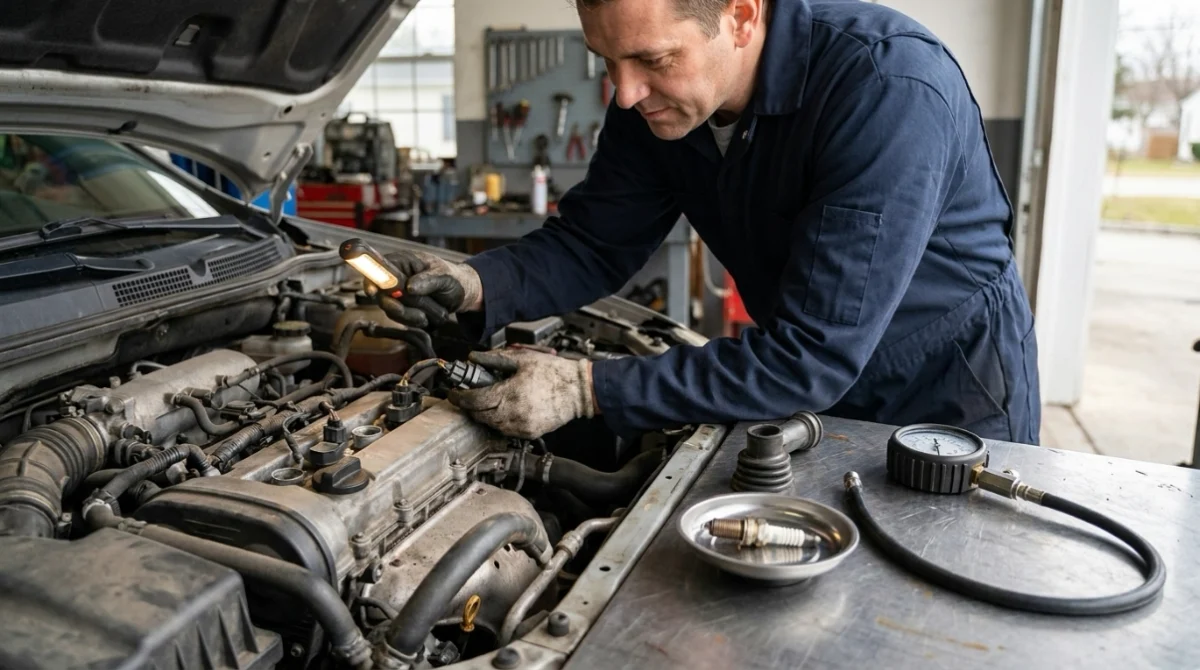
The most common P0304 causes fall into four groups: ignition, fuel, air, and mechanical problems. Electrical wiring faults can also interrupt ignition or fuel delivery.
1. Worn or Fouled Spark Plug
A spark plug must create a strong spark under cylinder pressure. Worn electrodes, deposits, oil contamination, or physical damage can cause intermittent firing.
A plug can look acceptable at first glance yet still fail under load. Compare cylinder 4’s plug with plugs from neighboring cylinders.
2. Weak or Failing Ignition Coil
Coil-on-plug engines use an individual ignition coil for each cylinder. A weak cylinder-4 coil can produce rough idle, hesitation, or misfiring during acceleration.
Heat and vibration can make coil failures intermittent. The engine may run normally when cold and begin misfiring after warming up.
3. Fuel Injector Fault
Cylinder 4 needs the correct amount of fuel at the correct time. A restricted, leaking, electrically open, or poorly controlled injector can disturb that mixture.
Don’t assume an injector is dirty just because P0304 appears. Connector damage and wiring faults can produce similar symptoms.
4. Ignition Wiring or Connector Damage
Loose terminals, corrosion, oil contamination, damaged insulation, and broken wires can interrupt a coil or injector circuit. Intermittent wiring problems often become worse with engine movement.
Inspect connectors before replacing expensive parts. A loose terminal can mimic a failed component.
5. Vacuum or Intake Leak
An air leak near the intake runner for cylinder 4 can create a lean mixture. That mixture may become difficult to ignite, especially at idle.
A smoke test is often more reliable than spraying chemicals around a running engine. Intake designs differ, so follow manufacturer procedures.
6. Low Compression
Combustion requires adequate cylinder sealing. Burned valves, worn piston rings, valve-train trouble, head-gasket leakage, or other mechanical damage can reduce compression.
If spark and fuel checks pass but P0304 remains, mechanical testing becomes more important. A compression or cylinder leak-down test can help separate electrical problems from internal engine faults.
| Possible Cause | Clue You May Notice | Useful Next Check |
|---|---|---|
| Spark plug | Misfire under load, worn or fouled plug | Inspect and compare plugs |
| Ignition coil | Intermittent misfire or hesitation | Follow manufacturer coil-testing procedure |
| Fuel injector | Uneven idle or cylinder-specific fueling issue | Check injector operation and circuit |
| Air leak | Lean running, often more noticeable at idle | Inspect intake and perform an appropriate leak test |
| Low compression | Persistent misfire after spark and fuel checks | Compression or leak-down testing |
| Wiring fault | Misfire changes with vibration or heat | Inspect connectors, terminals, and harness |
Section Takeaway: P0304 can come from several systems. Test cylinder 4 systematically instead of buying the first part named in a code description.
How Do You Diagnose P0304 Without Replacing the Wrong Parts?
Start with scan data, then move from simple visual checks toward more involved testing. Save evidence before clearing the code.
Step 1: Scan Every Stored and Pending Code
Connect your OBD2 scanner and record all codes. P0304 appearing beside P0300, fuel-trim, injector-circuit, sensor, or timing codes can change your diagnostic direction.
Also save freeze-frame data when your scanner supports it. Freeze-frame data records operating conditions around the time the computer stored the fault.
- Engine RPM
- Vehicle speed
- Engine load
- Coolant temperature
- Short-term fuel trim
- Long-term fuel trim
As of 2026, many affordable scanners can display more than a code description. Live data and manufacturer-supported misfire information can make troubleshooting more useful.
Step 2: Inspect Cylinder 4 Carefully
Check the visible ignition and fuel-delivery components around cylinder 4. Look for anything loose, contaminated, cracked, overheated, or corroded.
- Spark plug condition
- Ignition coil and boot
- Injector connector
- Coil connector
- Nearby wiring harness
- Oil or water inside the spark-plug well
- Damaged vacuum or intake connections
Don’t disconnect or probe circuits randomly. Some modern ignition systems use sensitive electronics and manufacturer-specific procedures.
Step 3: Determine Whether the Fault Follows a Component
On engines where components are interchangeable, technicians sometimes compare cylinder components to see whether the misfire follows one. This method must only be used when the parts are truly compatible and the manufacturer permits it.
For example, if a verified interchangeable coil is moved and the misfire moves with it, that gives stronger evidence than P0304 alone. Never assume coil or injector compatibility from appearance.
Technician’s note: Check your manufacturer’s service information before swapping ignition or fuel components. Connector design, calibration, and testing procedures can differ by engine.
Step 4: Check Fuel and Air
If ignition checks don’t reveal the problem, inspect fuel delivery and intake sealing. A cylinder-specific injector problem or intake leak can keep P0304 active.
Fuel-trim information may help identify a lean condition, but scanner numbers need context. Compare operating conditions rather than relying on one reading.
Step 5: Test Compression When Necessary
A persistent cylinder-specific misfire with good ignition and fuel operation raises concern about mechanical condition. Compression testing can show whether cylinder 4 is significantly different from the others.
A leak-down test goes deeper by showing where cylinder pressure may be escaping. Possible paths include intake valves, exhaust valves, piston rings, and the cooling system.
Manufacturer procedures should guide specifications and test conditions. If you own a Ford, for example, start with official Ford support information rather than a generic firing-order diagram.
Section Takeaway: The best P0304 diagnosis moves from scan evidence to ignition, fuel, air, wiring, and finally mechanical testing. The code itself never proves which part failed.
Can You Drive With a P0304 Code?
You shouldn’t ignore P0304. Whether you can drive a short distance depends on the warning-light behavior and how the engine is running.
If the Check-Engine Light Is Flashing
A flashing malfunction indicator light can indicate a severe active misfire. Continuing to drive may overheat and damage the catalytic converter.
Reduce load and get to a safe stopping point. If the engine shakes badly, loses power, smells unusual, or continues flashing, arrange professional help rather than continuing your trip.
If the Light Is Steady
A steady light is generally less urgent than a flashing one, but the problem still needs prompt diagnosis. Severe shaking, stalling, overheating, or loss of power can make continued driving unsafe regardless of light behavior.
Your owner’s manual has the final say for your vehicle. AAA’s OBD diagnostic guidance also explains why a trouble code is a diagnostic clue rather than a complete repair diagnosis.
Section Takeaway: A flashing check-engine light or strong drivability symptoms turn P0304 into an immediate stop-and-diagnose problem.
How Much Does It Cost to Fix P0304?

P0304 doesn’t have one repair price because it isn’t a failed-part code. The bill depends entirely on what testing proves caused cylinder 4 to misfire.
A spark-plug or simple ignition repair may stay in the low hundreds of dollars. Injector, wiring, intake, or more involved diagnostic work can move into several hundred dollars.
Internal engine repairs can exceed $1,000 and sometimes much more. Vehicle make, engine design, parts quality, labor rate, and region all affect the final amount.
| Repair Category | General Cost Level | Why It Varies |
|---|---|---|
| Spark plug or simple ignition fault | Usually lower | Plug access, coil design, and labor time |
| Injector or wiring repair | Moderate to higher | Diagnostic time and component accessibility |
| Vacuum or intake repair | Varies widely | Leak location and intake disassembly requirements |
| Internal engine repair | Potentially high | Valve, piston, head-gasket, or cylinder-head work |
Technician’s note: Get the cause confirmed before approving expensive parts. A diagnosis fee can cost far less than replacing coils, injectors, or mechanical parts that weren’t faulty.
P0304 FAQ
Can a Bad Spark Plug Cause P0304?
Yes. A worn, fouled, damaged, or incorrectly functioning cylinder-4 spark plug can cause P0304 because the air-fuel mixture may not ignite consistently. However, the code doesn’t prove the spark plug is bad, so inspect and test before replacing parts.
Can a Bad Ignition Coil Cause P0304?
Yes. On engines with individual coils, a weak or failed ignition coil serving cylinder 4 is a common possibility. Wiring, coil connectors, spark plugs, injectors, air leaks, and mechanical faults can create similar symptoms.
Can a Fuel Injector Cause a Cylinder 4 Misfire?
Yes. A restricted, leaking, electrically faulty, or poorly controlled cylinder-4 injector can produce a misfire. Check the injector circuit and fuel-delivery system rather than assuming the injector itself needs replacement.
Can Low Compression Cause P0304?
Yes. Burned valves, worn rings, valvetrain problems, head-gasket leakage, or other internal faults can reduce cylinder-4 compression. Compression and leak-down tests become important when ignition, fuel, wiring, and intake checks don’t explain the misfire.
Can P0304 Clear Itself?
An intermittent fault may stop occurring, and the warning light can eventually change after enough successful drive cycles. Stored or permanent diagnostic information may remain longer, so don’t assume the underlying problem is fixed simply because the light turns off.
Does P0304 Mean I Need a New Engine?
No. P0304 commonly comes from ignition, fuel, wiring, or air-delivery problems and does not automatically indicate major engine damage. Mechanical testing is warranted when simpler checks fail or other symptoms suggest low compression.
Should I Clear P0304 After Repairing the Problem?
Follow the vehicle manufacturer’s procedure. Before clearing anything, save the original codes and freeze-frame information, then verify the repair by checking whether the misfire returns during appropriate operating conditions.
Final Takeaway
P0304 means cylinder 4 is misfiring, but it doesn’t name the defective part. Spark plugs and ignition coils are common suspects, yet injectors, intake leaks, wiring faults, and low compression can create exactly the same code.
Start with your OBD2 scanner, save the evidence, inspect cylinder 4, and test before replacing anything. If the check-engine light flashes or the engine runs badly, stop unnecessary driving and arrange proper diagnosis.
The fastest repair isn’t the one that changes parts first. It’s the one that proves the cause first.
