
P0340 Causes: What Triggers This Camshaft Sensor Code?

Quick Answer
P0340 is triggered when the engine computer detects a problem with the camshaft position sensor circuit. The cause may be the sensor itself, damaged wiring, a loose connector, poor electrical power or ground, a timing problem, or a less-common computer fault. An OBD2 trouble code is a diagnostic clue, so test the circuit before replacing parts.
Most Common P0340 Causes
- Failed CMP sensor: The camshaft position sensor can stop producing a usable signal.
- Damaged wiring: Heat, rubbing, oil, or age can damage the sensor harness.
- Connector problems: Loose, bent, or corroded terminals can interrupt the signal.
- Power or ground fault: A missing supply voltage or poor ground can make a good sensor appear bad.
- Mechanical timing issue: A worn or shifted timing chain or belt can affect camshaft-to-crankshaft synchronization.
- PCM issue: Computer or software faults are possible, but they are much less common.
What to Do First
- Scan for every stored and pending code, inspect the connector and wiring, then test the circuit before buying a sensor.
P0340 can make a simple sensor problem look more complicated than it is. It can also do the opposite and make a wiring or timing fault look like a bad sensor.
I see the same mistake repeatedly with diagnostic codes: a driver reads a component name and immediately replaces that component. With P0340, that shortcut can waste both time and money.
In This Guide
What Does P0340 Mean?
P0340 means the powertrain control module detected a fault in the camshaft position sensor circuit. It does not prove that the camshaft position sensor itself has failed.
Definition: The camshaft position sensor, often shortened to CMP sensor, monitors camshaft position and speed. The engine computer uses that information to help control fuel injection, ignition timing, and other engine functions.
Why does the engine computer need a camshaft signal?
The crankshaft tells the computer where the pistons are moving. The camshaft signal helps identify where the engine is within its combustion cycle.
The computer compares those signals during starting and while the engine runs. If the camshaft signal disappears or becomes unusable, P0340 may be stored.
- Fuel injection: Camshaft position helps the computer determine when cylinders need fuel.
- Ignition control: The signal can help the PCM coordinate spark timing.
- Engine synchronization: Camshaft and crankshaft data work together to identify engine position.
- Variable valve timing: On equipped engines, camshaft information also supports valve-timing control.
Does P0340 always mean Bank 1 Sensor A?
P0340 is commonly described as a camshaft position sensor “A” circuit fault. Exact sensor naming and location vary with engine design.
Bank 1 normally refers to the side containing cylinder number one on engines with multiple cylinder banks. An inline engine may have only one bank.
Technician note: always use the repair information for your exact year, make, model, engine, and VIN when identifying the sensor. Sensor locations and circuit designs are not universal.
What Are the Most Common P0340 Causes?
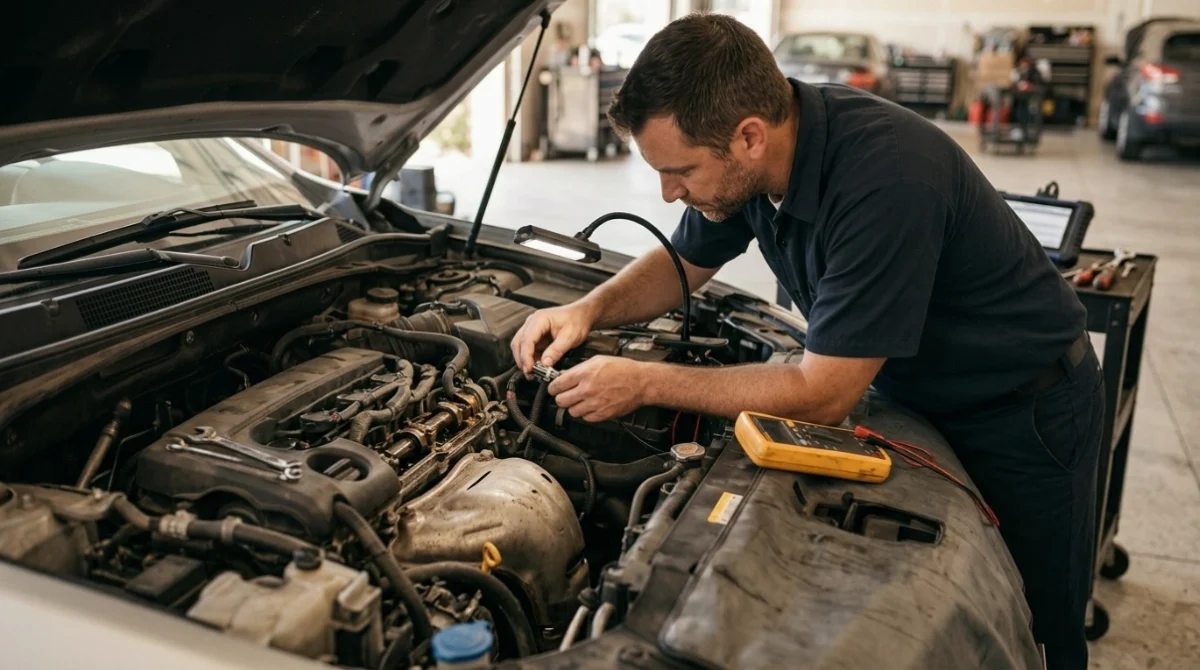
The most common P0340 causes involve the CMP sensor or its electrical circuit. Mechanical timing problems can also produce a signal the PCM cannot use.
1. Failed camshaft position sensor
An internally damaged CMP sensor can stop creating a reliable position signal. Heat-related failure may also make the problem intermittent.
A sensor can sometimes work when the engine is cold and fail after temperatures rise. That pattern makes proper testing especially useful.
2. Broken, shorted, or damaged wiring
The word circuit matters in the P0340 definition. The computer monitors more than the sensor housing itself.
Common harness problems include:
- Broken conductors inside the insulation
- Chafing where the harness touches an engine component
- Heat-damaged insulation near hot engine parts
- Wires pulled tight after previous repairs
- Shorts between signal, power, or ground circuits
- Rodent or physical damage to the harness
A visual inspection can catch obvious problems, but it cannot prove every wire is electrically sound. A conductor can break internally while its insulation still looks normal.
3. Loose, damaged, or corroded connector
A poor electrical connection can interrupt the CMP signal. Oil, moisture, corrosion, loose terminals, or a damaged connector lock can all matter.
I pay close attention to connectors after recent engine work. A plug that looks connected may not be fully seated or locked.
- Check terminal fit: A terminal should not be pushed backward inside the connector.
- Look for corrosion: Green or discolored terminals deserve closer inspection.
- Check contamination: Engine oil or moisture can enter some connectors.
- Inspect the lock: A broken locking tab may allow an intermittent connection.
4. Missing sensor power or poor ground
Some CMP sensors need a supplied voltage and ground before they can create a signal. A good sensor cannot work correctly when one of those circuits is missing.
Sensor design varies by vehicle. Never assume a particular terminal should have a specific voltage without checking manufacturer service information.
Technician note: use the correct wiring diagram and connector pinout before back-probing a circuit. Guessing at terminals can create additional electrical problems.
5. Camshaft reluctor or trigger problem
The sensor needs a physical target to determine camshaft position. That target may be called a reluctor, tone wheel, trigger wheel, or similar name.
Damage, incorrect installation, excessive clearance, or another mechanical problem can make the resulting signal unreliable. The exact design depends on the engine.
6. Timing chain or timing belt problem
A stretched, slipped, or incorrectly installed timing component can affect camshaft-to-crankshaft synchronization. This possibility becomes more important when correlation or valve-timing codes appear with P0340.
Mechanical timing faults often produce other clues:
- Abnormal engine noise
- Poor running across a broad RPM range
- Hard starting or no-start behavior
- Loss of power
- Camshaft/crankshaft correlation codes
- Recent timing-system repair history
7. PCM, ECU, or software problem
A failed powertrain control module is possible, but it should not be your first assumption. Sensor, wiring, connection, power, and mechanical checks normally come first.
Software updates or manufacturer-specific diagnostic procedures may also apply to certain vehicles. Check official service information before condemning a control module.
Section Takeaway: P0340 can come from the sensor, wiring, connector, power supply, ground, timing system, or control module. Test the entire signal path instead of replacing the sensor automatically.
Which Symptoms Usually Come With P0340?
P0340 symptoms range from only a Check Engine Light to a complete no-start condition. What you experience depends on the vehicle and how badly the signal has failed.
- Check Engine Light: The PCM stores the code after detecting the circuit problem.
- Long cranking: The engine may need extra time to identify its position during startup.
- Hard starting: Starting may become unpredictable or require several attempts.
- No-start condition: Some engines may crank but fail to start.
- Engine stalling: An intermittent CMP signal can contribute to sudden running problems.
- Rough idle: The engine may run unevenly or feel unstable.
- Hesitation: Acceleration may feel delayed or inconsistent.
- Reduced power: The PCM may rely on a backup operating strategy.
- Misfire-like behavior: Poor synchronization can create rough-running symptoms.
Symptoms alone cannot confirm P0340. A weak battery, crankshaft sensor problem, fuel problem, ignition fault, or mechanical issue can create similar complaints.
What if the car runs normally?
An intermittent circuit can set P0340 even when the engine feels normal during your next drive. Freeze-frame data may help show the conditions present when the fault occurred.
Record the code before clearing anything. Erasing it too early can remove useful information from the diagnostic process.
How Do You Diagnose P0340 Without Replacing the Wrong Part?
Start with the code, related codes, wiring, and connector condition. Then test the electrical circuit and signal according to manufacturer specifications.
Step 1: Scan the vehicle completely
Connect an OBD2 scanner and read stored, pending, and permanent codes where supported. Record freeze-frame information before clearing the memory.
A basic code reader may display P0340. A more capable scanner can make diagnosis easier by showing related live data and manufacturer-specific information.
- Record P0340 and every accompanying code.
- Save or photograph freeze-frame information.
- Check whether the code is current, pending, or historical.
- Look for crankshaft, timing, voltage, or misfire codes.
Step 2: Inspect the sensor and harness
Look around the CMP sensor before reaching for a replacement part. Many circuit problems are visible once you know where to look.
- Check whether the connector is fully seated.
- Inspect wiring for rubbing, cuts, melting, or stretching.
- Look for oil or moisture inside the connector area.
- Check for bent, loose, pushed-back, or corroded terminals.
- Review any recent engine or timing-system repairs.
A wiggle test can sometimes expose an intermittent connection while watching relevant scan data. Avoid pulling aggressively on old wiring.
Step 3: Check battery and electrical condition
Low or unstable system voltage can complicate electronic diagnosis. Make sure the battery and charging system are in reasonable condition before chasing unusual sensor readings.
This is especially important when several unrelated circuit or communication codes appear together. Multiple codes can point toward a broader electrical issue.
Step 4: Verify power, ground, and signal
The correct test depends on whether the vehicle uses a Hall-effect, magnetic, or another sensor design. Follow the manufacturer wiring diagram and test specifications.
Depending on the circuit, diagnosis may involve:
- Checking the sensor supply circuit
- Testing ground integrity
- Checking signal continuity
- Testing for a short to ground
- Testing for a short to voltage
- Checking terminal tension
- Viewing the CMP signal with appropriate test equipment
A multimeter can find many wiring faults. An oscilloscope is more useful when you need to evaluate signal shape or cam-to-crank synchronization.
Technician note: don’t apply generic resistance or voltage specifications to every CMP sensor. The correct test procedure depends on the vehicle’s circuit design.
Step 5: Check mechanical timing when the evidence points there
If the electrical circuit tests correctly, consider whether the camshaft signal is mechanically out of position. Related correlation codes make this check more important.
Do not dismantle the timing system based on P0340 alone. Use scan data, service procedures, engine symptoms, and related codes to justify deeper mechanical inspection.
Step 6: Verify the repair
After repairing the confirmed fault, clear the codes and operate the vehicle under suitable conditions. Scan again to confirm that P0340 does not return.
Verification matters. A code that disappears briefly can return if the original problem was an intermittent connector or damaged harness.
Section Takeaway: The best P0340 diagnostic path moves from scan data and visual checks to circuit testing, signal analysis, and mechanical inspection. That order reduces unnecessary parts replacement.
Which Related Codes Help Narrow the P0340 Cause?
Related trouble codes can change the direction of your diagnosis. One circuit code may suggest a local electrical fault, while several synchronization codes can point toward a broader problem.
| Code or Finding | What It Suggests | What to Check Next |
|---|---|---|
| P0340 alone | General CMP circuit problem | Sensor, connector, wiring, power, ground, and signal |
| P0341 | CMP range or performance concern | Signal quality, sensor target, timing, and manufacturer test procedure |
| P0342 or P0343 | Signal voltage is outside the expected range | Power, ground, signal wire, shorts, connector, and sensor |
| P0344 | Intermittent CMP circuit condition | Loose terminals, vibration-related wiring faults, heat-related failure |
| P0335-series code | Crankshaft position circuit may also be involved | CKP circuit plus cam/crank synchronization |
| P0016-series correlation code | Camshaft and crankshaft positions may disagree | Mechanical timing, VVT operation, oil condition, and signal correlation |
Never diagnose from the code number alone. Consider which codes appeared together and which one likely occurred first.
If a certain vehicle has a repeated problem, you can also use the NHTSA recall and manufacturer-communication lookup to check for official safety information or manufacturer communications tied to that model.
Can You Drive With P0340, and What Repairs Fix It?
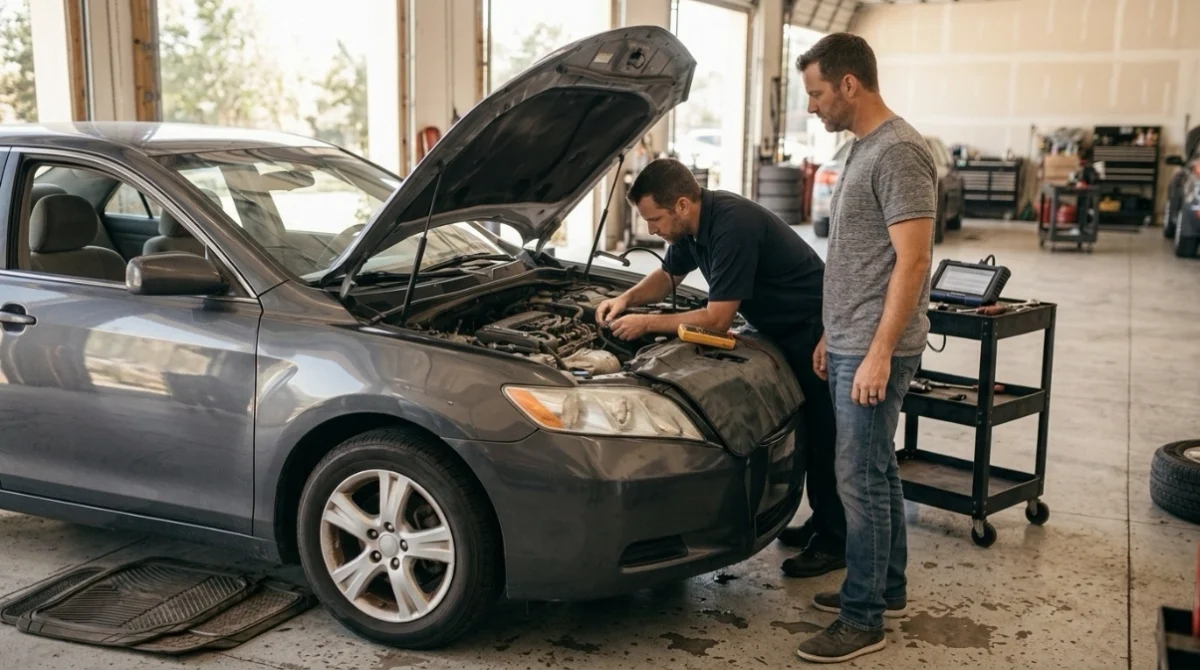
Driving with P0340 is not a good idea when the engine stalls, struggles to start, misfires, or loses power. A vehicle that appears normal still needs diagnosis because the fault may become intermittent or worsen.
AAA recommends paying attention to abnormal engine behavior when the Check Engine Light appears. Its Check Engine Light guidance advises stopping safely when a vehicle is losing power, shaking, smoking, or otherwise behaving abnormally.
Stop driving when the engine becomes unsafe or unpredictable
Arrange professional help when the vehicle cannot run reliably. Stalling in traffic or losing power during acceleration creates a practical safety concern.
- Engine repeatedly stalls
- Vehicle will not restart reliably
- Check Engine Light is flashing
- Engine shakes or misfires heavily
- Power drops suddenly
- Abnormal mechanical noises appear
What repair usually fixes P0340?
The correct repair is the one that fixes the failed part of the system. There is no single universal P0340 repair.
| Confirmed Cause | Typical Repair Direction | Repair Scope |
|---|---|---|
| Loose or contaminated connector | Correct connection or repair damaged terminals | Usually limited electrical work |
| Damaged harness | Repair or replace affected wiring | Varies with accessibility and damage |
| Failed CMP sensor | Replace sensor after confirming failure | Vehicle-dependent |
| Damaged trigger or reluctor | Repair the mechanical trigger system | Can require significant disassembly |
| Timing chain or belt problem | Correct mechanical timing and related worn parts | Often more involved |
| Control-module fault | Follow manufacturer diagnosis, software, or module procedure | Specialized diagnosis may be required |
How much does fixing P0340 cost?
There is no trustworthy universal price for a P0340 repair because the code describes a circuit fault rather than one failed component. Labor rates, engine layout, parts, vehicle age, and the confirmed cause all affect the total.
A connector repair and a timing-system repair are completely different jobs. Get the cause confirmed before approving parts or comparing quotes.
Technician note: ask for the diagnostic findings, not just a replacement recommendation. A good estimate should identify what failed and why the proposed repair addresses P0340.
Can an independent shop diagnose P0340?
Yes, a properly equipped independent repair shop can diagnose many P0340 problems. Access to correct service information and diagnostic tools matters more than simply reading the code.
The Alliance for Automotive Innovation discusses independent access to vehicle service information and diagnostic resources in its automotive right-to-repair information. Some manufacturer-specific procedures may still require specialized equipment or software.
As of 2026, modern vehicles continue to use increasingly integrated engine controls. That makes systematic testing more valuable than parts swapping.
Section Takeaway: Repair the proven cause, not the code description. If the engine stalls, misfires badly, or loses power, avoid unnecessary driving until the problem is diagnosed.
P0340 FAQ
What is the most common cause of P0340?
A failed camshaft position sensor and faults in its wiring or connector are common starting points. However, P0340 does not prove the sensor is bad, so inspect and test the circuit before replacing it.
Can a bad crankshaft sensor cause P0340?
A crankshaft position problem can affect camshaft-to-crankshaft synchronization and may appear with related trouble codes. Scan for crankshaft sensor and correlation codes, then follow the vehicle manufacturer’s diagnostic procedure.
Can a timing chain cause a P0340 code?
Yes, a timing problem can contribute to a camshaft signal the computer cannot interpret correctly. Timing-related or camshaft/crankshaft correlation codes alongside P0340 make mechanical timing more important to investigate.
Can low battery voltage cause P0340?
Low or unstable vehicle voltage can interfere with electronic diagnosis and sensor operation in some situations. If several unrelated electrical codes appear together, check battery and charging-system condition before replacing sensors.
Will replacing the camshaft position sensor fix P0340?
Only if testing confirms the sensor is the failed part. P0340 can also result from damaged wiring, connector faults, poor power or ground, mechanical timing issues, or less-common control-module problems.
Can I clear P0340 with an OBD2 scanner?
Most compatible OBD2 scanners can clear an engine trouble code after repairs. Clearing P0340 does not repair its cause, and the code may return once the PCM detects the fault again.
How do I know whether P0340 is electrical or mechanical?
Start by checking the circuit, connector, power, ground, and sensor signal. If those tests pass but synchronization or correlation remains wrong, manufacturer procedures may direct you toward the timing system or another mechanical cause.
Final takeaway: When P0340 appears, don’t assume the camshaft sensor needs replacement. Scan all codes, preserve freeze-frame data, inspect the circuit, test the signal path, and only then move toward mechanical timing or module diagnosis.
If you’re not comfortable back-probing engine-management circuits or checking camshaft timing, use a qualified technician. A proper diagnosis is usually cheaper than replacing good parts one at a time.
