
P0420 Causes: Why Catalyst Efficiency Drops Below Threshold

Quick Answer
P0420 is usually triggered when your vehicle detects that the catalytic converter on Bank 1 is not reducing emissions as effectively as expected. A worn converter is a common cause, but exhaust leaks, oxygen sensor problems, misfires, fuel-mixture faults, and oil or coolant contamination can produce the same result, so use an OBD diagnostic code check before replacing parts.
Common P0420 Causes
- Weak catalytic converter: The catalyst can lose its ability to store oxygen and process exhaust gases efficiently.
- Exhaust leak: Outside air entering near the oxygen sensors can distort the readings used to judge converter efficiency.
- Oxygen sensor fault: A slow, biased, or inaccurate sensor can make normal catalyst behavior look abnormal.
- Engine misfire: Unburned fuel entering the exhaust can overheat and damage the catalytic converter.
- Rich or lean mixture: Fuel-control problems can reduce converter efficiency or damage the catalyst over time.
- Oil or coolant burning: Contaminants reaching the exhaust can coat or damage the catalyst material.
Before You Buy a Converter
- Check for other diagnostic trouble codes, exhaust leaks, misfires, abnormal fuel trims, and oxygen-sensor problems first.
P0420 causes plenty of expensive guesswork because the code mentions catalyst efficiency and immediately makes drivers suspect the catalytic converter. I prefer to treat the code as evidence of an emissions-system problem, not as permission to order a converter.
As of 2026, the best approach is still to scan the vehicle, look for supporting codes, inspect the exhaust, and determine why the computer thinks catalyst efficiency has dropped. That process can separate a failed converter from a problem that could damage the replacement.
In This Guide
What Does P0420 Mean?
P0420 means Catalyst System Efficiency Below Threshold, Bank 1. The engine computer has detected exhaust-sensor behavior suggesting that the Bank 1 catalytic converter is not working as efficiently as expected.
Bank 1 is the side of the engine containing cylinder number one. An inline engine normally has only one cylinder bank, so Bank 1 refers to the engine’s only bank.
Definition: A catalytic converter is an emissions-control component in the exhaust system that helps convert harmful exhaust gases into less harmful compounds before they leave the tailpipe.
The vehicle does not normally measure catalyst material directly. Instead, the powertrain control module compares information from exhaust sensors before and after the converter.
The upstream sensor helps the computer monitor combustion and fuel control. The downstream sensor helps it evaluate how well the converter smooths changes in exhaust oxygen.
- Upstream sensor: Usually located before the catalytic converter.
- Downstream sensor: Usually located after the converter.
- Bank 1: The engine bank containing cylinder number one.
- Threshold: The programmed efficiency level the vehicle expects the catalyst to meet.
A healthy converter changes the exhaust-gas pattern between those two sensors. When the downstream pattern begins resembling the upstream pattern too closely, the computer may decide catalyst efficiency has dropped.
That still does not prove the converter itself caused the problem. Sensor errors, exhaust leaks, and engine faults can affect the same data.
Technician’s note: always identify every stored, pending, and permanent code before focusing on P0420 alone. Related codes can completely change the diagnostic direction.
What Are the Most Common P0420 Causes?
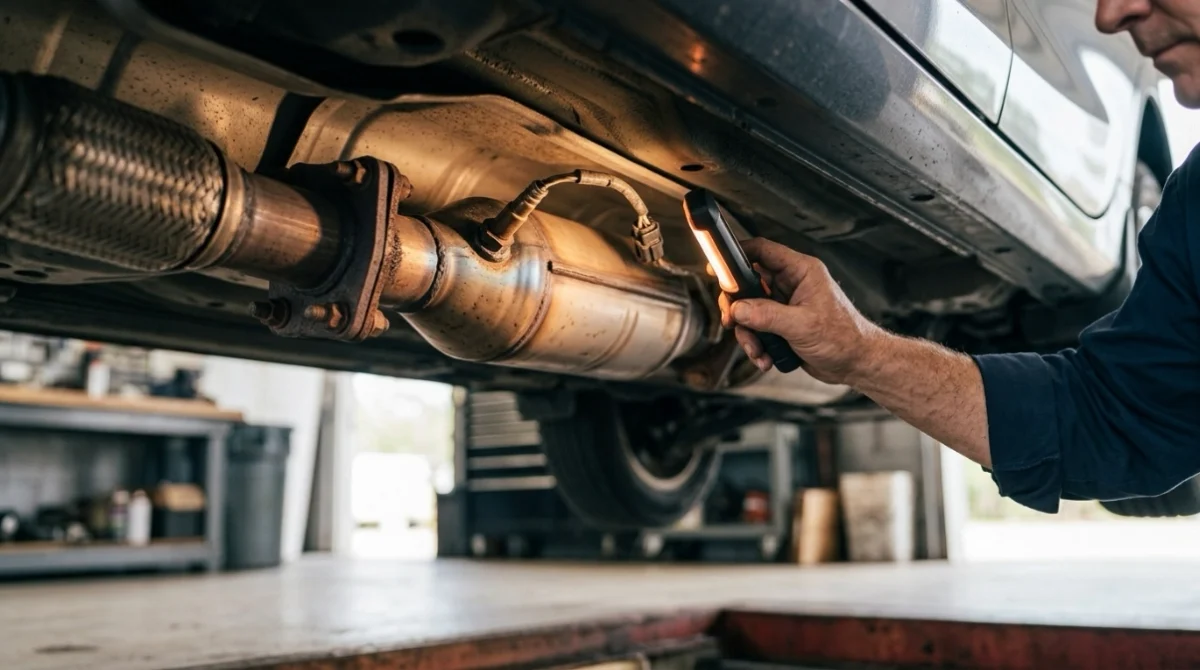
The most common P0420 causes involve either a catalytic converter that can no longer do its job or another fault that makes the converter appear inefficient. Finding the difference matters because replacing a converter without correcting the root cause can lead to another failure.
1. A Worn or Damaged Catalytic Converter
A deteriorated catalytic converter is one of the main causes of P0420. The internal catalyst can lose effectiveness after long exposure to heat, contamination, or abnormal exhaust conditions.
Converters can also suffer physical damage. Broken internal material may create rattling, restriction, or inconsistent exhaust flow.
- Normal age and long-term thermal cycling
- Repeated overheating
- Fuel entering the exhaust during misfires
- Oil contamination
- Coolant contamination
- Physical impact or damaged substrate material
AAA also notes that a catalytic-converter fault often has another vehicle problem behind it. That is why diagnosing the original cause matters before installing an expensive replacement.
You can review its general explanation of catalytic converter problems and replacement considerations when deciding whether professional testing is worthwhile.
2. An Exhaust Leak Before or Near the Converter
An exhaust leak can introduce outside oxygen into the exhaust stream. That extra oxygen may alter sensor readings and interfere with the computer’s catalyst-efficiency calculation.
Small leaks are easy to overlook. They may be most noticeable when the engine is cold and become quieter as the exhaust heats and expands.
- Cracked exhaust manifold
- Leaking manifold gasket
- Loose flange connection
- Damaged flex pipe
- Crack near an oxygen-sensor bung
A ticking sound during a cold start can support the exhaust-leak theory. Soot marks around a joint or flange are another useful clue.
3. A Faulty Downstream Oxygen Sensor
The downstream oxygen sensor plays an important role in catalyst monitoring. If its signal becomes biased or unusually slow, the computer may calculate catalyst efficiency incorrectly.
A sensor should not be replaced merely because P0420 appeared. Check its wiring, connector, heater operation, and live-data behavior first.
4. A Problem With the Upstream Air-Fuel or Oxygen Sensor
The upstream sensor influences fuel control on many vehicles. Incorrect data can push the engine richer or leaner than intended and can also interfere with catalyst monitoring.
Some newer vehicles use a wideband air-fuel ratio sensor instead of a traditional narrowband oxygen sensor. Their data behaves differently, so scanner interpretation must match the vehicle.
5. Damaged Wiring or Sensor Connectors
Heat, road debris, corrosion, and previous exhaust work can damage oxygen-sensor wiring. A poor connection may create an intermittent signal even when the sensor itself is still usable.
- Melted insulation near the exhaust
- Corroded connector terminals
- Loose pins
- Harnesses rubbing against metal
- Previous wiring repairs with poor connections
I always inspect connectors before recommending sensors. A scan tool can show a strange signal, but it cannot tell you that a terminal is barely making contact.
Section Takeaway: P0420 can come from the converter, exhaust system, oxygen sensors, or their wiring. Confirm the cause before ordering parts.
Can an Oxygen Sensor Cause P0420?
Yes, an oxygen sensor can contribute to P0420, but P0420 does not automatically mean an oxygen sensor has failed. Sensor performance needs to be tested rather than assumed.
The vehicle compares exhaust information before and after the catalyst. Incorrect information from either location can interfere with that comparison.
When the Downstream Sensor Becomes Suspicious
The downstream sensor becomes more suspicious when its readings are implausible, stuck, unusually slow, or inconsistent with operating conditions. A related oxygen-sensor circuit or heater code strengthens that suspicion.
Wiring problems can imitate sensor failure. Inspect the harness before condemning the sensor.
- Look for oxygen-sensor-specific diagnostic codes.
- Inspect connectors for water or corrosion.
- Check wiring near hot exhaust components.
- Compare live data only after the engine reaches normal operating temperature.
- Follow manufacturer-specific test information where available.
Why Replacing Both Sensors First Is a Bad Strategy
Replacing oxygen sensors simply because P0420 is present can waste money. If the catalytic converter has deteriorated internally, new sensors will not restore catalyst efficiency.
The opposite problem happens too. Installing a converter while ignoring a faulty sensor or exhaust leak can leave the code unresolved.
Pro tip: sensor voltage patterns and commanded tests vary by vehicle. Avoid using one universal voltage rule as proof that every oxygen sensor is good or bad.
Can Misfires, Fuel Problems, or Oil Burning Cause P0420?
Yes. Engine problems can damage a catalytic converter or create exhaust conditions that make its efficiency fall below the expected threshold.
This is one of the most important parts of P0420 diagnosis. Sometimes the converter is the victim rather than the original problem.
Engine Misfires
A misfire means combustion did not occur normally in one or more cylinders. Unburned fuel and oxygen can then enter the exhaust.
The converter can become extremely hot while processing that mixture. Repeated or severe misfires can shorten catalyst life.
- P0300 — random or multiple-cylinder misfire
- P0301-P0308 — common cylinder-specific misfire code range
- Rough idle
- Engine shaking
- Hesitation or poor acceleration
Rich Fuel Mixture
A rich condition means the engine receives more fuel relative to air than intended. Excess fuel increases the workload and heat placed on the converter.
Potential causes include leaking injectors, incorrect sensor inputs, excessive fuel pressure, or combustion problems. Supporting fuel-trim or mixture codes may appear alongside P0420.
Lean Fuel Mixture
A lean condition means the engine receives too little fuel or too much air for the commanded mixture. Vacuum leaks, intake leaks, fuel-delivery problems, and sensor errors can contribute.
A severe lean condition can cause misfires. That creates another path toward converter damage.
Oil Consumption
An engine that burns oil sends combustion byproducts into the exhaust. Over time, deposits can contaminate the catalyst and oxygen sensors.
- Frequent need to add engine oil
- Blue exhaust smoke
- Oil-fouled spark plugs
- Oil-related deposits in the exhaust stream
Coolant Entering the Combustion Chamber
Internal coolant leaks can contaminate the exhaust system. Depending on the failure, you may notice coolant loss, unusual exhaust vapor, overheating, or other engine symptoms.
Do not assume coolant contamination from P0420 alone. It requires separate engine diagnosis.
Technician’s note: if an active misfire is present, address it promptly before concentrating on catalyst efficiency. Continuing to feed unburned fuel into the exhaust can increase converter damage.
How Do You Diagnose the Real Cause of P0420?
Diagnose P0420 by confirming the code, checking related faults, inspecting the exhaust, reviewing fuel control, and comparing relevant sensor data. Do not begin by clearing the code and replacing the converter.
When I encounter P0420 during an OBD2 scan, the first thing I want to know is what else the vehicle recorded. A misfire or fuel-trim code may be more important than P0420 itself.
- Scan every module available to your tool: Record stored, pending, and permanent powertrain codes.
- Save freeze-frame data: Note engine load, coolant temperature, RPM, speed, and fuel-control information captured when the fault set.
- Check for misfire codes: Diagnose active combustion problems before blaming the converter.
- Inspect for exhaust leaks: Pay close attention to the manifold, flanges, flex pipe, and sensor mounting areas.
- Review fuel trims: Unusual corrections can point toward intake leaks, fuel-delivery problems, or incorrect sensor information.
- Inspect oxygen-sensor wiring: Look for melted insulation, damaged connectors, and corrosion.
- Evaluate sensor data: Compare upstream and downstream behavior using the correct specifications for that vehicle.
- Check service information: Manufacturer-specific diagnostic procedures may include catalyst monitors or software checks.
AAA explains that diagnostic trouble codes provide clues rather than automatically identifying the part that needs replacement. Its check-engine-light guidance also recommends diagnosing the underlying problem instead of ignoring the warning.
P0420 Cause Comparison
| Possible Cause | Supporting Clues | Related Codes You May See | Best Next Check |
|---|---|---|---|
| Degraded catalytic converter | P0420 returns after other faults are ruled out; downstream data suggests weak oxygen storage | P0420 alone may be present | Vehicle-specific catalyst testing |
| Exhaust leak | Cold-start ticking, soot marks, damaged flange or flex pipe | P0420; mixture codes may also appear | Physical or smoke-assisted leak inspection |
| Oxygen-sensor or wiring fault | Implausible live data, damaged harness, heater or circuit fault | P0130-P0167 family codes may appear depending on vehicle and sensor | Circuit, heater, connector, and live-data tests |
| Engine misfire | Rough running, shaking, hesitation, flashing check-engine light | P0300 or P0301-P0308 | Ignition, fuel, and compression diagnosis |
| Rich or lean operation | Abnormal fuel trims, drivability issues, mixture-related codes | Examples include P0171, P0172, P0174, or P0175 | Fuel trims, intake system, sensors, and fuel delivery |
| Oil or coolant contamination | Fluid loss, smoke, fouled plugs, or other engine symptoms | Varies with the underlying engine fault | Engine mechanical diagnosis |
Why Freeze-Frame Data Matters
Freeze-frame information records operating conditions from around the time a fault was detected. It may show whether the code appeared during idle, cruising, acceleration, or another operating condition.
Do not clear codes before saving this information. Once erased, useful diagnostic context may be lost.
Why You Should Check Other Codes First
P0420 may be a downstream consequence of another problem. An active misfire, fuel-mixture fault, or sensor circuit code can provide a clearer starting point.
I have seen scans where the catalyst code gets all the attention while a misfire code sits beside it. That is exactly how unnecessary parts replacement starts.
Section Takeaway: the best P0420 diagnosis looks at the entire engine and emissions system. The code tells you what the computer detected, not which part you must replace.
Can You Drive With P0420?

A vehicle with P0420 may still drive normally, but the code should not be ignored. The underlying problem can affect emissions, fuel economy, drivability, or catalytic-converter life.
A steady check-engine light generally gives you more time to arrange diagnosis than a flashing light. A flashing check-engine light can indicate an active problem such as a severe misfire that requires urgent attention.
- Steady light with normal driving: Arrange diagnosis soon.
- Flashing check-engine light: Reduce driving and seek prompt professional help.
- Engine shaking or severe power loss: Stop driving when it is safe.
- Strong burning or sulfur-like smell: Have the exhaust and engine inspected.
- Overheating: Stop and address the overheating problem immediately.
Do not repeatedly erase P0420 just to turn off the warning light. Clearing codes also resets diagnostic information and may delay confirmation of the real fault.
Safety note: if the check-engine light is flashing or the vehicle is running badly, professional diagnosis is safer than continuing to drive while testing the catalyst.
P0420 Causes FAQ
What is the number one cause of P0420?
A catalytic converter that has lost efficiency is a common cause of P0420. However, exhaust leaks, oxygen-sensor faults, misfires, fuel-mixture problems, and contamination should be checked before the converter is condemned.
Can a bad oxygen sensor cause a P0420 code?
Yes. A slow, biased, or inaccurate oxygen sensor can affect the data used for catalyst monitoring. Test the sensor and its wiring because P0420 by itself does not prove the oxygen sensor has failed.
Can an exhaust leak cause P0420?
Yes. An exhaust leak near the manifold, oxygen sensors, or catalytic converter can introduce outside oxygen and distort exhaust-sensor readings. Check for ticking noises, soot marks, damaged gaskets, cracked pipes, and leaking flanges.
Can bad spark plugs cause P0420?
Worn spark plugs do not usually trigger P0420 directly, but they can cause misfires. Repeated misfires can send unburned fuel into the exhaust, increase converter temperature, and eventually reduce catalyst efficiency.
Can a rich fuel mixture cause P0420?
Yes. Excess fuel can increase converter temperature and may damage the catalyst over time. Diagnose leaking injectors, fuel-control problems, incorrect sensor readings, and other causes of rich operation before replacing the converter.
Will P0420 go away after replacing an oxygen sensor?
Only if the oxygen sensor or its circuit caused the incorrect catalyst-efficiency reading. If the converter itself is weak or another engine problem remains, replacing the sensor will not permanently solve P0420.
Does P0420 always mean I need a new catalytic converter?
No. P0420 describes catalyst efficiency below the computer’s expected threshold, not a guaranteed converter failure. A complete diagnosis should rule out exhaust leaks, sensor faults, misfires, fuel-control problems, wiring damage, and contamination first.
Bottom line: treat P0420 as a diagnostic starting point, not a parts list. Scan the vehicle, save the freeze-frame data, repair supporting faults, and confirm converter performance before spending money on major exhaust components.
If you are not comfortable interpreting fuel trims, oxygen-sensor data, or catalyst-monitor results, have a qualified repair technician diagnose the vehicle. A proper test is usually cheaper than replacing good parts by guesswork.
