
P0441 Symptoms: What You’ll Notice and What the Code Means

Quick Answer
P0441 means your vehicle detected incorrect purge flow in the evaporative emission control system, commonly called the EVAP system. The most common P0441 symptom is a check engine light, although some vehicles may also develop rough idle, difficult starting after refueling, a fuel-vapor smell, or reduced fuel economy. An illuminated check engine light should be diagnosed rather than ignored, even when the vehicle seems to drive normally.
Common P0441 Symptoms
- Check engine light: This is often the only symptom you notice.
- Rough idle: An unwanted purge flow can disturb the air-fuel mixture at idle.
- Hard starting: Some vehicles become difficult to start, particularly after filling the fuel tank.
- Fuel-vapor odor: A damaged hose, canister, or other EVAP leak may allow vapor to escape.
- Fuel economy changes: Incorrect purge operation can sometimes affect how smoothly the engine manages fuel vapor.
- Emissions-test problems: An active P0441 and check engine light can prevent a vehicle from passing an OBD-based emissions inspection.
Best First Check
- Scan for P0441 and any related EVAP codes before replacing parts, then inspect the fuel cap and visible EVAP hoses.
P0441 can be confusing because your car may feel completely normal. I’ve found that the code becomes much easier to understand once you separate the symptom from the actual EVAP fault.
This guide explains what you may notice, what P0441 means, common causes, and how an OBD2 scanner helps you narrow the problem down.
In This Guide
What Are the Most Common P0441 Symptoms?
The most common P0441 symptom is a steady check engine light. Many drivers notice no change in performance at all.
That happens because the EVAP system mainly controls fuel vapor rather than directly powering the engine.
1. Check Engine Light
Your powertrain control module, or PCM, monitors EVAP operation. When commanded purge flow does not match what the computer expects, it can store P0441 and illuminate the malfunction indicator light.
The light is often steady rather than flashing. A flashing check engine light can indicate a more urgent problem, such as an active misfire, and deserves immediate attention.
2. Rough or Unstable Idle
A purge valve that remains open when it should be closed can allow too much fuel vapor or air into the intake. That can disturb the air-fuel mixture.
You might notice a slightly rough idle, unstable RPM, or occasional stumble. These symptoms are not present on every P0441 vehicle.
3. Hard Starting After Refueling
Difficulty starting immediately after filling the tank can be an important clue. A purge valve stuck open may allow excessive vapor into the intake while the engine is starting.
The engine may crank longer than usual or briefly run rich. If this happens repeatedly after refueling, mention it during diagnosis.
4. Gasoline or Fuel-Vapor Smell
A noticeable fuel-vapor smell can occur when an EVAP hose, connection, charcoal canister, or sealing point leaks. Never assume P0441 alone proves where the vapor is escaping.
If you smell strong raw gasoline or see liquid fuel, stop and inspect the vehicle safely rather than continuing to troubleshoot electronically.
5. Little or No Drivability Change
This is important. P0441 can appear while acceleration, shifting, starting, and idle all feel normal.
An OBD system monitors emissions-related components specifically so it can detect problems before a driver necessarily feels them.
| Symptom | How Common With P0441? | What It May Suggest |
|---|---|---|
| Check engine light | Very common | PCM detected incorrect EVAP purge behavior |
| No noticeable driving problem | Common | EVAP fault has limited effect on engine operation |
| Rough idle | Possible | Purge valve may be flowing when it should not |
| Hard start after refueling | Possible | Excess vapor may be entering the intake |
| Fuel-vapor smell | Possible | EVAP leak, damaged hose, canister, or sealing problem |
Section Takeaway: A check engine light with few or no drivability symptoms is the classic P0441 presentation. Rough idle, post-refueling starting trouble, and vapor odor provide extra diagnostic clues.
What Does P0441 Mean?
P0441 means “Evaporative Emission System Incorrect Purge Flow.” The computer commanded or checked EVAP purge operation and detected a response outside its expected range.
The EVAP system captures gasoline vapors from the fuel system instead of allowing them to escape directly into the atmosphere.
A charcoal canister stores those vapors. The purge valve later meters them into the engine so they can be burned.
- Charcoal canister: Temporarily stores gasoline vapor from the fuel tank.
- Purge valve: Controls vapor flow from the canister toward the engine.
- Vent valve: Helps control airflow into and out of the EVAP system during operation and testing.
- Vapor lines: Carry fuel vapor between the tank, canister, valves, and engine.
- Pressure or leak-monitoring hardware: Allows the vehicle to evaluate EVAP operation on systems that use it.
Federal OBD requirements include monitoring emission-related systems, including evaporative-emission operation. You can review general vehicle safety and regulatory information through the National Highway Traffic Safety Administration.
P0441 does not mean one specific part has failed. It tells you the computer detected the wrong purge behavior.
Technician’s note: Vehicle manufacturers use different EVAP layouts and monitor strategies, so diagnostic criteria can change by make, model, engine, and year.
What Causes a P0441 Code?
A faulty purge valve is an important possibility, but it is not the only cause. Diagnosis should confirm the fault before parts are ordered.
- Stuck purge valve: The valve may remain open, stay closed, or fail to control vapor flow correctly.
- Damaged EVAP hose: Cracked, disconnected, kinked, or blocked vapor lines can change expected purge flow.
- Loose or faulty fuel cap: Depending on the vehicle’s monitoring strategy, a sealing problem may contribute to EVAP faults.
- Vent valve problem: Incorrect vent operation can interfere with EVAP self-tests.
- Damaged charcoal canister: A cracked, saturated, or restricted canister can affect vapor movement.
- Blocked purge passage: A restriction between the canister and intake can reduce expected flow.
- Electrical fault: Wiring, connectors, valve circuits, or sensors can create incorrect system behavior.
- Vehicle-specific calibration issue: Certain models may have manufacturer-specific causes or service procedures.
That last point matters. Honda, for example, has issued vehicle-specific service information for certain models where P0441 was linked to a condition beyond the usual “replace the purge valve” assumption.
Always check manufacturer information for your VIN when a code keeps returning.
Pro tip: Don’t order an EVAP valve based only on P0441. Confirm its operation and inspect the rest of the system first.
How Do You Diagnose P0441 With an OBD2 Scanner?
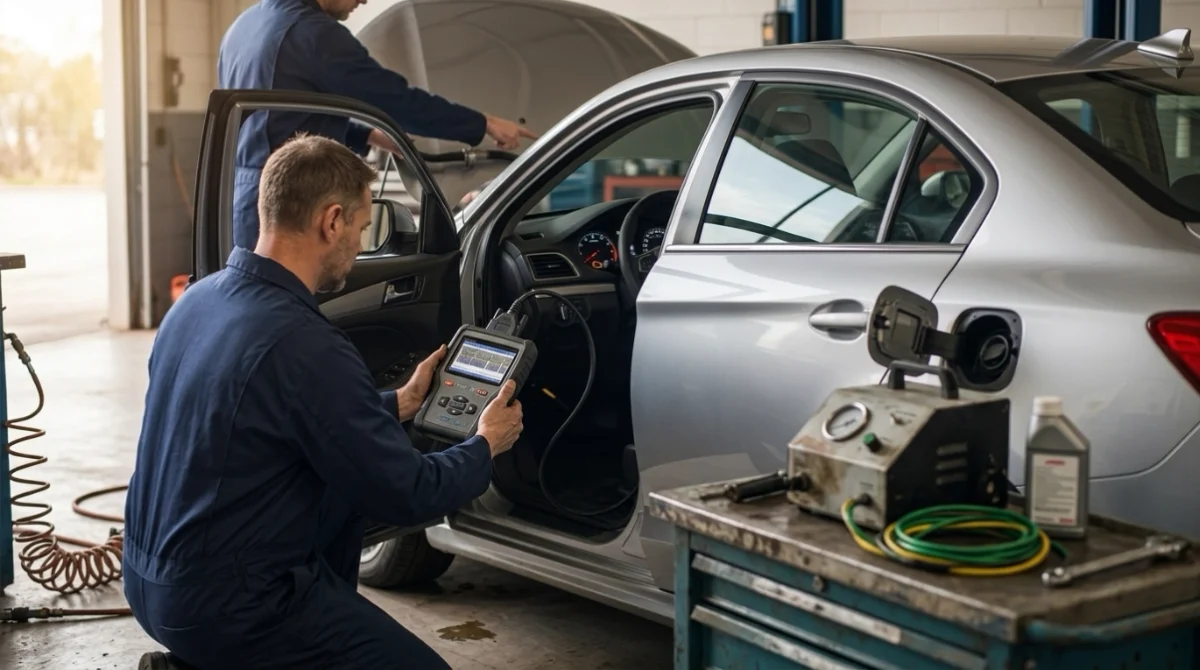
Start by reading every stored and pending diagnostic trouble code. P0441 becomes much easier to diagnose when you know what other EVAP codes are present.
An OBD2 scanner communicates with the vehicle’s onboard diagnostic system through the diagnostic connector, usually located beneath the dashboard.
- Read all codes. Record P0441 plus any P0440, leak, purge-circuit, vent, or fuel-system codes.
- Save freeze-frame data. Note engine temperature, RPM, fuel level, vehicle speed, and other available conditions from when the fault was detected.
- Check pending codes. A pending EVAP code may reveal a related fault that has not yet matured into a confirmed code.
- Inspect the fuel cap. Make sure it is correctly installed and examine its seal for obvious damage.
- Inspect visible EVAP lines. Look for disconnected fittings, cracks, damaged connectors, or crushed hoses.
- Use bidirectional tests when supported. A capable scan tool may command purge or vent components on compatible vehicles.
- Perform proper leak testing if needed. A professional smoke test can help locate leaks that are difficult to see.
AAA also explains that an OBD2 scanner can help investigate a check engine light, but a trouble code still needs diagnosis. The scanner identifies the system reporting a fault; it does not automatically identify the failed component.
Do not clear the code before recording useful diagnostic information. Clearing memory can erase freeze-frame data and reset emissions readiness monitors.
Technician’s note: Manufacturer procedures should take priority over generic testing, especially when commanding valves or performing EVAP pressure or smoke tests.
Can You Drive With a P0441 Code?
A vehicle with P0441 and no other serious symptoms is often still drivable for a short period. However, the fault should be diagnosed promptly rather than ignored.
AAA advises drivers to address a check engine light because it can indicate an emissions or engine-management problem.
- Usually less urgent: Steady check engine light, normal engine operation, no strong fuel smell, and no visible fuel leak.
- Get prompt diagnosis: Repeated hard starting, worsening idle, reduced performance, or persistent fuel-vapor odor.
- Stop and investigate safely: Visible liquid fuel, an intense raw-fuel smell, smoke, or another condition suggesting an immediate hazard.
- Treat a flashing light differently: A flashing check engine light can indicate a more serious fault than P0441 alone.
A current P0441 can also create problems at an OBD-based emissions inspection because the malfunction indicator light may remain illuminated.
You can review general warning-light guidance through AAA Automotive.
How Is P0441 Fixed?
The correct P0441 repair depends on what testing finds. Replacing the most commonly blamed component without diagnosis can waste money.
Possible repairs include:
- Correctly installing or replacing a faulty fuel cap when testing confirms a sealing problem.
- Repairing disconnected, split, pinched, or blocked EVAP hoses.
- Replacing a purge valve that fails electrical or functional testing.
- Repairing purge-valve wiring or damaged electrical connectors.
- Repairing or replacing a faulty vent valve.
- Replacing a damaged charcoal canister when confirmed defective.
- Repairing a vehicle-specific sensor, harness, or control issue identified by manufacturer diagnostics.
After the repair, the vehicle may need to complete its required EVAP monitor conditions before the computer confirms that the problem is gone.
Those conditions vary considerably. Fuel level, ambient temperature, engine temperature, drive time, and other factors may determine when an EVAP self-test runs.
Repair cost therefore varies widely by vehicle and fault. A cap or hose issue can be much simpler than finding an intermittent electrical problem or replacing an inaccessible EVAP component.
Pro tip: Get a diagnosis before approving parts. Ask whether the shop verified purge operation, inspected the vapor system, and checked relevant manufacturer service information.
Section Takeaway: P0441 is a diagnostic starting point, not a parts order. Test the purge system and related EVAP components before deciding what needs replacement.
P0441 Symptoms FAQ
Can P0441 cause rough idle?
Yes. A purge valve that flows when it should be closed can introduce unwanted vapor or air into the intake and may cause rough or unstable idle. However, many vehicles with P0441 idle normally, so roughness alone cannot confirm the cause.
Can P0441 cause hard starting after getting gas?
It can. Hard starting immediately after refueling is a useful clue because a purge valve stuck open may allow excessive fuel vapor into the intake. The symptom should still be diagnosed because other fuel, ignition, and EVAP problems can produce similar behavior.
Does P0441 always mean a bad purge valve?
No. A faulty purge valve is common enough to check, but hoses, wiring, vent components, the charcoal canister, restrictions, sensors, and vehicle-specific faults can also cause incorrect purge-flow detection.
Can a loose gas cap cause P0441?
A fuel-cap sealing problem can contribute to EVAP faults on some vehicles, but P0441 specifically relates to incorrect purge flow. Check the cap because it is simple, but do not assume tightening it will fix every P0441 condition.
Can P0441 cause a gasoline smell?
Possibly. An EVAP leak or damaged vapor-system component may allow gasoline vapor to escape. A strong raw-fuel smell or visible liquid leak deserves immediate inspection because that is more concerning than a check engine light alone.
Will P0441 clear itself?
The check engine light may eventually turn off if the fault disappears and the vehicle completes enough successful monitoring cycles. The stored code may remain in memory longer. If the underlying problem persists, P0441 will normally return.
What should I check first for P0441?
Read all stored and pending codes, save freeze-frame information, and inspect the fuel cap and visible EVAP hoses. Then test purge operation according to your vehicle manufacturer’s diagnostic procedure instead of immediately replacing the purge valve.
P0441 is usually manageable, but guessing gets expensive. Scan the vehicle, pay attention to symptoms such as rough idle or hard starting after refueling, and confirm the EVAP fault before replacing components.
