
Rechargeable Key Fob Batteries: Are LIR2032 Cells Safe?

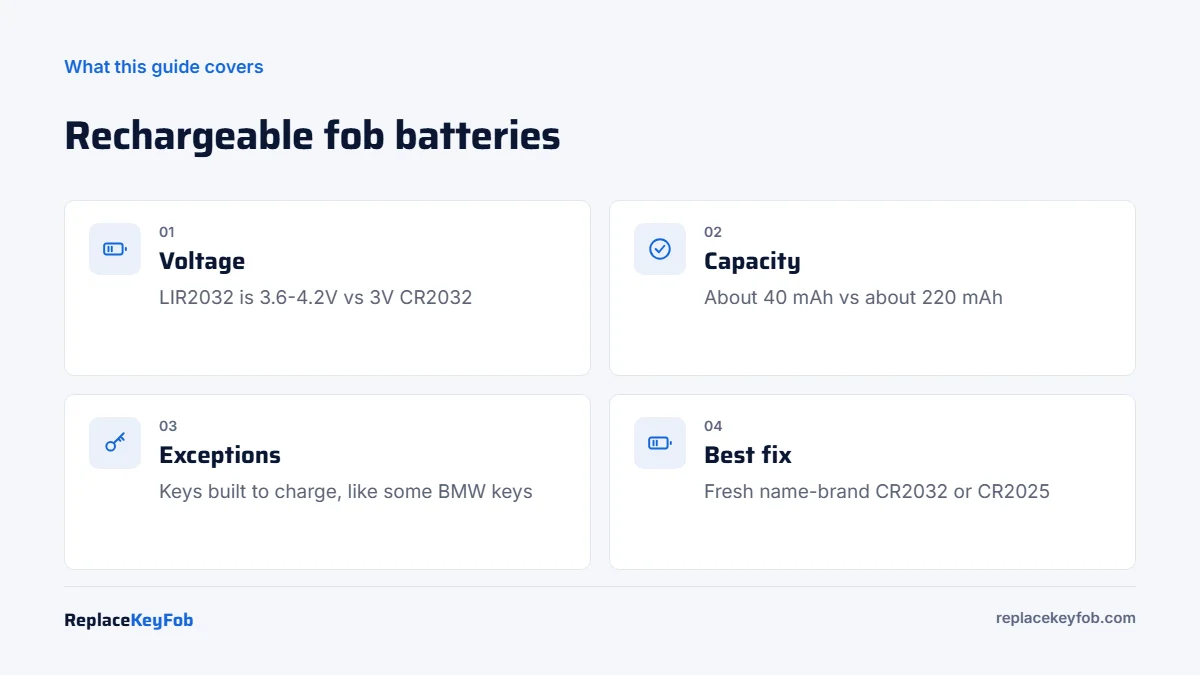
For almost every car key fob, a rechargeable coin cell is a bad swap. A rechargeable LIR2032 is the same size as a CR2032, but it runs at about 3.6 to 3.7 volts (up to 4.2 volts fresh off the charger) and holds only about 35 to 45 mAh, versus roughly 220 mAh for a standard 3V CR2032. It can stress the fob’s electronics and goes flat in weeks or a few months. Only fobs that were built with a charging circuit, such as some BMW keys, should use rechargeable cells.
Rechargeable coin cells look like an easy way to stop buying fob batteries. They fit in the same slot, cost little, and you can find them next to regular coin cells online. The problem is that “fits” and “works safely” are not the same thing. This guide explains what is actually different inside a rechargeable cell, which keys are designed for one, and what to buy instead if you are tired of dead fobs.
- Same size, different voltage: LIR2032 cells are 3.6 to 4.2V; a CR2032 is 3V. Most fobs are designed for 3V.
- Much smaller capacity: A typical LIR2032 holds about one fifth of the energy of a CR2032, so it dies far sooner.
- Factory rechargeable keys exist: Some keys, like older BMW keys that charge in the ignition and the BMW Display Key, are built for it. Use only the cell or service the maker specifies.
- Better fix: A fresh name-brand CR2032 or CR2025 usually lasts two to four years in a fob.
What Is a Rechargeable Key Fob Battery?
Most key fobs run on a primary (single-use) lithium coin cell such as a CR2032, CR2025, CR2016 or CR2450. These use lithium manganese dioxide chemistry, have a nominal voltage of 3V, and keep their charge for years on the shelf.
A “rechargeable key fob battery” usually means one of these:
- LIR-series lithium-ion coin cells (LIR2032, LIR2025, LIR2450). Same diameter and thickness as the CR version, but lithium-ion chemistry.
- 3V rechargeable lithium cells such as ML2032 (manganese lithium) or VL2020 (vanadium lithium). These stay near 3V but have small capacity and need a matching charging circuit.
- Keys with a built-in rechargeable battery that charge from the car, a cradle, or USB.
LIR2032 vs CR2032: The Numbers That Matter
| Spec | CR2032 (standard) | LIR2032 (rechargeable) |
|---|---|---|
| Chemistry | Lithium manganese dioxide (primary) | Lithium-ion (rechargeable) |
| Nominal voltage | 3.0V | 3.6 to 3.7V |
| Voltage when fully charged / new | About 3.2V | Up to 4.2V |
| Typical capacity | About 220 to 240 mAh | About 35 to 45 mAh |
| Size | 20 mm x 3.2 mm | 20 mm x 3.2 mm |
| Typical life in a key fob | 2 to 4 years | Weeks to a few months per charge |
Exact figures vary by brand, so check the datasheet printed on the pack. The pattern does not change, though: the rechargeable cell runs at a higher voltage and stores far less energy.
Why a Rechargeable Cell Is Risky in Most Fobs
Higher voltage than the circuit expects
Key fob circuit boards are designed around a 3V cell that slowly drops toward about 2.5V as it wears out. A freshly charged LIR2032 can sit at 4.2V. Some fobs tolerate this, some behave strangely (shorter range, buttons that work only sometimes, a constant “key battery low” warning), and some can be damaged. Because makers do not publish a maximum voltage for each fob, there is no safe way to know in advance.
Much shorter run time
Smart keys with keyless entry talk to the car many times a day, even in your pocket. With only a fraction of the capacity, a rechargeable cell can go flat in a few weeks. That means opening the case far more often, which wears the clips and the seal.
Charging and handling hassle
LIR cells need a dedicated lithium-ion coin charger. You have to pop the cell out of the fob to charge it, and a cheap charger or a damaged cell can overheat. If you want fewer battery swaps, this setup gives you more, not fewer.
Never put a rechargeable LIR cell in a fob just because it fits. If your owner’s manual lists a CR2032, CR2025, CR2016 or CR2450, use that exact battery.
Keys That Are Designed to Be Rechargeable
A few manufacturers do build rechargeable keys:
- Older BMW keys that charge in the ignition slot. Many 2000s BMW models used a rechargeable lithium cell (often a VL2020) that tops up while the key sits in the ignition. If the key dies even after long drives, the cell has usually reached the end of its life and has to be replaced. It is soldered to the board, so this is a job for a locksmith or dealer.
- BMW Display Key. This key has a built-in rechargeable battery that charges by USB or on a wireless charging pad.
- Phone-as-key and card keys. These are not coin-cell rechargeables, but they remove the battery question for many newer cars.
If your key is one of these, follow the owner’s manual and use only the specified replacement. For everything else, a standard coin cell is the right choice. Not sure which cell you have? Look it up in our key fob battery size chart.
What to Do Instead If Your Fob Battery Dies Too Often
Old stock and cheap no-name cells often arrive partly drained. Check the date on the pack and buy from a seller with fast turnover.
A CR2025 in a CR2032 slot can lose contact, and the reverse can crack the case. See CR2032 vs CR2025 for the differences.
A smart key left within a few feet of the vehicle can keep “waking up” and drain faster. Keep spare keys in a drawer, not on a hook by the garage door.
If a new battery dies within weeks, a stuck button or a damaged board may be draining it. See key fob not working after battery replacement.
CR2032 3V Lithium Coin Battery (Name Brand Multipack)
A multipack of fresh name-brand cells costs little, lasts years in most fobs, and keeps a spare ready. Match the number printed on your old battery.
As an Amazon Associate, ReplaceKeyFob earns from qualifying purchases.
Cost Comparison: Rechargeable vs Standard
A pair of LIR2032 cells plus a coin-cell charger often costs more than a multipack of name-brand CR2032 cells. Since one standard cell usually lasts two to four years in a fob, a single multipack can cover several years for the whole household. The rechargeable route saves money only on paper, and it adds risk to a key that can cost a few hundred dollars to replace and program. For real numbers, see our key fob battery replacement cost guide.
Final Word
Rechargeable coin cells make sense in devices designed to charge them. Car key fobs, with very few exceptions, are not. Stick with the battery your owner’s manual lists, buy fresh name-brand cells, and if your key is one of the factory rechargeable types, let a locksmith or dealer replace the internal cell when it wears out. Need help with the swap itself? Follow our step-by-step key fob battery replacement guide.
Frequently Asked Questions
It fits, but it is not recommended. An LIR2032 runs at 3.6 to 4.2V instead of 3V and holds far less energy, so it can cause faults and dies quickly. Use a CR2032 unless your fob maker says otherwise.
Usually weeks to a few months per charge, depending on how often the fob talks to the car. A standard CR2032 typically lasts two to four years.
Yes, such as ML2032 or VL2020 cells, but they have small capacity and need a matching charging circuit. They are used in keys built to charge them, not as drop-in replacements.
Examples include many older BMW keys that charge in the ignition slot and the BMW Display Key, which charges by USB or wireless pad. Check your owner’s manual to be sure.
Try a fresh name-brand cell of the exact size, keep the key away from the car when not in use, and if it still drains fast, have the fob checked for a stuck button or board fault.