
What Does P0174 Mean? Causes, Symptoms, Diagnosis, and Repair Guidance

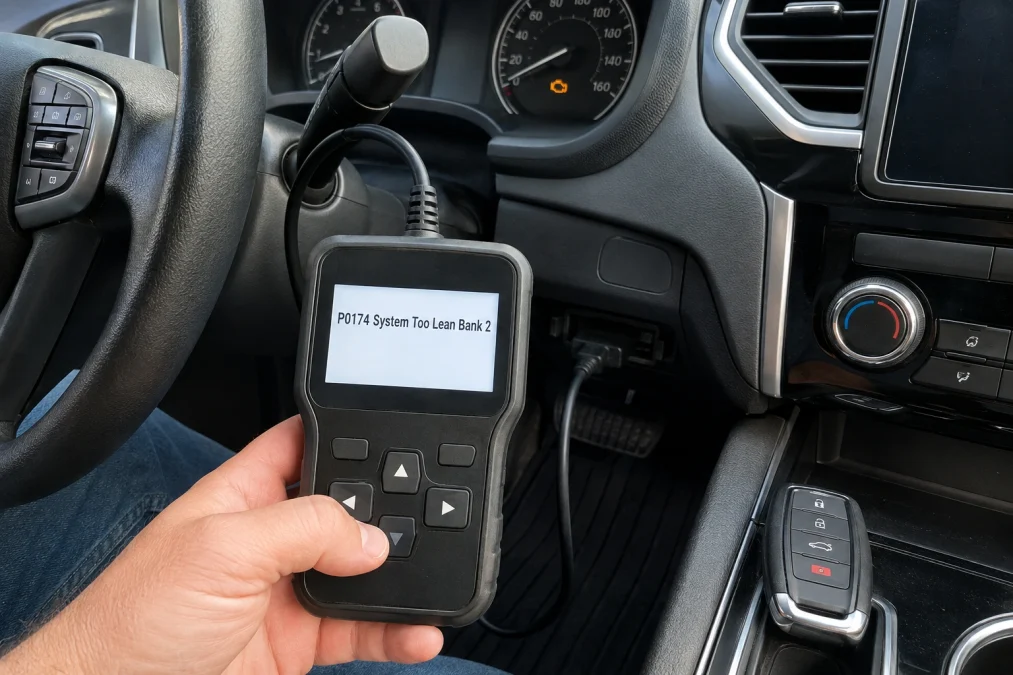
Your check engine light comes on, you connect an OBD2 scanner, and the screen displays P0174: System Too Lean Bank 2. The wording sounds serious, but it does not tell you which part has failed.
So, what does P0174 mean for your car? It means the engine computer has detected a lean air-fuel condition on one side of the engine. Too much air, too little fuel, or inaccurate sensor information can trigger the code.
This guide explains Bank 2, common causes, warning signs, diagnostic steps, repair options, and when professional help is the smarter choice.
Quick Answer
P0174 means “System Too Lean Bank 2.” The engine computer has detected too much air or too little fuel on the side of the engine that does not contain cylinder number one. Common causes include vacuum leaks, intake gasket leaks, fuel delivery problems, dirty sensors, exhaust leaks, or faulty oxygen-sensor readings.
What Does P0174 Mean on an OBD2 Scanner?
P0174 is a generic powertrain diagnostic trouble code. Its standard description is:
P0174 — System Too Lean, Bank 2
Ford’s official OBD system operation documentation identifies P0174 as a Bank 2 lean fuel-system fault. The monitoring system watches fuel adjustments while the engine operates in closed-loop mode. (Ford Service Content)
“Lean” means the engine computer believes the air-fuel mixture contains more air than expected for the amount of fuel being burned.
Modern engines constantly adjust the mixture. When the computer detects extra oxygen in the exhaust, it increases fuel delivery. These adjustments are called fuel trims.
P0174 is stored when the computer must add an excessive amount of fuel to Bank 2 but still cannot bring the mixture back within its expected range.
What Is Bank 2?
An engine bank is one side of an engine with two rows of cylinders, such as many V6, V8, V10, and horizontally opposed engines.
- Bank 1 is the side containing cylinder number one.
- Bank 2 is the opposite side.
The physical location varies by vehicle. Bank 2 may be on the driver or passenger side, depending on the engine design.
Do not identify Bank 2 by guessing. Consult the correct repair information for your vehicle’s year, make, model, and engine.
Most inline four-cylinder engines have only one cylinder bank. If a basic scanner displays P0174 on a vehicle that should not have Bank 2, verify the code with another scanner or a vehicle-specific diagnostic tool.
Is P0174 Related to the Key Fob or Immobilizer?
No. P0174 is an engine fuel-control code, not a key fob, transponder, or immobilizer code.
A weak key fob battery may prevent remote locking or keyless-entry functions. A damaged transponder key may cause a no-start condition or security warning. Neither problem normally creates a lean fuel mixture.
If your vehicle has P0174 and will not start, check whether it:
- Cranks normally but struggles to run
- Does not crank at all
- Shows a flashing security or key symbol
- Responds differently when you use a spare key
- Has additional engine or immobilizer codes
These details help separate an engine problem from a key-recognition problem.
How the Car Detects a Lean Condition
The engine control module receives information from several components, including:
- Mass airflow sensor
- Manifold pressure sensor
- Upstream oxygen or air-fuel-ratio sensors
- Fuel-pressure sensors
- Throttle-position sensor
- Coolant and intake-air temperature sensors
- Fuel injectors
The computer uses this information to calculate how much fuel the engine needs.
According to the EPA’s explanation of onboard diagnostics, the OBD system monitors emissions-related components and turns on the check engine light when it detects a malfunction that can affect emissions. (EPA NPDES)
A code tells you what the computer detected. It does not automatically identify the failed part.
Common Symptoms of Code P0174
Some vehicles continue to drive almost normally. Others develop noticeable performance problems.
Common symptoms include:
- Illuminated check engine light
- Rough or uneven idle
- Engine hesitation
- Reduced acceleration
- Surging while driving
- Hard starting
- Stalling at stops
- Whistling or hissing under the hood
- Engine misfire
- Poorer fuel economy
- Higher-than-normal idle speed
- Lack of power under load
The symptoms depend on how severe the lean condition is and whether another code is present.
A small vacuum leak may produce only a check engine light. A large intake leak or fuel-pressure problem may cause severe rough running or stalling.
Common Causes of P0174
P0174 has several possible causes. Replacing an oxygen sensor immediately is one of the most common and expensive diagnostic mistakes.
Vacuum or Intake Air Leaks
A vacuum leak lets air enter the engine without being measured properly. The computer does not command enough fuel for that extra air, so the mixture becomes lean.
Possible leak points include:
- Cracked vacuum hoses
- Loose intake tubing
- Split air-cleaner ducts
- Intake manifold gaskets
- Brake-booster vacuum hose
- PCV hoses and fittings
- Throttle-body gasket
- Vacuum-operated accessories
A leak close to Bank 2 may trigger only P0174. A larger central leak often triggers both P0174 and P0171.
Dirty or Faulty Mass Airflow Sensor
The mass airflow sensor, commonly called the MAF sensor, measures air entering the engine.
If it underreports airflow, the engine computer may deliver too little fuel. Because one MAF sensor usually measures air for the whole engine, a MAF problem often affects both banks rather than Bank 2 alone.
Never clean a MAF sensor with brake cleaner or carburetor cleaner. Use only a product specifically labeled for mass airflow sensors, and do not touch the delicate sensing element.
Intake Manifold Gasket Leak
A worn or damaged intake manifold gasket can allow unmetered air into one cylinder bank.
This is especially likely when:
- P0174 occurs mainly at idle
- Fuel trims improve at higher engine speed
- The engine is rough when cold
- A smoke test reveals leakage near Bank 2
- The vehicle has a known intake-gasket issue
The repair may require significant disassembly, depending on the engine.
Low Fuel Pressure
The engine may run lean when the fuel system cannot supply enough pressure or volume.
Possible causes include:
- Weak fuel pump
- Restricted fuel filter
- Faulty fuel-pressure regulator
- Damaged fuel line
- Electrical voltage problem at the pump
- Fuel-pump control module fault
Low fuel pressure commonly affects both banks, but one bank may reach the code-setting threshold first.
Restricted or Faulty Fuel Injectors
A clogged, damaged, or electrically faulty injector on Bank 2 can reduce fuel delivery.
Injector problems may also cause:
- A cylinder-specific misfire code
- Rough idle
- Shaking during acceleration
- Uneven exhaust sound
- Loss of power
- Fuel-trim imbalance between banks
Proper diagnosis may require an injector balance test rather than simply adding fuel-system cleaner.
Upstream Oxygen Sensor Problem
An upstream oxygen or air-fuel-ratio sensor monitors the exhaust before the catalytic converter.
A biased Bank 2 sensor may incorrectly report a lean mixture. However, the sensor may also be reporting a real condition caused by an air leak or fuel problem.
The presence of P0174 does not prove that the oxygen sensor is defective.
Exhaust Leak Before the Oxygen Sensor
An exhaust leak near the Bank 2 exhaust manifold or upstream sensor can draw outside air into the exhaust stream.
The added oxygen may cause the sensor to report a lean condition even when combustion is close to normal.
Listen for ticking during a cold start and inspect for:
- Cracked exhaust manifolds
- Loose mounting hardware
- Failed manifold gaskets
- Damaged sensor threads
- Leaking exhaust joints
PCV System Problems
A cracked PCV hose, disconnected fitting, stuck valve, or damaged diaphragm can create a major vacuum leak.
Depending on the intake design, the leak may affect one bank more than the other.
Less Common Causes
Other possibilities include:
- Incorrect engine timing
- Valve or compression problems
- Contaminated fuel
- Sensor wiring damage
- Incorrect aftermarket intake parts
- Improperly installed air filter housing
- Engine-control software issues
- Stuck-open purge valve
P0174 Cause and Repair Comparison
| Possible cause | Clues you may notice | Typical repair | Relative cost | DIY suitability |
|---|---|---|---|---|
| Loose or cracked intake hose | Hissing, high idle, visible damage | Reconnect or replace hose | Low | Good for basic DIY |
| Small vacuum leak | Rough idle, high fuel trim at idle | Replace hose, seal, or gasket | Low to moderate | Depends on access |
| Dirty MAF sensor | Hesitation, both banks lean | Carefully clean and retest | Low | Reasonable DIY |
| Faulty MAF sensor | Incorrect airflow readings | Test and replace sensor | Moderate | Basic to intermediate |
| Intake manifold gasket | Worse when cold or at idle | Replace gasket | Moderate to high | Advanced |
| Low fuel pressure | Weak acceleration, hard starting | Test pump and fuel system | Moderate to high | Professional testing advised |
| Restricted injector | Misfire on Bank 2 | Clean, test, or replace injector | Moderate | Intermediate to advanced |
| Exhaust leak | Cold-start ticking | Repair gasket, joint, or manifold | Moderate to high | Depends on access |
| Biased oxygen sensor | Scan data remains abnormal after other tests | Test wiring and replace sensor if confirmed | Moderate | Intermediate |
Actual cost depends on labor rates, vehicle design, part quality, and the amount of diagnostic time required.
Can You Keep Driving With P0174?
A steady check engine light with no major symptoms does not always require an immediate tow. However, you should arrange diagnosis soon.
Limit driving and avoid heavy acceleration if the engine is:
- Hesitating badly
- Stalling
- Shaking
- Misfiring
- Losing significant power
- Producing unusual exhaust sounds
- Difficult to start
Stop driving if the check engine light flashes. A flashing light commonly accompanies a serious active misfire that can overheat and damage the catalytic converter.
You should also stop if the engine cannot maintain a safe speed or repeatedly stalls in traffic.
How to Diagnose P0174 Step by Step
An OBD2 scanner is useful, but reading and erasing the code is not a complete diagnosis.
1. Record All Stored Codes
Write down:
- Stored codes
- Pending codes
- Permanent codes
- Freeze-frame information
- Short-term fuel trim
- Long-term fuel trim
- Engine speed
- Engine temperature
- Vehicle speed when the code appeared
Do this before clearing anything. Freeze-frame data shows the operating conditions present when the computer recorded the fault.
2. Check for Related Codes
Related codes can narrow the search.
Examples include:
- P0171: System Too Lean Bank 1
- Misfire codes such as P0300 or P0301–P0308
- MAF sensor codes
- Oxygen-sensor codes
- Fuel-pressure codes
- EVAP purge codes
P0171 and P0174 together often point toward a problem affecting the whole engine, such as a central vacuum leak, MAF error, or low fuel pressure.
P0174 by itself makes a Bank 2-specific intake leak, injector issue, exhaust leak, or sensor problem more likely.
3. Inspect the Air Intake
With the engine off, examine the intake path from the air-filter housing to the throttle body.
Look for:
- Loose clamps
- Cracked rubber bellows
- Disconnected hoses
- Poorly seated air-filter housing
- Missing seals
- Oil-soaked or damaged fittings
- Aftermarket parts that do not fit correctly
Flex rubber ducts gently. Cracks may hide inside folds.
4. Listen for Vacuum Leaks
Start the engine only when it is safe to do so. Listen for hissing or whistling around the intake manifold, PCV system, and vacuum hoses.
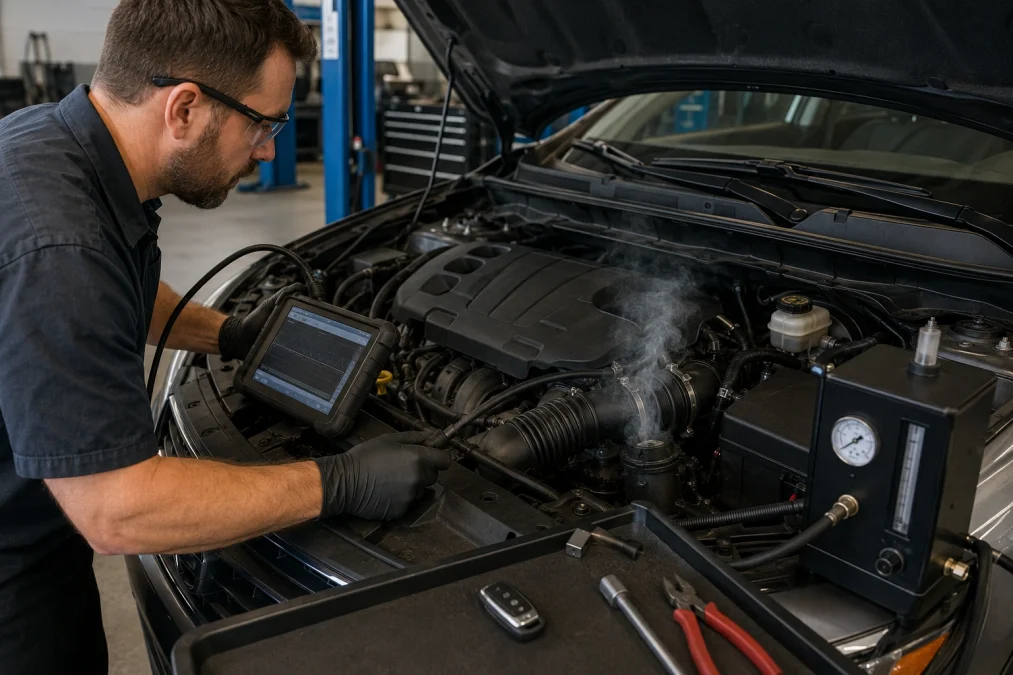
A professional smoke test is usually safer and more accurate than spraying flammable chemicals around a running engine.
Do not use gasoline, starting fluid, propane, or other flammable products to search for leaks.
5. Compare Fuel Trims
A capable scanner can display fuel trims for both banks.
Useful patterns include:
- High positive trim at idle that improves with engine speed: possible vacuum leak
- High positive trim at idle and higher speed: possible fuel-delivery or airflow-measurement problem
- Bank 2 much higher than Bank 1: likely Bank 2-specific problem
- Both banks similarly high: likely issue affecting the entire engine
Exact acceptable values vary by vehicle and operating condition. Manufacturer service information should take priority over a universal online number.
6. Check MAF Data
Inspect the MAF sensor connector and wiring. Make sure the air filter and intake duct are installed correctly.
Do not replace the sensor based only on P0174. Compare its live readings with specifications for the exact engine.
7. Test Fuel Pressure
Fuel-pressure testing may require specialized equipment and procedures.
Some direct-injection systems operate at extremely high pressure. Do not open a high-pressure fuel system without the correct training and service instructions.
A technician can compare commanded and actual fuel pressure and perform volume or pressure-retention tests when needed.
8. Inspect Bank 2 for Exhaust Leaks
Check the Bank 2 exhaust manifold, gasket, upstream sensor area, and nearby joints.
A small leak may be easiest to hear immediately after a cold start, before the metal expands.
9. Test Before Replacing Parts
Depending on the suspected cause, proper testing may include:
- Smoke testing
- Fuel-pressure testing
- Injector balance testing
- Oxygen-sensor response testing
- Wiring checks
- Compression testing
- Manufacturer-specific scan-tool tests
Replacing parts without these checks can cost more than paying for proper diagnostic time.
Expert Tip: Compare Bank 1 and Bank 2 fuel-trim readings before buying parts. A large difference between the banks points toward a side-specific problem, while similar readings usually suggest a fault affecting the entire engine.
Repair Quality, Parts, and Durability
The cheapest replacement part is not always the least expensive solution.
Low-quality airflow and oxygen sensors may:
- Produce inaccurate readings
- Fit poorly
- Fail early
- Create new diagnostic codes
- Have incorrect electrical characteristics
For sensors and fuel-system components, use a reputable brand that meets the vehicle manufacturer’s requirements. An original-equipment part may be worthwhile when the engine is sensitive to sensor calibration.
For hoses and gaskets, confirm that the material is designed for engine heat, oil vapor, vacuum, and fuel exposure where applicable.
After the repair, a technician should:
- Clear the diagnostic codes.
- Verify that no leaks remain.
- Recheck fuel trims.
- Road-test the vehicle.
- Confirm that relevant OBD monitors run successfully.
- Make sure P0174 does not return.
Clearing the light without correcting the fault is not a repair.
When to Call a Professional Locksmith or Dealership
P0174 normally requires an automotive repair technician rather than a locksmith. However, a locksmith may still be relevant when a starting or access problem occurs at the same time.
Call an Automotive Repair Shop When:
- The engine runs rough or misfires
- You need a smoke test
- Fuel pressure must be measured
- The intake manifold must be removed
- Injector testing is required
- Wiring or sensor signals need testing
- The code returns after a basic inspection
- You are unsure which side is Bank 2
The FTC’s auto repair guidance recommends asking about diagnostic charges and obtaining a written estimate that identifies the condition, required parts, and expected labor cost. (Consumer Advice)
Call an Automotive Locksmith When:
- The key fob is lost or damaged
- The security light is flashing
- The vehicle does not recognize the transponder key
- The ignition will not turn
- You need a replacement remote or smart key
- The doors will not unlock
- The engine problem began after key or immobilizer programming
An automotive locksmith can diagnose key-recognition and access problems, but most locksmiths do not repair intake leaks, fuel pumps, or engine-management faults.
The ALOA guidance for hiring a professional locksmith can help you evaluate training, credentials, and professional standards. (Aloa)
Consider a Dealership When:
- The vehicle is still under warranty
- A software update or manufacturer bulletin may apply
- Factory scan-tool functions are required
- The problem involves an open recall
- An independent shop cannot access required service information
- Several previous repair attempts have failed
Before paying for a potentially related repair, check your VIN through the NHTSA recall lookup information. Open safety recalls are repaired through the manufacturer’s dealer network without charge. (NHTSA)
Common Mistakes Car Owners Should Avoid
- Replacing the oxygen sensor immediately. The sensor may be correctly reporting a vacuum, exhaust, or fuel problem.
- Clearing the code before saving freeze-frame data. This removes useful diagnostic clues.
- Buying parts from the code description alone. A trouble code identifies a system condition, not necessarily a defective component.
- Cleaning the MAF sensor with the wrong chemical. Harsh solvents can permanently damage it.
- Spraying flammable products around a running engine. This creates a serious fire risk.
- Ignoring related codes. Misfire, fuel-pressure, and airflow codes may reveal the actual cause.
- Assuming Bank 2 is always on the same side. Cylinder arrangement differs among engines.
- Using the cheapest sensor available. Poor calibration can cause repeat problems.
- Continuing to drive with severe misfiring. This can damage the catalytic converter and create a roadside safety risk.
- Confusing an engine code with a key fob fault. P0174 is not an immobilizer or remote-entry code.
FAQs
Can a dirty air filter cause P0174?
A severely restricted or incorrectly installed air filter can affect airflow readings, but it is not the most common cause of a Bank 2-only lean code. Inspect the filter housing, intake duct, and MAF sensor before replacing parts.
Can a bad oxygen sensor cause P0174?
Yes, a biased Bank 2 upstream oxygen sensor can trigger P0174. However, intake leaks, exhaust leaks, and fuel-delivery problems should be tested first because the sensor may be reporting a real lean condition.
What is the difference between P0171 and P0174?
P0171 means the system is too lean on Bank 1. P0174 means it is too lean on Bank 2. When both appear together, look for a problem that can affect the entire engine.
Will P0174 clear itself?
The check engine light may turn off after several successful trips if the problem is no longer detected. The code may remain in history or as a permanent code until the vehicle completes the required self-tests.
Can a vacuum leak cause only P0174?
Yes. A leak near the Bank 2 intake runners or manifold gasket may affect that bank more than Bank 1. A central vacuum leak is more likely to affect both banks.
How serious is a P0174 code?
It ranges from minor to serious. A small leak may cause only a warning light, while a major fuel or intake problem can cause stalling, misfires, power loss, and catalytic-converter damage.
How do I know which side is Bank 2?
Find the location of cylinder number one using reliable service information for your exact engine. The opposite cylinder row is Bank 2. Do not rely only on driver-side or passenger-side descriptions.
Conclusion
So, what does P0174 mean? It means the engine computer has detected a lean condition on Bank 2 and is adding more fuel than expected to compensate.
The cause may be a simple cracked hose, but it may also involve an intake gasket, fuel injector, fuel-pressure problem, exhaust leak, MAF sensor, or oxygen-sensor circuit. Reading the code is only the starting point.
Begin with a careful intake inspection, save the scanner data, compare both banks, and test the suspected system before purchasing parts. If the engine runs poorly or the diagnosis requires smoke, fuel-pressure, or electrical testing, request a written estimate from a qualified repair facility. For simultaneous key-recognition or security-system problems, contact a trained automotive locksmith rather than assuming P0174 is related to the key fob.
